Knight and Rose Show – Episode 4: Strategies for Making More Effective Christians, Part 1

Welcome to episode 4 of the Knight and Rose podcast! Last week, we talked about what we found in campus ministries and churches. In today’s episode, we suggest ways for the church to build more effective Christians. If you like episode 4, please subscribe to the podcast, and subscribe to our new Youtube channel. We would really appreciate it if you left us a 5-star review on Apple iTunes / Apple Podcasts.

Podcast description:

Christian apologists Wintery Knight and Desert Rose discuss apologetics, policy, culture, relationships, and more. Each episode equips you with evidence you can use to boldly engage anyone, anywhere. We train our listeners to become Christian secret agents. Action and adventure guaranteed. 30-45 minutes per episode. New episode every week.

Episode 4:

Episode 4 Summary:

Last week, Wintery Knight and Desert Rose discussed how the church is falling short in evangelism and discipleship. In this episode, we discuss strategies for improving mentoring and discipleship of young Christians. We talk about how to help Christians love God more. We talk about strategies for talking about Christianity to non-Christians. We talk about forming teams to advance the gospel. We talk about which areas of knowledge can help you become a stronger, more effective Christian.

Speaker biographies

Wintery Knight is a black legal immigrant. He is a senior software engineer by day, and an amateur Christian apologist by night. He has been blogging at winteryknight.com since January of 2009, covering news, policy and Christian worldview issues.

Desert Rose did her undergraduate degree in public policy, and then worked for a conservative Washington lobbyist organization. She also has a graduate degree from a prestigious evangelical seminary. She is active in Christian apologetics as a speaker, author, and teacher.

Notes

At one point in the podcast, I mentioned reading papers and books that feature atheist perspectives in order “to learn how to defend it“. I meant to say “to learn how they defend it”. I recommend reading atheist perspectives in debates, so you get both sides. Lots of debate transcripts can be found on William Lane Craig’s web site Reasonable Faith.

We recorded this episode way back in February 2022. There’s been an update about Rose’s atheist neighbor who is a scientist. In the podcast, she says that after a dozen conversations with her, he thinks that there are good scientific reasons to think Christianity is true. This week, Rose told me that he now thinks that Christianity is the best explanation for the scientific evidence around the creation of the universe, and the cosmic fine-tuning.

References

Responding to the Philosophical Problem of Evil by Steven B. Cowan

The Origin Of Life, Part 2 Of 2: Biological Information by Wintery Knight

Recommended books by famous black economist Thomas Sowell

Money, Greed, and God 10th Anniversary Edition: The Christian Case for Free Enterprise by Jay Richards

The Poverty of Nations: A Sustainable Solution by Barry Asmus and Wayne Grudem

Institute for Family Studies (web site that features studies of interest to Christians on social issues)

William Lane Craig’s Secret Weapon Is His Amazing Wife Jan by Wintery Knight

Dr. Craig’s Secret Weapon (Reasonable Faith podcast)

About Wintery Knight (lists some of the movies I think have something to offer Christians)

Rifleman Dodd: A Novel Of The Peninsular Campaign by C. S. Forester

Are Christians Responsible For Making Plans And Making Good Decisions? (about Rifleman Dodd) by Wintery Knight

Podcast RSS feed:

https://feed.podbean.com/knightandrose/feed.xml

You can use this to subscribe to the podcast from your phone or tablet. I use the open-source AntennaPod app on my Android phone.

Podcast channel pages:

Video channel pages:

Music attribution:

Strength Of The Titans by Kevin MacLeod
Link: https://incompetech.filmmusic.io/song/5744-strength-of-the-titans
License: https://filmmusic.io/standard-license
Free health care? How much does Canada’s universal system cost?

I had a talk with a Canadian recently about health care. He had a lot to say about his own country’s free health care system, and how wonderful it was to not have to pay for health care. I was skeptical about the rosy picture he painted. After all, I have friends in Canada, and they have told me about their country’s high tax rates. And I’ve heard about the waiting lists, too. Let’s look at the evidence.

The Fraser Institute is a non-partisan think tank based in Canada that looks at policies to see whether they are achieving good results for Canadians. Each year they release statistics about the cost and performance of Canada’s health care system. The most recent report is for 2021 (preliminary numbers).

The report (PDF) says:

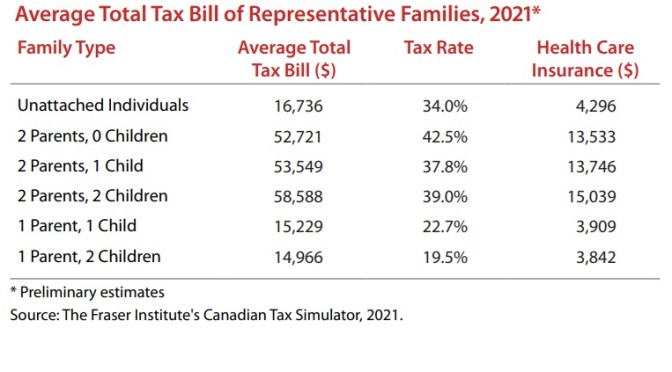
In 2021, the average unattached (single) individual, earning an  average income of $49,215, will pay approximately $4,296 for public health care insurance. An average Canadian family consisting of two adults and two children (earning approximately $150,177) will pay about $15,039 for public health care insurance.

Do Canadians really pay $15,039 per year for health care? Or are they paying to get on a waiting list for health care?

Let’s see another 2021 report, this one about health care wait times:

Specialist physicians surveyed report a median waiting time of 25.6 weeks between referral from a general practitioner and receipt of treatment—longer than the wait of 22.6 weeks reported in 2020. This year’s wait time is the longest wait time recorded in this survey’s history and is 175% longer than in 1993, when it was just 9.3 weeks.

The waiting time for a referral to a general practitioner to a specialist increased from 10.5 weeks in 2020 to 11.1 weeks in 2021. And the waiting time from seeing a specialist to actually getting treatment  increased from 12.1 weeks in 2020 to 14.5 weeks in 2021. And remember, this is Canadian health care. This isn’t the Mayo Clinic, the Cleveland Clinic, or Johns Hopkins. This is not the best health care in the world. That’s why Canadian politicians who swear their loyalty to the government health care system pack their bags and make for America when they need treatment. And they pay out of pocket for the best care.

Well, maybe these wait times are because the government is spending less on health care?

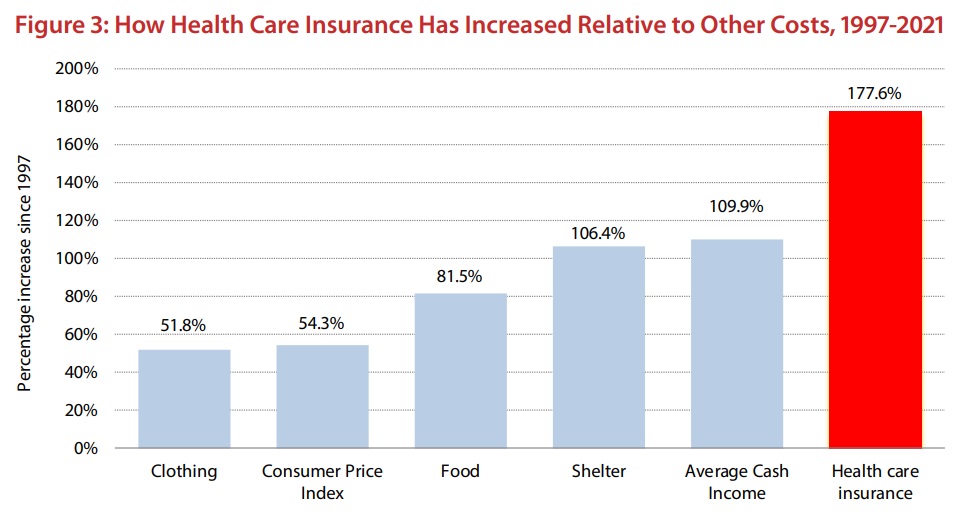
No. Actually, costs have been going up, and faster than other products and services.

Canada Health Care Costs Inflation 2021

Why is it going up? Well, like the public school monopoly, most of the money goes to administrators. There is no competitive free market system, where providers compete with each other for the dollars of their customers. No one cares about reducing costs to consumers while improving quality. Why would they? Canadians have zero choice in who gives them health care.

I did a quick search of Canadian news stories for the last week, to see what Canadians say about their health care system when they are talking to each other, instead of to Americans.

Here’s a story from the Globe and Mail, the more leftist of Canada’s national newspapers. (archived here)

It says:

One of the biggest problems such provinces are facing is a critical shortage of family doctors. One in five people in B.C. don’t have one, with more people pouring into the province every day. Last year, 100,000 people arrived – a record number that only exacerbates a desperate situation.

[…]According to Statistics Canada, 4.6 million people over the age of 12 did not have a family doctor in 2019.

[…]The shortage of physicians is a problem that has been growing over the years. Canada now ranks 51st in doctors per population, according to Index Mundi. In the 1970s, we ranked anywhere between fourth and eighth. The nursing shortage in Canada is just as severe.

And they confirm the Fraser Institute’s per-capita cost number:

The Organization for Economic Co-operation and Development has placed Canada 31st in hospital beds per population among the 38 countries that the OECD rank. In the meantime, according to the Canadian Institute for Health Information, total health care spending in the country was estimated to be $308-billion in 2021 – or $8,019 per Canadian. This number represents 12.7 per cent of our GDP, which puts our health care spending among the highest in the world.

$8,019 per Canadian! That’s “free health care”?

The article talks about British Columbia in particular:

B.C. Liberal MLA Shirley Bond pointed out that, on one day this week, almost every urgent- and primary-care centre in the city of Victoria was at capacity and not taking patients. The only one that was had a 4.5 hour wait.

My Canadian challenger said that Americans were dying in the streets, because they couldn’t get health care. But I think he was actually talking about his own country. Can you imagine not being able to get into an emergency room, or an urgent care provider? That’s what they have in British Columbia.

Where I live, I can go to 3 different hospital systems within 10 miles of my house. And that’s not counting the urgent care clinics on every city block. 24-hour pharmacies open on Easter at 3 AM. My health insurance costs $85 a paycheck. And when I needed an MRI, I got it the same week.

Still think you want Canadian health care? Still think you want a government monopoly to make everyone “equal”?

Are feminists right to think that gender-neutral marriage makes women happier?

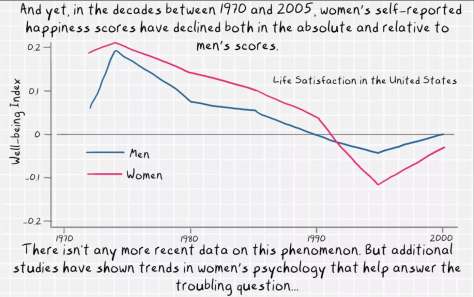
Male And Female Happiness After Feminism And Socialism
Male and female happiness throughout America’s adoption of radical feminism

I was reading this article by a feminist fiction writer on Vox, where she explains that although feminists have gotten what they wanted (careers, contraceptives, promiscuity, abortion, no-fault-divorce, daycare, etc. it hasn’t made them happier. So, what does this feminist fiction writer think would make feminists happier?

She gives two reasons why women women are still unhappy after feminism has been adopted by our society:

  • men don’t do enough housework
  • women are not as successful as men because they are discriminated against, the so-called “glass ceiling”

I think those complaints are pretty popular among feminists. Let’s take a look at some studies to see if her opinions are supported by peer-reviewed studies.

First study:

COUPLES who share housework duties run a higher risk of divorce than couples where the woman does most of the chores, a study has found.

The divorce rate among couples who shared housework equally was around 50 per cent higher than among those where the woman did most of the work.

“The more a man does in the home, the higher the divorce rate,” Thomas Hansen, co-author of the study entitled Equality in the Home, said.

Second study:

Researchers at the University of Illinois examined data on nearly 1,500 men and 1,800 women, aged between 52 and 60. Their well-being was evaluated through surveys.

The researchers first found that men’s well-being decreased once they had exited the workforce to become home-makers.

Meanwhile, the inverse was not so for women: Women’s psychological well-being was not affected by leaving their jobs to become stay-at-home mothers.

Third study:

A study called “Egalitarianism, Housework and Sexual Frequency in Marriage,” which appeared in The American Sociological Review last year, surprised many, precisely because it went against the logical assumption that as marriages improve by becoming more equal, the sex in these marriages will improve, too. Instead, it found that when men did certain kinds of chores around the house, couples had less sex. Specifically, if men did all of what the researchers characterized as feminine chores like folding laundry, cooking or vacuuming — the kinds of things many women say they want their husbands to do — then couples had sex 1.5 fewer times per month than those with husbands who did what were considered masculine chores, like taking out the trash or fixing the car. It wasn’t just the frequency that was affected, either — at least for the wives. The more traditional the division of labor, meaning the greater the husband’s share of masculine chores compared with feminine ones, the greater his wife’s reported sexual satisfaction.

Regarding the pay gap, that is entirely caused by women’s own choices. E.g. – the choice to study creative writing instead of petroleum engineering, the choice to work 35 hour weeks instead of 70 hour weeks, etc.

Fourth study:  (summarized by AEI economist)

When the [Bureau of Labor Statistics] reports that women working full-time in 2018 earned 81.4% of what men earned working full-time, that is very much different from saying that women earned 81.4% of what men earned for doing exactly the same work while working the exact same number of hours in the same occupation, with exactly the same educational background and exactly the same years of continuous, uninterrupted work experience, and with exactly the same marital and family (e.g., number of children) status. As shown above, once we start controlling individually for the many relevant factors that affect earnings, e.g., hours worked, age, marital status, and having children, most of the raw earnings differential disappears.

Fifth study:

This study leads to the unambiguous conclusion that the differences in the compensation of men and women are the result of a multitude of factors and that the raw wage gap should not be used as the basis to justify corrective action. Indeed, there may be nothing to correct. The differences in raw wages may be almost entirely the result of the individual choices being made by both male and female workers.

I think that women are entitled to make their own decisions, but they aren’t allowed to force the rest of us to subsidize their failures and celebrate their destructive outcomes.

I could go on, but I think enough has been said to show that research is very much at odds with feminist rhetoric. They feel they know what will make them happy and we gave them everything they asked for. They eliminated shaming of promiscuity with sex education. They get preferential treatment in the schools in a female-dominated education system. They are hired because of affirmative action quotas. They get expensive daycare, government schools, welfare and other programs. Taxes are raised to equalize outcomes for divorced women who choose men for feelings, and then nuke their own marriage enterprise. We have been on a long experiment of giving feminists everything they felt they wanted, at the expense of men’s rights and children’s rights, and it hasn’t even produced the results that feminists felt it would.

The social costs of feelings-based decision-making

Let’s look at two examples of policies that feminists asked for in the past, which didn’t work out the way they wanted.

I can understand why feminists would introduce sex education. They felt that “if everyone is having sex, then I won’t be the only one chasing attention from hot no-commitment bad boys by giving them recreational sex before marriage”.  They wanted to eliminate the standards of chastity and marriage-focused dating and normalize fun-focused drunken promiscuity. And they got that. But since they didn’t consult any research and evidence about how that would affect their future marriage stability and marriage happiness, they are even more unhappy than before.

How about no-fault divorce? No-fault divorce was brought in by a coalition of feminists, Marxists and trial lawyers. The Marxists want to destroy the family in order to increase dependence on the state. The trial lawyers wanted to make money. And the feminists thought that the standard approach to courting and marriage was just too much work. They didn’t want to be chaste. They didn’t want to be sober. They didn’t want to evaluate a man for traditional husband and father roles. The no-fault divorce laws gave them an escape from the messes caused by their own feelings-driven choices. But divorce just makes makes men and women much poorer, and passes the costs of supporting single mothers onto taxpayers.

And the costs of the failures of feminism are passed onto taxpayers.

Consider this study:

This paper examines the growth of government during this century as a result of giving women the right to vote. Using cross-sectional time-series data for 1870–1940, we examine state government expenditures and revenue as well as voting by U.S. House and Senate state delegations and the passage of a wide range of different state laws. Suffrage coincided with immediate increases in state government expenditures and revenue and more liberal voting patterns for federal representatives, and these effects continued growing over time as more women took advantage of the franchise. Contrary to many recent suggestions, the gender gap is not something that has arisen since the 1970s, and it helps explain why American government started growing when it did.

We are already $28 trillion in debt, partly because of feminism’s replacement of husbands and families with higher taxes and big government. Every time we transfer money from tax-paying men to feminists to fix their mistakes, it leaves less money in the hands of the men who actually want to get married. The declining value of marriage after feminism for men explains why marriage is being delayed, and why marriage rates are plunging.