Welcome to episode 19 of the Knight and Rose podcast! In this episode, Wintery Knight and Desert Rose discuss the historical reliability of the four Gospels – four ancient biographies about the life of Jesus. If you like this episode, please subscribe to the podcast, and subscribe to our YouTube channel. We would appreciate it if you left us a 5-star review on Apple Podcasts or Spotify.
Podcast description:
Christian apologists Wintery Knight and Desert Rose discuss apologetics, policy, culture, relationships, and more. Each episode equips you with evidence you can use to boldly engage anyone, anywhere. We train our listeners to become Christian secret agents. Action and adventure guaranteed. 30-45 minutes per episode. New episode every week.
Episode 19:
Episode Summary:
Wintery Knight and Desert Rose discuss several lines of evidences supporting the historical reliability of the four Gospels, for example: consistency with contemporary non-Christian sources, name disambiguation, undesigned coincidences, confirmation of historical details, etc. We also discuss whether miracles are possible. Finally, we recommend resources on Gospel reliability for all skill levels.
Speaker biographies
Wintery Knight is a black legal immigrant. He is a senior software engineer by day, and an amateur Christian apologist by night. He has been blogging at winteryknight.com since January of 2009, covering news, policy and Christian worldview issues.
Desert Rose did her undergraduate degree in public policy, and then worked for a conservative Washington lobbyist organization. She also has a graduate degree from a prestigious evangelical seminary. She is active in Christian apologetics as a speaker, author, and teacher.
Notes:
I accidently said that the expression “clear as spiderwebs” is from Shakespeare, but it’s actually a line from Cyrano de Bergerac. I feel bad for getting this wrong! Bad WK.
I’ve blogged about a half-dozen studies from different countries on the link between abortion and breast cancer. It’s always interesting to keep up with the research, so we know what to tell young people about the likely consequences of their choices with sex and abortion. The survey was reported by Life News.
Excerpt:
In 2018, the Breast Cancer Prevention Institute funded and published “Induced Abortion as an Independent Risk Factor for Breast Cancer: A Systematic Review and Meta-analysis of Studies on South Asian Women” in Issues in Law and Medicine. (A meta-analysis looks at separate but similar studies in order to use the pooled data for statistical significance. It is regarded by scientists as very strong evidence.)
Of the 20 studies analyzed, 16 were done on Indian women. The meta-analysis found a 151% increased risk of breast cancer after an induced abortion.
In 2014, “Breast Cancer and Induced Abortion,” an analysis also published in Issues in Law and Medicine, revealed that the incidence of breast cancers increased 10-14 years after an abortion. This analysis was consistent with the known biology of breast cancer. There was no statistically significant increase in breast cancer risk before 10 years and after 14 years of an abortion.
Induced abortion in India, referred to as “Medical Termination of Pregnancy,” was legalized in 1971. Sons are most highly prized and sex selection abortions, although illegal, are not uncommon.
A study published in the Lancet 2006 and based on conservative assumptions, reported that the practice of sex-selection accounts for about a half million missing female births yearly. Over the past two decades this translates into the abortion of some 10 million female fetuses.
Abortion is especially a problem for Indian women, because – as in China – India is very pro-abortion. Both India and China have a very pro-abortion culture, and sex-selection abortion is seen as normal.
Here are a couple of studies that focused on China and Chinese women who choose abortion.
Based on the expression of estrogen receptor (ER), progesterone receptor (PR) and HER2/neu (HER2), breast cancer is classified into several subtypes: luminal A (ER+ and/or PR+, HER2-), luminal B (ER+ and/or PR+, HER2+), HER2-overexpressing (ER-, PR-, and HER2+) and triple-negative (ER-, PR-, and HER2-). The aim of this case-control study is to determine reproductive factors associated with breast cancer subtypes in Chinese women. A total of 1,417 patients diagnosed with breast cancer in the First Affiliated Hospital, China Medical University, Shenyang, China between 2001 and 2009 and 1,587 matched controls without a prior breast cancer were enrolled.
[…]Postmenopause and spontaneous abortion were inversely associated with the risk of luminal tumors. By contrast, multiparity, family history of breast cancer and induced abortion increased the risk of breast cancer.
OBJECTIVE: To explore the risk factors of breast cancer for better control and prevention of the malignancy.
METHODS: The clinical data of 232 patients with pathologically established breast cancer were investigated in this 1:1 case-control study to identify the risk factors of breast cancer.
RESULTS: The history of benign breast diseases, family history of carcinoma andmultiple abortions were the statistically significant risk factors of breast cancer, while breast feeding was the protective factor.
CONCLUSION: A history of benign breast diseases, family history of carcinoma and multiple abortions are all risk factors of breast cancer.
Those are both about abortion and breast cancer in China.
IA is significantly associated with an increased risk of breast cancer among Chinese females, and the risk of breast cancer increases as the number of IA increases. If IA were to be confirmed as a risk factor for breast cancer, high rates of IA in China may contribute to increasing breast cancer rates.
The effect seems to be most observable for women who have induced abortions before ever completing a pregnancy.
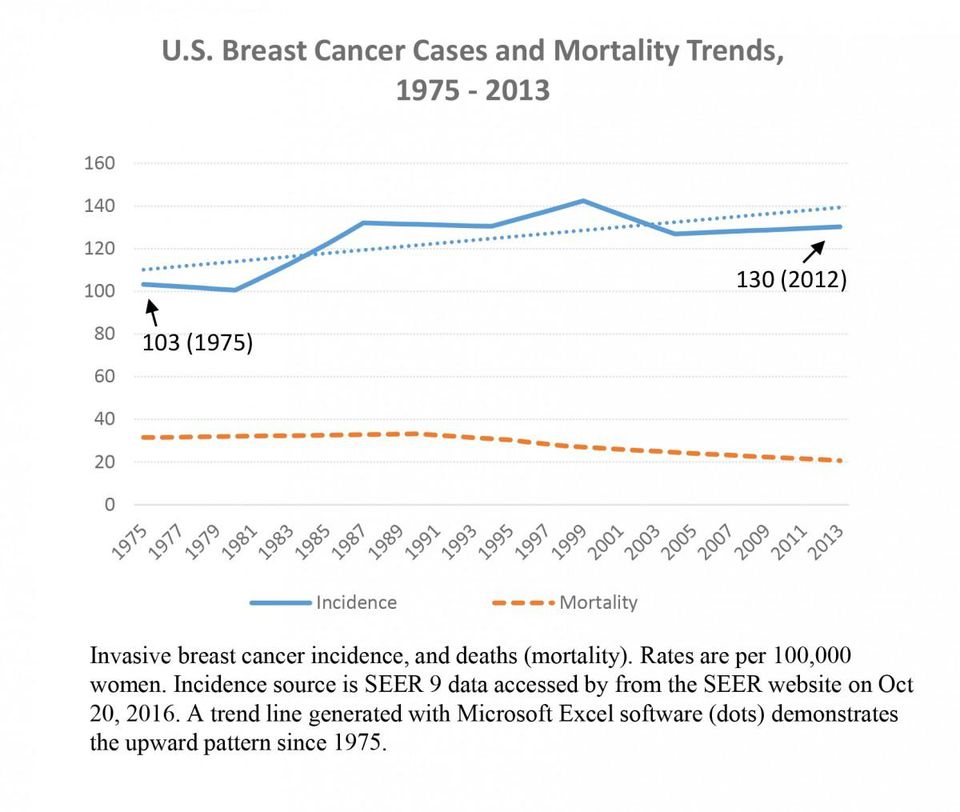
Even though the United States has massively focused on breast cancer screening and treatment, (in contrast to other cancers, such as prostate cancer), the rate of breast cancer has not declined:
Breast cancer rates have been rising since abortion was legalized
We have so much attention on breast cancer in the West. Many charities raising money for it. Policy changes to promote early testing. Taxpayer money being spent to stop it. And yet the rate has not gone down. It started going up right around the time abortion became legal.
Systemic racism is the idea that people can’t lift themselves out of poverty by making good decisions, because powerful groups in society that hold the poor down, regardless of their decisions. Do you think that America is a place where no matter what choices you make, you’ll never be able to be more prosperous? That’s what the leaders of Black Lives Matter think.
Here’s what Nikole Hannah-Jones, creator of the 1619 Project, says in the New York Times (a former newspaper):
To summarize, none of the actions we are told black people must take if they want to “lift themselves” out of poverty and gain financial stability — not marrying, not getting educated, not saving more, not owning a home — can mitigate 400 years of racialized plundering.
Got that? It doesn’t matter what individual choices a non-white person takes in America, they’re going to be poor. The “systemic racism” of the powerful whites will always keep them down. Single motherhood doesn’t make people poor, and marriage doesn’t make people wealthier. Dropping out of high school doesn’t make you poor, and getting a Masters degree in computer science won’t make you wealthier.
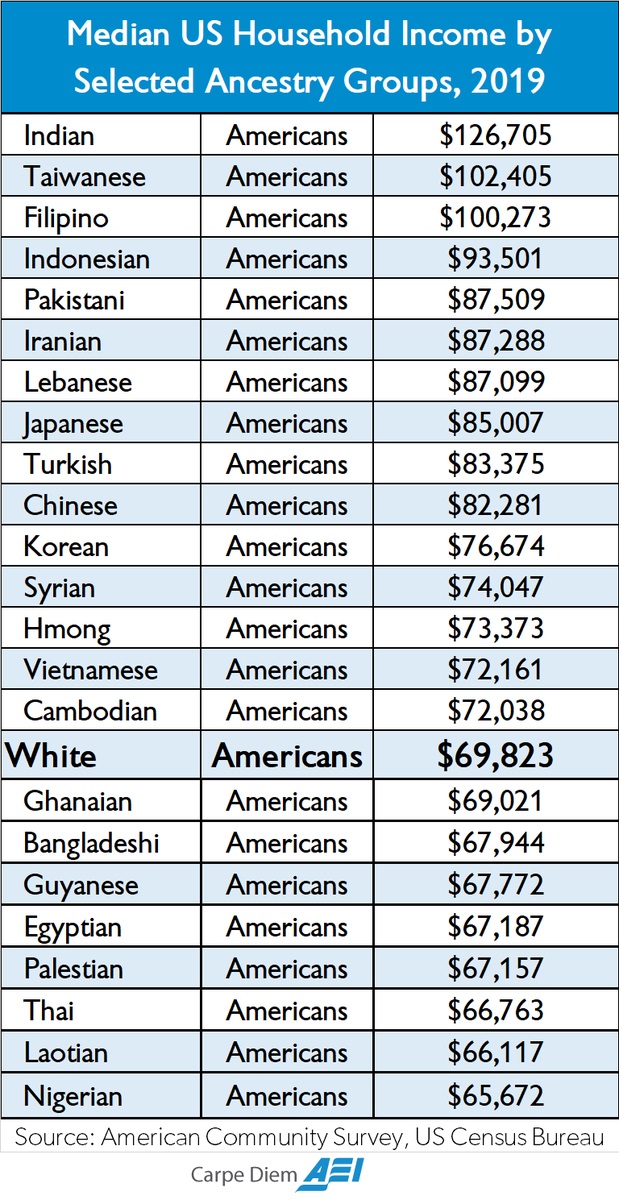
But let’s take a look at the data from the 2019 Census, and see the evidence:
Income By Ethnicity in America
White people are doing a bad job of keeping non-whites down
Well, it looks like at least SOME people of color are able to do well in America despite all the “systemic racism” that keeps non-whites down. And do you know what those non-white groups at the top have in common? They’ve made good decisions, they’ve worked hard, they haven’t blamed other people when they fail, and they’ve saved their money instead of spending it on shiny junk.
Let’s look at some decisions that the non-whites who are prosperous have made, that those further down have not.
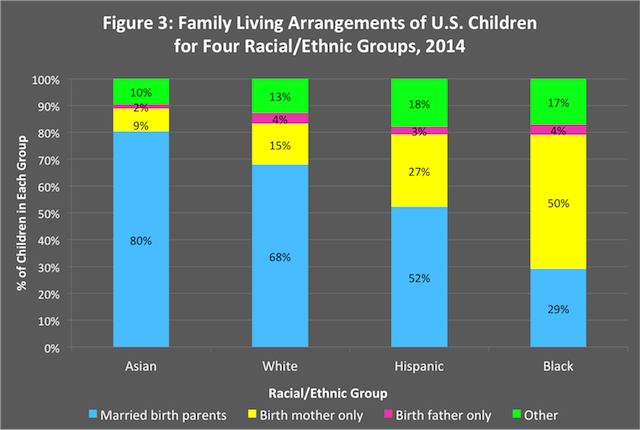
Asians marry before they have children, so the kids have two parents
Education and marriage
This article is written by the far-left radical Nicholas Kristof, writing in the radically-leftist New York Times (a former newspaper).
Excerpt:
A new scholarly book, “The Asian American Achievement Paradox,” by Jennifer Lee and Min Zhou, notes that Asian-American immigrants in recent decades have started with one advantage: They are highly educated, more so even than the average American. These immigrants are disproportionately doctors, research scientists and other highly educated professionals.
It’s not surprising that the children of Asian-American doctors would flourish in the United States. But Lee and Zhou note that kids of working-class Asian-Americans often also thrive, showing remarkable upward mobility.
[…]There’s also evidence that Americans believe that A’s go to smart kids, while Asians are more likely to think that they go to hard workers… Asian-American kids are allowed no excuse for getting B’s — or even an A-. The joke is that an A- is an “Asian F.”
One reason Asians students do so well is because their parents are usually married:
Strong two-parent families are a factor, too. Divorce rates are much lower for many Asian-American communities than for Americans as a whole, and there’s evidence that two-parent households are less likely to sink into poverty and also have better outcomes for boys in particular.
American blacks have a 73% out-of-wedlock birth rate. A huge difference compared to Asians.
So, when Nikole Hannah-Jones tells you that education and marriage don’t matter, she’s just wrong.
Compound interest
Education and marriage are important, but so is saving your money. The wealthiest people in America are typically the ones who are experts at saving money early, and investing it. They know about the law of compound interest. If you invest money early and leave it alone, then it will grow into a fortune by the time you are read to stop working.
This graph explains compound interest:
Investing $24,000 from age 21 to 41 vs investing $24000 from age 47 to 67
What does Nikole Hannah-Jones say when she looks at that graph? She doesn’t think that saving money makes a difference to having more or less wealth. She thinks skin color determines whether saving money makes you wealthy or not. The graph clearly shows what we should be recommending to young people of color. They need to stop spending money and start saving it, and the earlier the better. It doesn’t matter what your skin color is, saving money early JUST WORKS.
Similarly, when she says that home ownership doesn’t make you more wealthy, this is just terrible advice. It’s always better to pay down your own mortgage (at least when interest rates are low like they are now) than to pay someone else rent. You have to live somewhere, and paying for your own home is better because it costs about the same as rent, and then you get to keep the home when you’re done paying for it.
Communism
Nikole Hannah-Jones does have a “solution” to disparities in wealth. Her solution is communism. She wants to transfer money from those who earn, to those who don’t. But we already have tried that in the 20st century and it resulted in the deaths of over 100 million people. That’s not my opinion, that’s all documented in a book published by Harvard University Press.
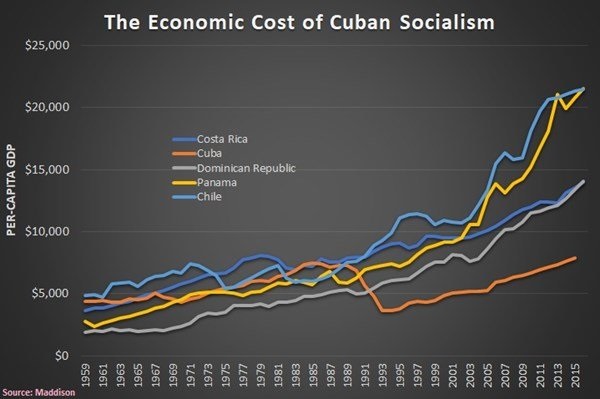
Socialism Communism Countries Per Capita GDP Income
You don’t even have to read the book to know the truth – just look at countries that score low on the Index of Economic Freedom, and compare their GDP per capita to countries that score high on the Index of Economic Freedom. The more communist a nation goes, the less wealth there is for the citizens. That’s why people in Venezuela are eating zoo animals and selling their bodies in prostitution for food, while nearby capitalist countries like Panama and Chile prosper. Nikole Hannah-Jones wants to reduce economic freedom, but we know by looking at other countries that this lowers per-capita GDP.
There’s a lot more than could be said here, but the point is that we need to be telling American blacks to make decisions that match the decisions of other successful non-white communities in America. We need to start teaching young people basic economics so they don’t fall prey to charlatans.





 WINTERY KNIGHT