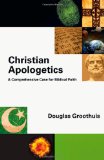
Lee Strobel interviews Douglas Groothuis on his new apologetics book

Christian Apologetics

Mary sent me this article from the BibleGateway site.

Excerpt:

Q. What’s the strongest argument in the arsenal of atheists these days? And why does it fall short?

A. That’s a big question. Different atheists will use different arguments, but they often confront Christians with two things: (1) Darwinism has refuted the idea of Designer and so defeats Christianity (and every other form of theism). They claim that undirected, purely material causes and entities can explain all of biology. (2) The existence of the amount of evil in the world destroys the idea that there is a God who is all-good and all-powerful. No such God would allow this to happen. This is called the problem of evil.

I address (1) in chapters 13 and 14 of Christian Apologetics. To put it into a nutshell: Darwinism is terribly overrated scientifically. Darwinists usually presupposes a materialistic worldview—this is their philosophy, not something derived from science itself—and then interpret everything in biology according to those categories. In other words, “What my net don’t catch, ain’t fish.”

But once we admit intelligent design as a legitimate category of explanation, we find that Darwinism loses its persuasive power as a comprehensive explanation of the biosphere. In fact, Darwinism cannot explain the existence of molecular machines (such as the bacterial flagellum) or the information in DNA code. Nor can it even present a compelling case that all life evolved from a common ancestor.

In addition, my book builds what I hope is a strong cumulative case for Christian theism before addressing the vexing problem of evil in the final chapter. First I consider “dead ends” to explain the fact of evil in the world. Every worldview—and not just Christianity—needs to give an account of the meaning of evil and how to deal with it.

So every worldview has to answer “the problem of evil.” I argue that atheism has no intellectual resources to bring to bear on the problem. It cannot explain the very existence of evil, since it lacks a transcendent and personal standard for good and evil, nor can it give any hope for how to wrestle with evil. This is because all the atheist can say is (to put it politely): “Stuff happens.”

However, Christianity, while challenged by the fact of evil, is not overwhelmed by it. Apart from the problem of evil, we can stand on the foundation of natural theology. There are compelling arguments for, among other things, a First Cause who designed the universe and who is the source of moral law and meaning. Moreover, we find historically reliable documents that speak of Jesus Christ as God incarnate—one who vindicated himself through his matchless life, death, and resurrection. Thus, we do not stand before the problem of evil intellectually naked. Rather, we are girded in strong rational armor.

The Christian answer to the problem of evil is that while God is sovereign, some of God’s creatures (angelic and humans) brought evil into the world through their rebellion. God did not create evil. However, as an all-wise God, God uses evil for greater goods that would not be achievable otherwise. Further, God proves his love and goodness by experiencing the worst possible evil through the crucifixion of Jesus, Christ, God, the Son. Christ’s resurrection three days later stamps history and eternity with the verdict that good (that is, God) wins out over evil in the end.

Q. You offer a compelling case for the resurrection of Jesus. What’s the strongest counter-argument to him rising from the dead? And why does that alternative fail?

A. None of the counter-arguments are as rationally strong as the claim that Jesus left an empty tomb and rose from the dead in space-time actuality. The naturalistic accounts all fail to explain key elements of what we know from history.

However, in recent years, the hallucination theory has generated the most attention, as Gary Habermas has pointed out. This theory affirms that Jesus did not objectively rise from the dead; instead, his followers subjectively hallucinated a resurrection and subsequently built their movement on this delusion. While this counter-argument may be “the best of the bad,” it is still very bad indeed.

First, hallucinations are not group phenomena, but rather individual experiences. But we have well-attested records that many people in their right minds observed the risen Jesus at the same time, as well as other individual appearances (as to Paul).

Second, if many people were deluded about Jesus and began a movement in his name, the Roman government could have put a stop to the young Jesus movement by producing his corpse publicly. They had both the means and the motive to do so. But we have no record of anything like that.

Third, Jesus’ followers did not expect him to rise from the dead. This was not part of their theology and they did not understand Jesus when he made reference to this fact before his resurrection. N.T Wright strongly argues for this. But hallucinations usually involve some form of wish fulfillment: people strongly desire something, and then hallucinate about it. This does not fit the objective historical evidence about Jesus’ followers at all.

I think if you follow apologetics at all, you can see that Doug knows his stuff. But look how precisely he gets the material out – so concisely. I think Doug’s apologetics book and Mike Licona’s resurrection book are the books of the year. But for intermediate to advanced apologists only! Doug and Michael are two of my absolute favorite Christian apologists.

Crime rates in Chicago and DC drop after gun control laws are struck down

From Fox News – what happens to crime rates when gun control laws are repealed? (H/T Reason To Stand)

Excerpt:

Murder and violent crime rates were supposed to soar after the Supreme Court struck down gun control laws in Chicago and Washington, D.C.

Politicians predicted disaster. “More handguns in the District of Columbia will only lead to more handgun violence,” Washington’s Mayor Adrian Fenty warned the day the court made its decision.

Chicago’s Mayor Daley predicted that we would “go back to the Old West, you have a gun and I have a gun and we’ll settle it in the streets…”

The New York Times even editorialized this month about the Supreme Court’s “unwise” decision that there is a right for people “to keep guns in the home.”

But Armageddon never happened. Newly released data for Chicago shows that, as in Washington, murder and gun crime rates didn’t rise after the bans were eliminated — they plummeted. They have fallen much more than the national crime rate.

Not surprisingly, the national media have been completely silent about this news.

One can only imagine the coverage if crime rates had risen. In the first six months of this year, there were 14% fewer murders in Chicago compared to the first six months of last year – back when owning handguns was illegal. It was the largest drop in Chicago’s murder rate since the handgun ban went into effect in 1982.

Meanwhile, the other four most populous cities saw a total drop at the same time of only 6 percent.

Similarly, in the year after the 2008 “Heller” decision, the murder rate fell two-and-a-half times faster in Washington than in the rest of the country.

It also fell more than three as fast as in other cities that are close to Washington’s size. And murders in Washington have continued to fall.

If you compare the first six months of this year to the first six months of 2008, the same time immediately preceding the Supreme Court’s late June “Heller” decision, murders have now fallen by thirty-four percent.

Gun crimes also fell more than non-gun crimes.

Robberies with guns fell by 25%, while robberies without guns have fallen by eight percent. Assaults with guns fell by 37%, while assaults without guns fell by 12%.

Just as with right-to-carry laws, when law-abiding citizens have guns some criminals stop carrying theirs.

Read the whole thing, there are more lovely facts in there. If you ever need to debate this, I recommend buying these academic studies published by the University of Chicago Press and by Harvard University Press. The former shows how crime rates dropped in the USA when Americans rescinded gun control laws, and the latter shows how crime rates rose in the UK when the British strengthened their gun control laws. Sometimes is good to have the data handy.

Let’s learn about the issue from the news

ABC News explains in this short 6-minute clip:

And here is a longer 44-minute show from Fox Business: (featuring a debate between economist John Lott and the Brady Campaign spokesman)

There are other debates in the show as well.

Now watch a 3-on-3 debate on gun control

This debate is in 13 parts, featuring the two of the best proponents of legal firearm ownership – John Lott and Gary Kleck. The real sparks fly during the Q&A, so don’t miss that. (If you can’t watch the debate, then you can read this post and this post instead).

Here’s part 1, which contains the introduction.

Here are the remaining speeches:

This is everything you need to know about whether legal ownership of firearms reduce crime.

Nobel prize award for accelerating universe is relevant to Christian apologetics

First, the story – and then we’ll see how the accelerating universe relates to the existence of God.

Excerpt:

Three astrophysicists who discovered that the universe’s expansion is accelerating rather than decelerating, as had been expected, win the Nobel Prize in physics.

Adam Riess was sure he’d spotted a blatant error in his results. It was 1997, and the young post-doc’s measurements of distant, exploding stars implied that the universe was expanding at a faster and faster rate, instead of slowing down, as he had expected.

It wasn’t an error at all. Instead, what was at fault were some basic assumptions about the workings of the universe.

On Tuesday, the Johns Hopkins University astrophysicist received the Nobel Prize in physics for the revolutionary discovery and its implications, along with team leader Brian Schmidt of Australian National University and astrophysicist Saul Perlmutter of UC Berkeley and Lawrence Berkeley National Laboratory, who had reached the same conclusion independently.

At the time of their work, astrophysicists believed that the rate of expansion of the universe — set in motion by the Big Bang 13.7 billion years ago — would be slowing down as matter was pulled together by gravity. The goal at the time was to figure out how rapid the deceleration was.

What the two teams found instead was that the expansion of the universe was accelerating — an observation that could best be explained by the existence of a mysterious “dark energy” that pushes matter farther and farther apart.

Many scientists had thought that, just as the universe started with the Big Bang, it would end with a Big Crunch — with gravity pulling all the matter in the universe inward.

Does anyone remember that week that I wrote those posts about “Why I am not a… <insert some religion here>”? I explained why I was not all kinds of different religions and denominations, including Roman Catholicism, Calvinism, Hinduism, Judaism, Islam, etc. Everyone was offended and we fought about it. Ah, I remember it well.

Well, recall the evidence I used to defeat Hinduism.

Excerpt:

Why I am not a Hindu

  1. Hindu cosmology teaches that the universe cycles between creation and destruction, through infinite time.
  2. The closest cosmological model conforming to Hindu Scriptures is the eternally “oscillating” model of the universe.
  3. The “oscillating” model requires that the universe exist eternally into the past.
  4. But the evidence today shows the the universe, and time itself, had a beginning at the big bang.
  5. The “oscillating” model requires that the expansion of the universe reverse into a collapse, (= crunch).
  6. In 1998, the discovery of the year was that the universe would expand forever. There will be no crunch.
  7. Therefore, the oscillating model is disconfirmed by observations.
  8. The oscillating model also faces theoretical problems with the “bounce” mechanism.

So that’s one reason why I am not a Hindu.

(The absolute origin of the universe out of nothing is also incompatible with Buddhism, Mormonism, etc. because they also require an eternally existing universe)

Notice anything? That’s right! I used this discovery, which was named the discovery of the year at the time, to argue that the universe would expand forever, thus contradicting the Hindu cosmology, which oscillates in cycles of existence and non-existence.

I think it’s important that you guys realize that when it comes to Christianity, we need to not mess around with church, Bible-y stuff. Bring the Nobel-prize-winning data and win the debate decisively. Leave no doubt. Do not use Christianese. Do not sing praise hymns. Do not cite Bible verses. You want to use the Nobel-prize-winning science. You want what works.

You can find some more refutations of other world religions here.

And it works on atheism

I think it’s important for all of you to be familiar with the scientific evidence for the Big Bang. It will help you with your cosmological argument, and it will help you to refute many, many other religions that require eternal universes, including atheism.

I wrote about how the Big Bang theory falsifies atheism before.

Excerpt:

According to the Secular Humanist Manifesto, atheism is committed to an eternally existing universe, (See the first item: “Religious humanists regard the universe as self-existing and not created.”). If something non-material brought all existing matter into being, that would be a supernatural cause, and atheists deny that anything supernatural exists. The standard Big Bang theory requires that all the matter in the universe come into being out of nothing. The Big Bang has been confirmed by experimental evidence such as redshift measurements, light element abundances and the cosmic microwave background radiation. This falsifies eternal models of the universe, which are required by atheist Scriptures.

You all need to know about the experimental evidence that confirms the Big Bang creation out of nothing.