Mark D. Linville: does Darwinian evolution make morality rational?

Have you ever heard an atheist tell you that naturalistic evolution is an answer to the moral argument? I have. And I found a good reply to this challenge in the book “Contending With Christianity’s Critics“. The chapter that responds to the challenge is authored by Dr. Mark D. Linville. It is only 13 pages long. I have a link to the PDF at the bottom of this post.

First, a bit about the author:

Blog: The Tavern at the End of the World
Current positions:

  • PhD Research Fellow
  • Tutoring Fellow in Philosophy

Education:

  • PhD in Philosophy with a minor in South Asian Studies and a specialization in Philosophy of Religion, University of Wisconsin-Madison
  • MA in Philosophy, University of Wisconsin-Madison
  • MA in Philosophy of Religion, Trinity Evangelical Divinity School
  • MA in Theology, Cincinnati Christian Seminary
  • BA in Biblical Studies, Florida Christian College

Here is his thesis of the essay:

Darwin’s account of the origins of human morality is at once elegant, ingenious, and, I shall argue, woefully inadequate. In particular, that account, on its standard interpretation, does not explain morality, but, rather, explains it away . We learn from Darwin not how there could be objective moral facts, but how we could have come to believe—perhaps erroneously—that there are.

Further, the naturalist, who does not believe that there is such a personal being as God, is in principle committed to Darwinism, including a Darwinian account of the basic contours of human moral psychology. I’ll use the term evolutionary naturalism to refer to this combination of naturalism and Darwinism. And so the naturalist is saddled with a view that explains morality away. Whatever reason we have for believing in moral facts is also a reason for thinking naturalism is false. I conclude the essay with a brief account of a theistic conception of morality, and argue that the theist is in a better position to affirm the objectivity of morality.

And here’s a sample to get your attention:

But even if we are assured that a “normal” person will be prompted by the social instincts and that those instincts are typically flanked and reinforced by a set of moral emotions, we still do not have a truly normative account of moral obligation. There is nothing in Darwin’s own account to indicate that the ensuing sense of guilt—a guilty feeling—is indicative of actual moral guilt resulting from the violation of an objective moral law. The revenge taken by one’s own conscience amounts to a sort of second-order propensity to feel a certain way given one’s past relation to conflicting first-order propensities (e.g., the father’s impulse to save his child versus his impulse to save himself). Unless we import normative considerations from some other source, it seems that, whether it is a first or second-order inclination,one’s being prompted by it is more readily understood as a descriptive feature of one’s own psychology than material for a normative assessment of one’s behavior or character. And, assuming that there is anything to this observation, an ascent into even higher levels of propensities (“I feel guilty for not having felt guilty for not being remorseful over not obeying my social instincts…”) introduces nothing of normative import. Suppose you encounter a man who neither feels the pull of social, paternal or familial instincts nor is in the least bit concerned over his apparent lack of conscience. What, from a strictly Darwinian perspective, can one say to him that is of any serious moral import? “You are not moved to action by the impulses that move most of us.” Right. So?

The problem afflicts contemporary construals of an evolutionary account of human morality. Consider Michael Shermer’s explanation for the evolution of a moral sense—the “science of good and evil.” He explains,

By a moral sense, I mean a moral feeling or emotion generated by actions. For example, positive emotions such as righteousness and pride are experienced as the psychological feeling of doing “good.” These moral emotions likely evolved out of behaviors that were reinforced as being good either for the individual or for the group.2

Shermer goes on to compare such moral emotions to other emotions and sensations that are universally experienced, such as hunger and the sexual urge. He then addresses the question of moral motivation.

In this evolutionary theory of morality, asking “Why should we be moral?” is like asking “Why should we be hungry?” or “Why should we be horny?” For that matter, we could ask, “Why should we be jealous?” or “Why should we fall in love?” The answer is that it is as much a part of human nature to be moral as it is to be hungry, horny, jealous, and in love.3

Thus, according to Shermer, given an evolutionary account, such a question is simply a non-starter. Moral motivation is a given as it is wired in as one of our basic drives. Of course, one might point out that Shermer’s “moral emotions” often do need encouragement in a way that, say, “horniness,” does not. More importantly, Shermer apparently fails to notice that if asking “Why should I be moral?” is like asking, “Why should I be horny?” then asserting, “You ought to be moral” is like asserting, “You ought to be horny.” As goes the interrogative, so goes the imperative. But if the latter seems out of place, then, on Shermer’s view, so is the former.

One might thus observe that if morality is anything at all, it is irreducibly normative in nature. But the Darwinian account winds up reducing morality to descriptive features of human psychology. Like the libido, either the moral sense is present and active or it is not. If it is, then we might expect one to behave accordingly. If not, why, then, as a famous blues man once put it, “the boogie woogie just ain’t in me.” And so the resulting “morality” is that in name only.

In light of such considerations, it is tempting to conclude with C. S. Lewis that, if the naturalist remembered his philosophy out of school, he would recognize that any claim to the effect that “I ought” is on a par with “I itch,” in that it is nothing more than a descriptive piece of autobiography with no essential reference to any actual obligations.

When it comes to morality, we are not interested in mere descriptions of behavior. We want to know about prescriptions of behavior, and whether why we should care about following those prescriptions. We are interested in what grounds our sense of moral obligation in reality. What underwrites our sense of moral obligation? If it is just rooted in feelings, then why should we obey our moral sense when obeying it goes against out self-interest? Feelings are subjective things, and doing the right thing in a real objective state of affairs requires more than just feelings. There has to be a real objective state of affairs that makes it rational for us to do the right thing, even when the right thing is against our own self-interest. That’s what morality is – objective moral obligations overriding subjective feelings. I wouldn’t trust someone to be moral if it were just based on their feelings.

N.T. Wright lectures on the seven mutations caused by resurrection of Jesus

Here’s a lecture from N.T. Wright, whose multi-volume case for the historicity of the bodily resurrection of Jesus seems to be getting a lot of respect from the other side, (although I strongly disagree with his economic and political views, which are naive at best). Wright has taught at Cambridge University, Oxford University, Duke University, McGill University, and lectured on dozens of prestigious campuses around the world. He’s published 40 books.

Here’s a video of his case for the resurrection:

N.T. Wright’s historical case for the bodily resurrection of Jesus

Wright basically argues that the resurrection cannot have been a myth invented by the early Christian community, because the idea of the Messiah dying and being bodily resurrected to eternal life was completely unexpected in Jewish theology, and therefore would not have been fabricated.

In Judaism, when people die, they stay dead. At the most, they might re-appear as apparitions, or be resuscitated to life for a while, but then die again later. There was no concept of the bodily resurrection to eternal life of a single person, especially of the Messiah, prior to the general resurrection of all the righteous dead on judgment day.

Wright’s case for the resurrection has 3 parts:

  • The Jewish theological beliefs of the early Christian community underwent 7 mutations that are inexplicable apart from the bodily resurrection of Jesus
  • The empty tomb
  • The post-mortem appearances of Jesus to individuals and groups, friends and foes

Here’s the outline of Wright’s case:

…the foundation of my argument for what happened at Easter is the reflection that this Jewish hope has undergone remarkable modifications or mutations within early Christianity, which can be plotted consistently right across the first two centuries. And these mutations are so striking, in an area of human experience where societies tend to be very conservative, that they force the historian… to ask, Why did they occur?

The mutations occur within a strictly Jewish context. The early Christians held firmly, like most of their Jewish contemporaries, to a two-step belief about the future: first, death and whatever lies immediately beyond; second, a new bodily existence in a newly remade world. ‘Resurrection’ is not a fancy word for ‘life after death’; it denotes life after ‘life after death’.

And here are the 7 mutations:

  1. Christian theology of the afterlife mutates from multiples views (Judaism) to a single view: resurrection (Christianity). When you die, your soul goes off to wait in Sheol. On judgment day, the righteous dead get new resurrection bodies, identical to Jesus’ resurrection body.
  2. The relative importance of the doctrine of resurrection changes from being peripheral (Judaism) to central (Christianity).
  3. The idea of what the resurrection would be like goes from multiple views (Judaism) to a single view: an incorruptible, spiritually-oriented body composed of the material of the previous corruptible body (Christianity).
  4. The timing of the resurrection changes from judgment day (Judaism) to a split between the resurrection of the Messiah right now and the resurrection of the rest of the righteous on judgment day (Christianity).
  5. There is a new view of eschatology as collaboration with God to transform the world.
  6. There is a new metaphorical concept of resurrection, referred to as being “born-again”.
  7. There is a new association of the concept of resurrection to the Messiah. (The Messiah was not even supposed to die, and he certainly wasn’t supposed to rise again from the dead in a resurrected body!)

There are also other historical puzzles that are solved by postulating a bodily resurrection of Jesus.

  1. Jewish people thought that the Messiah was not supposed to die. Although there were lots of (warrior) Messiahs running around at the time, whenever they got killed, their followers would abandon them. Why didn’t Jesus’ followers abandon him when he died?
  2. If the early Christian church wanted to communicate that Jesus was special, despite his shameful death on the cross, they would have made up a story using the existing Jewish concept of exaltation. Applying the concept of bodily resurrection to a dead Messiah would be a radical departure from Jewish theology, when an invented exaltation was already available to do the job.
  3. The early church became extremely reckless about sickness and death, taking care of people with communicable diseases and testifying about their faith in the face of torture and execution. Why did they scorn sickness and death?
  4. The gospels, especially Mark, do not contain any embellishments and “theology historicized”. If they were made-up, there would have been events that had some connection to theological concepts. But the narratives are instead bare-bones: “Guy dies public death. People encounter same guy alive later.” Plain vanilla narrative.
  5. The story of the women who were the first witnesses to the empty tomb cannot have been invented, because the testimony of women was inadmissible under almost all circumstances at that time. If the story were invented, they would have invented male discoverers of the tomb. Female discovers would have hampered conversion efforts.
  6. There are almost no legendary embellishments in the gospels, while there are plenty in the later gnostic forgeries. No crowds of singing angels, no talking crosses, and no booming voices from the clouds.
  7. There is no mention of the future hope of the general resurrection, which I guess they thought was imminent anyway.

To conclude, Wright makes the argument that the best explanation of all of these changes in theology and practice is that God raised Jesus (bodily) from the dead. There is simply no way that this community would have made up the single resurrection of the Messiah – who wasn’t even supposed to die – and then put themselves on the line for that belief.

And remember, the belief in a resurrected Jesus was something that the earliest witnesses could really assess, because they were the ones who saw him killed and then walking around again after his death. They were able to confirm or deny their belief in the resurrection of Jesus based on their own personal experiences with the object of those beliefs.

Pre-ban study: 53% of mothers with gender-confused boys have mental illness

Normally, on this blog, every other post is some “new study” that I can use in discussing the controversial issues of the day. A lot of the best new studies get unpublished if they go against the worldview of the secular left, for example, the famous ROGD study. (That one was later re-published). Or they don’t get published at all. It’s fun to see what was allowed to get published pre-ban.

Here’s a study that’s on PubMed, one of my favorite web sites for studies.

Abstract:

This pilot study compared mothers of boys with gender identity disorder (GID) with mothers of normal boys to determine whether differences in psychopathology and child-rearing attitudes and practices could be identified. Results of the Diagnostic Interview for Borderlines and the Beck Depression Inventory revealed that mothers of boys with GID had more symptoms of depression and more often met the criteria for Borderline Personality Disorder than the controls. Fifty-three percent of the mothers of boys with GID compared with only 6% of controls met the diagnosis for Borderline Personality Disorder on the Diagnostic Interview for Borderlines or had symptoms of depression on the Beck Depression Inventory. Results of the Summers and Walsh Symbiosis Scale suggested that mothers of probands had child-rearing attitudes and practices that encouraged symbiosis and discouraged the development of autonomy.

Fifty-three percent of the mothers of boys with gender identity disorder were diagnosed with Borderline Personality Disorder or had symptoms of depression.

Now, there are concerns I have about this study. First, it’s a small number of research subjects, which is understandable because back in 1991, there were not a lot of kids with gender identity disorder.

So what is Borderline Personality Disorder? Here is the description from the NIH:

People with borderline personality disorder may experience intense mood swings and feel uncertainty about how they see themselves. Their feelings for others can change quickly, and swing from extreme closeness to extreme dislike. These changing feelings can lead to unstable relationships and emotional pain.

People with borderline personality disorder also tend to view things in extremes, such as all good or all bad. Their interests and values can change quickly, and they may act impulsively or recklessly.

I don’t know much about mental illness, but I’ve been told never to date (much less marry) someone with BPD, because it is the most serious mental illness.

This finding from the study is interesting to me, because it suggests a reason why we are seeing this enormous surge in LGBT identification among young people. Sure, there is peer pressure, that’s what the study on ROGD was about. But now it suggests a chain between radical feminism, the Sexual Revolution, the decline of women’s happiness, and their transgender children.

We know for certain that women are experiencing far greater unhappiness after radical feminism became widespread, because they don’t like the goodies of radical feminism – promiscuity, abortion, careers, etc. – as much as they liked being married to a good man, and being a stay-at-home mother.

Daily Wire noted this in 2017:

According to a recent study from Yale University researchers, liberated, college educated women are freezing their eggs because they can’t find a man to marry and have children with before their natural childbearing years expire. In the U.K., for instance, one in five women is childless when their natural reproductive years expires, as opposed to one in ten women a mere generation prior.

So what’s to blame for this onslaught of college-educated yet terribly empty women?

The short answer is feminism.

The short answer is feminism, because although women claim that it’s men’s fault for not marrying them, no man with a brain would ever marry a feminist. It’s actually become too dangerous for men to even date feminists. I don’t even talk to them. The character traits that go with the feminist worldview are not just anti-marriage, they’re dangerous to men. Women who blame the bad results of their own choices on men are not safe to even speak to.

And as I’ve noted before, the decline of marriage is causing a massive spike in mental illness. Not in conservative women – just in progressive women.

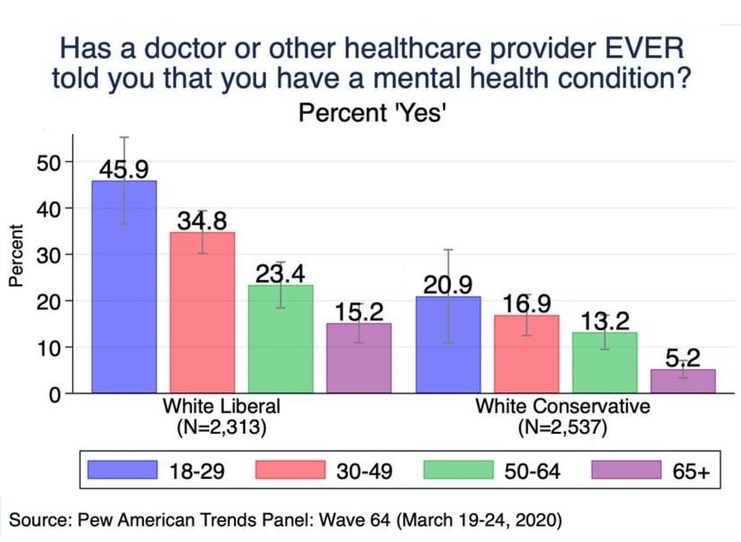
Feminist web site Evie Magazine reported on the some 2020 findings by Pew Research (left-wing pollster):

A 2020 Pew Research study reveals that over half of white, liberal women have been diagnosed with a mental health condition at some point.

[T]he study, which is titled Pew American Trends Panel: Wave 64, was dated March 2020 — over a year ago.

The study, which examined white liberals, moderates, and conservatives, both male and female, found that conservatives were far less likely to be diagnosed with mental health issues than those who identified as either liberal or even “very liberal.”

[…]White women, ages 18-29, who identified as liberal were given a mental health diagnosis from medical professionals at a rate of 56.3%, as compared to 28.4% in moderates and 27.3% in conservatives.

Here’s the part of the data I thought was most interesting:

White Liberal Women

It turns out that marriage accounts for a lot of women’s happiness. But by allying themselves with radical feminism, women have made themselves totally unattractive to marriage-minded men. I think that the explosion of kids with gender identity disorder is just one of the ways that feminism is working itself out.