
If we seriously want men to marry and become fathers, let’s repeal no-fault divorce

I saw a very good article at the Heritage Foundation web site about the importance of fathers for children. The author Virginia Allen listed out some of the benefits that fathers provide to children:

Studies have found that children raised without a father are:

  • At a higher risk of having behavioral problems.
  • Four times more likely to live in poverty.
  • More likely to be incarcerated in their lifetime.
  • Twice as likely to never graduate high school.
  • At a seven times higher risk of teen pregnancy.
  • More vulnerable to abuse and neglect.
  • More likely to abuse drugs and alcohol.
  • Twice as likely to be obese.

From education to personal health to career success, children who lack a father find themselves at a disadvantage to their peers raised in a two-parent household.

I was looking for a good analysis of why there’s been a decline of marriage and fatherhood, and I found an article by Joe Carter on far-left The Gospel Coalition, of all places. By looking at marriage rates and historical events that changed the marriage rate, he was able to identify the cause of the decline of marriage – and fatherhood.
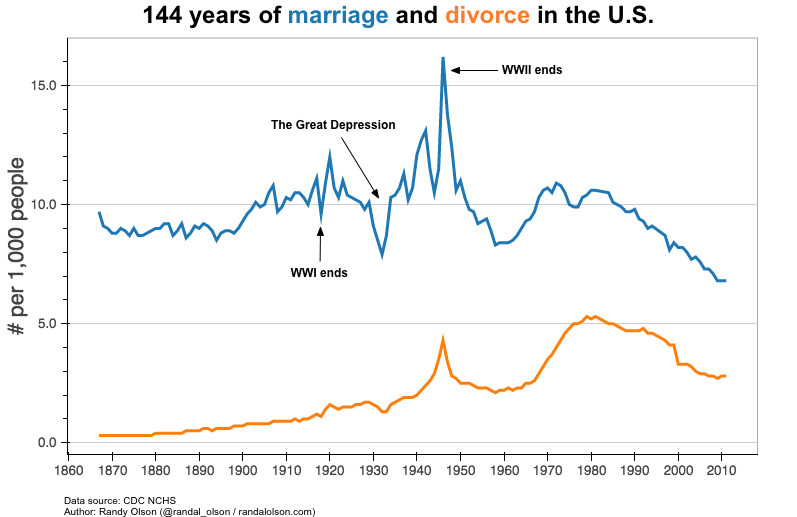
Marriage and divorce rates per capita

I’ll spare you the statistical analysis, which is excellent, and give you the conclusion – although you can guess it from the graph above:

Now that we’ve explored the data, what year should we use as the marker for the beginning of the decline of marriage in the United States? I would argue for 1985, the last year that the marriage rate topped 10 percent.

[…]What changed in 1985 that could have led to the decline in marriage? There are likely numerous factors—which we’ll examine in future articles—but one stands out in particular: By 1985, all states (except for New York) had enacted no-fault divorce legislation.

The most helpful book I know of about no-fault divorce is “Taken Into Custody”, by Dr. Stephen Baskerville. He wrote a column  for Crisis magazine that summarizes some of his ideas.

Excerpt:

Feminists were drafting no-fault divorce laws in the 1940s, which the National Association of Women Lawyers now describes as “the greatest project NAWL has ever undertaken.”

The result effectively abolished marriage as a legal contract. Today it is not possible to form a binding agreement to create a family.

The new laws did not stop at removing the requirement of citing grounds for a divorce, to allow divorce by mutual consent, as deceptively advertised at the time. Instead they created unilateral and involuntary divorce, so that one spouse may dissolve a marriage without any agreement or fault by the other.

Here’s what divorce does to the spouse who is the victim of the unilateral “no-fault” divorce:

Though marriage is a civil matter, the logic quickly extended into the criminal, including a presumption of guilt against the involuntarily divorced spouse (“defendant”). Yet formal due process protections of criminal proceedings did not apply, so forcibly divorced spouses became quasi-criminals not for recognized criminal acts but for failing or refusing to cooperate with the divorce by continuing to claim the protections and prerogatives of family life: living in the common home, possessing the common property, or—most vexing of all—parenting the common children.

Following from this are the horrendous civil liberties violations and flagrant invasions of family and individual privacy that are now routine in family courts. A personalized criminal code is legislated by the judge around the forcibly divorced spouse, controlling their association with their children, movements, and finances. Unauthorized contact with their children can be punished with arrest. Involuntarily divorced parents are arrested for running into their children in public, making unauthorized telephone calls, and sending unauthorized birthday cards.

In my conversations with men, no-fault divorce laws, and anti-male divorce courts are the main reasons given for why they do not pursue marriage and fatherhood. Men do not want to be coerced in a marriage with the threat of divorce by an unhappy wife. Men do not want to be subject to the government in so many areas of their lives if the wife does carry out the threat. They especially don’t want to be separated from their children. One my secular male friends told me that he would not marry unless the woman had evidence in her past of hating radical feminism and no-fault divorce. This was the main criteria. He actually was able to find a woman who was a men’s rights activist who hated divorce. But that was the only way he would marry.

Statistically speaking, the wife is more likely to initiate divorce than the husband. Women initiate 70% of divorces, the majority of those just because she is “unhappy”. I think this is because women get into marriage based on their feelings, and they think that it is the husband’s job to make them feel good. They see their happiness as the primary goal of the marriage, and see a marriage that does not make them happy as a marriage that needs to be ended.

Are we going to repeal no-fault divorce, then?

No-fault divorce was seen as a boon to women who had married the wrong men by following their hearts. It’s an interesting question to ask whether women really would want no-fault repealed. It would mean that they would have to get serious about who they marry, instead of just getting into marriage based on feelings. They would have to evaluate men according to expectations of what a man does in a marriage, instead of on feelings. They would have to think about what men want out of a marriage, and prepare themselves to provide for his needs. They would have to say no to their feelings, when choosing a man, and in keeping a man after the wedding.

If women aren’t willing to demand the repeal of no-fault divorce laws and get serious about men and marriage, then what’s the point of complaining that men don’t want to marry and become fathers? If you’re not willing to fix the root cause of the problem, then don’t complain about the problem.

Astrophysicist explains the problems with naturalistic origin of life

There’s an interesting article posted at Universe Today by Dr. Paul M. Sutter. Although he does accept unguided evolution after the origin of life, he doesn’t think that naturalism can account for the origin of life. On this blog, I’ve talked about three problem’s with life’s origin: 1) getting the right building blocks, 2) getting the right information, and 3) irreducible complexity. Let’s take a look.

Here is a link to the article from Universe Today.

Here is a quick bio of the author:

Paul M. Sutter is a theoretical cosmologist, award-winning science communicator, NASA advisor, U.S. Cultural Ambassador, and a globally recognized leader in the intersection of art and science. Paul is a research professor at the Institute for Advanced Computational Science at Stony Brook University and a visiting professor at Barnard College, Columbia University.

[…]Paul earned his PhD in physics in 2011 as a Department of Energy Computational Science Graduate Fellow at the University of Illinois. He then spent three years as a research fellow at the Paris Institute for Astrophysics followed by two years at the Trieste Observatory in Italy. Prior to his current appointment, he held a joint position as the chief scientist at the Center of Science and Industry in Columbus, Ohio and as a cosmological researcher at the Ohio State University.

Now let’s turn to his article.

It’s always good to remind people what is required for the simplest kind of life, and he does that:

To succeed at evolution and separate itself from mere chemical reactions, life must do three things. First, it must somehow store information, such as the encoding for various processes, traits, and characteristics. This way the successful traits can pass from one generation to another.

Second, life must self-replicate. It must be able to make reasonably accurate copies of its own molecular structure, so that the information contained within itself has the chance to become a new generation, changed and altered based on its survivability.

Lastly, life must catalyze reactions. It must affect its own environment, whether for movement, or to acquire or store energy, or grow new structures, or all the many wonderful activities that life does on a daily basis.

I remember listening to lectures about the origin of life by Dean Kenyon, Charles Thaxton, and Walter Bradley in my younger years. If I remember correctly, the minimal functions of a living system are capture energy, store information, and replicate. Sutter does a nice job of describing an even longer list.

So what’s the problem with appealing to chance and necessity to create all that? Well, in order to do all that, we need to have three components in place: DNA, RNA and molecular machines.

He writes:

Put exceedingly simply (for I would hate for you to mistake me for a biologist), life accomplishes these tasks with a triad of molecular tools.

One is the DNA, which through its genetic code stores information using combinations of just four molecules: adenine, guanine, cytosine, and thymine. The raw ability of DNA to store massive amounts of information is nothing short of a miracle; our own digital system of 1’s and 0’s (invented because it’s much simpler to tell if a circuit is on or off than some stage in-between) is the closest comparison we can make to DNA’s information density. Natural languages don’t even earn a place on the chart.

The second component is RNA, which is intriguingly similar to DNA but with two subtle, but significant, differences: RNA swaps out thymine for uracil in its codebase, and contains the sugar ribose, which is one oxygen atom short of the deoxyribose of DNA. RNA also stores information but, again speaking only in generalities, has the main job of reading the chemical instructions stored in the DNA and using that to manufacture the last member of the triad, proteins.

“Proteins” is a generic catch-all term for the almost uncountable varieties of molecular machines that do stuff: they snip apart molecules, bind them back together, manufacture new ones, hold structures together, become structures themselves, move important molecules from one place to another, transform energy from one form to another, and so on.

Proteins have one additional function: they perform the job of unraveling DNA and making copies of it. Thus the triad completes all the functions of life: DNA stores information, RNA uses that information to manufacture proteins, and the proteins interact with the environment and perform the self-replication of DNA.

What’s the problem? The problem is that this all has to come together at the start, in order to have life. You can’t build up gradually, from one component, to two components, to three components. All three are needed at the start. This is what Michael Behe calls irreducible complexity, but others have described it as minimal complexity.

Sutter says:

The interconnected nature of DNA, RNA, and proteins means that it could not have sprung up ab initio from the primordial ooze, because if only one component is missing then the whole system falls apart – a three-legged table with one missing cannot stand.

And just to be clear, he would have to provide some evidence of “primordial ooze”. As I’ve blogged about before, life appears almost instantaneously after the cooling of the Earth. He might like to appeal to “billions of years” to get that first replicator, but he doesn’t have billions of years. Molecular oxygen, which is poisonous to origin of life chemistry, was present right after the Earth cooled. And that’s not my opinion – that’s right out of the prestigious peer-reviewed journal Nature.

Evolution News notes:

A recent Nature publication reports a new technique for measuring the oxygen levels in Earth’s atmosphere some 4.4 billion years ago. The authors found that by studying cerium oxidation states in zircon, a compound formed from volcanic magma, they could ascertain the oxidation levels in the early earth. Their findings suggest that the early Earth’s oxygen levels were very close to current levels.

[…]Their findings not only showed that oxygen was present in the early Earth atmosphere, something that has been shown in other studies, but that oxygen was present as early as 4.4 billion years ago. This takes the window of time available for life to have begun, by an origin-of-life scenario like the RNA-first world, and reduces it to an incredibly short amount of time. Several factors need to coincide in order for nucleotides or amino acids to form from purely naturalistic circumstances (chance and chemistry). The specific conditions required already made purely naturalist origin-of-life scenarios highly unlikely. Drastically reducing the amount of time available, adding that to the other conditions needing to be fulfilled, makes the RNA world hypothesis or a Miller-Urey-like synthesis of amino acids simply impossible.

I understand that naturalists want to believe that nature is self-contained, and can do it’s own creating. That belief is practically required in order to have careers in academia. Scientists have to at least claim that “naturalism can do it” or they would draw the unwanted attention of the Darwin mob – the people who got people like William Dembski, Guillermo Gonzalez, Richard Sternberg, etc. fired. However, the scientific evidence doesn’t support naturalism. I wish more people would form their views based on scientific evidence, rather than on the religion of naturalism.

How Howard W. Gilmore, commander of the USS Growler, earned the Medal of Honor

Today is the 81st anniversary of a very brave, self-sacrificial act that is well known by all American submariners. The story I talk about below occurred on February 7th, 1943, when America was at war against Japanese imperialists. It took place aboard the USS Growler, a Gato-class submarine. The hero of the story is Commander Howard W. Gilmore. Let’s take a look.

My first brush with the story of the Growler occurred when I was very young, and was playing a game called “Gato” (made by Spectrum Holobyte) on the Macintosh computer that my parents bought for my older brother. In the game, you played as the commander of the USS Growler. COMSUBPAC (Commander of Submarines in the Pacific) would send me missions, and I would execute them. I was able to find an online version that ran in Microsoft’s Edge browser on archive.org.

So, here is an article from the Submarine Force Museum about the USS Growler and Commander Howard W. Gilmore.

It says:

Howard Walter Gilmore was born in Selma, Alabama on September 29, 1902. He enlisted in the Navy on November 15, 1920 and was appointed to the US Naval Academy in 1922. In 1926 he was sent to his first station on the battleship USS Mississippi (BB-41). By 1930, Gilmore was seeking something new and exciting and underwent submarine training in New London.

[…]By March of 1942, construction of the Growler was finished, and Gilmore and his crew would operate out of Pearl Harbor in the Pacific theater.

Their first war patrol would come in late June 1942 in the Aleutian Islands. During this patrol, Gilmore once again narrowly escaped disaster, avoiding two torpedoes that were fired at him during an attack by three Japanese destroyers. In August, they would leave for their second patrol in the East China Sea near Taiwan. During what would end up being Growler’s most successful war patrol, they sunk four merchant ships totaling 15,000 tons. Her third patrol was quiet, and she would remain in Brisbane, Australia for the rest of 1942.

The Growler and her crew left Brisbane on New Year’s Day 1943 for her fourth war patrol. Her mission was to target Japanese shipping lanes in the Bismarck Archipelago. In early February, while charging her batteries on the surface, Gilmore spotted a provision ship and prepared for a surface attack. The 900-ton provision ship Hayasaki saw the on-coming submarine and attempted to ram the Growler. In the darkness, Gilmore “sounded the collision alarm and shouted, ‘Left full rudder!’-to no avail.

Perhaps inadvertently, Growler hit the Japanese adversary amidships at 17 knots, heeling the submarine 50 degrees, bending sideways 18 feet of her the bow, and disabling the forward torpedo tubes.” The Japanese crew began firing at the bridge, killing the assistant officer and a lookout who were on deck. Gilmore and two other men were also wounded during the burst of gun fire. Gilmore, without thinking, called for the bridge to be cleared. Gilmore realized that if they dove, the Growler could be saved, but there was no time for him to make it below. Despite this, he gave the call to “Take her down!”

LCDR Arnold Schade, shaken and unsure, followed the last order his captain would ever give him. Schade would surface the ship a few hours later but found no sign of the Hayasaki. There was also no sign of Gilmore. Schade and the crew were able to keep the battered ship together long enough to make it back to Brisbane on February 17th. Gilmore’s death would unfortunately not be the only tragedy for the Growler. On her 11th war patrol in 1944, she was lost at sea. By her end, The Growler received eight battle stars for her role in the Pacific War.

CDR Howard Gilmore was posthumously awarded the Medal of Honor for his sacrifice to save his ship.

Whenever I see that someone has earned a Medal of Honor – the highest military award that can be given – I always look up their Medal of Honor citation.

Here is Gilmore’s.

There’s a good episode of “The Silent Service” about Gilmore:

As a Christian, I try to make the words of the Bible more practical by reading stories that parallel some of the teachings of Jesus. In this case, Gilmore is pretty clearly living out that command to “love your neighbor as yourself” and “in humility consider others more important than yourselves” and “greater love has no one than this, that he lay down his life for his friends”. What’s interesting to me about this story is that it’s not an enlisted man or a lower officer who is doing it, it’s the Commander of the boat.

If you’re at all interested in getting started in learning military history, a good place to start is with the American submarine commanders in the Pacific. The enemy we fought was very clearly evil, and treated civilians and prisoners horribly. They attacked us first at Pearl Harbor. I have found the commanders to be mostly men of extraordinary intelligence and character. I especially recommend the books “Wahoo” and “Clear the Bridge!” by Richard O’Kane, and “Thunder Below” by Eugene Fluckey. At the operational level, I enjoyed Charles Lockwood’s “Sink ‘Em All”. Those can all be obtained as audio books, too. I just got “Silent Victory: The U.S. Submarine War against Japan” in the mail. No audio book for that one, though.

If you like board games, there is a good board game called “Silent Victory”. The manufacturer is taking pre-orders for the third printing now. If you prefer computer games, “Crash Dive 2” puts you in command of a Gato-class submarine, and it’s not too complicated.