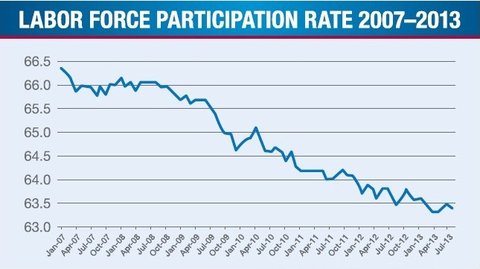
A comprehensive disaster like the Obama administration can’t be summed up in one statistic, but the one that comes closest is labor force participation. The combined effect of many misguided policies–Obamacare, ballooning spending, massive debt, tax increases, subsidizing of inefficient energy, anti-growth regulation, encouragement of food stamp fraud, and many more–has been to drive many millions of Americans out of the labor force. Express Employment Professionals has produced a white paper that illuminates this human tragedy:
The labor force participation rate is currently at a level not seen since the 1970s – 63.4 percent.
While the unemployment rate has steadily decreased from its high of 10.0 percent in October of 2009 to 7.4 percent in July of 2013, the percentage of Americans in the labor force has not risen. It has fallen about 2.7 percentage points since the onset of the latest recession.
This is a tragedy in the making, and its impact on the country has been underestimated. When Americans quit looking for work because they conclude not working beats working, America faces a significant problem.
[…]President Obama’s policies have devastated all age groups, but the most heartbreaking impact is on the young:
Gallup reports that, “The lack of new hiring over the past several years…seems to have disproportionately reduced younger Americans’ ability to obtain full-time jobs.”
According to Gallup’s “Payroll to Population” measure, fewer Millennials were working full time in June of 2013 than in June of 2012, 2011, or 2010.
A recent 2012 Pew Research Center study found that 36 percent of the nation’s Millennials were still living with their parents.
And massive growth in the number of people collecting disability, too:
Fourteen million Americans on disability–that is more than the populations of Wyoming, Vermont, North Dakota, Alaska, South Dakota, Delaware, Rhode Island, Montana, New Hampshire, Maine, Hawaii, Idaho and West Virginia, combined: every man, woman and child in 13 states. The exploding ranks of the “disabled” are due to the absence of jobs in Barack Obama’s economy.
Keep in mind that we are blowing through over a trillion dollars in deficits for EACH of Obama’s 4 years in office. Shouldn’t we be getting a higher level of labor force participation? If you took out a loan to expand your business, you would certainly expect to be able to hire more people and get more sales and make more products, wouldn’t you? But it seems as if we took out a HUGE loan as a nation and we are actually contracting our business.
I’ve been writing this week about my recent experience at Summit Worldview Academy and the nature of student training. There are a number of similar worldview programs around the country (including the Centurions Program and the Worldview Academy), and I’m always impressed to see how many students are interested in this kind of intensive preparation. To be sure, there are always some students at these conferences who are present because their parents demanded their attendance, but these young people are always in the vast minority. Most students come (and put themselves through the rigorous material) because they heard about it through a friend who highly recommended the experience. And while there are some fun opportunities to hike, relax and play games along the way, these activities (commonly associated with youth group retreats) are typically few and far between at worldview camps. Students are here to roll up their sleeves and get to work. They’re far more interested in learning than lounging. Youth pastors can glean somethingfrom worldview academies.
I have to confess: When I was a new youth pastor, I was more likely to provide my students with pizza than preparation. I thought the only way to attract students in the first place was to satisfy their desire for entertainment and social interaction. I simply tried to wedge in the important stuff (theological and apologetics training, Spiritual formation and Biblical literacy) along the way. It took me a year or so to find a better approach. I eventually realized my students would willingly delay their desire for fun if I could effectively show them their need for truth. I began to take them to places where their worldview was tested and I did my best to demonstrate their deficiencies. As a result, the Utah and Berkeley trips became a regular offering of my ministry. It wasn’t long before my students were ready to do whatever it took to better defend themselves. They were more than willing to delay their desire for what they used to think of as fun to achieve a greater goal. Along the way, they discovered how satisfying it is to learn the truth, articulate it effectively, and engage the world.
It turns out that students are willing to raise the bar and do much more than we expect of them in most youth groups across the country. If you’re a youth pastor or are serving in a youth ministry, think about what your students are typically willing to do in order to succeed on their club sports team or to prepare for their next academic AP test. Our students are already working hard to prepare themselves in some area of their young lives; why aren’t we willing to ask them to prepare this rigorously as Christians? It’s time to show students why it’s so important to equip themselves as Christian ambassadors. It’s time to stop teaching and start training.
Wallace has also posted a new podcast on this very topic.
The Please Convince Me podcast is my favorite podcast. There is just something about the way he speaks about Christian topics that is so practical and real-world. I even like it better than all the political and policy podcasts that I listen to. This particular episode is so good. I never had parents and youth pastors and pastors that sounded like this.
I blogged before about another podcast that he did about training a group of students to defend the faith at the University of California at Berkeley . That’s what our youth pastors should be doing instead of working to hard at entertaining the young adults. He really knows what it is like to deal with young people, and he has a real passion for teaching high school students about how to defend their worldview before they get to university. I would really like to see more pastors looking at young people in this way – as people in need of training who will be facing challenges in college. Without the training, our young people will be the ones who are changed. I don’t think that a lot of pastors and parents are working on projects like this the way that Wallace is. That needs to change.
Latest opinion polls show a further drop in support for Labor two weeks out from an election, with one indicating the Prime Minister may struggle to hold his own seat.
The Nielsen poll, published on Fairfax websites, shows Labor’s primary vote has fallen two points to 35 per cent.
After preferences, that gives the Coalition a six-point lead – 53 per cent to 47 per cent.
If the results were replicated evenly across the country on election day, Labor would lose 10 seats.
The poll of 2,500 respondents has a margin of error of 2.6 per cent.
Meanwhile, a Newspoll published in The Australian newspaper, shows Prime Minister Kevin Rudd is behind the Coalition candidate, Bill Glasson, in his Brisbane seat of Griffith.
The poll of 500 voters shows Mr Rudd trails his opponent 52 per cent to 48 per cent on a two-party preferred basis. The margin of error is 4.4 per cent.
Another Newspoll of almost 1,400 voters in the Coalition’s eight most marginal seats in Queensland shows the Coalition’s primary vote has surged eight points to 54 per cent, while the ALP’s primary vote has slipped to 32 per cent.
It shows the Coalition has a commanding two-party preferred lead of 60 per cent to Labor’s 40 per cent.
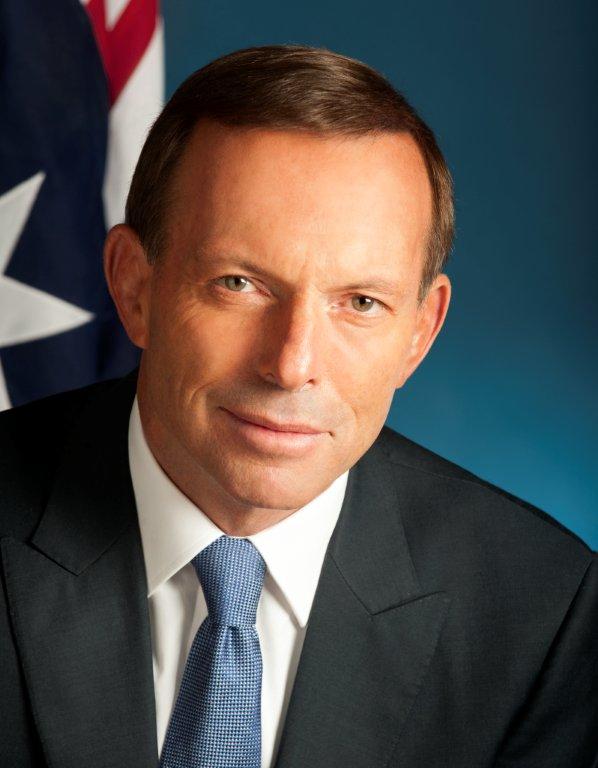
Mr Rudd’s personal support has also fallen to 39 per cent, with 49 per cent of voters across the marginal seats preferring Opposition Leader Tony Abbott.
The Coalition is is composed of the Liberal party (which is actually the conservative party) and the National party (which is also conservative).
I found an interview with Tony Abbott posted on India Today, when I searched for some keywords related to his policies. I searched for a detailed policy-oriented interview in the mainstream media, but couldn’t find much. Strangely enough, the Australian media seemed to be more concerned with gaffes and fear-mongering about Abbott’s socially conservative views. It’s as if the mainstream media is aiming for some sort of Jon Stewart coverage of the election, instead of telling us about each candidate’s plans and proposals.
Here’s some of the interview:
1. What are your plans to grow the economy?
The Liberal Party understands that successful businesses generate prosperity for the entire community by creating jobs, investing in growth and earning important export income.
We will lower costs for Australian businesses by removing Labor’s carbon tax. We will take the shackles off Australian businesses by cutting $1 billion in red tape every year. And we will boost productivity by encouraging more people into the workforce with better child care and a paid parental leave scheme and we will build 21st century infrastructure.
The economy will be strengthened by a new lowered company tax rate of 28.5% from 1 July 2015. This builds on the Coalition’s track record of delivering real tax reform focussed on cutting and simplifying taxation in Australia. Our fully funded tax cut will restore confidence in the management of Australia’s economy and boost job creation and investment.
The Coalition will also build a more diverse, world-class economy – a 5 pillar economy – to unleash Australia’s real economic potential. In particular, we will build on our strengths in manufacturing innovation, agriculture exports, advanced services, world class education and research as well as boosting mining exports.
2. The cost of living has gone up in the recent years, how will the Liberals help families cope with the rising costs?
We will start reducing cost of living pressures for families by immediately scrapping Labor’s carbon tax, taking the pressure off rapidly rising electricity and gas prices.
The average family will be $500 better off next year alone and seniors will still keep their fortnightly pension and benefit increases- all without a carbon tax. We will not proceed with Labor’s FBT changes on cars. And we will restore the Private Health Insurance Rebate as soon as we responsibly can.
3. We have a lot of small businesses in our community, how will Liberals help them?
The Liberal Party understands the small businesses are the real job creators in the economy, employing almost half of the workforce in Australia. We will reduce costs for every business by abolishing the carbon tax, directly reducing electricity, gas and transport costs. By removing $1 billion of red tape each year, small businesses will be able to put more time, effort and resources in their ‘real’ work, rather than complying with complex and unnecessary government requirements.
The Coalition’s paid parental leave scheme will mean small businesses would no longer be disadvantaged in the ‘war for talent’, attracting and keeping quality staff.
We will also ease expense pressures on small businesses by delaying the increase of compulsory superannuation contributions to 12 per cent by a further two years.
8. Do you have a view about same-sex marriage?
There are very strong feelings on both sides of this particular issue right now. I take a conservative position on it myself. I think that we should not lightly change something which has been this way since time immemorial. But I don’t believe that I can necessarily impose my view on society for all time, all I can do is candidly and honestly tell people what my view is. I support the traditional definition of marriage as between a man and a woman. Now I know that others dispute this, because I have lots of arguments inside my own family on this subject now. But my position, it’s always been clear, it’s always been consistent, and as long as I’m in the Parliament if the issue comes up that’s the way I will vote. Whether it remains for all time the Liberal Party, and the Coalition’s position, well that will be a matter for our party, for our Coalition if it were to come up in a future Parliament.
11. Everyone is talking about the Asian Century, what does this mean for the Liberals? What are your plans?
An important element of our economic plan for Australia is to strengthen our trading relationships with Asia, welcome investment from the region, boost our exports and deepen Australia’s knowledge of and engagement with countries in Asia. We recognise the rapid emergence of both China and India and the opportunities this will afford Australia in the future.
Specifically, we will take real action to increase economic activity by fast-tracking Free Trade Agreements with China and India amongst others.
We will strengthen our diplomatic relationship and trade ties with India and boost mining exports by exporting uranium to that country.
We will help Australians gain study and work experience, strengthen the ties with the region, learn to adapt behaviour to Asian contexts and work more effectively with Asian governments.
The Coalition’s new Colombo Plan would encourage and support Australian undergraduates to study for part of their degrees in a university in the Asia-Pacific region, so promoting Australia’s deeper engagement with the region to the benefit of both.
It’s nice to see what policies a conservative would propose. We haven’t had much of that around here for a long time, have we?
The Australian election will be held on September 7th. I would appreciate it if my Australian readers can keep me informed about stories related to the election campaign.

 WINTERY KNIGHT