Wisconsin governor Walker’s reforms hit the left in their wallets

Canadian Prime Minister Stephen Harper
Canadian Prime Minister Stephen Harper is mean

First, let’s talk about Stephen Harper. I sometimes blog about conservative Canadian prime minister Stephen Harper, who Dennis Prager calls “the leader of the free world”. He has a record of putting into place laws that cut off the ability of the left to get campaign funding without consent from the people supplying the money.

Here’s an article from Canada’s National Post.

Excerpt:

While the political showdown making news this month has pitted Prime Minister Stephen Harper against Senator Mike Duffy, a more important battle is shaping up for the 2015 election. It’s between the Conservative Party and organized labour — as evidenced by the resolutions the party will be debating at its policy convention in Calgary this week.

Proposals include allowing secret ballots during strikes, banning the use of dues for political purposes, requiring increased financial disclosure by unions, and passing right-to-work legislation. The resolutions are moved by electoral district associations in Alberta, Ontario and Quebec, and together represent what appears to be the largest block of resolutions on any one theme.

Why the focus on organized labour, and why now? In part, it’s ideological. While small-c conservatives respect freedom of association, they also respect the freedom not to associate. The labour movement’s rules — particularly the RAND formula, which obliges workers in unionized workplaces to join whether they want to or not — restricts workers’ freedom of choice. Unions also spend dues on causes that workers may not support, and demand workers follow their direction on strike action, even if workers may be opposed or not be able to afford the loss in pay.

[…]The Conservatives have pledged to balance the federal budget by the time they go to the polls. One of the elements of their plan is downsizing government, which pits them directly against the Public Service Alliance of Canada. For two years now, PSAC has been fighting against Conservative cuts to the bureaucracy and the party’s policy of reduction by attrition. PSAC’s rallies and campaigns, however, have done nothing to dent the Tories’ resolve (long overdue, considering that they substantially grew the size of the bureaucracy during the early years of their mandate). Curtailing PSAC’s power and voice would help the Tories achieve their downsizing goals for both the short and long term.

Back in 2006, Stephen Harper banned political contributions from corporations and unions. Nasty! And he’s not done yet, according to this article. It’s good to win, and win, and win again. I am tired of conservatives losing, even in other countries.

Governor Scott Walker

Now when I look around at the Republican Party, I rarely see the same will to do effective things that will cripple the left financially. It’s like Republicans don’t want to offend people, especially journalists. They want to be liked at cocktail parties.

But there is one Republican who is fine with being hated by his enemies, and he is getting a lot of attention from conservatives ahead of the 2016 election.
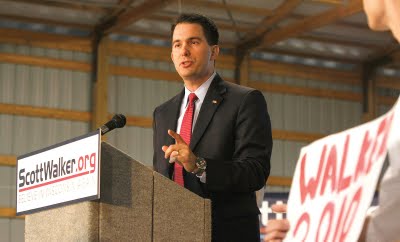
Wisconsin Governor Scott Walker
Wisconsin Governor Scott Walker is also mean

Here’s the story from the Associated Press.

Excerpt:

The 2011 state law that all but ended collective bargaining for most public workers has hit Wisconsin’s second largest union particularly hard.

The latest tax documents available show combined income of American Federation of State, County and Municipal Employees (AFSCME) dropped 45 percent in 2012 _ the first full year of the law, according to The Capital Times.

In 2011, the four councils that make up the state organization reported a combined income of $14.9 million. In 2012 that dropped to $8.3 million. Dues revenue dropped 40 percent to $7.1 million.

Walker and supporters of the law said it was a way to help local governments reduce the costs of employee benefits, but the legislation also included measures aimed at financially weakening unions by ending automatic dues deductions.

The union’s Council 40 executive director, Rick Badger, says that while the declines in revenue stemming from the law were expected, he has been encouraged by the number of workers who have continued to pay voluntary dues.

“In fact, what (the law’s) architects might find surprising is our resilience,” he wrote in an email. He said thousands of “front-line workers are remaining engaged in fighting for their rights despite heavy-handed political attempts to silence them.”

While public unions no longer enjoy the official bargaining power that they exercised in recent decades, he said many public workers continue to value their presence as advocates for their rights and welfare.

AFSCME is second only to the Wisconsin Education Association Council, or WEAC, in members in Wisconsin. It has long been a powerful player in state politics, funneling money directly to campaigns and running independent television ads in support of pro-labor candidates, as well as providing a legion of employees and member volunteers who made sure their union brethren voted on Election Day.

The law has also hit other big unions in the state. For instance, WEAC, the state’s largest teachers union, saw its revenue drop from $26 million in 2011 to $20 million in 2012.

This is definitely someone we conservatives need to look at in 2016. He has had to face the left in a blue-ish state, and he won.

During the Christmas vacation, I read governor Walker’s new book, which was a Christmas present from my friend ECM. If you want to learn more about governor Walker, I recommend picking that up. I actually got the audio version, and it’s read by governor Walker himself.

Related posts

William Lane Craig vs Walter Sinnott-Armstrong: evil, suffering and God’s existence

This is one the top 4 best debates that William Lane Craig has done in my opinion. (The other two are Craig-Millican debate and the first and second Craig-Dacey debates) This one doesn’t seem to get a lot of play on the Internet: there’s no video, transcript or anything. But it is a great debate, and on a problem we are all concerned about: the problem of evil and suffering. One other thing – Sinnott-Armstrong is also a very courteous, respectful and intelligent scholar and he is very good at defending his side. This is a very cordial and engaging debate, and because it was held in front of a church audience, it was targeted to laymen and not academics.

The MP3 file is here.

There is also a book based on this debate, published by Oxford University Press. I was actually able to find a PDF of it online. I should also remind people that you can get the wonderful Craig-Hitchens debate DVD from Amazon.com if you are looking for a debate to watch, or show in your church.

The debaters:

The format:

  • WSA: 15 minutes
  • WLC: 15 minutes
  • Debaters discussion: 6 minutes
  • Moderated discussion: 10 minutes
  • Audience Q&A: 18 minutes
  • WSA: 5 minutes
  • WLC: 5 minutes

SUMMARY:

WSA opening speech:

Evil is incompatible with the concept of God (three features all-powerful, all-god, all-knowing)

God’s additional attributes: eternal, effective and personal (a person)

He will be debating against the Christian God in this debate, specifically

Contention: no being has all of the three features of the concept of God

His argument: is not a deductive argument, but an inductive/probabilistic argument

Examples of pointless, unjustified suffering: a sick child who dies, earthquakes, famines

The inductive argument from evil:

  1.  If there were an all-powerful and all-good God, then there would not be any evil in the world unless that evil is logically necessary for some adequately compensating good.
  2.  There is evil in the world.
  3.  Some of that evil is not logically necessary for some adequately compensating good.
  4. Therefore, there can’t be a God who is all-powerful and all-good.

Defining terms:

  • Evil: anything that all rational people avoid for themselves, unless they have some adequate reason to want that evil for themselves (e.g. – pain, disability, death)
  • Adequate reason: some evils do have an adequate reason, like going to the dentist – you avoid a worse evil by having a filling

God could prevent tooth decay with no pain

God can even change the laws of physics in order to make people not suffer

Responses by Christians:

  • Evil as a punishment for sin: but evil is not distributed in accordance with sin, like babies
  • Children who suffer will go straight to Heaven: but it would be better to go to Heaven and not suffer
  • Free will: this response doesn’t account for natural evil, like disease, earthquakes, lightning
  • Character formation theodicy: there are other ways for God to form character, by showing movies
  • Character formation theodicy: it’s not fair to let X suffer so that Y will know God
  • God allows evil to turn people towards him: God would be an egomaniac to do that
  • We are not in a position to know that any particular evil is pointless: if we don’t see a reason then there is no reason
  • Inductive evil is minor compared to the evidences for God: arguments for a Creator do not prove that God is good

WLC opening speech:

Summarizing Walter’s argument

  1. If God exists, gratuitous does not exist.
  2. Gratuitous evil exists.
  3. Therefore, God does not exist.

Gratuitous evil means evil that God has no morally sufficient reason to permit. WSA doesn’t think that all evil is incompatible with God’s existence, just gratuitous evil.

Everyone admits that there are instances of evil and suffering such that we cannot see the morally sufficient reason why God would allow it to occur.

The claim of the atheist is that if they cannot see that there is a moral justification for allowing some instance evil, then there is no moral justification for that instance of evil.

Here are three reasons why we should not expect to know the morally sufficient reasons why God permits apparently pointless evil.

  1. the ripple effect: the morally sufficient reason for allowing some instance of evil may only be seen in another place or another time
  2. Three Christian doctrines undermine the claim that specific evils really are gratuitous
  3. Walter’s own premise 1 allows us to argue for God’s existence, which means that evil is not gratuitous

Christian doctrines from 2.:

  • The purpose of life is not happiness, and it is not God’s job to make us happy – we are here to know God. Many evils are gratuitous if we are concerned about being happy, but they are not gratuitous for producing the knowledge of God. What WSA has to show is that God could reduce the amount of suffering in the world while still retaining the same amount of knowledge of God’s existence and character.
  • Man is in rebellion, and many of the evils we see are caused by humans misusing their free will to harm others and cause suffering
  • For those who accept Christ, suffering is redeemed by eternal life with God, which is a benefit that far outweighs any sufferings and evils we experience in our earthly lives

Arguing for God in 3.

  • If God exists, gratuitous does not exist.
  • God exists
  • Therefore, gratuitous does not exist.

Four reasons to think that God exists:

  • the kalam cosmological argument
  • the fine-tuning argument
  • the moral argument
  • the argument from evil

Scientists discover that tides affect a planet’s habitability

Circumstellar Habitable Zone

Science Daily reports on a new factor that affects planetary habitability: tides. Specifically, tides can affect the surface temperature of a planet, which has to be within a certain range in order to support liquid water – a requirement for life of any conceivable kind.

Excerpt:

Tides can render the so-called “habitable zone” around low-mass stars uninhabitable. This is the main result of a recently published study by a team of astronomers led by René Heller of the Astrophysical Institute Potsdam.

[…]Until now, the two main drivers thought to determine a planet’s temperature were the distance to the central star and the composition of the planet’s atmosphere. By studying the tides caused by low-mass stars on their potential earth-like companions, Heller and his colleagues have concluded that tidal effects modify the traditional concept of the habitable zone.

Heller deduced this from three different effects. Firstly, tides can cause the axis of a planet`s rotation to become perpendicular to its orbit in just a few million years. In comparison, Earth’s axis of rotation is inclined by 23.5 degrees — an effect which causes our seasons. Owing to this effect, there would be no seasonal variation on such Earth-like planets in the habitable zone of low-mass stars. These planets would have huge temperature differences between their poles, which would be in perpetual deep freeze, and their hot equators which in the long run would evaporate any atmosphere. This temperature difference would cause extreme winds and storms.

The second effect of these tides would be to heat up the exoplanet, similar to the tidal heating of Io, a moon of Jupiter that shows global vulcanism.

Finally, tides can cause the rotational period of the planet (the planet’s “day”) to synchronize with the orbital period (the planet’s “year”). This situation is identical to the Earth-moon setup: the moon only shows Earth one face, the other side being known as “the dark side of the moon.” As a result one half of the exoplanet receives extreme radiation from the star while the other half freezes in eternal darkness.

The habitable zone around low-mass stars is therefore not very comfortable — it may even be uninhabitable.

Here is my previous post on the factors needed for a habitable planet. Now we just have one more. I actually find this article sort of odd, because my understanding of stars was that only high-mass stars could support life at all. This is because if the mass of the planet was too low, the habitable zone wouldbe very close to the star. Being too close to the star causes tidal locking, which means that the planet doesn’t spin on its axis at all, and the same side faces the star. This is a life killer.

This astrophysicist who teaches at the University of Wisconsin explains it better than me.

Excerpt:

Higher-mass stars tend to be larger and luminous than their lower-mass counterparts. Therefore, their habitable zones are situated further out. In addition, however, their HZs are much broader. As an illustration,

  • a 0.2 solar-mass star’s HZ extends from 0.1 to 0.2 AU
  • a 1.0 solar-mass star’s HZ extends from 1 to 2 AU
  • a 40 solar-mass star’s HZ extends from 350 to 600 AU

On these grounds, it would seem that high-mass starts are the best candidates for finding planets within a habitable zone. However, these stars emit most of their radiation in the far ultraviolet (FUV), which can be highly damaging to life, and also contributes to photodissociation and the loss of water. Furthermore, the lifetimes of these stars is so short (around 10 million years) that there is not enough time for life to begin.

Very low mass stars have the longest lifetimes of all, but their HZs are very close in and very narrow. Therefore, the chances of a planet being formed within the HZ are small. Additionally, even if a planet did form within the HZ, it would become tidally locked, so that the same hemisphere always faced the star. Even though liquid water might exist on such a planet, the climactic conditions would probably be too severe to permit life.

In between the high- and low-mass stars lie those like our own Sun, which make up about 15% percent of the stars in the galaxy. These have reasonably-broad HZs, do not suffer from FUV irradiation, and have lifetimes of the order of 10 billion years. Therefore, they are the best candidates for harbouring planets where life might be able to begin.

This guy is just someone I found through a web search. He has a support-the-unions-sticker on his web page, so he’s a liberal crackpot. But he makes my point, anyway, so that’s good enough for me.

Maybe the new discovery is talking about this now, but I already knew about the tides and habitability, because I watched The Privileged Planet DVD. Actually that whole video is online, and the clip that talks about the habitable zone and water is linked in this blog post I wrote before.