
The dangers of judging others based on physical attractiveness

UK apologist Calum Miller has a long post up at Dove Theology about people making judgments based on physical appearances.

Here’s the part that really struck me:

Quite obviously, most people put an emphasis on physical appearance. They decide who to date or be friends with at least partly on the basis of physical appearance, and by doing so they create an expectation of the opposite sex (or the same sex) looking good enough. They make comments about people looking good or looking bad. They make comments about people wearing nice or unimpressive clothes, or combinations of clothes. They spend obscene amounts on improving their appearance. They include physical criteria in their lists of what they look for in a partner. They reject people because they don’t match some physical criteria. They ogle at others, sometimes making comments to their friends while doing so.

Sometimes they do much of this non-verbally: they make faces to indicate disgust (or something less extreme, but of the same genus) if a suggestion of romantic or social interest is raised regarding someone who has an obvious deformity, or who is wearing something unsightly, or who is too short, or whatever else. Or they gesture to direct friends’ attention towards a good-looking person, it being incredibly important that such a person be noticed and lusted after.

Men and women both do this, and do so to enormous degrees. The fact that men have less resources to change how they look, or that some people go to further extremes in their shallowness, or that some people make these ratings and judgments quantitative, is not really the main problem. The main problem is these underlying attitudes and behaviours pervading society at a much deeper level. I know very few people of either sex who don’t make comments about others’ looks, height and clothes, and that includes champions of these recent campaigns which claim to challenge such shallowness.

The fact that this image seems so farcical is a testament to the fact that this shallowness is something propagated by both sides. The fact that many women will spend their time looking at topless men in magazines while men peruse infamous lads’ mags confirms this further. And really, I will controversially suggest, there is not much difference between the woman who fawns over the face and body of a male model with her friends, and the man who comments, “nice t*ts” to his. The latter may be more extreme, more sexually explicit, and more crude, but it is really the same kind of thing: an objectification of the other sex, and an instance of lust, which is an indulgence in sexual attraction and the use of another person’s body for self-gratification, without the context of a marital commitment and the promise of life-long self-sacrifice and mutual giving.

And the most hard-hitting part of all of this is that Christians do all of this too, in my experience to just as significant a degree. Christians reject people on their looks, they include stringent physical criteria when looking for partners, they lust regularly and verbalise their lust to their friends, and by doing all these things they create expectations which others feel obliged to fulfill, and which make others feel inadequate and excluded when they don’t fulfill them (either because they don’t spend extortionate amounts of time and money doing so, or because no realistic amount of time and money would suffice to fulfill them).

Read the rest. I am not sure if I go as far as he does in the rest of the post, but I definitely agreed with him on the paragraph in bold.

This is something that struck me very hard when I was a young man, and it was especially annoying when Christians did it. I always believed that the most important thing about a person was their character, and that this would especially be true for Christians. Imagine my surprise when I found that Christians in the church were just as likely to judge on appearances as anyone else. There isn’t much that people can do to improve their appearance, but we can do a lot to have good theology and sounds apologetics. But in the church, it seems to me that theology and apologetics are on no one’s list of priorities. If our job was to preach the gospel, then it seems to me that we should be valuing skills that help us show that the gospel is true.

But there’s more to say. Everyday, Christians have to decide who to evangelize, who to defend the faith to, who to disciple, and who to make friends with. It seems to me that we need to remember that every person was made to know God. So we can’t be picking and choosing who to do Christianity with based on appearances. Furthermore, if you are assembling a team of Christian friends to serve as resources, we shouldn’t be picking on the basis of appearance, we should be picking on the basis of interest and aptitude. If your job as a Christian is to focus on theology and apologetics, and the application of that in loving God and loving your neighbor, then you will pick a completely different set of friends than if your job is to be popular.
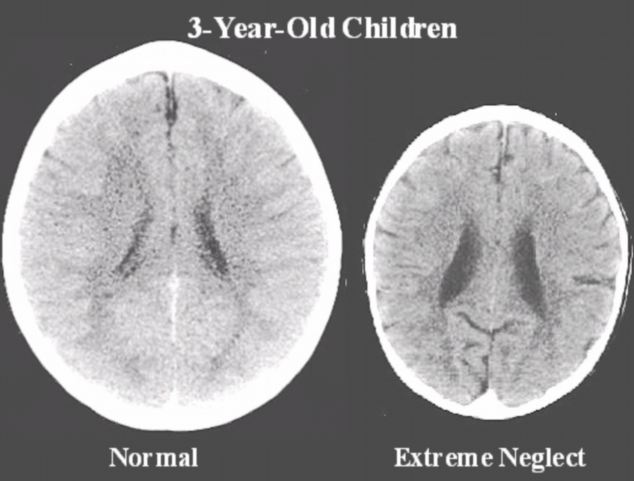
Study: brain of child neglected by mother is smaller and underdeveloped

Dina sent me this article from the UK Daily Mail.

Here is the scan:

Brain scans of 3-year old children: normal vs neglected

Excerpt:

Both of these images are brain scans of a two three-year-old children, but the brain on the left is considerably larger, has fewer spots and less dark areas, compared to the one on the right.

According to neurologists this sizeable difference has one primary cause – the way each child was treated by their mothers.

The child with the larger and more fully developed brain was looked after by its mother – she was constantly responsive to her baby, reported The Sunday Telegraph.

But the child with the shrunken brain was the victim of severe neglect and abuse.

According to research reported by the newspaper, the brain on the right worryingly lacks some of the most fundamental areas present in the image on the left.

The consequences of these deficits are pronounced – the child on the left with the larger brain will be more intelligent and more likely to develop the social ability to empathise with others.

But in contrast, the child with the shrunken brain will be more likely to become addicted to drugs and involved in violent crimes, much more likely to be unemployed and to be dependent on state benefits.

The child is also more likely to develop mental and other serious health problems.

Professor Allan Schore, of UCLA, told The Sunday Telegraph that if a baby is not treated properly in the first two years of life, it can have a fundamental impact on development.

He pointed out that the genes for several aspects of brain function, including intelligence, cannot function.

[…]The study correlates with research released earlier this year that found that children who are given love and affection from their mothers early in life are smarter with a better ability to learn.

The study by child psychiatrists and neuroscientists at Washington University School of Medicine in St. Louis, found school-aged children whose mothers nurtured them early in life have brains with a larger hippocampus, a key structure important to learning, memory and response to stress.

The research was the first to show that changes in this critical region of children’s brain anatomy are linked to a mother’s nurturing, Neurosciencenews.com reports.

The research is published online in the Proceedings of the National Academy of Sciences Early Edition.

Lead author Joan L. Luby, MD, professor of child psychiatry, said the study reinforces how important nurturing parents are to a child’s development.

I have a very good feminist non-Christian friend who sometimes comments here. I once asked her about marriage and she said that her skills would be wasting on raising children. I explained to her my view that a mother needs to stay at home with the children, and that is more important work. I expect my future wife to read all kinds of books on child care and to give the child attention, nutrition, exercise and play so that the child will grow up to be an effective Christian. Maybe I need to be clear. I am not going to spend hundreds of thousands per child with just any woman. I need a woman who can produce influential and effective Christians who will engage in the public square. And we do not entrust that job to just anyone. Professional women who are willing to be stay-at-home moms in the first five years of each child’s life.

I expect the woman I marry (if I marry) to have a college degree, and preferably a graduate degree, and a couple of years of employment. Then she has to stay home and invest in those children through the first five years at least. After that she can stay home or work as much as she thinks is beneficial to the family goals of impacting the university, the church and the public square – as well as continuing to raise those children. It’s not a waste of her talent to make the next William Lane Craig, the next Marsha Blackburn, the next Doug Axe, or the next Edith Jones. Even if we only aim for those guys and get decent, hard-working Christians who make a difference using apologetics, that would still be something. The main thing is not to be scared to try to achieve something with the family – if you aim at nothing, you always hit it.

UPDATE: I am linking to a relevant post from Lindsay, a Christian mother who has a graduate degree in biology and was teaching biology before leaving her career to care for her children.

The story of how the Failed Atheist failed at atheism in the UK

My friend The Failed Atheist has posted his testimony on his blog. Some of the phrases might be a bit unfamiliar, because he grew up in the UK. I always thought that the UK was filled with Christians who loved England and all wanted to be knights when they grew up. I didn’t grow up in the UK, but my room as a child was still filled with books on knights and chivalry. Some of them with scribbled drawings in them! I also knew about the Battle of Britain and Spitfire airplanes were pictured on my wall posters. Anyway, I digress.

Here are the first 3 paragraphs of his story:

Within the next few months I would have been a Christian for ten years and that seems like a long time. Not only did my life go in the direction I had never expected but I’m also the sort of person I never expected I’d be. Over the last ten years I’ve often been asked how and why (two very different questions) I became a Christian which to most people seemed an obvious and embarrassing mistake. I suppose this shouldn’t come as much of a surprise because most people post 9/11 and Dawkin’s ‘The God Delusion’ have gone the other way.

School Nativity

I could write a lot but I will try my best to stick to what I think are the most salient points and not ramble. So, I grew up in a secular non-religious single parent family and as far as I can remember like most British children I was in the school nativity play (I was a shepherd) and was occasionally read the odd Bible story by a neighbor. Although the only one I can actually remember was the wise judgement of Solomon found in 1 Kings 3:16-28. I spent one year at a Church of England primary school and if I’m honest the only thing I can remember is that the Priest was a bit of a weirdo.

My Early Doubts

My interactions with anyone I knew who were religious amounted to the JW’s stopping by to give me a copy of the Watchtower which I probably fed to the dog. I also happened to live very near to a massive Mormon temple but it was years before I even knew what  a Mormon actually was and why they wore magic underwear. I remember a friend of mine in Biology class when I was about 13 asking me whether I thought there was a God, I can almost remember verbatim what I said to him, “I like the idea of there being a God but there is no evidence for one”. If most people are brutally honest I reckon most people would prefer to be born in a universe where their existence mattered to the omnipotent, omniscient, omnipresent creator of the universe. The reverse being what Bertrand Russell so eloquently summarized the astronomers view of the human life to be “...a tiny lump of impure carbon and water crawling impotently on a small and unimportant planet…“. Of course I should point out that the degree to which we prefer something to be true has no bearing on whether it is in fact true. I digress.

So by 13 I was persuaded that the universe I inhabited was not created by any deity, and that evolution alone explained life’s journey from the single cell organism to complex carbon based life as reflected in natures pinnacle creation the ‘wise man’ Homo sapiens. Most people I grew up with were either atheists or agnostics although my next door neighbors were Roman Catholics but if I’m honest I didn’t have a clue what that even meant. I just remember my mate coming back one Sunday with tons of money telling me it was his ‘Holy Communion’. I didn’t know what that was and I didn’t think to ask but I remember being jealous, I could’ve done with people pinning cash to my tracksuit bottoms.

His blog has an excellent list of recommended books, as well, separated into categories.

It’s funny how people remember the little opinions they had when they were very young, one way or the other. I remember feeling very protective of God from the beginning, and thinking how he would not be very happy with my parents or the mean kids in school. We were always on the same side, and everyone else was on the other side. Sometimes I wonder if Christianity is easier that way, when you don’t think of your parents as God or exemplars of godliness, then when your parents fail you then think that God is a failure by extension. I remember showing my mother hard verses of the Bible as a child, (e.g. – Matt 10:34-38), and when she said they were false (she is a Muslim-raised atheist), I remember thinking “well, so much the worse for you when you meet him, then” and “well, I don’t even know how I ended up in this family of insolent God-haters”. I remember thinking that my real parents were probably angels and my human parents had probably stolen me from them. I was just a kid, so all this made sense to me then. I was so different than anyone in my family – I am the first Protestant and almost everyone else is Muslim or Hindu, with just a few Catholics and atheists. I’m very happy working alone, though.