With Romney out, Scott Walker leads Iowa poll with 16%, Bush at 9%

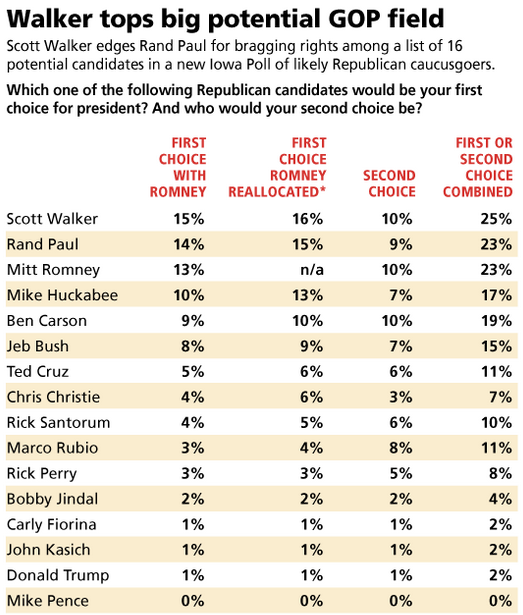
GOP primary Iowa poll from 2/1/15

A Des Moines Register poll from Iowa came out today, showing Scott Walker in the lead, and the lead increases if Romney is out.

Here are the details:

Presidential stage newcomer Scott Walker, the conservative reform pit bull who inspired death threats from the left, has become the one to watch in the race for the Republican nomination a year out from the Iowa caucuses.

At 15 percentage points, he leads a big, tightly packed field of potential contenders in a new Des Moines Register/Bloomberg Politics Iowa Poll of likely Republican caucusgoers. The caucuses are scheduled for Feb. 1, 2016.

The Wisconsin governor is also the No. 2 most popular choice for likely caucusgoers who want an establishment candidate, and he’s the No. 2 for those who want an anti-establishment candidate, the poll shows.

“He’s in a sweet spot,” pollster J. Ann Selzer said. “People who don’t want an ultra-conservative think he’s OK. People who don’t want a moderate think he’s OK.”

[…]The day after polling wrapped up, Romney announced he’s out of the competition. When the numbers in this poll are shuffled — by giving Romney’s votes to the contenders his supporters named as their second-choice pick — the five others in the top tier gain support.

[…]Walker’s support has jumped 11 points since the last Iowa Poll. In October, only 4 percent of likely caucusgoers named Walker as their first choice for president.

[…]At the same time, the favorability rating for Walker has climbed 11 percentage points; Carson, 9; Huckabee, 7; Cruz, 6; Santorum, 5; and Paul, 5, the new poll shows.

“The candidates perceived as more conservative are not only leading but are gaining,” GOP strategist Vin Weber, a former Minnesota congressman, noted after looking over the results.

Walker and Carson have the lowest “unfavorable” ratings:
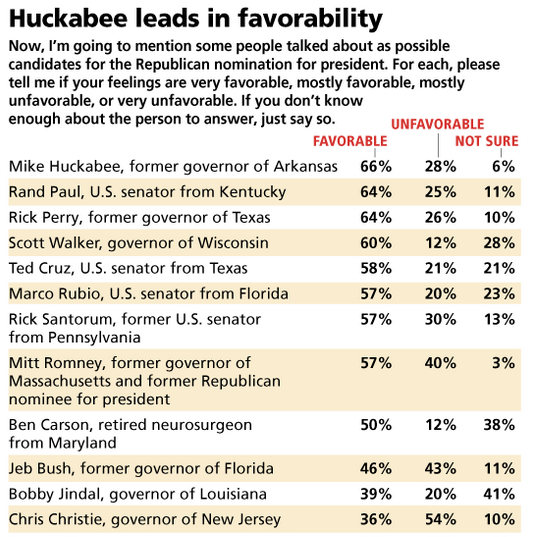
GOP primary Favorability

This is good news for Walker, but it’s disturbing to me that Huckabee (big government tax-and-spend moderate) and Paul (Peter Pan isolationist pot-legalizer) are that high up in the poll. Ben Carson is looking good, though. I like that the leftist establishment candidates (Bush, Christie and Romney) all had high unfavorable ratings. That’s a good sign.

Walker was on ABC’s This Week show:

Wisconsin Gov. Scott Walker (R) has not officially announced that he will run for president in 2016, but he is feeling very confident about his chances.

Martha Raddatz, host of ABC’s “This Week,” asked Walker on Sunday morning whether there is a 99 percent chance he’ll run.

“I don’t know that I’d take the odds,” Walker responded. “I’ll just tell you one thing. After three elections for governor in four years in a state that hasn’t gone Republican since 1984 for president, I wouldn’t bet against me on anything.”

A new Bloomberg/Des Moines Register poll shows Walker as the favorite among possible GOP presidential candidates. The governor was the first choice of 15 percent of respondents, just edging out Kentucky Sen. Rand Paul.

Walker said he believes he could defeat likely Democratic nominee Hillary Clinton because she represents an earlier era in Washington, D.C., politics for which most Americans are not nostalgic.

“People want new, fresh leadership with big, bold ideas, and the courage to act on it,” Walker said. “And if we’re going to take on a name from the past, which is likely to be former Secretary of State Hillary Clinton, I think for the party we need a name from the future.”

Looking good. Again, we have to have a candidate who is competent enough on fiscal issues, and has the results, if we hope to get around the media’s tendency to go after social conservatives. My list right now is this:

  1. Scott Walker
  2. Bobby Jindal
  3. Rick Perry
  4. Susan Martinez
  5. Ted Cruz

Pence is off my list after a couple of recent big government missteps (state media and Medicaid expansion).

Related posts

Republicans propose expansion of 529 college savings plans

I guess by now everyone has heard about Obama’s plan to eliminate college savings plans.

The left-leaning New York Times reported on it:

President Obama is proposing a radical change to the 529 college savings plans held by millions of families, which would require those who use them to rethink their approach to college savings.

As part of his plan to simplify the tax code and help the middle class, one of the 529 plan’s most attractive benefits would be eliminated: Money could no longer be withdrawn tax-free. (The new rules would apply only to new contributions.)

The accounts, many of which are run by the states, allow people to make contributions that grow tax-free. The money can be withdrawn without the paying of capital gains taxes as long as the proceeds are used for education expenses. Many states provide state income tax deductions for contributions as well.

The proposal has now been withdrawn after a huge uproar. The real question is, why would he propose such a stupid thing?

First, it’s important to understand that government raises the cost of higher education with subsidies, which the Democrats favor:

A new study by Dennis Epple, Richard Romano, Sinan Sarpca and Holger Sieg for the National Bureau of Economic Research suggests that the impact of these aid programs is clearly different from what federal policy makers intended. “We show that private colleges game the federal financial aid system,” they conclude. Every dollar in new financial aid to students leads to about 40 cents less spent by the colleges on institutional financial aid — so students benefit far less than federal policy makers intended.

In 1987, Secretary of Education William Bennett argued that more federal aid leads to higher tuitions, enabling schools to increase spending. This seems broadly consistent with the latest research results. The net attendance impact of these federal programs, according to the study for NBER, is “modest.” In short, these programs haven’t substantially spurred student access to colleges, all the while burdening taxpayers and student borrowers.

The ballooning federal aid increases schools’ spending. The researchers don’t analyze changes in university spending, but an examination of other evidence suggests that money isn’t going primarily into improving instruction. Colleges have gone on a building spree (financed in part by amassing large debt — more than $220 billion at schools whose bonds are rated by Moody’s alone), and pay and perquisites for top university administrators has risen sharply.

The Democrats already want higher education to be out of reach – that’s why they keep increasing subsidies. So, eliminating college savings plans is in line with this goal of putting higher education out of reach. It’s another way to cause people to have fewer children, something that Democrats are very passionate about. After all, if you can’t pay for higher education for four kids, you’ll only have two. Democrats have this terrible fear of over-population, and it drives a lot of their policies, including abortion.

But that’s not all – there’s another reason to stop people from saving for college.

Second, it stops people from saving their own money:

Megan McArdle suggests, quite reasonably, that this is a desperate move by those who need to finance ever bigger government and are simply going where the money is: the vast American middle class. You can understand why the champions of big government would be slavering over the very thing that defines the middle class, its savings. As she points out, 529s are not the first target. There have already been trial balloons about raiding 401(k)s and IRAs. The truly committed leftist looks upon our private savings as a vast reserve of capital unfairly withheld from its proper function of servicing the needs of the state.

I think that’s the real explanation. This is not so much a rational calculation about how to finance the behemoth state. This is an admission by a man who has no more election campaigns to run, and therefore no pragmatic constraints, about his real outlook and real preferences. A president who just a few weeks ago hailed the triumph of a supposed “middle-class economics” is revealing his hatred and contempt for the middle class.

Republicans would like to see people saving more and more money so that they are less and less dependent on the government. This is because the more independent you are, the more fre you are – and Republicans are for personal liberty.

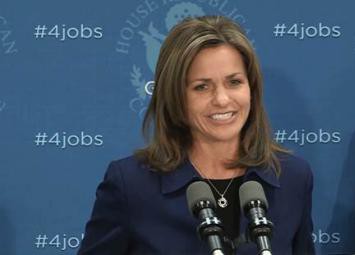
This is GOP Congressman Lynn Jenkins:

Kansas Congresswoman Lynn Jenkins

Here is her Republican response to Obama’s proposal to eliminate 529s:

Good morning. I’m Lynn Jenkins, Congresswoman from the Second District of Kansas and Vice-Chair of the House Republican Conference.

This is the time of year when high school seniors are putting the final touches on their college applications. That means it’s also the time when families are preparing to start paying for that education — whether it’s a 4-year college, community college, or a technical school. (Scroll down for video of these remarks.)

As a parent with two children in college, I know this can be one of the most rewarding, and at the same time challenging, aspects of being a parent — particularly at a time when costs are going up while wages stay about the same. All told, Americans now owe more than $1 trillion in student loan debt.

And so in the new Congress, Republicans are working to lower costs for middle-class families and empower folks with bottom-up solutions that help prepare you for the future.

That’s why, this week, I introduced a bipartisan plan to expand popular 529 college savings accounts.

As you know, these 529 plans were created to help middle-class families save and plan for college. Many parents open them not long after their children are born. And ever since Congress allowed folks to withdraw from these accounts tax-free for college expenses, 1 million account holders have turned into 12 million.

Unfortunately, instead of expanding 529s, the president recently proposed raising taxes on college savings. If implemented his scheme would have turned back the clock on middle-class families, and taken money from your savings to pay for more government. This would have discouraged families from using 529s, meaning less savings, more debt, and more government dependence.

This proposal increases middle-class independence from the government, and makes people more free to work, earn, save and chart their own course. It’s different from the Democrat proposals which increase dependence on government and reduces liberty.

Atheist Christopher Hitchens’ case against the existence of God

I thought that I would go over an opening statement from a previous debate featuring Christopher Hitchens to find out what atheists are like in debates. I used his opening speech from his debate with Frank Turek. The audio from that debate is here, at Brian Auten’s Apologetics 315 site.

Now the important thing to remember about a generic debate on whether GOD EXISTS is that there should be no mention of any particular God, such as the Christian God, and no mention of the history of any particular religion. All arguments that assume specific theological or moral doctrines or specific religious history are irrelevant to a debate on generic theism.

The question being debated is: does a God who created and designed the universe, who has all the traditional properties of God, such as omniscience, omnipotence, omni-benevolence, etc. exist? That is the question being debated in a “Does God Exist?” debate.

Frank Turek’s case for theism:

Frank Turek made 4 relevant arguments for theism, each of which alone would support his conclusion, that God exists:

  • the origin of time, space, matter and energy out of nothing
  • the fine-tuning of the physical constants to support the minimum requirements for life of any kind
  • the origin of the biological information in the first self-replicating organism
  • objective, prescriptive moral rules need to be grounded by the designer of the universe

And he also listed 4 features of the universe that are more consistent with theism than atheism (= materialism).

  • non-material minds that allow rationality that would be impossible on materialism/determinism
  • the mathematical structure of the universe and its intelligibility to the scientific method
  • free will, which is required for moral responsibility and moral choices, requires a non-material mind/soul
  • our first person experience of consciousness is best explained by a non-material mind/soul

Hitchens’ case against theism

To counter, Hitchens has to argue against God using arguments in one of two forms:

  1. The concept of God is logically self-contradictory
  2. An objective feature of the world is inconsistent with the attributes of God

The claim that God does not exist is a claim to know something about God, namely, that he does not exist. This claim requires the speaker to bear a burden of proof. In a debate on “Does God Exist?”, Hitchens must deny that God exists. Let me be clear: Hitchens must defeat the arguments for the claim that God exists, and then defend the claim that God does not exist, and support that claim using arguments and evidence.

Hitchens makes 2 basic claims:

  • There are no good reasons to believe that theism is true
  • There are good reasons to believe atheism is true

So far so good. But what are his good reasons for atheism?

  1. I personally don’t like Christianity, therefore God doesn’t exist
    – Premise: I personally don’t like Catholicism getting rid of limbo
    – Premise: I personally don’t like Hell
    – Premise: I personally don’t like some episodes in church history
    – Conclusion: God doesn’t exist
  2. The plurality of religions means that no religious claims can be correct, therefore God doesn’t exist
    – Premise: There are lots of religions
    – Premise: The religions all disagree in their truth claims about the external world
    – Conclusion: No religion’s claims can be correct, therefore God doesn’t exist
  3. I believe in one less God than you, therefore God doesn’t exist
    – Premise: You disbelieve in every God I do, except one
    – Conclusion: God doesn’t exist
  4. Religious people are stupid and evil, therefore God doesn’t exist
    – Premise: Religious people are ignorant
    – Premise: Religious people are fearful
    – Premise: Religious people are servile
    – Premise: Religious people are masochistic
    – Conclusion: God doesn’t exist
  5. Evolution explains how life progressed from single cell to today’s bio-diversity, therefore God doesn’t exist
    – Premise: Modern theists like Turek believe in Paley’s argument, and argued it in this debate
    – Premise: Paley’s argument was refuted by evolution
    – Conclusion: God doesn’t exist
  6. God wouldn’t have made the universe this way, therefore God doesn’t exist
    – Premise: If God exists, then he would have made the universe my way
    – Premise: The heat death of the universe wasn’t done my way
    – Premise: The extinction of species wasn’t done my way
    – Premise: The size of the universe wasn’t done my way
    – Premise: The amount of open space wasn’t done my way
    – Premise: The large number of stars wasn’t done my way
    – Premise: The age of the universe wasn’t done my way
    – Conclusion: God doesn’t exist
  7. Religion makes people do things that I don’t like, therefore God doesn’t exist
    – Premise: Some religions do suicide bombing
    – Premise: Some religions do child abuse
    – Premise: Some religions do genital mutilation
    – Conclusion: God doesn’t exist
  8. If you speak a sentence, I can repeat the same words as you said, therefore God doesn’t exist
    – Premise: Anything that you say is good, I can say is good too
    – Premise: Anything that you say is bad, I can say is bad too
    – Conclusion: God doesn’t exist
  9. Atheists are morally superior to religious people, therefore God doesn’t exist
    – Premise: I act in a way that is consistent with my personal, arbitrary moral preferences
    – Premise: You don’t act in a way that is consistent with my personal, arbitrary moral preferences
    – Conclusion: God doesn’t exist
  10. If I believe in God, I would have to submit to an authority
    – Premise: If I believe in God, then I can’t do whatever I want
    – Premise: But I want to do whatever I want
    – Conclusion: God doesn’t exist
  11. I don’t like certain Christian doctrines, therefore arguments for God from science fail and therefore God doesn’t exist
    – Premise: I don’t like the atonement
    – Premise: I don’t like the virgin birth
    – Premise: I don’t like the incarnation
    – Premise: I don’t like original sin
    – Premise: I don’t like the resurrection
    – Conclusion: Arguments that are built on recent discoveries from the progress of science like the big bang, fine-tuning, origin of life, etc. are incorrect, and therefore God doesn’t exist

General comments about Hitchens’ case:

  • The form of all of these arguments is logically invalid. The conclusions do not follow from the premises using the laws of logic, such as modus ponens and modus tollens.
  • Hitchens cannot complain about morality because he has no foundation for objective moral facts. What he is really expressing is that he personally does not like such-and-such a state of affairs, based on his own arbitrary personal preferences, and the arbitrary social customs that evolved in the place and time that he finds himself in. On atheism, “morality” is just describing what people do – either individually or as groups living in different times and places. There is no objective right and wrong, and no objective way we ought to be. All statements are subjective. They describe what the speaker personally likes and dislikes. Just like taste in foods or taste in dress – which varies by individually, and is influenced by time and place ARBITRARILY.

Specific comments about each argument:

  • Argument 1 tries to disprove God by arguing from Hitchens’ personal preferences about specific Christian doctrines. Christian doctrines are irrelevant to a debate about generic theism. And there is no reason why God should be bound by the personal, subjective preferences of one man. In fact, the concept of God entails that his unchanging nature is the standard of good and evil. So, this argument doesn’t disprove God, it’s just a statement of personal, subjective preference.
  • Argument 2: Just because there are different truth claims made by different groups, doesn’t mean no one is correct. Mormons believe that matter existed eternally, and Jews believe it was created out of nothing. The big bang theory shows that the Mormons are wrong and the Jews are right.
  • Argument 3: First of all, the debate is a about a generic Creator and Designer, not any particular religious conception of God. So the argument is irrelevant. Moreover, Christians reject Zeus, for example, because Zeus is supposed to exist in time and space, and therefore could not be the cause of the beginning of time and space.
  • Argument 4: This is just the ad hominem fallacy. Hitchens is attacking the character of the theist, but that doesn’t show theism is false.
  • Argument 5: This argument can be granted for the sake of argument, even though it’s debatable. The point is that it is irrelevant, since it doesn’t refute any of Turek’s actual scientific arguments like the big bang, the fine-tuning of the physical constants, the origin of information in the simplest living cell.
  • Argument 6: Again, there is no reason to think that God should be bound by Hitchens’ personal opinion of how God should operate.
  • Argument 7: This is the ad hominem fallacy again. The good behavior of religious believers is not a premise in any of Turek’s FOUR arguments for theism. Therefore, Hitchens’ point is irrelevant to the debate.
  • Argument 8: The fact that the atheist can parrot moral claims is not the issue. Being able to speak English words is not what grounds objective, prescriptive morality. The issue is the ontology of moral rules, the requirement of free will in order to have moral responsibility and moral choices, ultimate significance of moral actions, and the rationality of self-sacrificial moral actions.
  • Argument 9: This is just the ad hominem fallacy again.
  • Argument 10: This is not argument so much as it reveals that the real reason Hitchens is an atheist is emotional. One might even say infantile.
  • Argument 11: Again, these specific Christian doctrines are irrelevant to a debate about generic theism. And Hitchen’s subjective, personal preferences about Christian doctrine certainly do not undermine the objective scientific support for the premises in Turek’s 3 scientific arguments.

So Frank Turek talked about facts in the external world, and Christopher Hitchens mistakenly thought that his opinions and preferences about what he would do if he were God were interesting to us. They might be interesting to his psychiatrist, but they are not interesting to us.