Atheist struggles with the problem of rationally grounding moral values and duties

Which worldview rationally grounds morality?

An atheist named John Gray wrote a piece in the radically leftist UK Guardian that’s been getting a lot of attention from Christians.

Here’s Gray:

Awkwardly for these atheists, Nietzsche understood that modern liberalism was a secular incarnation of these religious traditions. [. . .]  Nietzsche was clear that the chief sources of liberalism were in Jewish and Christian theism: that is why he was so bitterly hostile to these religions. He was an atheist in large part because he rejected liberal values. To be sure, evangelical unbelievers adamantly deny that liberalism needs any support from theism. If they are philosophers, they will wheel out their rusty intellectual equipment and assert that those who think liberalism relies on ideas and beliefs inherited from religion are guilty of a genetic fallacy. Canonical liberal thinkers such as John Locke and Immanuel Kant may have been steeped in theism; but ideas are not falsified because they originate in errors. The far-reaching claims these thinkers have made for liberal values can be detached from their theistic beginnings; a liberal morality that applies to all human beings can be formulated without any mention of religion. Or so we are continually being told. The trouble is that it’s hard to make any sense of the idea of a universal morality without invoking an understanding of what it is to be human that has been borrowed from theism.

Here’s Maverick Philosopher to explain why the atheist has this intuition:

Consider equality.  As a matter of empirical fact, we are not equal, not physically, mentally, morally, spiritually, socially, politically, economically.  By no empirical measure are people equal.  We are naturally unequal.  And yet we are supposedly equal as persons.  This equality as persons we take as requiring equality of treatment.  Kant, for example, insists that every human being, and indeed very rational being human or not, exists as an end in himself and therefore must never be treated as a means to an end.  A person is not a thing in nature to be used as we see fit.  For this reason, slavery is a grave moral evil.  A person is a rational being and must be accorded respect just in virtue of being a person.  And this regardless of inevitable empirical differences among persons.   Thus in his third formulation of the Categorical Imperative in his 1785 Foundations of the Metaphysics of Morals, Kant writes:

Act so that you treat humanity, whether in your own person or in that of another, always as an end and never as a means only.  (Grundlegung 429)

In connection with this supreme practical injunction, Kant distinguishes between price and dignity. (435)  “Whatever has a price can be replaced by something else as its equivalent; on the other hand, whatever is above all price, and therefore admits of no equivalent, has dignity.”  Dignity is intrinsic moral worth.  Each rational being, each person, is thus irreplaceably and intrinsically valuable with a value that is both infinite — in that no price can be placed upon it — and the same for all. The irreplaceability of persons is a very rich theme, one we must return to in subsequent posts.

These are beautiful and lofty thoughts, no doubt, and most of us in the West (and not just in the West) accept them in some more or less confused form.  But what do these pieties have to do with reality?  Especially if reality is exhausted by space-time-matter?

Again, we are not equal by any empirical measure.  We are not equal as animals or even as rational animals. (Rationality might just be an evolutionary adaptation.)  We are supposedly equal as persons, as subjects of experience, as free agents.  But what could a person be if not just a living human animal (or a living ‘Martian’ animal).  And given how bloody many of these human animals there are, why should they be regarded as infinitely precious?  Are they not just highly complex physical systems?  Surely you won’t say that complexity confers value, let alone infinite value.  Why should the more complex be more valuable than the less complex?  And surely you are not a species-chauvinist who believes that h. sapiens is the crown of ‘creation’ because we happen to be these critters.

If we are unequal as animals and equal as persons, then a person is not an animal.  What then is a person?  And what makes them equal in dignity and equal in rights and infinite in worth?

When it comes to discussing morality, we aren’t interested in what people can do if they feel like it. We are not interested in feelings at all. We are interested in whether a worldview provides a rational grounding for the moral value of human beings, and the moral duties we have towards other human beings.

In the past, I’ve written that morality can only be rationally grounded by a worldview that includes the following 5 concepts:

1) Objective moral values

There needs to be a way to distinguish what is good from what is bad. For example, the moral standard might specify that being kind to children is good, but torturing them for fun is bad. If the standard is purely subjective, then people could believe anything and each person would be justified in doing right in their own eyes. Even a “social contract” is just based on people’s opinions. So we need a standard that applies regardless of what people’s individual and collective opinions are.

2) Objective moral duties

Moral duties (moral obligations) refer to the actions that are obligatory based on the moral values defined in 1). Suppose we spot you 1) as an atheist. Why are you obligated to do the good thing, rather than the bad thing? To whom is this obligation owed? Why is rational for you to limit your actions based upon this obligation when it is against your self-interest? Why let other people’s expectations decide what is good for you, especially if you can avoid the consequences of their disapproval?

3) Moral accountability

Suppose we spot you 1) and 2) as an atheist. What difference does it make to you if you just go ahead and disregard your moral obligations to whomever? Is there any reward or punishment for your choice to do right or do wrong? What’s in it for you?

4) Free will

In order for agents to make free moral choices, they must be able to act or abstain from acting by exercising their free will. If there is no free will, then moral choices are impossible. If there are no moral choices, then no one can be held responsible for anything they do. If there is no moral responsibility, then there can be no praise and blame. But then it becomes impossible to praise any action as good or evil.

5) Ultimate significance

Finally, beyond the concept of reward and punishment in 3), we can also ask the question “what does it matter?”. Suppose you do live a good life and you get a reward: 1000 chocolate sundaes. And when you’ve finished eating them, you die for real and that’s the end. In other words, the reward is satisfying, but not really meaningful, ultimately. It’s hard to see how moral actions can be meaningful, ultimately, unless their consequences last on into the future.

Atheism can ground none of these. Christian theism grounds all five of them.

And it’s because of this fact that people look on atheism as a flight from morality, rather than a serious grappling with the moral life. When Christian theists hear about stories like Dr. Richard Carrier announcing that he’s been cheating on his wife, who supported his atheistic ministry for years while he did essentially nothing productive, we are not surprised. He’s only following the advice of Dr. Richard Dawkins, who is a big advocate for adultery. And then there is atheist apologist John Loftus – adultery is what got him started in atheism.

Self-sacrificial, incumbent morality makes as much sense on atheism as astrophysics makes to fishes. It’s a complete reduction of the question “what ought I to do in order to be good?” to “what pleasurable things can I get away with doing in this time and place?” Anything. Goes.
Media silent on DOJ report that refutes their “hands up, don’t shoot” myth

CNN reporters spread lies about Ferguson
CNN clowns lie about Ferguson “hands up, don’t shoot”

Yesterday, I reported on how the Department of Justice had found officer Darren Wilson innocent, and asserted that the mainstream media that spread lies about him would not correct their lies.

Newsbusters reported on how the mainstream media reported on the DOJ report.

Excerpt:

“Hands Up, Don’t Shoot” has been the rallying cry of Ferguson protesters since officer Darren Wilson fatally shot Michael Brown on a Missouri street last August. Brown, the “gentle giant,” was shot while trying to surrender or de-escalate his encounter with Wilson. It was an article of faith on the left, and the three networks used the phrase 140 times in their coverage of Ferguson.

Now, the DOJ report and Attorney General Eric Holder have admitted that the catch phrase was based on false witness accounts. None of the networks apologized or admitted their own reporting spread that false narrative. Instead, they focused on DOJ’s assertions of racism in the Ferguson police department. 

In a press conference yesterday, AG Holder admitted that a false account of events had mysteriously gained popularity with the public, but he wouldn’t admit the media had some small part in this. “I recognize that the findings in our report may leave some to wonder how the department’s findings can differ so sharply from some of the initial, widely reported accounts of what transpired,” he said, “It remains not only valid – but essential – to question how such a strong alternative version of events was able to take hold so swiftly, and be accepted so readily.” 

Er, it might have something to do with people in the media and government (Holder very much included) being all too eager to believe, or at least cynically parrot that “alternative version.” For example, the “Hands Up, Don’t Shoot” phrase was mentioned 34 times by NBC, 51 by ABC and 55 by CBS from August 9, 2014 to March 3, 2015.

But only the CBS Evening News, which gave 42 seconds to clearing Wilson, noted that there was “no credible evidence Brown had his hands up attempting to surrender.”

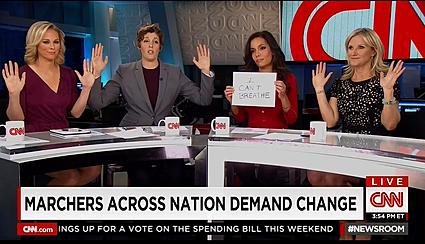
[…]It’s not just the broadcast news that was complicit in spreading false information and adding fuel to the fire in the Ferguson case. Shockingly, a CNN panel even participated in siding with the protesters by hosting their own, “Hands Up” protest after the grand jury found Wilson not guilty of any criminal charges in December.

You can see the CNN panel raising their hands in order to spread the “hands up, don’t shoot” lie in the photo above.

Is media bias real?

From the Washington Examiner, a study of the political contributions made by the mainstream media.

Excerpt:

Senior executives, on-air personalities, producers, reporters, editors, writers and other self-identifying employees of ABC, CBS and NBC contributed more than $1 million to Democratic candidates and campaign committees in 2008, according to an analysis by The Examiner of data compiled by the Center for Responsive Politics.

The Democratic total of $1,020,816 was given by 1,160 employees of the three major broadcast television networks, with an average contribution of $880.

By contrast, only 193 of the employees contributed to Republican candidates and campaign committees, for a total of $142,863. The average Republican contribution was $744.

[…]The data on contributions by broadcast network employees was compiled by CRP at the request of The Examiner and included all 2008 contributions by individuals who identified their employer as one of the three networks or subsidiaries. The data does not include contributions by employees of the three networks who did not identify their employer.

The CRP is the organization behind OpenSecrets.org, the web site that for more than a decade has put campaign finance data within reach of anybody with an Internet connection.

President Obama received 710 such contributions worth a total of $461,898, for an average contribution of $651 from the network employees. Republican presidential nominee Sen. John McCain received only 39 contributions totaling $26,926, for an average donation of $709.

And more from a study done by the radically leftist MSNBC.

Excerpt:

MSNBC.com identified 143 journalists who made political contributions from 2004 through the start of the 2008 campaign, according to the public records of the Federal Election Commission. Most of the newsroom checkbooks leaned to the left: 125 journalists gave to Democrats and liberal causes. Only 16 gave to Republicans. Two gave to both parties.

The donors include CNN’s Guy Raz, now covering the Pentagon for NPR, who gave to Kerry the same month he was embedded with U.S. troops in Iraq; New Yorker war correspondent George Packer; a producer for Bill O’Reilly at Fox; MSNBC TV host Joe Scarborough; political writers at Vanity Fair; the editor of The Wall Street Journal’s weekend edition; local TV anchors in Washington, Minneapolis, Memphis and Wichita; the ethics columnist at The New York Times; and even MTV’s former presidential campaign correspondent.

I think that we need to be really careful when we watch the mainstream media news channels. It’s not good to willingly subject ourselves to lies that we find comfortable – that fit within our already-established prejudices. As you can see from the handling of the DOJ report on Ferguson, we should be skeptical of what we hear from the news media.

What do ancient non-Christian sources tell us about the historical Jesus?

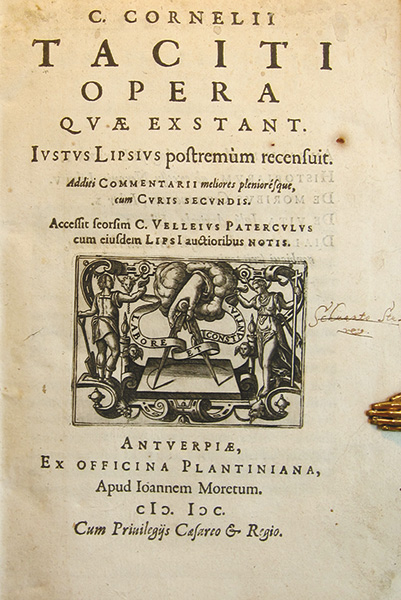
The Annals, by Roman historian Tacitus

This article from Biblical Archaeology covers all the non-Christian historical sources that discuss Jesus.

About the author:

Lawrence Mykytiuk is associate professor of library science and the history librarian at Purdue University. He holds a Ph.D. in Hebrew and Semitic Studies and is the author of the book Identifying Biblical Persons in Northwest Semitic Inscriptions of 1200–539 B.C.E. (Atlanta: Society of Biblical Literature, 2004).

Here are the major sections:

  • Roman historian Tacitus
  • Jewish historian Josephus
  • Greek satirist Lucian of Samosata
  • Platonist philosopher Celsus
  • Roman governor Pliny the Younger
  • Roman historian Suetonius
  • Roman prisoner Mara bar Serapion

And this useful excerpt captures the broad facts about Jesus that we get from just the first two sources:

We can learn quite a bit about Jesus from Tacitus and Josephus, two famous historians who were not Christian. Almost all the following statements about Jesus, which are asserted in the New Testament, are corroborated or confirmed by the relevant passages in Tacitus and Josephus. These independent historical sources—one a non-Christian Roman and the other Jewish—confirm what we are told in the Gospels:31

1. He existed as a man. The historian Josephus grew up in a priestly family in first-century Palestine and wrote only decades after Jesus’ death. Jesus’ known associates, such as Jesus’ brother James, were his contemporaries. The historical and cultural context was second nature to Josephus. “If any Jewish writer were ever in a position to know about the non-existence of Jesus, it would have been Josephus. His implicit affirmation of the existence of Jesus has been, and still is, the most significant obstacle for those who argue that the extra-Biblical evidence is not probative on this point,” Robert Van Voorst observes.32 And Tacitus was careful enough not to report real executions of nonexistent people.

2. His personal name was Jesus, as Josephus informs us.

3. He was called Christos in Greek, which is a translation of the Hebrew word Messiah, both of which mean “anointed” or “(the) anointed one,” as Josephus states and Tacitus implies, unaware, by reporting, as Romans thought, that his name was Christus.

4. He had a brother named James (Jacob), as Josephus reports.

5. He won over both Jews and “Greeks” (i.e., Gentiles of Hellenistic culture), according to Josephus, although it is anachronistic to say that they were “many” at the end of his life. Large growth
in the number of Jesus’ actual followers came only after his death.

6. Jewish leaders of the day expressed unfavorable opinions about him, at least according to some versions of the Testimonium Flavianum.

7. Pilate rendered the decision that he should be executed, as both Tacitus and Josephus state.

8. His execution was specifically by crucifixion, according to Josephus.

9. He was executed during Pontius Pilate’s governorship over Judea (26–36 C.E.), as Josephus implies and Tacitus states, adding that it was during Tiberius’s reign.

Some of Jesus’ followers did not abandon their personal loyalty to him even after his crucifixion but submitted to his teaching. They believed that Jesus later appeared to them alive in accordance with prophecies, most likely those found in the Hebrew Bible. A well-attested link between Jesus and Christians is that Christ, as a term used to identify Jesus, became the basis of the term used to identify his followers: Christians. The Christian movement began in Judea, according to Tacitus. Josephus observes that it continued during the first century. Tacitus deplores the fact that during the second century it had spread as far as Rome.

I remember reading the 1996 book by Gary Habermas entitled “The Historical Jesus: Ancient Evidence for the Life of Christ“. This book is a little before the time of most of you young Christian apologists, but back before the time of Lee Strobel and J. Warner Wallace, this is the stuff we all read. Anyway, in the book he makes a list of all that can be known about Jesus from external sources. And fortunately for you, you don’t have to buy the book because you can read chapter 9 of it right on his web site.

From Tacitus he gets this:

From this report we can learn several facts, both explicit and implicit, concerning Christ and the Christians who lived in Rome in the 60s A.D. Chronologically, we may ascertain the following information.

(1) Christians were named for their founder, Christus (from the Latin), (2) who was put to death by the Roman procurator Pontius Pilatus (also Latin), (3) during the reign of emperor Tiberius (14 37 A.D.). (4) His death ended the “superstition” for a short time, (5) but it broke out again, (6) especially in Judaea, where the teaching had its origin.

(7) His followers carried his doctrine to Rome. (8) When the great fire destroyed a large part of the city during the reign of Nero (54 68 A.D.), the emperor placed the blame on the Christians who lived in Rome. (9) Tacitus reports that this group was hated for their abominations. (10) These Christians were arrested after pleading guilty, (11) and many were convicted for “hatred for mankind.” (12) They were mocked and (13) then tortured, including being “nailed to crosses” or burnt to death. (14) Because of these actions, the people had compassion on the Christians. (15) Tacitus therefore concluded that such punishments were not for the public good but were simply “to glut one man’s cruelty.”

And from Josephus he gets this:

(1) Jesus was known as a wise and virtuous man, one recognized for his good conduct. (2) He had many disciples, both Jews and Gentiles. (3) Pilate condemned him to die, (4) with crucifixion explicitly being mentioned as the mode. (5) The disciples reported that Jesus had risen from the dead and (6) that he had appeared to them on the third day after his crucifixion. (7) Consequently, the disciples continued to proclaim his teachings. (8) Perhaps Jesus was the Messiah concerning whom the Old Testament prophets spoke and predicted wonders. We would add here two facts from Josephus’ earlier quotation as well. (9) Jesus was the brother of James and (10) was called the messiah by some.

So when you are reading the New Testament, these facts are the framework that you read within. It’s a good starting point when dealing with people who have never looked into who Jesus was and what he taught and what his followers believed about him, right from the start.