
Obama told us that Yemen was a success of his foreign policy

The Wall Street Journal reports:

The Obama administration’s calculated gamble during the past three years in Yemen has crumbled in recent days, leaving the country on the brink of a civil war with U.S. troops involved in counterterror operations withdrawing amid intense fighting.

What happened in Yemen, according to descriptions by current and former officials and experts, was a miscalculation about the changes unleashed by the Arab Spring revolutions. It involved an overreliance by Washington on a promising new leader who ultimately was unable to hold off rival forces and tensions, they said.

As a result, a country President Barack Obama last year cited as a model of American counterterrorism success has now descended into chaos, with U.S. influence and drone strikes no match for at least four sides at war with one another.

“In many ways, this is all the Thanksgiving Dinner from hell,” said Jon Alterman, a former State Department official and director of the Middle East program at the Center for Strategic and International Studies. “It is people who have been dealing with each other for a long time, none are satisfied, and the fight has broken out. And the first thing is figuring out who the different sides are.”

The U.S. and allies such as Yemen’s neighbor Saudi Arabia had tried to take advantage of the Arab Spring revolution in Yemen in 2011. They supported a new, friendly regime led by President Abed Rabbo Mansour Hadi.

The White House hailed Mr. Hadi’s leadership and—with his cooperation—carried out dozens of drone strikes against the country’s al Qaeda offshoot. Meanwhile, they collected intelligence and training Yemeni forces to battle the terrorist group al Qaeda in the Arabian Peninsula, or AQAP.

But the Obama administration limited its involvement with others in Yemen, and was largely removed from numerous tribal leaders and the rising rebel group known as the Houthis, according to former U.S. officials and foreign policy experts. The success of the White House’s involvement with Yemen relied largely on Mr. Hadi staying in power, they said, adding that the White House had few alternatives. That is why the U.S. approach was upended last month when Shiite-linked Houthi rebels, believed to be backed by Iran, seized control of Yemen’s capital and forced Mr. Hadi to flee. Forces loyal to Mr. Hadi are now warring against the Houthis, and U.S. officials believe, against his predecessor, Ali Abdullah Saleh.

The Yemeni president has asked Gulf countries to intervene militarily against the Houthis as they advance toward his base in the southern city of Aden, according to Saudi media reports quoting Mr. Hadi’s foreign minister. Over the past few days, the Houthis have been advancing southward into the major southern city of Taiz, where they have encountered resistance and large street protests against them. Houthi gunmen fired live ammunition and tear gas on Monday into crowds of demonstrators in the city, wounding at least seven people. Meanwhile, militants claiming allegiance to Islamic State carried out dramatic suicide attacks in an area that had traditionally been the safe haven for rival AQAP, which some believe could trigger competitive jihadist attacks.

The Houthis had already taken over the airport and some government buildings in Taiz and erected checkpoints in the southern city when the violence flared, said local government officials and protest organizers, who reported the casualties.

[…]Before political chaos erupted earlier this year, the U.S. had everything invested in Mr. Hadi. Central Intelligence Agency Director John Brennan was a key liaison to the country when he served as a top White House counterterrorism aide in the first years of the Obama administration. His replacement, Lisa Monaco, had kept in constant contact with Mr. Hadi since then.

In September, President Obama hailed Yemen as a success story in its counterterrorism approach, saying the country’s aggressive pursuit of terrorists would prevent the spread of Islamic State.

Look at the stupidity of Samantha Power:

Samantha Power, the U.S. ambassador to the United Nations, said Sunday that all parties in Yemen should agree to U.N.-backed negotiations and “refrain from any further unilateral and offensive military actions.”

“We are supporting all the right [United Nations] resolutions, but most of the people in Yemen could care a flying fig for a U.N. resolution,” said Barbara Bodine, who was U.S. Ambassador to Yemen at the time of the USS Cole attack.

The Obama administration simply cannot take evil seriously – they keep thinking that everyone in the world is like them, and it’s killing our foreign policy. Obama keeps making promises that him and his party of amateurs and academics cannot keep.
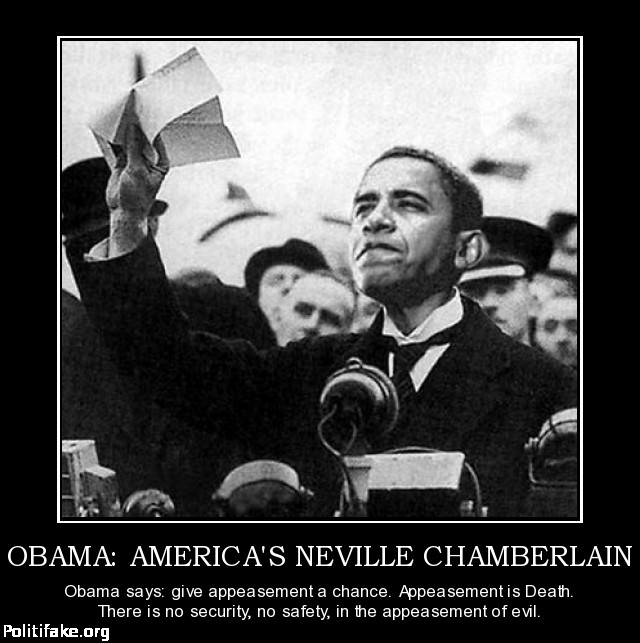
Neville Chamberlain Obama: peace in our time

If you like your doctor, you can keep your doctor. If you like your health plan, you can keep your health plan. If you like your IRS e-mails, you can keep your IRS e-mails. If you like your Tea Party charitable status, you can keep your Tea Party charitable status. If you like your Ukraine, you can keep your Ukraine. If you like your traditional marriage, you can keep your traditional marriage. If you like your State Department transparency, you can keep your State Department transparency. If you like your European missile defense, you can keep your European missile defense. If you like your 12 carrier strike groups, you can keep your 12 carrier strike groups. If you like your full-time work week, you can keep your full-time work week. If you like your health care for veterans, you can keep your health care for veterans. If you like your $8 trillion dollar debt,  you can keep your $8 trillion dollar debt. If you like your coal plant, you can keep your coal plant. If you like your race relations, you can keep your race relations. If you like your freedom to not buy others abortion drugs, you can keep your freedom to not buy others abortion drugs. If you like your F-22 stealth fighter, you can keep your F-22 stealth fighter. If you like your Israel, you can keep your Israel.

We can fix the spending, we can fix the laws, we can fix the fraud, we can fix the corruption, we can repeal Obamacare… but the foreign policy blunders will be very, very hard to fix.


Has the Creator of the universe ever spoken to us?

Has God every reached out to humanity?

People often ask the question, “why must I believe in Jesus and only Jesus in order to be rightly related to God?”

Indeed. Why should we care about the teachings of Jesus more than any other religious leader. Well, we know from scientific evidence that the universe had a beginning, and hence a Creator. We know from the fine-tuning argument that there is a Designer of the cosmos, as well. So the question becomes, has there ever been a human being who could give us accurate information about who the Creator and Designer is?

It turns that there is such a person, and we know it because we have evidence that this person rose from the dead – a feat only possible if the Creator and Designer wanted to draw attention to this person, and to his teachings. The account of this is recorded in a collection of ancient writings called the New Testament, which can be investigated using the ordinary rules of ancient historiography. Although much of what is written in the New Testament cannot be proven historical, a few facts that are reported there pass the mainstream historical tests. From those facts, we can infer that God was putting his stamp of approval on the teachings of a very important person.

The man who returned from the dead

Dr. Craig’s famous minimal facts case for the resurrection has been posted at the Christian Apologetics Alliance. He presents 4 facts admitted by the majority of New Testament historians, and then he supplies multiple pieces of evidence for each fact.

Here are the four facts:

  • FACT #1: After his crucifixion, Jesus was buried in a tomb by Joseph of Arimathea. 
  • FACT #2: On the Sunday following the crucifixion, Jesus’ tomb was found empty by a group of his women followers.
  • FACT #3: On multiple occasions and under various circumstances, different individuals and groups of people experienced appearances of Jesus alive from the dead.
  • FACT #4: The original disciples believed that Jesus was risen from the dead despite their having every predisposition to the contrary.

He shows how each fact is supported reasons which pass the standard historical rules used by ancient historians.

Here’s the detail on fact #3, the post-mortem appearances.

FACT #3: On multiple occasions and under various circumstances, different individuals and groups of people experienced appearances of Jesus alive from the dead.

This is a fact which is almost universally acknowledged among New Testament scholars, for the following reasons:

1. The list of eyewitnesses to Jesus’ resurrection appearances which is quoted by Paul in I Cor. 15. 5-7 guarantees that such appearances occurred. These included appearances to Peter (Cephas), the Twelve, the 500 brethren, and James.

2. The appearance traditions in the gospels provide multiple, independent attestation of these appearances. This is one of the most important marks of historicity. The appearance to Peter is independently attested by Luke, and the appearance to the Twelve by Luke and John. We also have independent witness to Galilean appearances in Mark, Matthew, and John, as well as to the women in Matthew and John.

3. Certain appearances have earmarks of historicity. For example, we have good evidence from the gospels that neither James nor any of Jesus’ younger brothers believed in him during his lifetime. There is no reason to think that the early church would generate fictitious stories concerning the unbelief of Jesus’ family had they been faithful followers all along. But it is indisputable that James and his brothers did become active Christian believers following Jesus’ death. James was considered an apostle and eventually rose to the position of leadership of the Jerusalem church. According to the first century Jewish historian Josephus, James was martyred for his faith in Christ in the late AD 60s. Now most of us have brothers. What would it take to convince you that your brother is the Lord, such that you would be ready to die for that belief? Can there be any doubt that this remarkable transformation in Jesus’ younger brother took place because, in Paul’s words, “then he appeared to James”?

Even Gert Ludemann, the leading German critic of the resurrection, himself admits, “It may be taken as historically certain that Peter and the disciples had experiences after Jesus’ death in which Jesus appeared to them as the risen Christ.”3

Yes, Gerd Ludemann is actually an atheist new Testament historian, and he has even debated Dr. Craig on the resurrection – not once, but twice. That’s the kind of evidence Dr. Craig uses in his case.

So, if you are undertaking an investigation to see if the God who creates and designs the universe has anything to say to you, a good place to start is seeing what this guy Jesus had to say to you. No faith required.

New study: what you study in college matters more than where you go to college

What you study matters more
What you study matters more (click for larger image)

This study was reported by the leftist The Economist.

They write:

A new report from PayScale, a research firm, calculates the returns to a college degree. Its authors compare the career earnings of graduates with the present-day cost of a degree at their alma maters, net of financial aid. College is usually worth it, but not always, it transpires. And what you study matters far more than where you study it.

Engineers and computer scientists do best, earning an impressive 20-year annualised return of 12% on their college fees (the S&P 500 yielded just 7.8%). Engineering graduates from run-of-the-mill colleges do only slightly worse than those from highly selective ones. Business and economics degrees also pay well, delivering a solid 8.7% average return. Courses in the arts or the humanities offer vast spiritual rewards, of course, but less impressive material ones. Some yield negative returns. An arts degree from the Maryland Institute College of Art had a hefty 20-year net negative return of $92,000, for example.

I think if you are looking for a great way to be out of debt before you are 30, it’s a great idea to do your first few years at community college, get rid of all your generic prerequisite courses, then move on to college/university to do your computer science/engineering courses, and then graduate.

Here is the nightmare scenario: you go study a non-stem major at an expensive university, come out with a ton of debt and NO JOB in your field. A much better solution is to go to a less-expensive, less-presitigious school that has a good STEM program in the area you want, and then get in and get out as quickly as possible. Make sure that you either do internships or work in the summer in your field. At this point, you should be willing to pay your employer for letting you work for them, or volunteer – you want to get a company name on your resume, and a name added to your references before you graduate and start looking for a real full-time job. Any pay they give you should be considered a bonus – that’s how important it is to work in your field before graduating. The before-graduation work experience will help you to know what skills are in demand, too – which will improve your course selection. You might even be able to get a mentor from the company you work for to advise you.

The longer you go without working related to your field, the harder it is to be competitive in the job market.  It’s very important to get debt paid off – especially now, because interest rates are going to be rising soon. You definitely want to start investing as soon as possible, so you can use that interest rate in your favor as you head towards retirement. It’s a rocky road ahead with an $18.5 trillion debt, a demographic challenge from the large number of retirees, and the decline of marriage and family. It makes sense to focus on financial issues as early as possible, and have a good plan.