
Is Obama’s nuclear deal with Iran good for our national security?

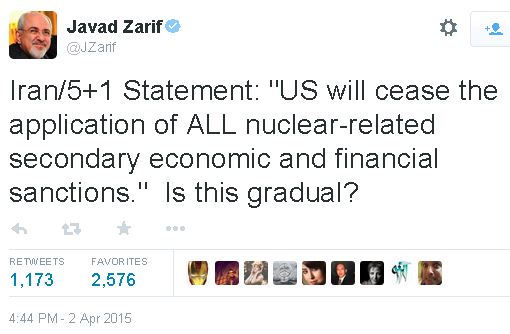
Iran chief negotiator: all sanctions will stop
Iran’s chief negotiator: all the sanctions cease immediately

This is the top article on the Wall Street Journal right now. It’s written by two former Secretaries of State, Henry Kissinger and George P. Shultz.

They are assessing the Iran deal:

While Iran treated the mere fact of its willingness to negotiate as a concession, the West has felt compelled to break every deadlock with a new proposal. In the process, the Iranian program has reached a point officially described as being within two to three months of building a nuclear weapon. Under the proposed agreement, for 10 years Iran will never be further than one year from a nuclear weapon and, after a decade, will be significantly closer.

[…]Progress has been made on shrinking the size of Iran’s enriched stockpile, confining the enrichment of uranium to one facility, and limiting aspects of the enrichment process. Still, the ultimate significance of the framework will depend on its verifiability and enforceability.

[…]Under the new approach, Iran permanently gives up none of its equipment, facilities or fissile product to achieve the proposed constraints. It only places them under temporary restriction and safeguard—amounting in many cases to a seal at the door of a depot or periodic visits by inspectors to declared sites. The physical magnitude of the effort is daunting. Is the International Atomic Energy Agency technically, and in terms of human resources, up to so complex and vast an assignment?

In a large country with multiple facilities and ample experience in nuclear concealment, violations will be inherently difficult to detect. Devising theoretical models of inspection is one thing. Enforcing compliance, week after week, despite competing international crises and domestic distractions, is another. Any report of a violation is likely to prompt debate over its significance—or even calls for new talks with Tehran to explore the issue. The experience of Iran’s work on a heavy-water reactor during the “interim agreement” period—when suspect activity was identified but played down in the interest of a positive negotiating atmosphere—is not encouraging.

Compounding the difficulty is the unlikelihood that breakout will be a clear-cut event. More likely it will occur, if it does, via the gradual accumulation of ambiguous evasions.

When inevitable disagreements arise over the scope and intrusiveness of inspections, on what criteria are we prepared to insist and up to what point? If evidence is imperfect, who bears the burden of proof? What process will be followed to resolve the matter swiftly?

The agreement’s primary enforcement mechanism, the threat of renewed sanctions, emphasizes a broad-based asymmetry, which provides Iran permanent relief from sanctions in exchange for temporary restraints on Iranian conduct. Undertaking the “snap-back” of sanctions is unlikely to be as clear or as automatic as the phrase implies. Iran is in a position to violate the agreement by executive decision. Restoring the most effective sanctions will require coordinated international action. In countries that had reluctantly joined in previous rounds, the demands of public and commercial opinion will militate against automatic or even prompt “snap-back.” If the follow-on process does not unambiguously define the term, an attempt to reimpose sanctions risks primarily isolating America, not Iran.

The gradual expiration of the framework agreement, beginning in a decade, will enable Iran to become a significant nuclear, industrial and military power after that time—in the scope and sophistication of its nuclear program and its latent capacity to weaponize at a time of its choosing. Limits on Iran’s research and development have not been publicly disclosed (or perhaps agreed). Therefore Iran will be in a position to bolster its advanced nuclear technology during the period of the agreement and rapidly deploy more advanced centrifuges—of at least five times the capacity of the current model—after the agreement expires or is broken.

That doesn’t sound like a good deal to me.

It sounds like we are trading permanent relief from sanctions. Those sanctions were built up over years of negotiations with the UN countries. Sanctions that are not easy to “snap back” if Iran breaks the deal, because they require negotiations with many different UN countries again – it won’t be automatic. That’s the “asymmetry” they are talking about in the article. Iran can break the agreement unilaterally, or just block the inspections, and the sanctions will stay off until we get agreement with the UN countries.

Here’s the former Democrat campaign worker, and now State Department spokeswoman Marie Harf:

She is confused by all the “big words” that these two Secretaries of State used in the article above.

But it gets worse!

Here’s the latest from the Times of Israel. (H/T Director Blue via ECM)

It says:

Iran will begin using its latest generation IR-8 centrifuges as soon as its nuclear deal with the world powers goes into effect, Iran’s foreign minister and nuclear chief told members of parliament on Tuesday, according to Iran’s semi-official FARS news agency.

If accurate, the report appears to make a mockery of the world powers’ much-hailed framework agreement with Iran, since such a move clearly breaches the US-published terms of the deal, and would dramatically accelerate Iran’s potential progress to the bomb.

Iran has said that its IR-8 centrifuges enrich uranium 20 times faster than the IR-1 centrifuges it currently uses.

According to the FARS report, “Iran’s foreign minister and nuclear chief both told a closed-door session of the parliament on Tuesday that the country would inject UF6 gas into the latest generation of its centrifuge machines as soon as a final nuclear deal goes into effect by Tehran and the six world powers.”

It said that Foreign Minister Mohammad Javad Zarif and Atomic Energy Organization of Iran (AEOI) head Ali Akbar Salehi made the promise when they briefed legislators on the framework agreement, and claimed the move was permitted under the terms of the deal.

Oh, I guess was wrong. This is a good deal! For Iran.

Sigh. I guess if you want to be even more horrified by the Iran deal, you can listen to an interview that Hugh Hewitt did with Wall Street Journal columnist Bret Stephens, and there’s a transcript as well for those who would rather read about the incompetence of the Obama administration rather than hear about the incompetence of the Obama administration.

How brief was the period in which the Cambrian phyla suddenly appeared?

The Cambrian explosion refers to the sudden appearance of new body plans in the fossil record. ID proponents think that the period is between 5-10 million years at the most. Naturalists want to stretch out the period in which the body plans appear to tens of millions of years. The two sides can’t both be right. What’s the truth?

Evolution News has the answer.

Excerpt:

To establish the length of the most explosive period of innovation within the Cambrian explosion itself, Meyer cites the work of MIT geochronologist Samuel Bowring and his colleagues as well the work of another group led by Smithsonian paleontologist Douglas Erwin. The Bowring-led study showed that (in their words) “the main period of exponential diversification” within the Cambrian lasted “only 5-6 million years” (emphasis added). Meyer explains:

An analysis by MIT geochronologist Samuel Bowring has shown that the main pulse of Cambrian morphological innovation occurred in a sedimentary sequence spanning no more than 6 million years. Yet during this time representatives of at least sixteen completely novel phyla and about thirty classes first appeared in the rock record. In a more recent paper using a slightly different dating scheme, Douglas Erwin and colleagues similarly show that thirteen new phyla appear in a roughly 6-million-year window. (p. 73)

[…][T]ake a look first at the following figure that Bowring and his colleagues included in their definitive 1993 article, published in the journal Science. They use radiometric methods to date the different stages of the Cambrian period, including the crucial Tommotian and Atdabanian stages in which the greatest number of new animal phyla and classes arise. Note that the so-called Manykaian stage of the Cambrian period lasts about 10-14 million years. Note also that the main pulse of morphological innovation didn’t begin during this stage but rather during the Tommotian and Atdabanian — a period that they describe as taking between “5 to 10 million years,” and in a more detailed passage as taking about 5-6 million years.

[…]In the figure above, the Tommotian and Atdabanian stages of the Cambrian period together span only about 5 million years, starting at about 530 and ending about 525 million years ago. Bowring’s figure also depicts the total number of classes and orders present at any given time during the Cambrian period. The biggest increases in morphological innovation occur during the Tommotian and Atdabanian stages. Indeed, during this period the number of known orders nearly quadruples. Moreover, Bowring and his colleagues also make clear that this period corresponds to the main pulse of Cambrian morphological innovation as measured by the number of new phyla and classes that first appear. They note that, while a few groups of animals do arise in the earliest Manykaian stage of the Cambrian, the most rapid period of “exponential increase of diversification,” corresponding to the Tommotian and Atdabanian stages, “lasted only 5 to 6 m.y.”

You can see the figure they are reference in the Evolution News article.

Also, check out these clips that explain the Cambrian explosion:

Part 1:

Part 2:

The first clip features James Valentine, a professor of biology at the University of California who just co-authored a new book on the Cambrian explosion and is not a proponent of intelligent design.

The consensus among scientists regarding the period of time in which the new body plans appear is 5-6 million years. Biologically speaking, that’s a blink of an eye. You aren’t going that kind of complexity and innovation in such a short period of time any more than you can expect to win the lottery by buying 5-6 million tickets when the odds of winning are 1 in a googol (10 to the 100th power – 1, followed by 100 zeroes). You don’t have enough lottery tickets to make winning the lottery likely. Similarly, 5-6 million years is not enough time for naturalistic mechanisms to code brand new body plans from scratch. It would be like trying to research and write a Ph.D thesis during a single lunch hour. It’s just not enough time to produce the amount of information that’s required.

New study: tiny songbirds fly over the Atlantic ocean and back each year

Blackpoll Warbler- so tiny and so cute!
Blackpoll Warbler- so cute!

I love birds! I really, really do! A lot!

So here is the latest study, reported in Science Daily about our amazing feathered friends.

They write:

For more than 50 years, scientists had tantalizing clues suggesting that a tiny, boreal forest songbird known as the blackpoll warbler departs each fall from New England and eastern Canada to migrate nonstop in a direct line over the Atlantic Ocean toward South America, but proof was hard to come by.

Now, for the first time an international team of biologists report “irrefutable evidence” that the birds complete a nonstop flight ranging from about 1,410 to 1,721 miles (2,270 to 2,770 km) in just two to three days, making landfall somewhere in Puerto Rico, Cuba and the islands known as the Greater Antilles, from there going on to northern Venezuela and Columbia. Details of their study, which used light-level, or solar, geolocators, appear in the current issue of Biology Letters.

First author Bill DeLuca, an environmental conservation research fellow at the University of Massachusetts Amherst, with colleagues at the University of Guelph, Ontario, the Vermont Center for Ecostudies and other institutions, says, “For small songbirds, we are only just now beginning to understand the migratory routes that connect temperate breeding grounds to tropical wintering areas. We’re really excited to report that this is one of the longest nonstop overwater flights ever recorded for a songbird, and finally confirms what has long been believed to be one of the most extraordinary migratory feats on the planet.”

While other birds, such as albatrosses, sandpipers and gulls are known for trans-oceanic flights, the blackpoll warbler is a forest dweller that migrates boldly where few of its relatives dare to travel. Most migratory songbirds that winter in South America take a less risky, continental route south through Mexico and Central America, the authors note. A water landing would be fatal to a warbler.

[…]For this work the scientists fitted geolocator packs on 20 birds in Vermont and 20 more in Nova Scotia. They were able to recapture three birds from the Vermont group and two from the Nova Scotia group for analyses.

So-called light-level geolocators use solar geolocation, a method used for centuries by mariners and explorers. It is based on the fact that day length varies with latitude while time of solar noon varies with longitude. So all the instrument needs to do is record the date and length of daylight, from which daily locations can then be inferred once the geolocator is recaptured. “When we accessed the locators, we saw the blackpolls’ journey was indeed directly over the Atlantic. The distances travelled ranged from 2,270 to 2,770 kilometers,” DeLuca says.

Evolution News has more on the discovery.

They write:

More record-breaking discoveries may be in store. Oskin says that some of the blackpoll warblers spend their summers in Alaska and Canada instead of New England. If they fly east before joining the southern route to Colombia and Venezuela, it would add three thousand more miles to their annual migration.

[…]But that’s not all. Lest we forget, there are the Monarch butterflies, much smaller and lighter than birds, that travel three thousand miles from Canada to Mexico each year, as detailed in Illustra’s film Metamorphosis. Even though butterflies don’t fly non-stop, that’s — well, we need an adjective beyond “extraordinary.” And more recently, British scientists found that another butterfly, the painted lady, flies triple that distance — nine thousand miles — in its annual migration from the UK to Africa.

Think of all the integrated systems that have to be in place to make these migrations possible. The birds or butterflies need elegant flight systems, with all the attendant muscles, nerves, and structural supports required. They require digestive systems to sustain them, circulatory systems, thermal systems, sensory systems, and protection from the elements. Most astonishing are the navigational systems, including sensing the stars or the earth’s magnetic field, to take them unerringly to their destination and back over routes of thousands of miles. To pack all that in a tiny animal is a masterpiece of miniaturization. Oh — and then there’s a reproductive system, and a battery of instincts to operate all the systems.

It seems fair to say these engineering marvels are beyond the reach of unguided Darwinian evolution. The birds don’t have to fly that far. Warblers could stay inland along the coast, and feed on the way, or learn to get by through the winter like other birds do. Butterflies, too, could stay with other species that don’t migrate. Natural selection would take the easy road, get rid of the wings, and let them grovel in the dirt to eke out a living. These migratory abilities are gratuitous and superfluous to the requirements of mere survival. Such over-design, right on the “brink of impossibility,” speaks of design so beyond our comprehension, we can only stand in awe.

Butterflies are OK, but birds are much better – you can actually make friends with birds. Anyway, if you like birds as much as I do… well, no one likes them as much as I do… but if you like birds a lot, then you should get Illustra’s documentary Flight: The Genius of Birds and watch it. And share it with your friends.