the commandment to not kill does not apply to killing enemy soldiers in war
government is authorized to prevent foreign countries from harming citizens the same way it prevents criminals from harming citizens
there are examples in the Bible of using military force to stop an aggressive nation, e.g. – David vs Goliath
principles of a just war, and relevant Bible passages, e.g. – just cause, only as a last resort
Moral principles for the conduct of a just war, e.g. – proportionality, combatants vs non-combatants
Can a Christian serve in a just war in good conscience?
What should a Christian do if called upon to fight in an unjust war?
Part 2 topics: (responses to pacificism)
what are the arguments in favor of pacifism?
government can do some things that individuals cannot do, e.g. – taxing vs stealing, punishing criminals vs revenge
it’s wrong for individuals to use force to advance the gospel, but not wrong for government to use force to restrain evil
Jesus loves everyone, but even he will come in judgment one day and use force to punish evil
what about nuclear weapons, nuclear arsenals for deterrence, and defenses to long-range nuclear missiles?
missile defense systems work, e.g – Iron Dome in Israel stopped about 85% of incoming missiles
building defenses does not embolden the enemy to attack us, it deters the enemy from attacking us
“turn the other cheek” means don’t return an insult, but you can defend yourself from physical threats
My favorite part of this two-part series was the midpoint of part 2, when a lady asked him a question about what is behind pacificism. Dr. Grudem runs through all the places in society where the secular left is opposed to authorities judging and punishing bad behavior with force. There are so many examples of this: parents disciplining rebellious children, teachers disciplining misbehaving kids, police catching criminals (lots of that lately!), courts putting criminals in jail for long periods of time, giving murderers the death penalty, using waterboarding on terrorists, and of course pacifism in the face of aggression, e.g. – Iran vs Israel, Russia vs Ukraine. Then another lady asked him why the same people who are so concerned about going easy on violent criminals and aggressive nations are so intent on being able to kill defenseless innocent children in the womb. Good question.
Here’s a wonderful post on decision making and the will of God posted on Neil’s blog. Neil links to another post where someone is trying to figure out what God wants him to do.
Excerpt:
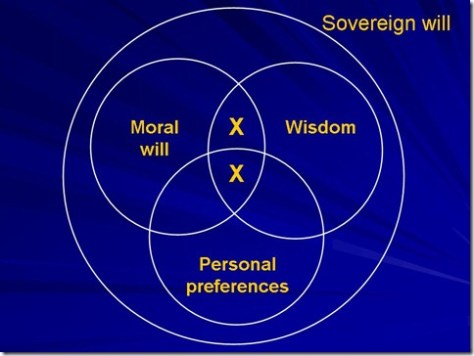
Really short version: Aside from direct and clear personal revelation from God, you don’t have access to his sovereign will when making decisions. Therefore you must look at other factors. If it isn’t moral, don’t do it. If it is moral but not wise, don’t do it. If it is moral and wise, then use your personal preferences.
Using this model you can end up with a wise and biblical decision, but you have avoided the traps of the “God told me to ____” routine. People who run around saying that God told them this and that convey a super-spirituality that can leave less mature believers wondering if they really have a relationship with God (i.e., “God doesn’t tell me every little thing to do, so maybe I don’t really know him.”).
He has a helpful picture posted as well:
This is actually a very important topic for me, because I like making plans and making good decisions. I like being the quarterback or squad leader of my own life. I like to pick objectives and then make plans to achieve them. (Nothing too exotic, just simple stuff like saving money or reading more books)
Actually, I really oppose the idea that God has a magical fairy tale will for each person that will make them happy and fulfilled. For me, life isn’t like that. I don’t expect God to lead me along like a child at a scavenger hunt. I expect to survey the battlefield where I am and then do something to make a difference. There are lots of things you can do that will please God. Should you focus on your career and sponsor apologetics conferences? Or should you use your spare time preparing Sunday school lessons? There are lots of good things you could do to please God. Your job is to pick the one that will be the most effective. It doesn’t matter if it makes you happy, it only matters if it’s effective and if you are good at it.
Who is Rifleman Dodd?
A while back, I was busily working my way through the U.S. Marine Corps Official Reading List, and I came across a book by C.S. Forester called Rifleman Dodd, or alternatively titled Death to the French. It’s a work of historical fiction that takes place during the Napoleonic wars. The story is about a British marksman named Dodd, who is cut off from his own lines during a withdrawal maneuver. He is subsequently left to fend for himself behind enemy lines. An ordinary man might be full of despair and forget about his mission entirely. But Dodd is no ordinary man. Not only does he find a way to survive by finding food to eat, water to drink and places to sleep, but he also tries to remember his orders and to think about what he can do to advance the cause of his General, the Duke of Wellington.
It’s about a green-coated British infantry rifleman in the Napoleonic Wars, an age when rifles were a novelty and most of the army was red-coated and carried muskets. Private Matthew Dodd gets separated from his regiment during a retreat and finds himself stranded behind enemy (French) lines in Portugal. With the occasional aid of some natives, but mostly on his own, he harasses the French with his rifle and tries to prevent them from building a bridge across the Tagus River. It’s a remarkable tale of survival and solitary achievement, of a rank-and-file soldier who lives by his wits and slowly learns to make plans without orders, and shows leadership qualities and a knowledge of warfare.
I think we’re in the same situation as Dodd.
There is no point in us looking for breadcrumb trails to happiness at this point. That’s not the point of Christianity. The point of Christianity is friendship with God, imitation of Christ, honoring moral obligations, self-sacrificial love for your neighbor (and even your enemies!), and dedication to the truth – whether anyone else likes you or not. It’s not supposed to make you happy, and it’s not necessarily going to be a normal life like everyone else has. Things may not work out the way you’d like them to.
We seem to be making such a big deal about compassion and forgiveness in the Christian life these days – such a big emphasis on our feelings. Almost like we have forgotten that we have obligations to our friend – and his objectives. A relationship doesn’t mean that one person completely disregards the character and goals of the other person and then is automatically granted forgiveness whenever they want it. That’s not a friendship – that’s using someone else for your own ends. Maybe it’s time to remember what this is all about.
To answer that question, let’s look at the latest from The Weekly Standard by Johnathan Last.
It says:
You may recall Brendan Eich. The cofounder and CEO of Mozilla was dismissed from his company in 2014 when it was discovered that, six years earlier, he had donated $1,000 to California’s Proposition 8 campaign. That ballot initiative, limiting marriage to one man and one woman, passed with a larger percentage of the vote in California than Barack Obama received nationally in 2012. No one who knew Eich accused him of treating his gay coworkers badly—by all accounts he was kind and generous to his colleagues. Nonetheless, having provided modest financial support to a lawful ballot initiative that passed with a majority vote was deemed horrible enough to deprive Eich of his livelihood. Which is one thing.
What is quite another is the manner in which Eich has been treated since. A year after Eich’s firing, for instance, Hampton Catlin, a Silicon Valley programmer who was one of the first to demand Eich’s resignation, took to Twitter to bait Eich:
Hampton @hcatlin Apr 2
It had been a couple weeks since I’d gotten some sort of @BrendanEich related hate mail. How things going over there on your side, Brendan?
BrendanEich @BrendanEich
@hcatlin You demanded I be “completely removed from any day to day activities at Mozilla” & got your wish. I’m still unemployed. How’re you?
Hampton @hcatlin Apr 2
@BrendanEich married and able to live in the USA! . . . and working together on open source stuff! In like, a loving, happy gay married way!
It’s a small thing, to be sure. But telling. Because it shows that the same-sex marriage movement is interested in a great deal more than just the freedom to form marital unions. It is also interested, quite keenly, in punishing dissenters. But the ambitions of the movement go further than that, even. It’s about revisiting legal notions of freedom of speech and association, constitutional protections for religious freedom, and cultural norms concerning the family. And most Americans are only just realizing that these are the societal compacts that have been pried open for negotiation.
He co-founded the company, invented the most widely-used client-side programming language used on the Internet, and he had to step down for making a donation to the cause of male-female marriage. This guy is a hundred times the programmer that I will ever be. And yet he has not found a job since he was thrown out of the company that he co-founded and made successful.
That’s why I have an alias. Because I want to be able express my convictions about issues ranging from abortion to marriage to intelligent design to climate change without losing my job. I need my job to be able to help other Christians, and to have any chance at all of getting married and having children.
The Weekly Standard article traces the progress of the gay agenda, quoting from gay activists in Slate, The Daily Beast, The Atlantic, The Economist, The New Republic, etc.
Let’s look at one of them: Jonathan Rauch writing in The Daily Beast:
Then Rauch turned to the question of whether or not the creation of same-sex marriage was an obvious extension of liberty—as gay rights advocates have always insisted—or something much bigger:
Virtually all human societies, including our own until practically the day before yesterday, took as a given that combining the two sexes was part of the essence of marriage. Indeed, the very idea of a same-sex marriage seemed to most people a contradiction in terms. . . .
By contrast, marriage has not always been racist. Quite the contrary. People have married across racial (and ethnic, tribal, and religious) lines for eons, often quite deliberately to cement familial or political alliances. Assuredly, racist norms have been imposed upon marriage in many times and places, but as an extraneous limitation. Everyone understood that people of different races could intermarry, in principle. Indeed, that was exactly why racists wanted to stop it, much as they wanted to stop the mixing of races in schools. In both intent and application, the anti-miscegenation laws were about race, not marriage.
Why should this distinction matter today, if both kinds of discrimination are wrong? Because asking people to give up history’s traditional understanding of marriage is a big ask. You don’t expect thousands of years of unquestioned moral and social tradition to be relinquished overnight.
[…]The First Amendment carves out special protections for religious belief and expression. That does not mean, of course, that Christian homophobes can discriminate as much as they want provided they quote the Bible. It does mean, at least for a while, courts and legislatures will strike compromises balancing gay rights and religious liberty, something they did not have to do with black civil rights. This makes gay marriage more complicated—legally, socially, and even ethically—than interracial marriage. And it means gay-marriage supporters will hit a constitutional brick wall if we try to condemn our opponents to immediateand total perdition.
Got that? Gay activists do “expect thousands of years of unquestioned moral and social tradition to be relinquished” – just not overnight. Courts and legislatures can compromise on annihilating freedom of speech and religious liberty – at least for a while. The generous gay rights activists won’t condemn those of us who think that children need a mother and a father to immediate punishment of the sort that Brendan Eich got. Or the punishment that the Oregon bakery got. Or the punishment that the Washington florist got. Or the punishment that the New Mexico photographer got. Only some people will need to be punished – as an example to the others to fall in line.
Are you getting this? This is fascism.
There are three things to do to make it safe for people who believe in natural marriage to speak out without fear. First, never vote for any Democrats ever again, and make sure that the Republicans you vote for are supportive of religious liberty and free speech. Second, we need to get informed in order to be persuasive on the marriage issue. Read a book on pro-marriage apologetics. Read another book on the sociological evidence that shows the importance of mothers and fathers to children. And then read another book on the sociological evidence for the harm caused to children raised by same-sex parents. Then you will know what you have to know to be a change agent for marriage where you are. Finally, it’s never a bad idea to donate to the Alliance Defending Freedom, the team of lawyers who defend Christians in court.


 WINTERY KNIGHT