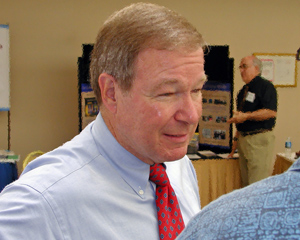
Walter Bradley asks: what is religion really supposed to be about?

Dr. Walter L. Bradley

This lecture is based on the book “Truth in Religion” by famous philosopher Mortimer J. Adler. At the time of writing the book, he was not a Christian, but there is still a lot of value in the book for Christians who are trying to understand what religion should really be about.

About the speaker

The speaker is one of my top 3 favorite speakers of all time in Christian apologetics, Dr. Walter Bradley. (The other two are Dr. Stephen C. Meyer and Dr. Michael Strauss)

Here’s a biography:

Dr. Bradley received his B.S. in Engineering Science and his Ph.D. in Materials Science from the University of Texas in Austin.

Dr. Bradley taught for eight years at the Colorado School of Mines before assuming a position as Professor of Mechanical Engineering at Texas A&M University (TAMU) in 1976.

During his 24 years at Texas A&M, Dr. Bradley served as Head of the Department of Mechanical Engineering at Texas A&M University and as Director of the Polymer Technology Center, and received five College of Engineering Research Awards. He has received over $4,500,000 in research grants and has published over 140 technical articles and book chapters. He has also co-authored “The Mystery Of Life’s Origin: Reassessing Current Theories. He is a Fellow of the American Society for Materials and of the American Scientific Affiliation and serves as a consultant for many Fortune 500 companies.

You can read more about his recent research on how to use coconuts to make car parts in this article from Science Daily.

The MP3 file is here. (31 minutes + Q&A)

Topics:

  • what is pluralism?
  • what is multiculturalism?
  • what is relativism?
  • some propositions are true culturally – just for certain groups in certain times (cultures)
  • some proposition are true trans-culturally – true independently of what anyone wants or feels
  • Mathematical truth is trans-cultural – it is true regardless of cultural fashions
  • Scientific truth is trans-cultural – it is true regardless of cultural fashions
  • Some truths are not like this – cooking traditions, clothing traditions and greeting traditions
  • These kinds of truths are NOT trans-cultural, they vary by culture
  • The question is – is religion true like math and science, or true depending on the culture
  • Some people think that your religion depends on where you were born or what your family believes
  • Religions make conflicting claims about the way the world really is, so they can’t all be true
  • And these conflicts are at the core of the religions – who God is, how can we be related to him, etc.
  • So if religions convey trans-cultural truth, then either one is true or none are true
  • If they are not trying to convey trans-cultural truth, then they are not like math and science
  • Let’s assume that religion is the same as trans-cultural truth
  • How can we know which religion is true? 1) the laws of logic, 2) empirical testing against reality
  • Logical consistency is needed to make the first cut – self-contradictory claims cannot be true
  • To be true trans-culturally, a proposition must at least NOT break the law of non-contradiction
  • According to Mortimer Adler’s book, only Christianity, Judaism and Islam are not self-contradictory
  • All the others can be excluded on the basis of overt internal contradictions on fundamental questions
  • The others that are self-contradictory can be true culturally, but not trans-culturally
  • The way to proceed forward is to test the three non-contradictory religions against science and history
  • One of these three may be true, or they could all be false
  • We can test the three by evaluating their conflicting truth claims about the historical Jesus
  • Famous skeptics have undertaken studies to undermine the historical Jesus presented in the Bible
  • Lew Wallace, Simon Greenleaf and Frank Morrison assessed the evidence as atheists and became Christians
  • There is a lot of opposition in culture to the idea that one religion might be true
  • But if you take the claims of Jesus at face value, he claims to be the unique revelation of God to mankind
  • Either he was telling the truth about that, or he was lying, or he was crazy
  • So which is it?

Why don’t religious people ask if their religion is true?

People seem to be chicken these days about claiming that their religion is true. It’s easier to say that my religion is true for me, and your religion is true for you – reduce it to personal preferences. So long as everyone is sincere about what they believe, then that’s the most important thing, right?

But it is NOT TRUE that you can believe whatever you want as long as you are sincere – sincerity doesn’t mean that you can’t be mistaken. I can jump off the top of the Sears Tower and be sincere in my belief that I will float down like a feather, but that doesn’t make my belief true. If you want to have a good relationship with God, you have to know things about him, not just have sincere beliefs. You have to know whether he exists and what he is like – really. It’s not enough to have sincere beliefs that are not actually true.

I think that God’s existence and character can be assessed and known based on logic and evidence. I think that God exists independently of whether I want him to or not, and I think that his character and desires are not the same as my character and desires. And I don’t really care what my neighbors think of my disagreeing with them, my goal is not to keep silent and to just get along with them and be happier in my community.

God’s first commandment to us is not to love our neighbor – that’s number two. Number one is to love him. And how can we love him, if we don’t want to know him. And how can we love him, if we don’t tell people the truth about him when they ask us?

That message is not going to win us a lot of friends, but our job as Christians is to tell how and why God stepped into history. Jesus expects us to be his ambassadors and to carry out the task of evangelism faithfully, and to suffer with him and – if necessary – to be rejected like he was rejected.

Federal court cripples Obama administration’s bird-killing green energy agenda

This is business as usual for the Democrat Party

So, one of the quirky things about me is that I am a huge bird lover.

Birds are my favorite creatures, and I oppose anything that harms them. Well, it turns out that green energy schemes harm a lot of birds, whether it be solar power or wind power.

To get around this fact, the Obama administration decided to to allow green energy producers to get licenses to kill rare, protected birds – including bald eagles and golden eagles. Green energy scams are a useful way for the Obama administration to pay off their campaign bundlers with taxpayer money, as a reward for helping Democrats get elected. And if huge numbers of rare, protected birds have to die to do that, well, it’s no big deal.

Here’s the story from Bird Watching Daily. (H/T ECM)

It says:

The U.S. District Court in San Jose, California, today ruled that the Department of the Interior violated federal laws when it created a final regulation allowing wind energy and some other companies to obtain 30-year permits to kill protected Bald and Golden Eagles without prosecution by the federal government. The court decision invalidates the rule.

American Bird Conservancy (ABC), a plaintiff in the lawsuit, hailed the decision. “We are pleased that the courts agreed with us that improper shortcuts were taken in the development of this rule,” said Michael Hutchins, director of ABC’s Bird Smart Wind Energy Program. “The court found that important laws meant to protect our nation’s wildlife were not properly followed by the U.S. Fish and Wildlife Service, putting Bald and Golden Eagles at greater risk.”

The court wrote: “… substantial questions are raised as to whether the Final 30-Year Rule may have a significant adverse effect on bald and golden eagle populations.”

By the way, in case you wanted a reference for my claim that solar power also harms birds, this Scientific American article explains how solar power kills endangered bird species.

You might never have seen an Yuma clapper rail. Fewer than 1,000 are thought to still be sloshing about in cattail-thick marshes from Mexico up to Utah and across to California. But if you were lucky enough to spot one, you might chuckle at its oversized toes.

When officials with the National Fish and Wildlife Forensics Laboratory saw one of these endangered birds last year, it was no laughing matter. It was dead. It was one of 233 birds recovered from the sites of three Californian desert solar power plants as part of a federal investigation. The laboratory’s wildlife equivalents of CSI stars concluded that many of the birds had been fatally singed, broken, or otherwise fatally crippled by the facilities.

233 doesn’t sound too bad, but the total death toll is much higher.

This Weather.com article puts the number of birds killed by solar power at thousands every year for just one solar power plant:

According to the Associated Press, up to 28,000 birds per year might be meeting an early death after burning up in the focused beams of sunlight, with birds dying at a rate of one bird every two minutes. The burned-up birds are being dubbed “streamers,” after the poof of smoke produced by the igniting birds.

A report by the USFWS states that most of the birds are dying from various levels of exposure to “solar flux” which causes “singeing of feathers.”

“Severe singeing of flight feathers caused catastrophic loss of flying ability, leading to death by impact with the ground or other objects,” the report states. “Less severe singeing led to impairment of flight capability, reducing ability to forage and evade predators, leading to starvation or predation.”

Solar power is actually worse than wind power, when it comes to killing birds, and that’s still going on, unchecked. When I look at the dead and injured birds in the pictures from these news stories, it just makes me sick.

Colorado Court of Appeals rules that Christian must bake cakes for gay wedding

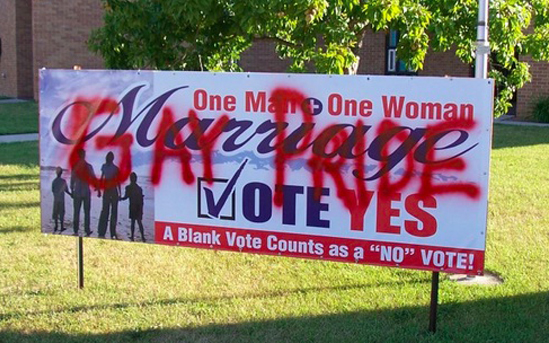
Gay activist vandalizes pro-marriage sign

This is from the Daily Signal.

Excerpt:

A custom cake baker in suburban Denver can’t cite his religious convictions in declining to make a wedding cake for two men, a Colorado appeals court ruled today.

“Cake artist” Jack Phillips said he gladly serves gays and lesbians in his family business. But, Phillips said, he could not in good conscience design a wedding cake for a same-sex couple when, as a Christian, he believes marriage is the union of a man and a woman.

A three-judge panel of the Colorado Court of Appeals ruled that not doing so amounts to illegal discrimination based on sexual orientation, Associated Press reported.

You’ll recall that Colorado is one of the states that does not recognize religious liberty as a human right:

States with non-discrimination laws

If you live in one of the non-gray states, you’re at risk.

What’s troubling to me about this is that Phillips was defended by Jeremy Tedesco of the Alliance Defending Freedom. He is a very capable religious liberty lawyer.

More:

The baker’s lawyer, Jeremy Tedesco, told The Daily Signal that the three judges “got it wrong on all counts” in a unanimous, 65-page opinion.

“He objects to the message, not to their protected status,” Tedesco said of the business owner’s attitude toward Charlie Craig and David Mullins, the two men who wanted him to design a wedding cake. “That’s not discrimination under the law.”

Tedesco, senior legal counsel with Alliance Defending Freedom, added:

Business owners have a right–especially when they’re engaged in expression, as our client is–to run their business in accordance with their beliefs. …When they’re engaged in expression, [they may] decline to create an expression that violates their convictions.

What’s interesting is that after being denied the cake, the gay couple easily went to another shop and got a cake. There was no harm done.

But that was not good enough for them, hence their decision to involve the state, and punish the Christian for choosing not to celebrate something he disagreed with.

Tedesco says that the baker should not be forced to say something that he violates his conscience:

As The Daily Signal reported, Tedesco argued that compelling Phillips to create a cake for the wedding of two men would violate his First Amendment rights not only to freedom of religion but also free speech or expression.

“The other side of the case thinks there are no First Amendment rights in the commercial context and once you open a business, you cede all First Amendment protections,” Tedesco told The Daily Signal after the hearing in Denver.

The ADF intends to appeal the case to the Colorado Supreme Court, and then to the Supreme Court of the United States. Unfortunately, since Obama won in 2008 and 2012, the Supreme Court is likely to rule against religious liberty. We’ll find out, I guess.

You can read more about Jeremy Tedesco here.