So, I know that most of Trump’s supporters are in fact Democrats from blue states, because of this article from the New York Times.
Donald Trump holds a dominant position in national polls in the Republican race in no small part because he is extremely strong among people on the periphery of the G.O.P. coalition.
He is strongest among Republicans who are less affluent, less educated and less likely to turn out to vote. His very best voters are self-identified Republicans who nonetheless are registered as Democrats. It’s a coalition that’s concentrated in the South, Appalachia and the industrial North, according to data provided to The Upshot by Civis Analytics, a Democratic data firm.
Registered Democrats.
New York Values
Now, let’s see the New York values that Trump trumpeted in his recent debate with Ted Cruz.
Trump says this:
Now, what that short video carefully and you will find that New York Values mean the following:
on gay marriage: “too premature for me to comment on”
gays in the military: “not something that would disturb me”
abortion: “I’m very pro-choice”
partial-birth abortion: “No, [I would not ban partial birth abortion]”
Trump says SIX TIMES in that 1-minute video that these 4 points are “New York Values”. These are the New York Values that Ted Cruz disagreed with in their debate.
Between 1989 and 2010, The Donald gave $314,300 to Democratic groups and candidates and $290,600 to Republicans, according to a Daily Caller analysis of records maintained by the Center for Responsive Politics.
But Trump’s donation gap was even larger during the mid-2000s, which saw the end of Republican congressional majorities and the ascendance of the Democratic party.
So, Trump supporters support donating to Democrats, and they support Nancy Pelosi and Harry Reid.
Business mogul Donald Trump is optimistic about the future of New York City if Democratic candidate Bill de Blasio wins the mayoral election.
“I think pretty strongly that he’ll end up being a good mayor, maybe a very good mayor and I don’t think he’s going to want to kill the golden goose,” Trump told an Albany radio station Thursday, according to the New York Daily News.
Let’s find out what Bill de Blasio is like, so we can find out what policies Trump thinks would be good for New York city.
Establishing universal pre-K was a hallmark campaign pledge for de Blasio — an expansion he said could be achieved by raising taxes on New York’s wealthiest residents.
Many are blaming the murder of two New York City cops on Saturday afternoon on Mayor Bill de Blasio following his recent support for protesters in the city marching in opposition to a grand jury’s decision to not indict the police officer who killed Eric Garner.
Hundreds have taken to social media to say that de Blasio has ‘blood on his hands’ and should ‘be charged with murder’ after the two men were killed ‘execution style’ in Brooklyn.
What’s more, many feel that de Blasio should not attend the officers’ funerals, this after many members of the NYPD signed a petition asking that the Mayor not attend their service should they be killed in the line of duty in light of his recent actions.
Donald Trump supports de Blasio, and so do his supporters. These are the views of Trump and of Trump’s supporters.
I hope everyone understands what New York values are now, and understands what Trump voters are supporting. This is what Trump voters believe.
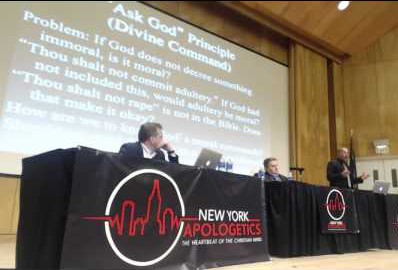
Turek’s cross-examination period starts at 74m22s and ends at 89m20s.
Shermer’s cross-examination period starts at 89m50s and ends at 105m0s.
Topics of Turek’s cross-examination:
evolution produces Shermer’s moral sense and Hitler’s moral sense
why does Shermer think his is better than Hitler’s, since both were produced by the same evolution?
what makes right or wrong if evolution is the source of morality?
why is Stalin’s opinion of right and wrong less valuable than the herd’s opinion of right and wrong?
do the Founding Fathers ground inalienable rights in a Creator, or in evolution?
can atheism ground the existence of inalienable rights?
can you ground objective moral values and objective moral duties by asking people how they feel?
can you ground objective human rights on atheism by shouting like a madman and interrupting?
how can you trust your thinking if they are the result of an unguided, random process of evolution?
how can you have rational thoughts if materialism is true, and you are a machine made out of meat?
can you ground objective moral values and objective moral duties on personal preferences?
how do the personal preferences of some individuals create an objective moral duty for other individuals?
does naturalistic evolution orient human beings toward survival or truth?
on materialism, what is the chemical composition of justice?
Topics of Shermer’s cross-examination:
Radical muslims are exactly the same as evangelical Christians, and have the same God (Allah is the same as the Triune Christian God)
Radical muslims would assert that their God is the same as the Triune Christian God, with Jesus and the Holy Spirit also being God
Therefore, we can lay the blame for what radical muslims do on the backs of evangelical Christians
Radical muslims and evangelical Christians are the same, because “you’re enthusiastic, they’re enthusiastic”
The Bible’s notion of indentured servitude to pay off debt is the identical to the idea of slavery based on race
The Bible’s notion that masters and slaves are equal in the sight of God forms a basis for thinking they are unequal
The Bible teaches things that I disagree with, like the idea that marriage should provide children with a mother and a father
Gay marriage is solidly grounded in evolution, even though the morality that evolution produces varies by time and place
Atheists can ground objective moral values and objective moral duties by asking people how they feel
Can atheists who want to legalize gay marriage because “they’re in love” prohibit polygamy or incest as marriage?
Is shouting “you’re on the wrong side of history” a way to rationally ground morality in an accidental atheistic universe?
Is it loving for atheists to celebrate a lifestyle that exposes gay men to sickness and premature death?
Is it “bigotry” for the Center for Disease Control to warn men who have sex with men about higher health risks?
How do Christians decide what is right and wrong when they are confronted with a moral dilemma?
How do humans sense the objective moral standard that is required for them to make moral judgments
Can enlightenment philosophers who merely imagine human rights actually create those human rights?
If revelations change over time for Mormons, does that undermine the need for God to ground objective morality?
I apologize for the poor quality of the video and audio. The moderator was extremely ineffective, letting Shermer go on and on making speeches instead of asking questions during his questioning time. Also, Shermer apparently thought that shouting at Turek and waving his finger at Turek was a good strategy to defend against Turek’s use of logic and evidence.
My thoughts on Michael Shermer
I do want to make some general comments about what Shermer said. Shermer’s view of morality is “what is best for the greatest number of people”. There are no inalienable rights that act as a break on the will of the majority. Shermer has no objection to anything that the majority has decided in any time or in any place. If he were there, he would agree that whatever they decided was morally right.
Two hundred years ago, Shermer would have endorsed slavery. And if he were in Germany 50 years ago, he would have endorsed the Holocaust. If he lived in a Pakistan today, he would endorse stoning women for wearing the wrong clothes. Atheists always think that whatever the majority is doing in a particular time and place is right for them. There are no inalienable human rights that exist apart from human opinions, on atheism.
Another problem is that Shermer is constantly making moral judgments when his own view is that morality is constantly changing in different times and places. He condemns the moral values of other times and places without having any standard in his worldview that can decide between different moral values and duties. It is like saying that lunch is better than breakfast because lunch is here and now, and breakfast was then and there. That is literally what atheists do when they make moral judgments. They have no standard that applies to different times and places, just the ever evolving opinions of the majority of people in different times and places.
Is Michael Shermer concerned about morality?
Finally, I want people to understand what kind of person Michael Shermer is. You can read a post by PZ Myers on his blog Pharyngula to get the picture. I think it’s useful to know about Shermer’s own morality since he seems to like to make moral judgments so much during debates. In my own experience in dealing with atheists, although they will talk about slavery and the Crusades, there is nothing in an atheist’s moral system that makes things wrong for all times and all places. They bring it up to stop you from judging them about the things that they care about. When an atheist says “the Crusades! Slavery!” what they really mean is “I need to shame you for having a basis for moral judgments against me, so that you won’t say anything about me getting married women drunk then raping them”. That’s what atheistic use of moral language is really about.
What atheists really think about morality
Atheist Richard Dawkins says atheists have no objective moral standards:
In a universe of blind physical forces and genetic replication, some people are going to get hurt, other people are going to get lucky, and you won’t find any rhyme or reason in it, or any justice. The universe that we observe has precisely the properties we should expect if there is, at bottom, no design, no purpose, no evil and no good, nothing but blind, pitiless indifference… DNA neither knows nor cares. DNA just is. And we dance to its music. (Richard Dawkins, River Out of Eden: A Darwinian View of Life (1995))
So, when Shermer tries to shame Christians for behaviors in other times and places which our society here and now disagrees with, what he really means is “morality, objectively speaking, is nonsense, but I will use your moral sense that comes from your non-atheistic worldview to shame you, so that you won’t have the confidence to judge me for my immoral behavior”. And we need to get used to understanding this about atheists. Morality is nonsense to them, and their real goal is to get you off their back for their hedonism. For atheists, morality is just complying with arbitrary social customs which vary by time and place. There is nothing more to it than aping their neighbors (at least when their neighbors are watching). And they would have aped slave-owners, widow-burners and Nazi prison guards too, if they lived in that time and place. And shouted at Christians for disagreeing with them, just like Shermer did about gay marriage.
If you like the way that Frank Turek debates, then be sure and check out his new book “Stealing From God“. I highly recommend it.
Here a good study on relationship tempo and relationship quality.
Abstract:
Rapid sexual involvement may have adverse long-term implications for relationship quality. This study examined the tempo of sexual intimacy and subsequent relationship quality in a sample of married and cohabiting men and women. Data come from the Marital and Relationship Survey, which provides information on nearly 600 low- to moderate-income couples living with minor children. Over one third of respondents became sexually involved within the first month of the relationship. Bivariate results suggested that delaying sexual involvement was associated with higher relationship quality across several dimensions. The multivariate results indicated that the speed of entry into sexual relationships was negatively associated with marital quality, but only among women. The association between relationship tempo and relationship quality was largely driven by cohabitation. Cohabiting may result in poorer quality relationship because rapid sexual involvement early in the romantic relationship is associated with entrance into shared living.
The authors are from Cornell University and University of Wisconsin – Madison. Prestigious schools, and very far to the left.
Here’s another recent study that shows that if a woman has more partners than just her husband as a premarital sex partner, the risk of divorce increases.
Conclusion:
Using nationally representative data from the 1995 National Survey of Family Growth, I estimate the association between intimate premarital relationships (premarital sex and premarital cohabitation) and subsequent marital dissolution. I extend previous research by considering relationship histories pertaining to both premarital sex and premarital cohabitation. I find that premarital sex or premarital cohabitation that is limited to a woman’s husband is not associated with an elevated risk of marital disruption. However, women who have more than one intimate premarital relationship have an increased risk of marital dissolution.
Data from the 1988 US National Survey of Family Growth (NSFG) were utilized to assess the impact of premarital sexual activity on subsequent marital stability. Among white NSFG subjects first married in 1965-85, virgin brides were significantly less to have become separated or divorced (25%) than women who had not been virgins at marriage (35%).
[…]The lower risk of divorce on the part of white women with no premarital sexual experience persisted even after numerous intervening and background variables were controlled.
And I am going to save the best study for last. This marvelous PDF is from August 2014, and is put out by the National Marriage Project at the University of Virginia. It is comprehensive, and links to many papers from decades ago to the state of the art today. It seems like people are really rushing into sex these days, without much thought. They want to have fun, feel accepted, be like their friends, conform to the culture. But sometimes, it’s better to be practical than to be governed by the desire for fun and thrills. If you want to do something, look at the research and find out what the consequences are before you do it. That’s what a sensible person does.
When it comes to discussing the Bible’s rules on sex, evidence is very important. Evidence is what convinces even non-Chrsitian people to take the Bible seriously when it comes to putting sex in its proper place. That’s why we need to know what the Bible says, and we need to augment that with real-world evidence so that it is applied to our own decision-making, and so that we can be persuasive when discussing it with others.