It’s time for my annual trip to the movie theater… to see “13 Hours”

13 Hours: The Secret Soldiers of Benghazi

Here’s the trailer:

I listened to an episode of of the Weekly Standard podcast featuring Stephen Hayes. No one has done more and better reporting on Benghazi than Stephen Hayes, and I’ve featured his work on it on this blog. I wanted to see what he thought of the movie. He loved it, and said it was accurate to the way it was reported by the Weekly Standard and elsewhere.

I looked at 3 reviews, and chose this one from the leftist Seattle Times to quote here.

Excerpt:

Friend? Or foe?

Those are the critical questions bedeviling the six main characters in “13 Hours: The Secret Soldiers of Benghazi.”

Strangers in a strange land, unable to speak or understand Arabic, assigned to provide security at a secret CIA installation in the restive Libyan city of the title — for them, those questions have life and death implications when the nearby ambassadorial compound is overrun by jihadist attackers on the night of Sept. 11, 2012. The assault claims the lives of Ambassador Christopher Stevens and three other Americans.

In Michael Bay’s gripping dramatization of that controversial event, the men, highly trained American private security operatives, can’t be sure if the figures they see moving toward them in the dark are jihadists or friendly Libyan militia members who are supposed to be the main protectors of the compound. The loyalty of those supposed allies is also questionable. It’s only when the shooting starts that the questions are answered, and then the six are in for the fight of their lives.

The picture is reminiscent of “Black Hawk Down” and “American Sniper” in the way it marries visceral Hollywood-style filmmaking (a Bay trademark) with sober subject matter in a manner that doesn’t trivialize the seriousness of the story it’s telling.

Based on Mitchell Zuckoff’s 2014 best-seller “13 Hours,” Bay’s movie is a ground-level depiction of heroism in the midst of the fog of war. Hewing closely to Zuckoff’s true-life account, Bay seems to have no political ax to grind, at least with respect to the role in the fiasco of then-Secretary of State Hillary Clinton, whose name is never mentioned.

I have heard the actual operators interviewed on TV and on several radio shows. They were heavily involved in the book and the movie. So, I’m going to do something that I really hate, and give the movie theater my money to see this thing. I am almost certain I won’t be disappointed. I loved Act of Valor, American Sniper and especially Lone Survivor, and people are comparing this movie to those movies. If you’re looking for something to see this weekend, try this one.
Is Marco Rubio right about his attacks on Ted Cruz’s business tax plan?

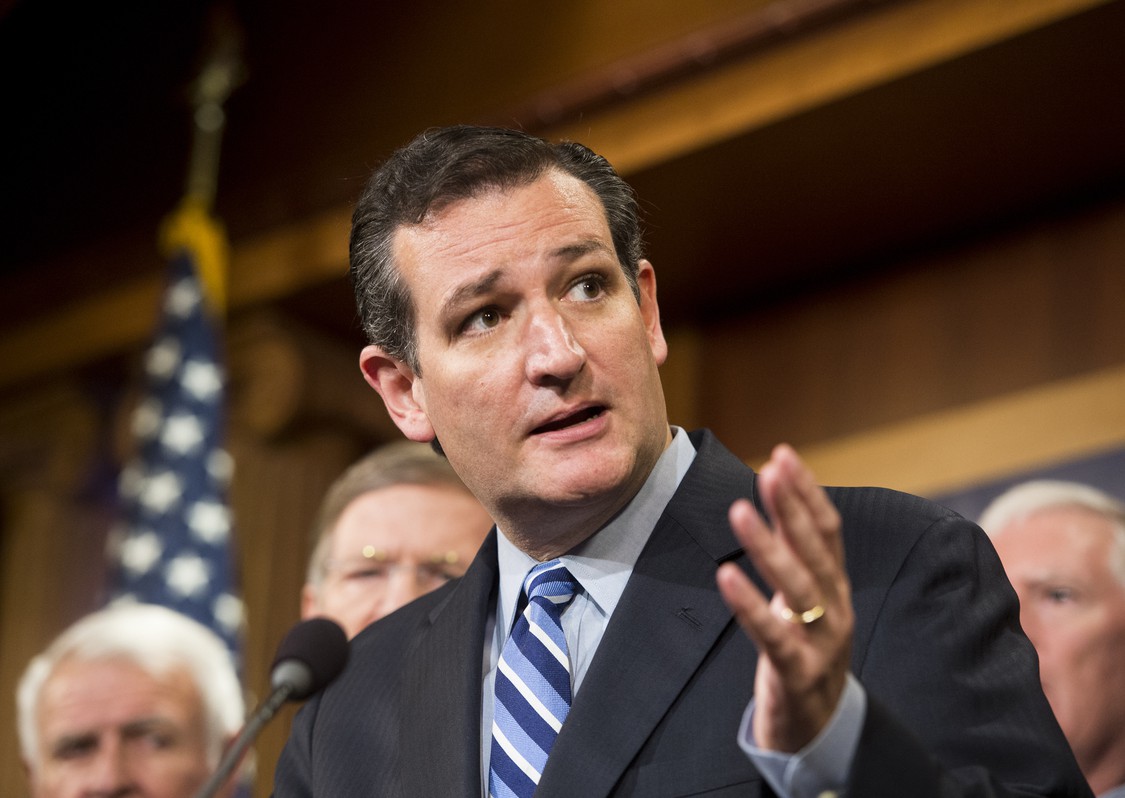
Texas Senator Ted Cruz

Here’s an article from Dan Mitchell of the Cato Institute, published with Forbes magazine. Cato economists are libertarians, so they are good at fiscal policy, but terrible at moral and social issues.

It says:

But here’s the part of Cruz’s plan that raises a red flag. He says he wants a “business flat tax,” but what he’s really proposing is a value-added tax.

His proposal is a VAT because wages are nondeductible. And that basically means a 16 percent withholding tax on the wages and salaries of all American workers (for tax geeks, this part of Cruz’s plan is technically a subtraction-method VAT).

Normally, I start foaming at the mouth when politicians talking about value-added taxes. But Senator Cruz obviously isn’t proposing a VAT for the purpose of financing a bigger welfare state.

Instead, he’s doing a swap, imposing a VAT while also getting rid of the corporate income tax and the payroll tax.

And that’s theoretically a good deal because the corporate income tax is so senselessly destructive(swapping the payroll tax for the VAT, as I explained a few days ago in another context, is basically a wash).

But it’s still a red flag because I worry about what might happen in the future. If the Cruz plan is adopted, we’ll still have the structure of an income tax (albeit a far-less-destructive income tax). And we’ll also have a VAT.

So what happens 10 years from now or 25 years from now if statists control both ends of Pennsylvania Avenue and they decide to reinstate the bad features of the income tax while retaining the VAT? They now have a relatively simple way of getting more revenue to finance European-style big government.

And also don’t forget that it would be relatively simple to reinstate the bad features of the corporate income tax by tweaking Cruz’s business flat tax/VAT.

[…]Notwithstanding my concern about the VAT, Senator Cruz has put forth a plan that would be enormously beneficial to the American economy.

Instead of being a vehicle for punitive class warfare and corrupt cronyism, the tax code would simply be the method by which revenue was collected to fund government.

Rubio ignored all of those details during the debate, and instead accused Cruz of bringing in a VAT tax that is the same as those in Europe, with no other taxes being lowered or eliminated to compensate. It’s dishonest, but he was probably hoping that Cruz would not have time to respond.

Here’s Cruz’s response from the debate last night:

In Rubio’s question, he deliberately misrepresented Cruz’s proposal by neglecting to mention all the taxes that Cruz would eliminate. Dan Mitchell mentioned them. I don’t understand why Rubio is smearing a fellow conservative with such attacks. Unless maybe Rubio is not a fellow conservative at all? I’ll be looking at that more next week.

This is not the first time that Rubio has tried to distort facts in order to smear Ted Cruz. Honestly, I used to have Rubio listed as my 5th choice, but he keeps smearing Cruz with dishonest attacks that are easily cleared up with a little knowledge from experts. I have therefore removed Rubio from my list of candidates.

Debate evaluations

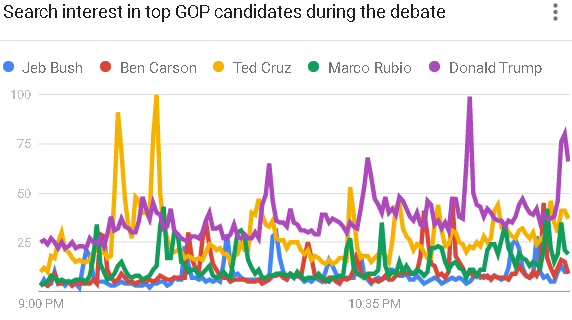
Google Trends shows that the debate was essentially a showdown between Trump and Cruz, based on search engine traffic during the debate:

Google Trends analysis of search terms during Fox Business GOP primary debate

There are some reports out now on who did well in last night’s debate.

And The Weekly Standard has a new podcast up.

Ted Cruz’s scary, unreported, undisclosed Goldman Sachs loan

Texas Senator Ted Cruz

The New York Times reported that Ted Cruz borrowed money from his Goldman Sachs investment account to finance his Senate campaign, then didn’t disclose it. Is their story correct? Let’s see.

Caffeinated Thoughts explains:

The New York Times “broke” a story yesterday about a Goldman Sachs loan that Ted and Heidi Cruz obtained during his run for U.S. Senate that wasn’t reported properly on an FEC filing.  I’vedefended Marco Rubio when New York Times fired garbage at him, and I’ll do the same with Cruz.

This story was one *discovered* from public disclosure forms, and it is a story that alreadyran in 2013.  So the New York Times didn’t run any new news here. All they did was run some opposition research that a rival campaign gave them. *Great* journalism.

This is a non-story. Beyond the fact it is rehashed news taken from public records here are a couple reasons why there’s nothing there.

First, The loan was disclosed. It may not have been on the right FEC form at the right time, but it was made public and it was made public before Cruz’s runoff election against then Texas Lt. Governor Dewey Dewhurst.

The Caffeinated Thoughts article has a public, federal reporting document filed on July 9th, 2012, that has the following entry: “Goldman Sachs Margin Loan”. So this loan was not hidden and undisclosed and secret and scandalous. Cruz simply made an error and didn’t disclose it on another public form.

Newsflash: borrowing on margin is normal

For those of you who invest, like me, you’ll know that anyone can borrow money on margin from their investment brokerage account, although it is not recommended. Goldman Sachs is an investment broker, and you can borrow money on margin if you have a brokerage account with them. You can do the same thing with E-Trade, Ameritrade, ScottTrade, etc. This is not some great mystery. This is a margin loan given to you by your investment brokerage firm, with collateral provided by your investment securities.

Anyway, let’s see Cruz explain it in his own words.

First, on CNN:

Second, here is Cruz’s 2-minute answer from last night

Now, that’s a simple answer that anyone can understand, but the left wants to make it seem sinister and sneaky. There is no question that the left, including the mainstream media, has it in for Cruz. The radically leftist New Republic entitled this story “Ted Cruz Defends His Undisclosed Loan from Goldman Sachs”. The radically leftist New York Times called it “Ted Cruz Didn’t Report Goldman Sachs Loan in a Senate Race”. Associated Press “Cruz Failed To Disclose Goldman Loan On Reports”. Secular Talk “Ted Cruz Took $500k From Goldman Sachs & Didn’t Disclose it”. They don’t have time to report on any of the scandals of the Obama administration – especially Hillary Clinton. But they do have time to make a mountain out of a mole hill about a simple thing like borrowing on margin.

I feel bad for Cruz in the way that he has to answer these deceptive attacks from the leftist media, and then again from Marco Rubio and Donald Trump, who parrot the stories they read in the leftist media. These things are easily explained, but you have to actually understand how real life works. It just depresses me when I think about how hard it is for an honest man to run for office in a world like this. You can’t fight back against these smears… the minute you respond to one, there’s another dozen lies to answer. It’s just depressing.

The best part of the debate

However, I will end this post on a high note. The highlight of the debate last night was that Cruz finally defended himself from Trump’s attacks.

Here is their entire exchange on Trump’s birther argument against Cruz:

Cruz graduated from Princeton and Harvard Law. He clerked for J. Michael Luttig in the 4th District Court of Appeals, then Chief Justice Earl Rehnquist at the U.S. Supreme Court. Two conservative justices. As Solicitor General of Texas, he defended religious liberty, gun rights and other conservative issues in front of the Supreme Court. The man understands Constitutional law.

Here is Frank Luntz’s focus group responding to the exchange:

You can read an assessment of the exchange in the radically leftist New York Times, of all places – which actually gets it right for a change. Headline is “Ted Cruz, Once Dismissed, Emerges as a Slashing Debater”. I’m not kidding.

In any case, I responded to the charge in detail here, citing legal experts on both sides of the political spectrum.