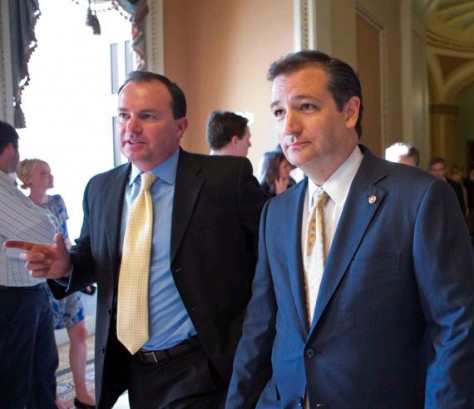
Cruz challenges Trump to one-on-one debate after Trump chickens out of Fox News debate

I think that this little cry-baby wants his pacifier

Story from the non-partisan The Hill.

Excerpt:

Sen. Ted Cruz (R-Texas) said late Tuesday that Donald Trump’s fear of defending his record is behind the GOP front-runner’s boycott of the next Fox News GOP presidential debate.

“The reality is, the reason Donald is doing this – I actually don’t think it’s because of [Fox News host] Megyn [Kelly] at all,” he said on Fox News’s “Hannity.”

“I think it’s because he’s afraid to defend his record, that he knows he can’t defend his record and he’s trying to hide from the voters of Iowa,” Cruz said six days from the early voting state’s caucuses next Monday.

“He’s not willing to stand up and explain why he supports Bernie Sanders-style, full-on socialized medicine, expanding ObamaCare so the federal government is in charge of our healthcare,” he said, tying Trump with the Democratic presidential contender.

“He can’t explain why today he supports taxpayer funding for Planned Parenthood,” the Republican White House hopeful added.

“He can’t explain why he supported [President] Obama’s stimulus plan and supported Obama’s TARP bail-out of the big banks. He doesn’t want to answer those questions, and he refuses to show up.”

[…]Trump announced late Tuesday that he is skipping the seventh GOP presidential debate in Des Moines, Iowa Thursday evening.

I really hope that Trump does agree to a formal debate with Cruz, but honestly, he doesn’t have the balls for it.

Endorsements that matter

I don’t usually blog about endorsements for any candidates, but I will note that Ted Cruz picked up the endorsement of the president of the conservative Family Research Council think tank.

Washington Times reports:

Tony Perkins, president of the Family Research Council, has endorsed Sen. Ted Cruz of Texas for president, calling Mr. Cruz “a constitutional conservative who will fight for faith, family and freedom.”

“I trust Ted to fight to pull America out of the political and cultural tailspin that President Obama’s policies have put us in,” Mr. Perkins said. “This is no normal election; this election is about the very survival of our Constitution and our republic.”

Mr. Cruz said he was “honored” to have Mr. Perkins’ endorsement, calling him “a man of incredible principle and faith.”

Mr. Perkins is currently president of the FRC, which promotes socially conservative values and is one of the most influential conservative advocacy groups in the country.

[…]The Texas senator has also been endorsed by Dr. James Dobson, another social conservative leader, and past FRC President Gary Bauer.

Cruz also has the endorsement of Focus on the Family founder James Dobson. Focus on the Family and the Family Research Council are the groups that most informed my views on social issues, like marriage and right to life. They have an evidence-based approach to social issues. It’s much easier to debate these issues if you use their studies and materials. I can only guess that they think that Cruz is the candidate who is most capable of this style in the public square.

Ted Cruz’s achievements

For those looking for a good summary of Ted Cruz’s achievements as a conservative, there was a good article at Legal Insurrection.

It says:

Prior to winning that senate seat with conservative grassroots and TEA Party support and becoming the first Hispanic to serve as a senator from Texas, Cruz was also the first Hispanic—and the longest-serving person in Texas history—to hold the office of Solicitor General of Texas.

Cruz joined the George W. Bush campaign in 1999 as a domestic policy adviser and advised then-candidate and Governor Bush on a wide range of policy and legal matters, including civil justice, criminal justice, constitutional law, immigration, and government reform.

During the Bush administration, Cruz served as associate deputy attorney general at the DOJ and as a policy adviser on the Federal Trade Commission.  While at the FTC, Cruz was an avid free-market crusader—an extension of his high school participation in the Houston-based Free Market Education Foundation, a program Cruz entered at the age of 13.

At Princeton, where Cruz obtained his bachelor’s degree in Public Policy and shone as a star debater, he wrote his senior thesis on the separation of powers in which he argued that the Founders provided a means, in the Ninth and Tenth Amendments, of protecting the people from a totalitarian central government.

After graduating with honors from Princeton, Cruz attended Harvard Law School, where he not only served as an editor on both the Harvard Law Review and the Harvard Journal of Law and Public Policy but was also a founding editor of the Harvard Latino Law Review.

In his role as Solicitor General of Texas, Cruz successfully defended the constitutionality of the Ten Commandments on the Texas capitol grounds, defended the Second Amendment by arguing that the DC handgun ban infringed on the rights of the people to bear arms, and he defended Texas against an attempt to re-open the cases of 51 Mexican nationals, all of whom were convicted of murder in the United States and were on death row.

[…][H]e ably fought the Rubio-Schumer immigration bill, has repeatedly worked to repeal ObamaCare (including a memorable filibuster in the Senate), and has been vocal in calling out even other Republicans as “campaign conservatives.”

Let me tell you how I would like my life to be like. I would like it if I could open the newspaper and see someone articulate and intelligent advocating for the conservative principles that were built into this country at the Founding – federalism, freedom of speech, the rule of law, judicial restraint, limited government, and so on. I would like to see Supreme Court nominees who interpret the Constitution instead of legislating from the bench. I would like to see fewer regulations and a lower tax burden on working individuals and private sector job creators. I would like to see smaller government and the abolition of public sector unions. I would like to see respect for the religious liberty of Bible-believing Christians.

I don’t think we are going to see any of these things if we nominate Donald Trump instead of Ted Cruz.

Texas prosecutor with link to Planned Parenthood charges pro-life whistleblowers

Planned Parenthood senior executive: organ harvesting so she can get a Lamborghini

The Federalist has the story:

Months after the release of undercover videos detailing Planned Parenthood’s scheme to traffic aborted baby body parts, a grand jury has finally brought brought criminal charges. Not against Planned Parenthood, but against David Daleiden, the pro-life activist behind the undercover sting videos.

A grand jury in Harris County, Texas, returned two charges on Monday afternoon against Daleiden, the activist who planned and organized the undercover sting videos. Although the grand jury allegedly investigated Planned Parenthood, no charges were brought against the nation’s largest abortion provider, whose executives were shown in multiple videos attempting to sell trafficked organs and other body parts harvested from aborted babies. One Planned Parenthood executive, while haggling over the prices of aborted baby organs, noted that she needed to get the right price because, “I want to buy a Lamborghini.”

According to a press release from the office of Harris County district attorney’s office which was provided to The Federalist, Daleiden was charged with the purchase and sale of human organs, a misdemeanor, and with tampering with a governmental record, a felony. Sandra Merritt, one of Daleiden’s associates, was also charged with tampering with a governmental record.

“For more than two months, the 232nd Grand Jury extensively reviewed the joint investigation into allegations of misconduct by PPGC,” stated the press release. “This grand jury cleared PPGC of breaking the law. However, the grand jury did hand down indictments for two individuals who were involved in making the allegations against PPGC public via covert recordings made in April 2015.”

Lauren Reeder, one of the prosecutors in the Harris County district attorney’s office, revealed last August that she was a member of the board of directors for the Planned Parenthood affiliate that was targeted by Daleiden.

Reeder’s LinkedIn page indicates that she has been a Planned Parenthood board member since 2013 and a fundraiser for the abortion provider since 2009.

The maximum sentence for “tampering with a governmental record” (using a fake ID, which almost every teen does) is 20 years.

Well, what happens next? This Houston Chronicle says:

Days after Harris County District Attorney Devon Anderson announced that she was launching a criminal investigation into the Houston-area branch of Planned Parenthood, Anderson said she had learned one of her subordinates was on the board of directors of the agency.

[…]”She will not be involved in any manner in this investigation,” Anderson said. “If at any time in the future, reliable and credible information is brought to my attention that would question our ability to continue to perform a fair, thorough and independent investigation of this matter due to her board membership, I will revisit the issue of seeking the appointment of an independent prosecutor and act accordingly.”

Seems to me that there should be a special prosecutor, because the district attorney’s office is obviously not going to be impartial. Even if the Planned Parenthood woman is not involved directly, she works with the people who are involved. The best thing to do is get a special prosecutor.

Meanwhile, the state of Texas is continuing to investigate Planned Parenthood as a result of the videos.

William Lane Craig discusses faith and reason with university students

William Lane Craig lecturing to university students

This is an interview of Dr. William Lane Craig before college students at the University of Central Florida. (95 minutes)

You can get an MP3 of the lecture here. (33 MB)

Questions from the interviewer: (40 minutes)

  • What started you on his journey of studying faith and reason?
  • How would you define the word “faith”?
  • Are faith and reason compatible? How are they related?
  • How can reasonable faith help us to avoid the two extremes of superstition and nihilism?
  • Who makes the best arguments against the Christian faith?
  • Why are angry atheists like Dawkins and Hitchens more well known than better-informed academic atheists?
  • Does the Bible require Christians to give the unbeliever reasons for their faith?
  • How does faith spur Christians to think carefully about the big questions in life?
  • Should the American church prod churchgoers to develop their minds so they can engage the secular culture?
  • When talking about Christianity intellectually, is there a risk of neglecting the experience of being a Christian?
  • Which Christian apologist has shaped your thinking the most?
  • Which Christian philosopher has shaped your thinking the most?
  • Does the confidence that comes from apologetics undermine humility and reverence?
  • If you had to sketch out a 5 minute case for Christianity, what would you present?
  • Can non-Christians use their reason to arrive at truth?
  • Are there cases where atheists must affirm irrational things in order to remain atheists?
  • Can the universe have existed eternal, so that there is no need to explain who created it?
  • Even if you persuade someone that Christianity is true, does that mean they will live it out?

There is also a long period of questions, many of them hostile, from the audience of students (55 minutes).

  • Haven’t you said nasty things about some atheists? Aren’t you a meany?
  • What do you make of the presuppositional approach to apologetics?
  • Can a person stop being a Christian because of the chances that happen to them as they age?
  • Why did God wait so long after humans appeared to reveal himself to people through Jesus?
  • Can a person be saved by faith without have any intellectual assent to truth?
  • How do you find time for regular things like marriage when you have to study and speak so much?
  • How would you respond to Zeitgeist and parallels to Christianity in Greek/Roman mythology?
  • Do Christians have to assume that the Bible is inerrant and inspired in order to evangelize?
  • If the universe has a beginning, then why doesn’t God have a beginning?
  • Can you name some philosophical resources on abstract objects, Platonism and nominalism?
  • How can you know that Christianity more right than other religions?
  • Should we respond to the problem of evil by saying that our moral notions are different from God’s?
  • Define the A and B theories of time. Explain how they relate to the kalam cosmological argument.
  • How can Christians claim that their view is true in the face of so many world religions?
  • What is the role of emotions in Christian belief and thought?
  • Can evolution be reconciled with Christian beliefs and the Bible?
  • When witnessing person-to-person, should you balance apologetics with personal testimony?
  • Is there a good analogy for the trinity that can help people to understand it? [Note: HE HAS ONE!]
  • How can Christians reconcile God’s omniscience, God’s sovereignty and human free will?

This is a nice introductory lecture that is sure to get Christians to become interested in apologetics. As you watch or listen to it, imagine what the world would be like if every Christian could answer the questions of skeptical college students and professors like Dr. Craig. What would non-Christians think about Christianity if every Christian had studied these issues like Dr. Craig? Why aren’t we making an effort to study these things so that we can answer these questions?

It is really fun to see him fielding the questions from the skeptical university students. My favorite question was from the physics student who sounds really foreign, (at 1:19:00), then you realize that he is a Christian. I do think that Dr. Craig went a little far in accommodating evolution, but I put that down to the venue, and not wanting to get into a peripheral issue. I’m also surprised that no one asked him why God allows humans to suffer and commit acts of evil.

If you are looking for a good basic book on apologetics, then I would choose “Is God Just a Human Invention?” by Sean McDowell and Jonathan Morrow. And you can even be part of a reading group that Brian Auten of Apologetics 315 just announced, that I will be participating in. We will all be reading the book together, chapter by chapter, and lots of people will be available to answer your questions.

Who is William Lane Craig?

About William Lane Craig:

William Lane Craig is Research Professor of Philosophy at Talbot School of Theology in La Mirada, California.

Dr. Craig pursued his undergraduate studies at Wheaton College (B.A. 1971) and graduate studies at Trinity Evangelical Divinity School (M.A. 1974; M.A. 1975), the University of Birmingham (England) (Ph.D. 1977), and the University of Munich (Germany) (D.Theol. 1984). From 1980-86 he taught Philosophy of Religion at Trinity… In 1987 they moved to Brussels, Belgium, where Dr. Craig pursued research at the University of Louvain until assuming his position at Talbot in 1994.

He has authored or edited over thirty books, including The Kalam Cosmological ArgumentAssessing the New Testament Evidence for the Historicity of the Resurrection of JesusDivine Foreknowledge and Human FreedomTheism, Atheism and Big Bang Cosmology; and God, Time and Eternity, as well as over a hundred articles in professional journals of philosophy and theology, including The Journal of PhilosophyNew Testament StudiesJournal for the Study of the New TestamentAmerican Philosophical QuarterlyPhilosophical StudiesPhilosophy, and British Journal for Philosophy of Science.

Craig’s CV is here.

Craig’s list of publications is here.

William Lane Craig is, without a doubt, the top living defender of Christianity. He has debated all of the most famous atheists, including Christopher Hitchens, Sam Harris, etc. as well as academic atheists like Quentin Smith, Peter Millican, etc. if you search this blog, you’ll find many debates posted here, sometimes even with snarky summaries.