Who has done more on the pro-life and pro-marriage issues – Trump or Cruz?

Donald Trump and his friends, the Clintons

This is from the non-partisan The Hill.

Excerpt:

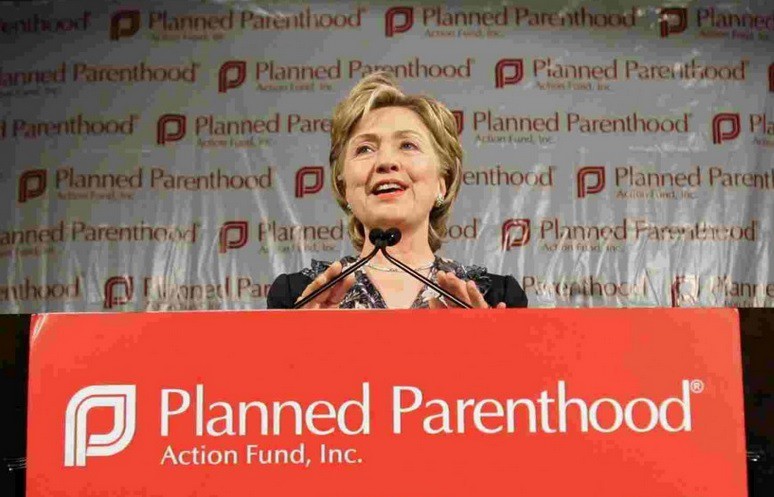
Republican presidential front-runner Donald Trump defended Planned Parenthood during an interview Tuesday night, doubling down on his remarks that part of the group should be funded.

“They do good things,” Trump said during an interview with Sean Hannity that aired on Fox News.

[…]Planned Parenthood praised Trump’s remarks earlier Tuesday when on the question of funding he said on CNN that he would look at other “good aspects” of Planned Parenthood.

“Donald Trump seems to have realized that banning all abortions, shutting down the government, and defunding Planned Parenthood are extreme positions that are way too far outside the mainstream for even him to take,” Eric Ferrero, vice president for communications, said in a statement shared with The Hill.

Now, Donald Trump was pro-abortion for his entire life, until he decided to run as Republican in the 2016 primary. Then he became pro-life. That’s what he says, anyway. So what was his reasoning for becoming pro-life?

Live Action has the quote, and the problem with Trump’s reasoning:

Trump shared the reason behind his claimed pro-life conversion at the first GOP debate:

“Friends of mine years ago were going to have a child, and it was going to be aborted. And it wasn’t aborted. And that child today is a total superstar, a great, great child. And I saw that. And I saw other instances…I am very, very proud to say that I am pro-life.”

Look here – a child’s right to life does not depend on their ability to become a total superstar in the eyes of Donald Trump. He doesn’t understand the logic of the pro-life position.

More Live Action:

In January 2015, when he was asked to define what “pro-life” meant to him, he stated: “It means that it’s an issue. It is an issue, and it’s a strong issue.” When asked if he believed abortion early in a pregnancy was murder, Trump said, “No.” And then, when the questioner continued to press Trump, asking if he would be against abortion if the life of the mother was not at risk and if rape or incest were not involved (his exceptions), he stated, “It depends when,” while continuing to repeat, “I’m pro-life.”

Not convincing.

What about on gay marriage?

Republican presidential candidate Donald Trump says he can see both sides in the case of Kim Davis, the Kentucky clerk who has been ordered to jail for refusing to issue marriage licenses to same-sex couples, but that “the Supreme Court has ruled” on the issue and “it is the law of the land.”

If 5 Justices on the Supreme Court redefine marriage, it’s the law of the land . That’s what Trump says.

Texas Senator Ted Cruz

What about Ted Cruz?

Cruz is pro-life:

  • Cruz has received a 100% rating from the National Right to Life Committee.
  • He voted for numerous defunding measures for Obamacare and Planned Parenthood since being voted in the Senate.
  • He voted in favor of the Child Interstate Abortion Notification Act.
  • He voted for the Pain Capable Unborn Child Protection Act which he co-sponsored.
  • He is a co-sponsor of the Born-Alive Abortion Survivors Act.
    Cruz said that the unborn are “absolutely” persons under the 14th Amendment.
  • Cruz was endorsed by Georgia Right to Life and has signed their personhood pledge.

Here are a few more:

  • In January 2015, Cruz co-sponsored a bill to create a federal ban on abortion after 20 weeks of pregnancy and urged Congress to take up the legislation.
  • In March 2015, Cruz introduced two resolutions of disapproval to the D.C. Ordinances, one, the Reproductive Health Non-Discrimination Amendment Act, could require pro-life organizations to fund abortion services in employee’s health care and could force them to hire someone who supports abortion. The House passed the resolution, but unfortunately, the Senate failed to bring it before committee.
  • In May 2013, Cruz co-sponsored Sen. Mike Lee’s resolution to investigate abortion practices in the US in light of the Gosnell case. He spoke on the floor and condemned Gosnell’s unspeakable crimes.
  • Argued (successfully) before the Supreme Court in defense of the federal ban on partial-birth abortion.
  • Successfully defended in federal court Texas’s Rider 8, which prohibits state funds for groups that provide abortions.

Cruz has also been active on the marriage issue:

  • In April 2015, Cruz introduced a marriage amendment and bill to defend states that define marriage as between one man and one woman.
    • The Restoration of Marriage Amendment amends the Constitution to guarantee the right of the people to define marriage in their laws as the union of one man and one woman and to prevent the courts from ever again misconstruing the Constitution to require that marriage or its benefits be extended to unions other than the union of man and woman.
    • The Protect Marriage from the Courts Act of 2015 bars federal courts from ruling on state marriage laws. Pursuant to Congress’ power under Article III of the Constitution to limit the jurisdiction of the lower federal courts and to make exceptions to the appellate jurisdiction of the Supreme Court, this legislation restricts the jurisdiction of federal courts to determine the constitutionality of state laws defining marriage as the union of one man and one woman.
  • In April 2015, Cruz joined an amicus brief supporting the right of states to define marriage
    • Summary: defending states’ marriage laws against the proposed right under the 14th amendment that all same-sex couples have the right to marriage
  • In February 2015, Cruz reintroduced the State Marriage Defense Act. He originally introduced it in February, 2014.
  • Cosponsored the First Amendment Defense Act, which would prevent any federal agency from denying a tax exemption, grant, contract, license, or certification to an individual, association, or business based on their belief that marriage is a union between a man and a woman.

Regarding that last item, Trump was asked whether he would pass Cruz’s First Amendment Defense Act in his first 100 days in office, and he said no. Cruz said yes, by the way – which is not surprising since he sponsored the act in the first place.

And on the Kim Davis issue, Cruz put religious liberty above judicial tyranny.

Listen to him discuss it on the Mark Levin show:

And on the Megyn Kelly show:

Now listen to Donald Trump:

Does any Trump supporter really believe that he would defend religious liberty as well as Cruz?

CBO: national debt will rise to $30 trillion in the next decade

Democrats took control of government spending in 2007

The Washington Times has a warning for all the young voters who are freaking out over the spending promises of Hillary Clinton and Bernie Sanders.

Here it is:

The federal government will be flirting with $30 trillion in debt within a decade, the Congressional Budget Office reported Monday, blaming an aging population, new spending and tax cuts approved on Capitol Hill, and the growing burden from Obamacare for erasing the progress Washington had made over the past few years.

Analysts said Obamacare will chase more workers out of the labor force over the next five years, adding pressure to an economy still struggling to spring to life more than seven years into the Obama recovery.

The Affordable Care Act itself is still struggling to attract a customer base, the CBO said, lowering its estimate for the number of people who will sign up for the exchanges from 21 million to 13 million — a drop of nearly 40 percent in projections. Customers collecting taxpayer subsidies this year will be 11 million, down from the 15 million the CBO projected a year ago.

[…]Deficits will continue to rise over the next 10 years, topping $1 trillion again in 2022 and reaching $1.4 trillion in 2026, the analysts said.

Basically, we’ve dug ourselves into a whole with all this spending – taking money out of the productive private sector and giving it to the wasteful public sector.

How wasteful?

This wasteful:

The National Aeronautics and Space Administration is spending $80,000 to see what effects space flight has on oral herpes.

The federal space agency has awarded multiple grants and contracts to a researcher at the University of Florida to determine the “Effect of Spaceflight on Herpes virus Genome Stability and Diversity,” beginning last summer. The project recently received an additional $15,000 in December.

“The goal of this study will be to determine the changes in the genomic and mutational diversity that is present in the Herpes virus virome present in astronaut saliva and urine samples collected before, during, and after space flight,” according to NASA’s description of the research. “Ground subjects will serve as the control group providing saliva and urine samples preflight and postflight during the same schedule as the astronauts.”

That $80,000 was taken from private sector businesses and individual families. They could have spent it on jobs, innovation or consumer spending. But instead the government took it and wasted it on garbage.

Texas Senator Ted Cruz

There is someone who has a plan to deal with these deficits. And his plan is to shut down or scale back many government departments.

Ted Cruz:

For the individual income tax under his tax reform, Cruz’s plan provides for one flat rate of 10% on everything – wages, capital gains, dividends, personal business income, rent, interest, and all other forms of individual income. The corporate income tax would be abolished, and replaced with a 16% Business Flat Tax, which applies to sales of goods and services, minus all purchases and expenses for inputs for production. It automatically provides for immediate “expensing,” or an immediate deduction for all purchases of plant and equipment, and all other capital investment, which inherently involves purchases of inputs from other businesses. It is essentially a consumption tax for business.

That net business tax, which also automatically abolishes all special-interest, corporate-welfare loopholes, raises an enormous amount of revenue, $25.4 trillion over the first 10 years alone. This enables the plan to include abolishing the Social Security and Medicare payroll tax, which is the highest tax most working people pay, with Social Security and Medicare financed in full. It also enables the plan to include abolishing the death tax, the Alternative Minimum Tax, and all Obamacare taxes, as well as the corporate income tax. With a standard deduction of $10,000 per adult, and a $4,000 personal exemption, the first $36,000 of income for a family of four would be exempt from all significant federal taxes.

Because such tax reform would be enormously pro-growth, the Tax Foundation scores it on a dynamic basis as a net tax cut of $768 billion over the first 10 years. The Tax Foundation, which has developed a formal, sophisticated, and thorough economic model of the economy, estimates Cruz’s tax reform would create nearly 5 million new jobs, increase wages by 12%, and increase real economic growth over the next decade by nearly 14% more than under current tax policies. The after tax income of all workers would increase by 21.3% on average, with those in the bottom 20% of the income ladder seeing income increases of 15.3%.

Cruz intends to pay for these tax cuts by reducing the size and scope of government – pushing many federal responsibilities down to the state level, where there is more accountability to the people.

The four agencies are the standard four that most conservatives want to abolish or streamline:

  • Department of Energy (raises energy prices for individuals and businesses)
  • Department of Commerce (hands our taxpayer money to businesses favored by big government)
  • Department of Education (indoctrinates children in big government dogma, e.g. – global warming)
  • Department of Housing and Urban Development (caused the housing bubble recession by forcing banks to loan money to unqualified individuals, then bailed them out with taxpayer money)

Many other smaller government departments would be streamlined or eliminated. There would be a hiring freeze in the federal government, and pay increases would be based on merit, not tenure. Cruz would also save a trillion dollars over 10 years by repealing Obamacare, and replacing it with a consumer-driven alternative.

Although young people are in love with the idea that government will give them things by taxing others, that’s not sustainable. They ought to be voting for someone who wants to cut spending and cut government.

How do atheists try to accommodate the Big Bang in their worldview?

J. Warner Wallace: God's Crime Scene
J. Warner Wallace: God’s Crime Scene

OK, so J. Warner Wallace has a new book out and it’s about science and God.

I wanted to link to something about Lawrence Krauss trying to accommodate the Big Bang within his worldview of atheism.

Wallace writes:

One of the key pieces of evidence in the universe is simply it’s origin. If our universe began to exist, what could have caused it’s beginning? How did everything (all space, time and matter) come into existence from nothing? One way atheist physicists have navigated this dilemma has simply been to redefine the terms they have been using. What do we mean when we say “everything” or “nothing”? At first these two terms might seem rather self-explanatory, but it’s important for us to take the time to define the words. As I’ve already stated, by “everything” we mean all space, time and matter. That’s right, space is “something”; empty space is part of “everything” not part of “nothing”. For some of us, that’s an interesting concept that might be hard to grasp, but it’s an important distinction that must be understood. When we say “nothing”, we mean the complete absence of everything; the thorough non-existence of anything at all (including all space time and matter). These two terms, when defined in this way, are consistent with the principles of the Standard Cosmological Model, but demonstrate the dilemma. If everything came from nothing, what caused this to occur? What is the non-spatial, atemporal, immaterial, uncaused, first cause of the universe? A cause of this sort sounds a lot like a supernatural Being, and that’s why I think many naturalists have begun to redefine the terms.

Lawrence Krauss, Arizona State University Professor (School of Earth and Space Exploration and Director of the Origins Initiative) wrote a book entitled, “A Universe from Nothing: Why There Is Something Rather than Nothing”. As part of the promotion for the book, Krauss appeared on the Colbert Report where he was interviewed by comedian Stephen Colbert. During the interview, Krauss tried to redefine “nothing” to avoid the need for a supernatural first cause:

“Physics has changed what we mean by nothing… Empty space is a boiling, bubbling brew of virtual particles popping in and out of existence… if you wait long enough, that kind of nothing will always produce particles.” (Colbert Nation, June 21st, 2012)

Now if you’re not careful, you might miss Krauss’ subtle redefinition. In describing the sudden appearance of matter (“particles”), Krauss assumes the prior existence of space (“empty space”) and time (“if you wait long enough”). If you’ve got some empty space and wait long enough, matter appears. For Krauss, the “nothing” from which the universe comes includes two common features of “everything” (space and time), and something more (virtual particles). This leaves us with the real question: “Where did the space, time and virtual particles come from (given all our evidence points to their origination at the beginning of our universe)?” Krauss avoids this inquiry by moving space and time from the category of “something” to the category of “nothing”.

If you’ve got a teenager in your house, you might recognize Krauss’ approach to language. I bet you’ve seen your teenager open the refrigerator door, gaze at all the nutritious fruits and vegetables on the shelves, then lament that there is “nothing to eat.”

I used to say that when I was a teenager, but I grew out of it. I didn’t go on the Comedy Channel and try to convince everyone that what I was saying about the refrigerator was scientifically accurate.

Anyway, here is a debate between William Lane Craig and Lawrence Krauss, if you want to see how Krauss defends his “refrigerator has nothing to eat” view of cosmology. I know everybody and even many Christians all think that we have something to hide when it comes to science, but if you would just watch these debates, you would see that there is nothing to fear from science at all. We own it.

Meanwhile, I want to show you that this is not at all rare among atheists.

Look, here is Peter Atkins explaining how he makes the Big Bang reconcile with his atheism – and notice that it’s a completely different view than Krauss:

So, just who is this Peter Atkins, and why is he a good spokesman for atheism?

From his Wikipedia bio.

Peter William Atkins (born August 10, 1940) is an English chemist and a fellow and professor of chemistry at Lincoln College of the University of Oxford. He is a prolific writer of popular chemistry textbooks, including Physical Chemistry, 8th ed. (with Julio de Paula of Haverford College), Inorganic Chemistry, and Molecular Quantum Mechanics, 4th ed. Atkins is also the author of a number of science books for the general public, including Atkins’ Molecules and Galileo’s Finger: The Ten Great Ideas of Science.

[…]Atkins is a well-known atheist and supporter of many of Richard Dawkins’ ideas. He has written and spoken on issues of humanism, atheism, and what he sees as the incompatibility between science and religion. According to Atkins, whereas religion scorns the power of human comprehension, science respects it.

[…]He was the first Senior Member for the Oxford Secular Society and an Honorary Associate of the National Secular Society. He is also a member of the Advisory Board of The Reason Project, a US-based charitable foundation devoted to spreading scientific knowledge and secular values in society. The organisation is led by fellow atheist and author Sam Harris.

Now watch that 6-minute video above. Peter Atkins thinks that nothing exists. He thinks he doesn’t exist. He thinks that you don’t exist. This is how atheism adapts to a world where the Big Bang creation event is fact.

I think Peter Atkins should join Lawrence Krauss on the Comedy Channel and present that view. I would laugh. Wouldn’t you?