Study: homeschooled children less likely to leave their faith

A family praying and reading the Bible

Lindsay, a super-mom who homeschools her kids with her super-husband Doug, sent me this article from Christian News.

Quick blurb:

The recently-released findings from an in-depth study of nearly 10,000 young adults show that Millennials who were homeschooled are less likely to leave the faith than individuals who attended private or public schools.

Late last month, Generations with Vision and the National Home Education Research Institute published the results of their Gen2 Survey. The study explores the correlations between different educational methods and the spiritual decisions of Millennials who were raised in the church.

“The purpose of the study is to examine these adults who were churched growing up and to understand the key influences which either encouraged or deterred them from believing and practicing the faith of their parents,” said the survey’s director and lead researcher, Dr. Brian Ray.

Using a sample size of 9,369 18-to 38-year-olds who were churched while growing up, the Gen2 Survey collected data on Millennials’ educational backgrounds, worldviews, and religious beliefs. The study found that individuals who were homeschooled, attended church regularly, and had good relationships with their parents were most likely to remain involved in the Christian faith.

“Having a strong relationship with the child’s mother and father, attending church as a child, and years homeschooled were all clearly positively associated with Millennials’ basic Christian orthodoxy, broader biblical beliefs, Christian behaviors (e.g., attending church, keeping sex in marriage, prayer, not using pornography), satisfaction in life, civic and community involvement, and having beliefs similar to one’s parents,” Ray stated.

87% of study participants who were homeschooled said they have strong Christian beliefs. Conversely, Millennials who were enrolled in public schools or private Christian schools were more likely to walk away from the faith later in life.

“Number of years in Christian school and number of years in public school were negatively associated with most of the adult beliefs and behaviors just mentioned,” Ray explained.

Statistically, homeschooled young adults were six times as likely to be believers and seven times as likely to be stronger in their Christian beliefs as Millennials attending private schools. Homeschooled Millennials were also two times as likely to be stronger in Christian beliefs as those who attended Christian schools or public schools.

I find that when I court Christian women, they pretty much have the idea that kids are are for providing fun for their parents. And if you make a plan to make them achieve anything, then that is bad because it’s less fun for the parents. Sometimes they try to dress it up in emotional or religious language when they are explaining it to others, but under cross-examination, it really turns out to be “marriage and parenting are better when we do whatever I feel like moment by moment”. If the man does not step up during the courtship with the research and get agreement on issues like homeschooling, then he needs to shut it down and move on. Women who are guided by their feelings instead of studies in decisions about how to parent are not safe to marry. Either they accept the the best practices from research, or they are out of the running.

Of course, that necessarily means finding a wife who has done a decent degree, worked a few years, and saved up enough money to help you to keep her at home with young children. I am seeing a lot of men in my office who have decent salaries, but they still can’t keep their wives at home, because their wives ran up $200,000 in student loans (this actually happened to my co-worker Javier). Other times, I see grown women into their mid-30s, still carrying tens of thousands in student loans, and refusing to get a full-time job in their field (this actually happened to a missionary I know who refused to work any job but waitress / bartender). Sometimes, the woman just doesn’t want to stay home, because she likes the feel of earning her own money instead of being dependent on her husband. That screws the kids as well, but it’s a very popular attitude today. These are the things that a man has to check for before he marries – and remember that there is often a great gulf between words and past actions. Don’t be fooled by someone who talks about what they will do in the future, when their past is completely different.

So if a couple determines that they are going to have no strict approach to how to parent the kids, then they should not be surprised their children fall away from the faith. Either you are aware of who is teaching your kids, and what they are teaching them, or you are not. It is no coincidence that the secular left pushes for earlier and earlier starts to schooling and more and more free college. They know that the more they get the kids away from their parents and in with peers of the same age and secular leftist professors and teaches, the more those kids are likely to adopt their values – not the values of their parents. Not the values of grown-ups who have to survive in the real world with common sense.


What’s a good sign that a person wants to go Heaven, and will like it there?

Church is good for you
Find a church that doesn’t have the problems that you complain about

The Dina tweeted this column by Matt Walsh yesterday, and I am not sure how much I agree with it, but I found it very interesting.

Matt writes about how most American Christians think that they will go to Heaven either because 1) they have done “good” things or 2) you have faith in Jesus (without letting your faith in Jesus impact your life in any way that goes against your self-interest). He doesn’t think that either of those really mean that you will fit into Heaven.

He writes:

We do good things, we reassure ourselves. We believe. We’ll be fine. But “believing” and being a generally nice guy don’t matter on their own. What matters is to love Christ. If I don’t love Christ but I still give to charity because it makes me feel good, I’m no closer to Heaven than I would be if I were a bank robber. And if I don’t love Christ but I still believe that He exists and He is Lord, I am no closer to Heaven than I would be if I were an atheist. In fact, I’m probably much further away (“Even the demons believe”).

[…]Heaven is not for those who merely believe in God or perform wonderful deeds in His name, but for those who truly wish to do nothing but love and serve Him for all eternity. In other words, Heaven is for those who actually want to go. And we only want to go to Heaven if we want a life that is completely consumed by Christ and nothing else. If we want a life that is only partly Christ, we don’t want Heaven. We may as well admit it now while there’s still time: We don’t want Heaven.

If Christ is not even close to our primary joy in life, how can we go to a place where He is the only joy? If we are content to make Christ only a part of our lives here, how can we go to a place where there is no life but Him?

[…]Many of us think we desire Heaven because we imagine it as a place of self-centered pleasure. We believe that the happiness of Heaven is much like the happiness we find on Earth. So, if we enjoy eating good food, watching movies, playing sports, whatever, we fantasize that Heaven will be like some sort of resort where we can eat all the cheesecake we want and have access to an infinite Netflix library and maybe toss the pigskin around with Johnny Unitas on a football field in the clouds. And if this is the only kind of happiness we desire — a selfish, indulgent kind of happiness — then we clearly do not desire the happiness of Heaven.

[…]John Henry Newman once suggested that our attitude towards church is a pretty good indication of how much we really desire Heaven, and how much we’d actually enjoy it if we went there. As he pointed out, we cannot expect to find happiness in Heaven if we detest going to church, praying, and reading the Bible. If we find religion to be a crashing bore, and are stimulated only by what is selfish and secular, how do we think we’ll fare in a place where the only things we really love are obliterated, and the one thing we always avoid must now be the center of our existence forever?

If all the things that are purely about God in this life are, to us, dull and uninteresting, and all we do is bide our time until we can get back to the TV, then Heaven would be torture. There would be no leaving God to get back to the TV. It would be only God always. If we find little appeal in spending even a few minutes with God now, how can we expect that we’ll find any appeal in spending infinity with Him?

This is the problem with people who say they don’t pray, attend church, or read Scripture, but they go on walks instead, or spend time with their families, or go to the beach, and that’s where they “find God.” It’s true that God can be found in all of those things, but you can also enjoy them without thinking about God at all. There are only a few activities in life that are purely, solely, and inevitably about God and God only, and those are the activities many Christians enjoy least of all. Most of us can’t stand to worship the Lord unless it’s in the context of some relaxing and entertaining recreational activity, yet we still claim to desire Heaven.

No, it’s not Heaven we want. It’s a vacation.

I have always railed against the feminized church and pious anti-intellectual man-blaming pastors, but that was only because those were the only churches and pastors I had encountered. After moving a few months ago to a red state, I started attending a new church, based on their past apologetics-oriented activities, and the intellectual ability of the pastor. Since trying this new church, I’ve found it no problem at all to show up every Sunday for the service and for Sunday school. And I don’t feel anything awful about it.

I’ve been really blessed lately, red state, great new job, and achieving financial independence at last. I wanted to reconnect with God and so I went out and found a decent church. The whole point of me going there was to hear the hymns, think about the sermons, and read the parts of the Bible that I don’t normally read. I wanted a refresher on the character of my Boss, so that I could make better decisions that would respect him.  Jesus has been my Boss a long time. It never hurts to go back and find out what the Boss is like.

Dina and all my friends are happy that I am going to church. And I hope all my friends understand now why I wasn’t going much before. The problem was that there were no churches where I used to live that had intelligent pastors AND that were hosting apologetics events AND that equipped members of the flock to engage in public debates with atheists. This church does those things.

It doesn’t hurt that I get to wear a shirt and tie, or that the worship service has so many great classical hymns that don’t blow out my eardrums (I really hate dark churches with loud contemporary music!). Of course I was going to go to church, people – I just had to find a good one first. And that was their problem to solve, not mine.

Whose policies are responsible for the Islamic State terrorist attack against children?

Muslim populations in Europe

First, the news story from the UK Telegraph.

Excerpt:

Salman Abedi, 22, who was reportedly known to the security services, is thought to have returned from Libya as recently as this week.

Devout Muslim:

He had become radicalised recently – it is not entirely clear when – and had worshipped at a local mosque that has, in the past, been accused of fund-raising for jihadists.

Abedi’s older brother Ismail had been a tutor at Didsbury mosque’s Koran school. The imam last night said that Salman Abedi, who wore Islamic dress, had shown him “the face of hate” when he gave a talk warning on the dangers of so-called Islamic State.

A family friend described him as “very religious”.

Parents were Islamic refugees:

Born in 1994, the second youngest of four children, Abedi’s parents were Libyan refugees who fled to the UK to escape Gaddafi.

Well educated:

Abedi went to school locally and then on to Salford University in 2014 where he studied business management before dropping out.

He lived in a “red-brick terrace” home with his parents. No poverty to speak of.

Wall Street Journal says:

Islamic State on Tuesday claimed responsibility for the attack, the deadliest in the U.K. since 2005.

[…]In a statement published online, Islamic State said the attack was revenge for “aggression toward Muslim countries” and identified the assailant as a “soldier of the caliphate.”

The root problem is, of course, the open borders immigration policies enacted by the Labour Party of the UK. It was their attempt to tilt the electorate away from the free enterprise system, towards government dependency. And it worked. Of course, if a few UK citizens have to die for the far left Labour Party to win election after election… so be it, right?

Sober-minded Christian writer David French commented on this story at National Review:

While it’s impossible to predict any given terror attack, there are two laws of terrorism that work together to guarantee that attacks will occur, and they’ll occur with increasing frequency. First, when terrorists are granted safe havens to plan, train, equip, and inspire terror attacks, then they will strike, and they’ll keep striking not just until the safe havens are destroyed but also until the cells and affiliates they’ve established outside their havens are rooted out. Second, when you import immigrants at any real scale from jihadist regions, then you will import the cultural, religious, and political views that incubate jihad. Jihadist ideas flow not from soil but from people, and when you import people you import their ideas.

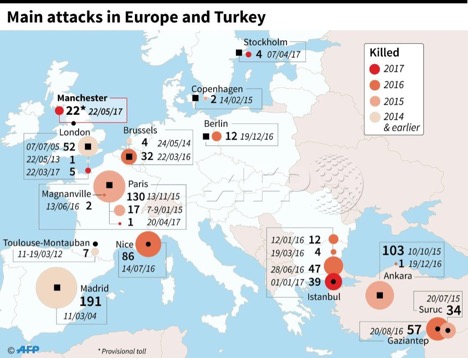
Let’s look at how these two ideas have worked together in both Europe and America. The map below (from AFP) charts significant terror attacks in Europe (including Turkey). You’ll note a significant increase in activity since 2014, since ISIS stampeded across Syria and into Turkey and established a terrorist caliphate in the heart of the Middle East. There existed a safe haven and a population to inspire back in Europe. The result was entirely predictable:

This is the predicable result he mentions:

Map of terrorist attacks in EuropeMap of terrorist attacks in Europe

And this is significant:

What about the United States? A similar phenomenon was in play. This Heritage Foundation timeline of terror attacks and plots documents a total of 95 incidents since 9/11. The numbers are revealing. After the implementation of the (now) much-derided Bush strategy, there were a grand total of 27 terror attacks and plots — almost all of them foiled.

After the end of the Bush administration, the numbers skyrocketed, with 68 plots or attacks recorded since. A number of them, including the Fort Hood shooting, the Boston Marathon bombing, the San Bernardino mass murder, and the Orlando nightclub massacre, have been terrifying successful. Indeed, there have been more domestic terror plots and attacks since the rise of ISIS in the summer of 2014 than there were in the entirety of the Bush administration after 9/11. And make no mistake, jihadist terrorists are disproportionately immigrants and children of immigrants.

What did Bush do that was so successful? He not only pressed military offensives in the heart of the Middle East, he fundamentally changed the American approach to immigration and implemented a number of temporary measures that, for example, dramatically decreased refugee admissions and implemented country-specific protective measures that have since been discontinued.

You’ll recall that Islamic State was caused by Barack Obama’s decision to retreat from Iraq. The refugee crisis worsened because of his other failed interventions in Libya and Syria. This is what happens when people are carried away by a happy-sounding “anti-war” message. Wiser voters thought about what would happen if we pulled out of Iraq, and voted against Obama. The wiser voters lost.

Speaking of Democrats, I wonder if Barack Obama and his Democrat supporters will call this terrorist attack “workplace violence”, like he did with the Fort Hood terrorist attack by Major Nidal Hassan? I’ve talked to a few Democrats about immigration from countries with a significant population of radicalized Muslims, and they are all in favor of increased immigration from those countries. Democrats are more scared of pro-marriage, pro-life Christians than of Islamic terrorists. After all, it’s not them dying in these attacks. Give them their gay marriage and their free birth control.

But I’m also noticing a lot of Christians trying to appear generous and compassionate lately, by embracing the same open borders policies as the progressives. They’re claiming generosity and compassion in public by spending other people’s money and risking other people’s lives. This is especially popular among Christians in academia, seeking to curry favor with their secular colleagues. For many Christian leftists like Russell Moore, embracing open borders immigration policy, is a quick way to avoid charges of lacking compassion. Except nobody ever asks these pious Christians who has compassion for the victims of their policies.

Finally, national security expert Andrew C. McCarthy notes that the current Republican administration’s efforts to vet incoming immigrants from Muslim countries has been opposed by Democrats in the judiciary, and far-left civil rights groups. Republicans are trying to prevent terrorist attacks like this at home, but they are opposed at every turn by naive Democrat voters who are more interested in feeling good and looking good than in protecting the victims of terrorist attacks. You can’t have it both ways when it comes to national security.