
Marine Captain earned Medal of Honor fighting communists in North Korea

First, let’s go from the top down to set the context for the profile of William E. Barber.
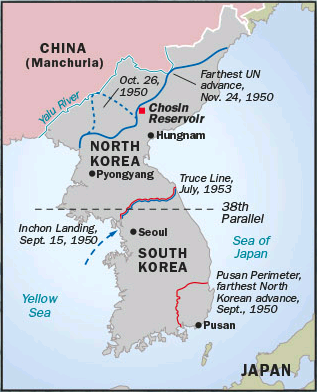
Map of the Korean War

In the summer of 1950, North Korean communists launch a completely unprovoked attack across the 38th parallel against their peaceful, democratic neighbors, the South Koreans. The Americans immediately sent an invasion force by sea to drive them out. The North Koreans easily manage to take over the capital Seoul, and the allies are left with only one port in the southeast – Pusan. In September of 1950, American forces land an invasion force at Inchon, cutting off the North Korean invasion force surrounding Pusan. The North Koreans retreat, and there is hope that American forces will be home by Christmas. But then, unbeknownst to the Americans, the Chines communists  invade North Korea from the north and surround the American forces near the Chosin reservoir, threatening to annihilate an entire Marine division.
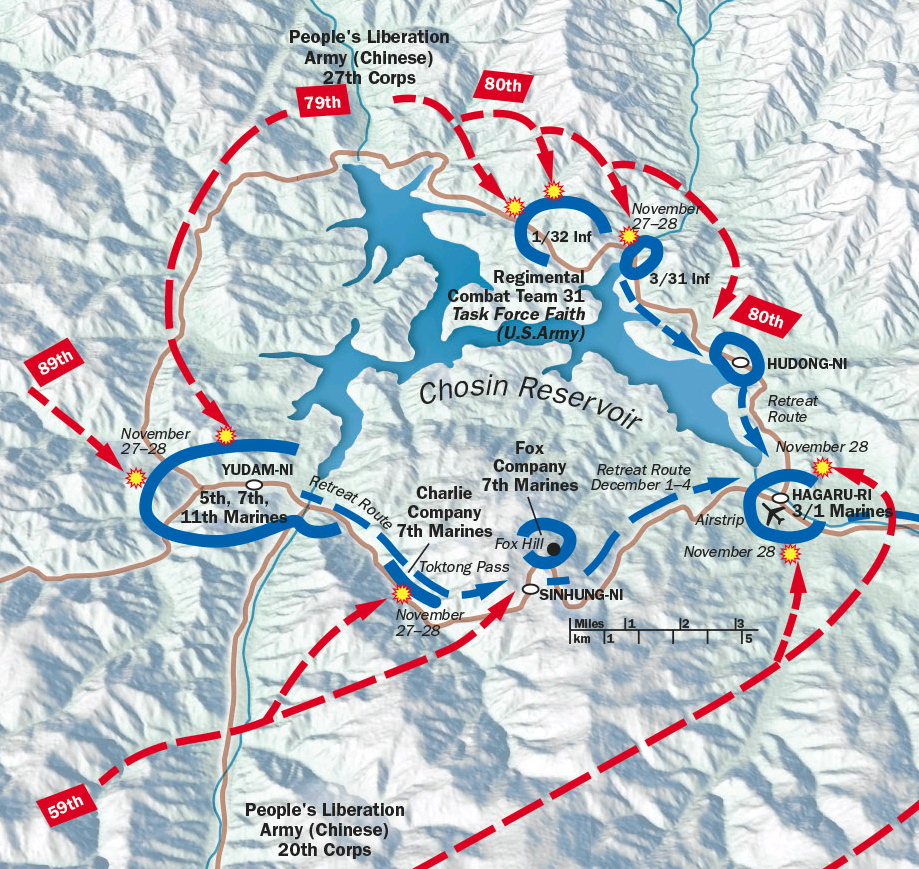
The Marines at Yudam-Ni are surrounded and must retreat to Hagaru-Ri

As you can see from the map, there are a whole bunch of American troops fighting to the north/east and south/west of the Chosin Reservoir. The marines near Yudam-Ni need to retreat along a road called the MSR (main supply road) back to Hagaru-Ri. But in order to conduct that retreat, they have to hold onto the vital Toktong pass, which is overwatched by Fox company from their position on Fox Hill. Can Charlie company and Fox company hold off the entire Chinese 59th division (10,000 men) with only two companies (about 250 men each)?
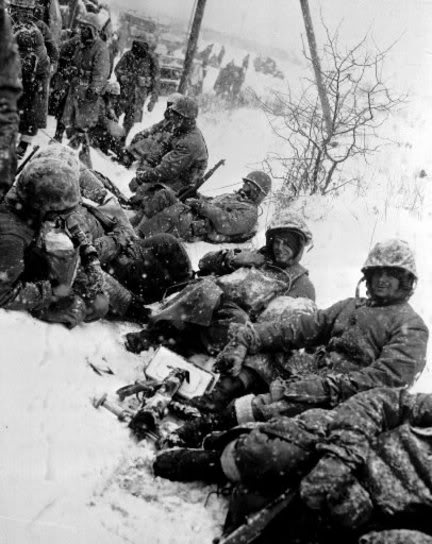
U.S. Marines "The Chosin Few", December 1950
U.S. Marines “The Chosin Few”, December 1950

Well, the book I read (which Dina gave me for Christmas), was about Fox company and their defense of the Toktong pass. This is what the leftist New York Times had to say about the man in charge of Fox company (“F company”) in a 2002 article:

Col. William E. Barber, who won the Medal of Honor for his leadership of a vastly outnumbered company under siege on a snowy hilltop in one of the worst defeats in Marine history, the Battle of the Chosin Reservoir in 1950, died on April 19 at his home in Irvine, Calif. He was 82.

The cause was bone-marrow cancer, said Jerry Courtier, a friend who hopes to write Colonel Barber’s biography.

The reservoir is south of the Yalu River, which separates North Korea from China. After the Americans had pushed the North Koreans almost to the Yalu, 150,000 Chinese troops unexpectedly crossed the river into North Korea. Colonel Barber’s unit, Company F of the Second Battalion of the Seventh Marines, First Marine Division, was on a hill that commanded the Toktong Pass, a vital gap between Yudam Ni and Hagaru Ri, two towns separated by 78 miles.

The stakes were huge. If F Company yielded its position, 8,000 marines at Yudam Ni would be cut off from the 3,000 at Haguru Ri by tens of thousands of Chinese troops.

Through five days and six nights in subzero weather and often swirling snow, Colonel Barber, then a captain, inspired his men, outnumbered more than five to one, to cling to their tenuous positions. He was shot in a bone near his groin on the second day but continued to make the rounds of the hill. He likened the wound to a bee sting.

When the unit was ordered to withdraw and fight its way to safety, Captain Barber refused. Three times, the enemy broke through the line, only to be repulsed.

”I knew that we could probably hold, and I knew that if we didn’t hold we could exact a very heavy toll,” he said in an interview in 1976 with The Los Angeles Times.

His citation for the nation’s top medal said that he commanded his men from a stretcher. But Hector A. Cafferata Jr., who as a rifleman won the Medal of Honor in the same battle, insisted that Captain Barber refused the stretcher.

”He walked the line, he kept us together,” said Mr. Cafferata, who was beside Captain Barber when he was shot.

In the mayhem, the Chinese blew whistles, beat cymbals and tooted bugles as they repeatedly attacked. Coffee froze before men could drink it, and some of the wounded died because plasma froze with no way to thaw it.

When the battle was over, more than 1,000 enemy soldiers were dead. Of Captain Barber’s original 240 men, 82 were able to walk away.

Gen. Raymond G. Davis, who was a lieutenant colonel in the Marines, received a Medal of Honor for leading the unit that rescued F Company.

William Earl Barber was born on Nov. 30, 1919, in Dehart, Ky. He attended what is now Morehead State University in Morehead, Ky., for two years and enlisted in the Marines, at the age of 21, in 1940.

He was so good at shooting a rifle that he was made a weapons instructor. After volunteering for parachute training, he demonstrated such proficiency that he became a parachute instructor.

In World War II, he was promoted to sergeant in 1942 and commissioned a second lieutenant in 1943. He was a rifle platoon commander at Camp Pendleton, Calif., when his unit was shipped to the Pacific.

Colonel Barber was in the first wave to hit Iwo Jima, where he was wounded twice. He received the Silver Star for bravery in addition to two Purple Hearts. At a ceremony on the 50th anniversary of the battle in 1995, he said:

”I am older now, as you are, but I can still see the colors of that February morning. The sky. The island. And sometimes I think I can hear the noise of battle.”

He was treated in Japan for his wounds and returned to the United States, where he worked as a recruiter, among other positions. He was promoted to captain in 1949 and was in the force that occupied Japan.

When he joined F Company in Korea, he saw a raggedy unshaven bunch and immediately ordered the the troops to shave, shine their shoes and look like marines. He suggested that his new charges resembled Pancho Villa’s bandits.

”He was one tough guy,” Mr. Cafferata said. ”He was by the book.”

He was by the book. He enlisted in the Marines because he was grateful to his country for allowing him to escape poverty and go into college, and he wanted to give something back.

You can read a review of the book I read about Fox company, and read about some of the details of what it was like for those men. You’ll never look at your own troubles the same way again. You can also read about Barber’s Medal of Honor citation here.
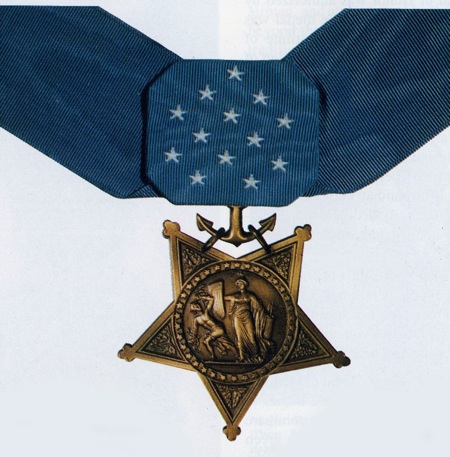
The Medal of Honor, Navy and Marines variant

So, now that I am done with that book, I have moved on to another Korean War book that Dina gave me, this one about George company. The Korean War might have been our most just war – defending a peaceful democratic ally from a totalitarian communist regime. You just have to compare North Korea and South Korea today to understand the stakes. North Korea is basically a godless concentration camp that tortures and murders its people if they so much as think the wrong thoughts about the atheist state. South Korea is free and prosperous, where the people have human rights, like the right to free speech and freedom of religion.

It’s important for me to read about the hardships that real heroes face, so that I don’t complain too much about my own tiny struggles. When you read about the struggles of great American soldiers, so many good things happen to you. Your own problems get smaller, your humility and gratitude get bigger. And you are reminded about why America is a great country, and what American character is really like. These things are not taught by leftists in the public schools. They are not talked about by leftists in the mainstream media. They are not presented by leftists in the Hollywood film industry. If you want to know the real America, you have to find it yourself.

The importance of Christian men setting an example of benevolent authority

A conflict of worldviews

I think that children are more likely to accept theism if they have a father who is able to lead them in a loving, caring way. And I also think that children who grow up with an authoritiarian or absent or defective father are more likely to reject theism. The father needs to be strong. The father needs to be good. Otherwise, it’s harder for the kids to believe in God.

Let’s start proving this with a lecture from psychologist Paul Vitz:

Here’s an article by Paul Copan (related to the lecture) which points out how father presence/absence and father quality affects belief and disbelief in God.

Excerpt:

Seventh, the attempt to psychologize believers applies more readily to the hardened atheist.It is interesting that while atheists and skeptics often psychoanalyze the religious believer, they regularly fail to psychoanalyze their own rejection of God. Why are believers subject to such scrutiny and not atheists? Remember another feature of Freud’s psychoanalysis — namely, an underlying resentment that desires to kill the father figure.

Why presume atheism is the rational, psychologically sound, and default position while theism is somehow psychologically deficient? New York University psychology professor Paul Vitz turns the tables on such thinking. He essentially says, “Let’s look into the lives of leading atheists and skeptics in the past. What do they have in common?” The result is interesting: virtually all of these leading figures lacked a positive fatherly role model — or had no father at all.11

Let’s look at some of them.

  • Voltaire(1694–1778): This biting critic of religion, though not an atheist, strongly rejected his father and rejected his birth name of Francois-Marie Arouet.
  • David Hume(1711–76): The father of this Scottish skeptic died when Hume was only 2 years old. Hume’s biographers mention no relatives or family friends who could have served as father figures.
  • Baron d’Holbach(1723–89): This French atheist became an orphan at age 13 and lived with his uncle.
  • Ludwig Feuerbach (1804–72): At age 13, his father left his family and took up living with another woman in a different town.
  • Karl Marx(1818–83): Marx’s father, a Jew, converted to being a Lutheran under pressure — not out of any religious conviction. Marx, therefore, did not respect his father.
  • Friedrich Nietzsche(1844–1900): He was 4 when he lost his father.
  • Sigmund Freud(1856–1939): His father, Jacob, was a great disappointment to him; his father was passive and weak. Freud also mentioned that his father was a sexual pervert and that his children suffered for it.
  • Bertrand Russell(1872–1970): His father died when he was 4.
  • Albert Camus(1913–60): His father died when he was 1 year old, and in his autobiographical novel The First Man, his father is the central figure preoccupation of his work.
  • Jean-Paul Sartre(1905–80): The famous existentialist’s father died before he was born.12
  • Madeleine Murray-O’Hair (1919–95): She hated her father and even tried to kill him with a butcher knife.

We could throw in a few more prominent contemporary atheists not mentioned by Vitz with similar childhood challenges:

  • Daniel Dennett (1942–): His father died when he was 5 years of age and had little influence on Dennett.13
  • Christopher Hitchens (1949–): His father (“the Commander”) was a good man, according to Hitchens, but he and Hitchens “didn’t hold much converse.” Once having “a respectful distance,” their relationship took on a “definite coolness” with an “occasional thaw.” Hitchens adds: “I am rather barren of paternal recollections.”14
  • Richard Dawkins (1941–): Though encouraged by his parents to study science, he mentions being molested as a child — no insignificant event, though Dawkins dismisses it as merely embarrassing.15

Moreover, Vitz’s study notes how many prominent theists in the past — such as Blaise Pascal, G.K. Chesterton, Karl Barth, and Dietrich Bonhoeffer — have had in common a loving, caring father in their lives.16

Not only is there that anecdotal evidence of a psychological explanation for atheism, but there is also statistical evidence.

Excerpt:

In 1994 the Swiss carried out an extra survey that the researchers for our masters in Europe (I write from England) were happy to record. The question was asked to determine whether a person’s religion carried through to the next generation, and if so, why, or if not, why not. The result is dynamite. There is one critical factor. It is overwhelming, and it is this: It is the religious practice of the father of the family that, above all, determines the future attendance at or absence from church of the children.

If both father and mother attend regularly, 33 percent of their children will end up as regular churchgoers, and 41 percent will end up attending irregularly. Only a quarter of their children will end up not practicing at all. If the father is irregular and mother regular, only 3 percent of the children will subsequently become regulars themselves, while a further 59 percent will become irregulars. Thirty-eight percent will be lost.

If the father is non-practicing and mother regular, only 2 percent of children will become regular worshippers, and 37 percent will attend irregularly. Over 60 percent of their children will be lost completely to the church.

Let us look at the figures the other way round. What happens if the father is regular but the mother irregular or non-practicing? Extraordinarily, the percentage of children becoming regular goesupfrom 33 percent to 38 percent with the irregular mother and to 44 percent with the non-practicing, as if loyalty to father’s commitment grows in proportion to mother’s laxity, indifference, or hostility.

[…]In short, if a father does not go to church, no matter how faithful his wife’s devotions, only one child in 50 will become a regular worshipper. If a father does go regularly, regardless of the practice of the mother, between two-thirds and three-quarters of their children will become churchgoers (regular and irregular). If a father goes but irregularly to church, regardless of his wife’s devotion, between a half and two-thirds of their offspring will find themselves coming to church regularly or occasionally.

A non-practicing mother with a regular father will see a minimum of two-thirds of her children ending up at church. In contrast, a non-practicing father with a regular mother will see two-thirds of his children never darken the church door. If his wife is similarly negligent that figure rises to 80 percent!

The results are shocking, but they should not be surprising. They are about as politically incorrect as it is possible to be; but they simply confirm what psychologists, criminologists, educationalists, and traditional Christians know. You cannot buck the biology of the created order. Father’s influence, from the determination of a child’s sex by the implantation of his seed to the funerary rites surrounding his passing, is out of all proportion to his allotted, and severely diminished role, in Western liberal society.

So, I think we can make a case that anyone who doesn’t have a benevolent, involved father is going to have a more difficult time believing that moral boundaries set by an authority are for the benefit of the person who is being bounded. They may not see the value of a relationship with someone who uses their power for to grow them and guide them. They may view the leadership of a powerful person skeptically, because they have been disappointed by father figures in their own lives.

I think the best way for a Christian man to to lead someone who is less powerful, is to explain why they want the person to grow in a particular dimension. Why are the moral boundaries there? Why is one course of action more practical than another? Why is it worth it to give up pleasure and do hard things? The experience of trusting male leadership as a child, and seeing it work out, helps a person keep their belief in God. In my own case, I trusted my Dad on things like saving and investing, studying computer science instead of English, living at home instead of going away to college, and many other things, and because I have seen that leadership produce dividends, it’s much easier for me to accept that I can be a disciple of Jesus and trust him when things don’t go my way. I am used to not getting my way right now, but having it work out well later. I have experienced it with my Dad.

What is the root cause of multiple-victim public shootings?

A family praying and reading the Bible

Let’s take a closer look at some recent active shooters, and see if we can find out what they have in common. And then we can decide whether the people who complain the most about gun violence are willing to do anything about the root cause of gun violence.

Let’s start with this article from The Stream, which looks at 3 mass murderers:

Dylann Roof: The killer of nine people in a Charleston, South Carolina church grew up in painful circumstances. His parents divorced when he was small. His father divorced his first wife after a few years of marriage. And he reportedly was abusive of his second wife, Dylann’s step-mother.

According to the Associated Press, “Court documents and nearly two dozen interviews show Roof’s early childhood was troubled and confused as well, as he grew up in an unstable, broken home amid allegations of marital abuse and infidelity.”

Stephen Paddock: The man who slaughtered 58 concert-goers in Las Vegas was the son of a top criminal.

Paddock’s father was named Benjamin. He “was on the FBI’s Top Ten Most Wanted list in the 1970s for robbing banks and was described as psychopathic in an arrest warrant. According to the warrant, the suspect’s father carried a firearm and was considered ‘armed and dangerous.’”

Benjamin Paddock was arrested and put in prison. But “six months after his sentencing, he escaped and robbed a bank in San Francisco before being recaptured in Oregon.”

[…]Adam Lanza: The son of divorce, the Sandy Hook Elementary School killer struggled with mental health issues for years.

Lanza’s parents divorced in 2009 after 28 years of marriage. Adam, then 17, was experiencing severe mental and emotional illnesses.

Three case studies are fine, but is this the general rule among active shooters?

The Federalist takes a look:

As University of Virginia Professor Brad Wilcox pointed out back in 2013: “From shootings at MIT (i.e., the Tsarnaev brothers) to the University of Central Florida to the Ronald E. McNair Discovery Learning Academy in Decatur, Ga., nearly every shooting over the last year in Wikipedia’s ‘list of U.S. school attacks’ involved a young man whose parents divorced or never married in the first place.” His observation is largely ignored.

In contrast, conversations about black-on-black violence often raise the link between broken households (or fatherless homes) and juvenile delinquency. But when the conversation turns to mass shootings, we seem to forget that link altogether.

[…]On CNN’s list of the “27 Deadliest Mass Shootings In U.S. History,” seven of those shootings were committed by young (under 30) males since 2005. Of the seven, only one—Virginia Tech shooter Seung-Hui Cho (who had been mentally unstable since childhood)—was raised by his biological father throughout childhood.

So what are some of the factors that lead to young men who have mental illness, anger issues, etc.?

Daycare

For one thing, young children’s brains don’t develop if they don’t have their mothers at home for the first 2 years at least, and the study I linked to said 3 years. Mothers are essential, during this time, for developing the parts of the brain that allow empathy and self-control. Unfortunately, keeping the mom home during the crucial early years is rare, because feminism requires that she work in order to be like a man.

No-fault divorce

I also recently blogged about how easy it is to initiate divorce just because you are unhappy. Well, when parents divorce for no good reason, (after having chosen a spouse poorly), that has a very bad effect on the children. Although the divorce rate is dropping, that’s because fewer people are marrying – they’re cohabitating instead. The alternative to marriage, cohabitation, is far more unstable than marriage. Either way, children lose out from the decreased stability of their parent’s union. The notion of lifelong commitment regardless of happiness is gone. Now we treat relationships as entertainment instead of enterprise.

So what should we do?

Well, to fix the daycare, we could give tax breaks to promote stay at home mothers. In the two countries where that was tried (UK and Canada), it was opposed by the political left. The UK wanted to give tax breaks ONLY to working mothers, not to stay at home mothers. And Canada did not want to extend income splitting to cover stay at home moms. Why not? Because when women work, the state gets more money, and the children adopt the values of the state in the government-run public schools. So, there is a solution to daycare’s bad influence on children, but the left opposes it.

And, to fix no-fault divorce, we could repeal no-fault divorce laws. Unfortunately no-fault divorce laws are strongly supported by powerful left-wing groups: trial lawyers and radical feminists. But they are also supported by women who don’t want to think too hard about who they are “in love” with. I was once told by a divorced mother of four whose husband cheated on her that she would never dream of marrying without no-fault divorce. Another childless divorced woman whose ex-husband cheated on her (she suspects) told me that it is impossible to tell whether a man is faithful or not through courtship and interviews. So long as women see marriage as something to be entered into on feelings, and exited lightly, children will be raised fatherless. It doesn’t help that we are subsidizing single motherhood with welfare and divorce courts that typically reward the the partner who initiates divorce (usually the woman). We could repeal no-fault divorce and single mother welfare, but again, the left opposes both of these things.

Leftist policies create the gun violence problem

As I’ve discussed before, the common denominator in all violent crime is that the violent criminal is male, and grew up without a father. The left pretends to be concerned with this, but they are not willing to address the root causes of the problem. They want more daycare, and they want it taxpayer-funded. They want universal pre-K, and they want it taxpayer-funded. They want to keep no-fault divorce, because it’s just too much work for women to make wise choices in how they make sexual choices and who they marry. And they want more and more welfare for single mothers, because women who have babies before they have husbands should be rewarded by taxpayers who made better decisions. People on the left want to subsidize fatherlessness, in short. And whatever you subsidize, you get more of.

Fatherlessness is the root cause of crime and mass murders, and the left doesn’t care about solving the real problem. It’s ironic that the left looks to government to solve the problem that government has actually created, by destroying marriage and the family unit.