

Category Archives: Videos

Can atheist Louise Antony rationally ground objective morality?

A conflict of worldviews

The debate on video:

I read Dr. Craig’s report of his debate with Louise Antony on the topic of God and morality. My impression from his review was that she hadn’t prepared for the debate and didn’t understand the moral argument at all.

My impressions of her were confirmed by J.W. Wartick’s blog post.

Summary:

Recently, I listened [again] to the debate between William Lane Craig and Louise Anthony. Some have lauded this debate as a stirring victory for secular ethics. (See, for example, the comments here–one comment even goes so far as to say “I swoon when someone evokes the Euthyphro Dilemma and frown at the impotent, goal-post-moving, ‘Divine nature’ appeal.”) In reality, I think Louise Anthony did indeed present the case for secular metaethics. The problem is that this case is utterly vacuous. 

I’ll break down why this is the case by focusing upon three areas of development in secular and theistic ethics: objective moral truths, suffering, and moral facts.

Here’s the snarkiest part:

Louise Anthony seems to be just confused about the nature of objective morality. She says in response to a question from the audience, “The universe has no purpose, but I do… I have lots of purposes…. It makes a lot of difference to a lot of people and to me what I do. That gives my life significance… The only thing that would make it [sacrificing her own life] insignificant would be if my children’s lives were insignificant. And, boy you better not say that!”

Craig responded, “But Louise, on atheism, their lives are insignificant.” Anthony interjected, “Not to me!”

But then she goes on to make this confused statement, “It’s an objective fact that they [her children] are significant to me.”

Note how Anthony has confused the terms here. Yes, it is an objective fact that according to Louise Anthony, her children matter to her. We can’t question Anthony’s own beliefs–we must trust what she tells us unless we have reason to think otherwise. But that’s not enough. What Craig and other theists are trying to press is that that simple fact has nothing to do with whether her children are actually valuable. Sure, people may go around complaining that “Well, it matters to me, so it does matter!” But that doesn’t make it true. All kinds of things can matter to people, that doesn’t mean that they are ontologically objective facts.

It matters to me whether the Cubs [an American baseball team] win the World Series. That hasn’t happened in 104 years, so it looks like it doesn’t matter in the overall scheme of the universe after all. But suppose I were to, like Anthony, retort, “But the Cubs matter to me! It’s an objective fact that them winning the World Series is significant to me!” Fine! But all the Cardinals [a rival team] fans would just laugh at me and say “SO WHAT!?

Similarly, one can look at Anthony with incredulity and retort, “Who cares!?” Sure, if you can get enough people around Anthony who care about her children’s moral significance, you can develop a socially derived morality. But that’s not enough to ground objective morality. Why should we think that her values matter to the universe at large? On atheism, what reason is there for saying that her desires and purposes for her children are any better than my desires and purposes for the Cubs?

She doesn’t even understand the difference between objective and subjective morality! Sigh. For her, it’s enough that people have feelings about what they like and don’t like, and that they have the feeling that they ought to act in line with their feelings. And if you challenge her about obviously evil people, e.g. – radical Islamists blowing up innocent children for their ideology, well she has no reason to say that their feelings-based morality is any more rationally grounded than her own. The problem with atheists is that they approach morality with the goal of explaining it away. They want to avoid having to comply with objective, prescriptive morality, but they also want to justify themselves to theists  by saying “look at me, I have standards too, I’m not a sociopath!” So, they invent a subjective morality based on their need to feel good and get the praise of their peers and congratulate themselves about acting according to a subjective standard. Problem solved! The fact is that there is no way to get to an objective moral standard that applies in all times and places on atheism. Accidental universe = anything goes. Period. End of issue.
Who wrote the gospels? When were they written? Are they based on eyewitnesses?

Let's take a look at the data
Let’s take a look at the data

Mike Licona is one of my favorite Christian historians, and so I’m going to rely on him to answer the questions in this post.  He explains why the four biographies in the New Testament should be accepted as historically accurate: (55 minutes)

Summary:

  • What a Baltimore Ravens helmet teaches us about the importance of truth
  • What happens to Christians when they go off to university?
  • The 2007 study on attitudes of American professors to evangelical Christians
  • Authors: Who wrote the gospels?
  • Bias: Did the bias of the authors cause them to distort history?
  • Contradictions: What about the different descriptions of events in the gospels?
  • Dating: When were the gospels written?
  • Eyewitnesses: Do the gospel accounts go back to eyewitness testimony?

This is basic training for Christians. They ought to show this lecture whenever new people show up, because pastors should not quote the Bible until everyone listening has this information straight.

I really hope you all have his big, awesome book on “The Resurrection of Jesus: A New Historiographical Approach“. This book is not for beginners, but it is comprehensive.

New book

Dr. Licona has a new book on the differences between the gospels coming out with Oxford University Press in 2016 (I just found out!), and so I thought it would be a good idea to re-post a lecture featuring the man himself.

He tweeted this about the new book:

The manuscript for my new book pertaining to why there are differences in the Gospels is almost complete and is scheduled to be published by Oxford University Press sometime in 2016. This book will reflect my research in Plutarch during the past 7.5 years.

I’m excited! Will definitely get this! Oxford is the most prestigious academic press, so it must be good.

Ben Shapiro speaks out against “microaggression” oversensitivity at U of Missouri

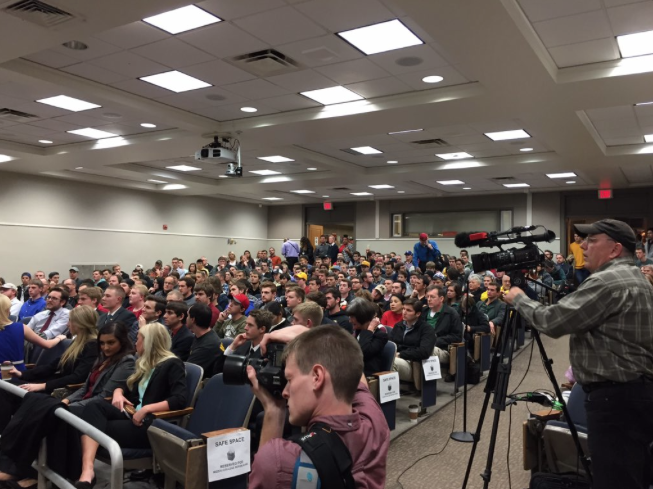
Nearly 400 students showed up to hear Ben Shapiro speak

My favorite political podcast is The Weekly Standard, and my favorite cultural podcast is Ben Shapiro. I really recommend subscribing to both and listening to them. The video of this lecture shows you what makes Ben Shapiro special. (H/T Kevin the Super Husband)

Lecture:

Question and Answer:

And here’s a news article for those who cannot watch from Breitbart News.

Excerpt:

Ben Shapiro’s speech Thursday evening at the University of Missouri was a galvanizing moment for the campus and community that became the national focus of media attention in early November after a group of radical black liberation activists, assisted by leftist faculty members, forced the resignation of the university’s president and chancellor.
The event marked the first large, public backlash to the political correctness gone wild that had overtaken Mizzou in the past several months.

Towards the end of his rousing speech, Shapiro discussed how the “micro aggression” culture of taking offense at minor, even unintended things leads to real aggression. Shapiro said, “There’s never been a bad person on planet Earth who has not felt justified in doing his or her bad thing. All colleges do now is give people reasons to feel justified in doing the bad things that they want to do.”

Shapiro lit into the very real aggressions that had played out at the University of Missouri, including the story that Breitbart News covered of Mizzou faculty member Dr. Melissa Click, who blocked a student reporter with a camera when he attempted to enter a public space on campus that #ConcernedStudent1950 activists had declared a “safe space” for themselves.

[…]The audience of over 350 responded immediately with applause that lasted several seconds. The crowd’s applause showed the cathartic impact of someone speaking the truth out loud at the University of Missouri.

Shapiro was invited to speak by the Young America’s Foundation. My first thought when I see an event like this is why aren’t Christian churches more involved in applying the Bible and Christian theology to the culture. My pastor almost never applies the Bible to anything that is happening in real life. He almost never references anything that is happening in the culture, much less current events.

Thank goodness there are brave conservatives like Ben Shapiro who are willing to put rounds downrange onto the target, rather than focus on pious language doesn’t equip anyone to declare or defend their conservative beliefs. There are so many ideas that are undermining the life plans of Christian men these days – feminism, postmodernism, relativism, global warming alarmism, socialism, pacificism, unilateral surrender and appeasement, and so on. And yet so few pastors can see these threats and how they differ with the Bible’s teachings. Even those that see seem to lack the courage of those who speak out about them. We need to be talking about what is happening in politics and in the culture, so that we can make a world where it is safe to speak out about Christian things without fear – even if the truth makes people feel “offended”.