
Category Archives: Polemics

Dr. Robin Collins explains two kinds of cosmic fine-tuning

I was busy working my way through “Debating Christian Theism“, a book published by Oxford University Press in August 2013. It features about 20 different topics from science, to philosophy, to history. For each topic, there is an essay by a world-class scholar in favor, and one opposed. So you get both sides of many interesting issues, at a very advanced level. The section on cosmic fine-tuning features a chapter written by Dr. Robin Collins.

About Robin Collins:

Robin Collins (PhD, University of Notre Dame, 1993), is professor of philosophy at Messiah College, Grantham, PA specializing in the area of science and religion.  He has written over twenty-five articles and book chapters on a wide range of topics, such as the fine-tuning of the cosmos as evidence for the existence of God, evolution and original sin, the Doctrine of Atonement, Asian religions and Christianity, and Bohm’s theory of quantum mechanics.  Some of his most recent articles/book chapters are “Philosophy of Science and Religion” in The Oxford Handbook of Science and Religion, “Divine Action and Evolution” in The Oxford Handbook of Philosophical Theology (2009)  “The Multiverse Hypothesis: A Theistic Perspective,” in Universe or Multiverse? (Cambridge University Press), and “God and the Laws of Nature,” in Theism or Naturalism: New Philosophical Perspectives (Oxford University Press, forthcoming).  He recently received a grant from the John Templeton Foundation to finish a book that presents the case for design based on physics and cosmology,  tentatively entitled The Well-Tempered Universe: God, Cosmic Fine-tuning, and the Laws of Nature.

The fine-tuning argument

Here’s a short article where Collins gives TWO examples of the fine-tuning. He is very modest in his argument, merely asserting that the fine-tuning is more compatible with theism than it is with atheism.

Excerpt:

Science is commonly thought to have undercut belief in God. As Nobel Prize winning physicist Steven Weinberg famously remarked, “the more we find out about the universe, the more meaningless it all seems.” Yet, the discoveries of modern physics and cosmology in the last 50 years have shown that the structure of the universe is set in an extraordinarily precise way for the existence of life; if its structure were slightly different, even by an extraordinarily small degree, life would not be possible. In many people’s minds, the most straightforward explanation of this remarkable fine-tuning is some sort of divine purpose behind our universe.

This fine-tuning falls into three categories: the fine-tuning of the laws of nature, the fine-tuning of the constants of physics, and the fine-tuning of the initial conditions of the universe. “Fine-tuning of the laws of nature” refers to the fact that if the universe did not have precisely the right combination of laws, complex intelligent life would be impossible. If there were no universal attractive force (law of gravity), for example, matter would be dispersed throughout the universe and the energy sources (such as stars) needed for life would not exist. Without the strong nuclear force that binds protons and neutrons together in the nucleus, there would not be any atoms with an atomic number greater than hydrogen, and hence no complex molecules needed for life. And without the Pauli-exclusion principle, all electrons would fall to the lowest orbital of an atom, undercutting the kind of complex chemistry that life requires.

Some fundamental physical numbers governing the structure of the universe—called the constants of physics—also must fall into an exceedingly narrow range for life to exist. For example, many have estimated that the cosmological constant—a fundamental number that governs the expansion rate of empty space—must be precisely set to one part in 10120 in order for life to occur; if it were too large, the universe would have expanded too rapidly for galaxies and stars to form, and if it were too small, the universe would have collapsed back on itself. As Stephen Hawking wrote in his book A Brief History of Time, “The remarkable fact is that the values of these numbers [i.e. the constants of physics] seem to have been very finely adjusted to make possible the development of life.” Finally, the initial distribution of mass energy at the time of the big bang must have an enormously special configuration for life to occur, which Cambridge University mathematical physicist Roger Penrose has calculated to be on the order of one part in 1010123. This is an unimaginably small number.

I know what you’re thinking: How do we know that non-Christian scientists acknowledge the fine-tuning of gravity in the way that Collins describes?

Well, the New Scientist actually talks about the fine-tuning of the force of gravity. And they’re not Christians.

Excerpt:

The feebleness of gravity is something we should be grateful for. If it were a tiny bit stronger, none of us would be here to scoff at its puny nature.

The moment of the universe‘s birth created both matter and an expanding space-time in which this matter could exist. While gravity pulled the matter together, the expansion of space drew particles of matter apart – and the further apart they drifted, the weaker their mutual attraction became.

It turns out that the struggle between these two was balanced on a knife-edge. If the expansion of space had overwhelmed the pull of gravity in the newborn universe, stars, galaxies and humans would never have been able to form. If, on the other hand, gravity had been much stronger, stars and galaxies might have formed, but they would have quickly collapsed in on themselves and each other. What’s more, the gravitational distortion of space-time would have folded up the universe in a big crunch. Our cosmic history could have been over by now.

Only the middle ground, where the expansion and the gravitational strength balance to within 1 part in 1015 at 1 second after the big bang, allows life to form.

Here’s a very long paper by Collins on the fine-tuning argument, where he answers several objections to the argument, including the multiverse/many-universe hypothesis. I normally make fun of the multiverse, (= the Flying Spaghetti Monster), but it actually does deserve a reasonable, fair response. (Unless Jerry asks, then it’s Flying Spaghetti Monster all the way).

How good are the atheistic arguments of Christopher Hitchens?

I thought that I would go over an opening statement from a previous debate featuring Christopher Hitchens to find out what atheists are like in debates. I used his opening speech from his debate with Frank Turek. The audio from that debate is here, at Brian Auten’s Apologetics 315 site.

Now the important thing to remember about a generic debate on whether GOD EXISTS is that there should be no mention of any particular God, such as the Christian God, and no mention of the history of any particular religion. All arguments that assume specific theological or moral doctrines or specific religious history are irrelevant to a debate on generic theism.

The question being debated is: does a God who created and designed the universe, who has all the traditional properties of God, such as omniscience, omnipotence, omni-benevolence, etc. exist? That is the question being debated in a “Does God Exist?” debate.

Frank Turek’s case for theism:

Frank Turek made 4 relevant arguments for theism, each of which alone would support his conclusion, that God exists:

  • the origin of time, space, matter and energy out of nothing
  • the fine-tuning of the physical constants to support the minimum requirements for life of any kind
  • the origin of the biological information in the first self-replicating organism
  • objective, prescriptive moral rules need to be grounded by the designer of the universe

And he also listed 4 features of the universe that are more consistent with theism than atheism (= materialism).

  • non-material minds that allow rationality that would be impossible on materialism/determinism
  • the mathematical structure of the universe and its intelligibility to the scientific method
  • free will, which is required for moral responsibility and moral choices, requires a non-material mind/soul
  • our first person experience of consciousness is best explained by a non-material mind/soul

Hitchens’ case against theism

To counter, Hitchens has to argue against God using arguments in one of two forms:

  1. The concept of God is logically self-contradictory
  2. An objective feature of the world is inconsistent with the attributes of God

The claim that God does not exist is a claim to know something about God, namely, that he does not exist. This claim requires the speaker to bear a burden of proof. In a debate on “Does God Exist?”, Hitchens must deny that God exists. Let me be clear: Hitchens must defeat the arguments for the claim that God exists, and then defend the claim that God does not exist, and support that claim using arguments and evidence.

Hitchens makes 2 basic claims:

  • There are no good reasons to believe that theism is true
  • There are good reasons to believe atheism is true

So far so good. But what are his good reasons for atheism?

  1. I personally don’t like Christianity, therefore God doesn’t exist
    – Premise: I personally don’t like Catholicism getting rid of limbo
    – Premise: I personally don’t like Hell
    – Premise: I personally don’t like some episodes in church history
    – Conclusion: God doesn’t exist
  2. The plurality of religions means that no religious claims can be correct, therefore God doesn’t exist
    – Premise: There are lots of religions
    – Premise: The religions all disagree in their truth claims about the external world
    – Conclusion: No religion’s claims can be correct, therefore God doesn’t exist
  3. I believe in one less God than you, therefore God doesn’t exist
    – Premise: You disbelieve in every God I do, except one
    – Conclusion: God doesn’t exist
  4. Religious people are stupid and evil, therefore God doesn’t exist
    – Premise: Religious people are ignorant
    – Premise: Religious people are fearful
    – Premise: Religious people are servile
    – Premise: Religious people are masochistic
    – Conclusion: God doesn’t exist
  5. Evolution explains how life progressed from single cell to today’s bio-diversity, therefore God doesn’t exist
    – Premise: Modern theists like Turek believe in Paley’s argument, and argued it in this debate
    – Premise: Paley’s argument was refuted by evolution
    – Conclusion: God doesn’t exist
  6. God wouldn’t have made the universe this way, therefore God doesn’t exist
    – Premise: If God exists, then he would have made the universe my way
    – Premise: The heat death of the universe wasn’t done my way
    – Premise: The extinction of species wasn’t done my way
    – Premise: The size of the universe wasn’t done my way
    – Premise: The amount of open space wasn’t done my way
    – Premise: The large number of stars wasn’t done my way
    – Premise: The age of the universe wasn’t done my way
    – Conclusion: God doesn’t exist
  7. Religion makes people do things that I don’t like, therefore God doesn’t exist
    – Premise: Some religions do suicide bombing
    – Premise: Some religions do child abuse
    – Premise: Some religions do genital mutilation
    – Conclusion: God doesn’t exist
  8. If you speak a sentence, I can repeat the same words as you said, therefore God doesn’t exist
    – Premise: Anything that you say is good, I can say is good too
    – Premise: Anything that you say is bad, I can say is bad too
    – Conclusion: God doesn’t exist
  9. Atheists are morally superior to religious people, therefore God doesn’t exist
    – Premise: I act in a way that is consistent with my personal, arbitrary moral preferences
    – Premise: You don’t act in a way that is consistent with my personal, arbitrary moral preferences
    – Conclusion: God doesn’t exist
  10. If I believe in God, I would have to submit to an authority
    – Premise: If I believe in God, then I can’t do whatever I want
    – Premise: But I want to do whatever I want
    – Conclusion: God doesn’t exist
  11. I don’t like certain Christian doctrines, therefore arguments for God from science fail and therefore God doesn’t exist
    – Premise: I don’t like the atonement
    – Premise: I don’t like the virgin birth
    – Premise: I don’t like the incarnation
    – Premise: I don’t like original sin
    – Premise: I don’t like the resurrection
    – Conclusion: Arguments that are built on recent discoveries from the progress of science like the big bang, fine-tuning, origin of life, etc. are incorrect, and therefore God doesn’t exist

General comments about Hitchens’ case:

  • The form of all of these arguments is logically invalid. The conclusions do not follow from the premises using the laws of logic, such as modus ponens and modus tollens.
  • Hitchens cannot complain about morality because he has no foundation for objective moral facts. What he is really expressing is that he personally does not like such-and-such a state of affairs, based on his own arbitrary personal preferences, and the arbitrary social customs that evolved in the place and time that he finds himself in. On atheism, “morality” is just describing what people do – either individually or as groups living in different times and places. There is no objective right and wrong, and no objective way we ought to be. All statements are subjective. They describe what the speaker personally likes and dislikes. Just like taste in foods or taste in dress – which varies by individually, and is influenced by time and place ARBITRARILY.

Specific comments about each argument:

  • Argument 1 tries to disprove God by arguing from Hitchens’ personal preferences about specific Christian doctrines. Christian doctrines are irrelevant to a debate about generic theism. And there is no reason why God should be bound by the personal, subjective preferences of one man. In fact, the concept of God entails that his unchanging nature is the standard of good and evil. So, this argument doesn’t disprove God, it’s just a statement of personal, subjective preference.
  • Argument 2: Just because there are different truth claims made by different groups, doesn’t mean no one is correct. Mormons believe that matter existed eternally, and Jews believe it was created out of nothing. The big bang theory shows that the Mormons are wrong and the Jews are right.
  • Argument 3: First of all, the debate is a about a generic Creator and Designer, not any particular religious conception of God. So the argument is irrelevant. Moreover, Christians reject Zeus, for example, because Zeus is supposed to exist in time and space, and therefore could not be the cause of the beginning of time and space.
  • Argument 4: This is just the ad hominem fallacy. Hitchens is attacking the character of the theist, but that doesn’t show theism is false.
  • Argument 5: This argument can be granted for the sake of argument, even though it’s debatable. The point is that it is irrelevant, since it doesn’t refute any of Turek’s actual scientific arguments like the big bang, the fine-tuning of the physical constants, the origin of information in the simplest living cell.
  • Argument 6: Again, there is no reason to think that God should be bound by Hitchens’ personal opinion of how God should operate.
  • Argument 7: This is the ad hominem fallacy again. The good behavior of religious believers is not a premise in any of Turek’s FOUR arguments for theism. Therefore, Hitchens’ point is irrelevant to the debate.
  • Argument 8: The fact that the atheist can parrot moral claims is not the issue. Being able to speak English words is not what grounds objective, prescriptive morality. The issue is the ontology of moral rules, the requirement of free will in order to have moral responsibility and moral choices, ultimate significance of moral actions, and the rationality of self-sacrificial moral actions.
  • Argument 9: This is just the ad hominem fallacy again.
  • Argument 10: This is not argument so much as it reveals that the real reason Hitchens is an atheist is emotional. One might even say infantile.
  • Argument 11: Again, these specific Christian doctrines are irrelevant to a debate about generic theism. And Hitchen’s subjective, personal preferences about Christian doctrine certainly do not undermine the objective scientific support for the premises in Turek’s 3 scientific arguments.

So Frank Turek talked about facts in the external world, and Christopher Hitchens mistakenly thought that his opinions and preferences about what he would do if he were God were interesting to us. They might be interesting to his psychiatrist, but they are not interesting to us.

Minimum wage: doing what feels good doesn’t produce good results

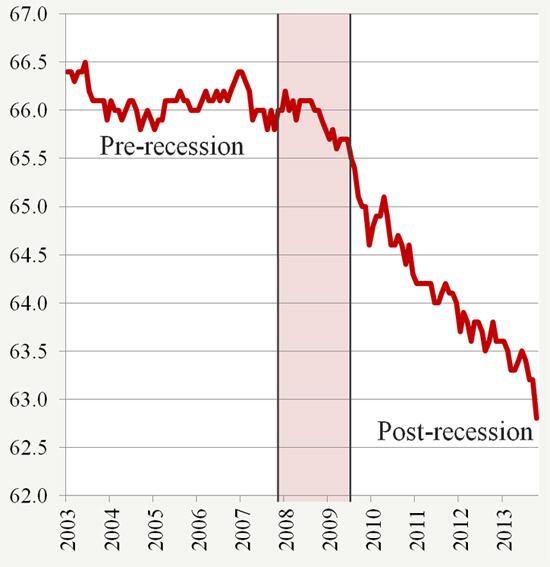
Labor Force Participation down to 62.8%

Will Obama’s plan to raise minimum wage help people?

From the Daily Caller. (H/T Conway)

Excerpt:

The Obama administration’s proposal to raise the minimum wage to $10.10 an hour could result in as many 1,084,000 jobs eliminated from the work force, according to a new study conducted by the Employment Policies Institute (EPI)

“No amount of denial by the president and his political allies — and no number of ‘studies’ published by biased researchers — can change the fact that minimum wage hikes eliminate jobs for low-skill and entry-level employees. Non-partisan economists have agreed on this consensus for decades, and the laws of economics haven’t changed,” Michael Saltsman, research director at EPI, said in a statement.

He offered an alternative to the president’s plan: “Instead of raising small businesses’ labor costs and creating more barriers to entry-level employment, the president and the Senate should focus on policies that help reduce poverty and create jobs.”

The  study was released in the wake of an expected vote on a Senate bill that aims to raise the federal minimum wage from the current $7.25 an hour to $10.10 an hour — a nearly 40 percent increase.

Many Democrats argue that increasing the federal minimum will reduce poverty without having an adverse effect on unemployment.

EPI’s report, which used analysis from economists at Miami and Trinity University, reached a different conclusion.

Researchers used recently updated Census Bureau data from 2012 and 2013 to calculate how each individual state would be impacted by the proposed wage hikes. As a lump sum, Americans would see a loss of at least 360,000 jobs, and perhaps even over one million if hourly wages are increased to $10.10.

The number of job losses would be the most dramatic in large states, such as California and Texas. Economists found that California could lose as many as 100,016 jobs and Texas could see up to 128,617 jobs disappear from its economy.

But’s it’s not just this proposal that is the problem, it’s his past policies.

After FIVE YEARS of Obamanomics, we still have a record 100 MILLION people still out of work from when he became President. There has been NO RECOVERY since the housing bubble, which was caused by the Democrats in Congress. Policies like raising the minimum wage only make that worse, although it sounds great to Obama’s low information supporters.

Minimum wage raises cause higher unemployment

Government Spending Vs Jobs

From Investors Business Daily.

Excerpt:

How amusing to watch Democrats wring their hands over what they can do to get businesses to create jobs, when one of the biggest job killers is the minimum wage they keep hiking.

Recall that it was Democrats who raised the federal wage floor a whopping $2.10 an hour in the middle of the recession. The record 41% increase has led to record unemployment among young people, especially black teens.

Congress started ratcheting up the minimum wage from $5.15 an hour in mid-2007, arguing it would help abate poverty. But retailers looking to slash costs eliminated low-skilled, entry-level jobs rather than pay the mandated increases.

Now 1.5 million fewer teens are working. Last year’s unemployment rate for workers ages 16 to 19 shot up to 26% from 2007’s 15%.

As for black teens, their joblessness soared to a record 43% after the final raise to $7.25 took effect in mid-2009. It helped put more than half of young black men out of work — a first.

The president proposes cranking the minimum wage even higher to $9.50. Then he wants to raise it every year thereafter as a “living wage” indexed to inflation.

Yes, this is the problem that happens when you elect someone who knows nothing whatsoever about economics. And when I say nothing, I mean he is in disagreement with virtually all economists across the ideological spectrum.

A large majority of economists agree

Moderate economist Gregory Mankiw of Harvard University lists the policies that are accepted by virtually all economists.

Here’s Greg’s list, together with the percentage of economists who agree:

  1. A ceiling on rents reduces the quantity and quality of housing available. (93%)
  2. Tariffs and import quotas usually reduce general economic welfare. (93%)
  3. Flexible and floating exchange rates offer an effective international monetary arrangement. (90%)
  4. Fiscal policy (e.g., tax cut and/or government expenditure increase) has a significant stimulative impact on a less than fully employed economy. (90%)
  5. The United States should not restrict employers from outsourcing work to foreign countries. (90%)
  6. The United States should eliminate agricultural subsidies. (85%)
  7. Local and state governments should eliminate subsidies to professional sports franchises. (85%)
  8. If the federal budget is to be balanced, it should be done over the business cycle rather than yearly. (85%)
  9. The gap between Social Security funds and expenditures will become unsustainably large within the next fifty years if current policies remain unchanged. (85%)
  10. Cash payments increase the welfare of recipients to a greater degree than do transfers-in-kind of equal cash value. (84%)
  11. A large federal budget deficit has an adverse effect on the economy. (83%)
  12. A minimum wage increases unemployment among young and unskilled workers. (79%)
  13. The government should restructure the welfare system along the lines of a “negative income tax.” (79%)
  14. Effluent taxes and marketable pollution permits represent a better approach to pollution control than imposition of pollution ceilings. (78%)

You can find out more about how raising the minimum wage increases unemployment, especially for young people and minorities, from this comprehensive, 50-year, government study.

This is why it is important for voters to understand economics. When you raise the price of labor, fewer employers will purchase labor. Supply and demand. This is so basic, that I am surprised that someone as educated as Obama doesn’t understand it. It’s probably because he has virtually no experience working in the private sector.