Category Archives: Polemics

Jupiter deflects comets and asteroids that might otherwise hit Earth

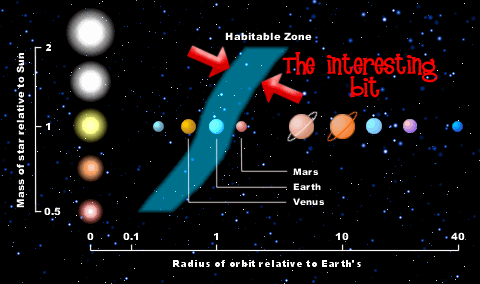
Circumstellar Habitable Zone

This is an older article from Astrobiology magazine, but it shows how important Jupiter is for habitability.

Excerpt:

To a biologist, the ingredients needed to form life include water, heat and organic chemicals. But some in the astrophysics and astronomy community argue that life, at least advanced life, may require an additional component: a Jupiter-sized planet in the solar neighborhood.

“A long-period Jupiter may be a prerequisite for advanced life,” said Dr. Alan Boss, a researcher in planetary formation. Boss, who works at the Carnegie Institution of Washington, is a member of the NASA Astrobiology Institute (NAI).

In our own solar system, Jupiter, with its enormous gravitational field, plays an important protective role. By deflecting comets and asteroids that might otherwise hit Earth, Jupiter has helped to create a more stable environment for life to evolve here. It’s generally believed that a massive impact was responsible 65 million years ago for wiping out dinosaurs on Earth. If not for Jupiter, it’s possible that many other such impacts would have occurred throughout Earth’s history, preventing advanced life from ever gaining a foothold.

Jupiter is significant not only for its size but also for its location in our solar system, far from the Sun. Because it orbits at slightly more than 5 AU (astronomical units the distance between the Earth and the Sun is 1 AU), there is plenty of room in the inner part of our Solar System to accommodate a range of smaller planets.

Within the inner solar system there exists a region, known as the habitable zone, where liquid water, and therefore life, can potentially exist on a planet’s surface. Without liquid water, life as we know it is not possible. The habitable zone around our Sun stretches roughly from the orbit of Venus to the orbit of Mars. Venus is generally believed to be too hot to support life. Earth, it appears, is just right. And the jury is still out on Mars.

Understanding the role that Jupiter plays in our own Solar System helps astronomers focus their search for habitable planets around other stars. “If,” Boss explains, “a Jupiter-mass planet on a stable, circular orbit [around another star at] around 4 to 5 AU was found, without any evidence for other gas giant planets with shorter period orbits, such a discovery would be like a neon light in the cosmos pointed toward that star, saying ‘Look here!’. That star would be a prime target for looking for a habitable, Earth-like planet.”

Previously, I blogged about how the circular orbit of Saturn and the mass of our star also play a role in making our planet habitable.

People who are not curious about science sort of take these blessings for granted and push away the God who is responsible for the clever life-permitting design of our habitat. In contrast, theists are curious and excited about what science tells us about the Creator. Theists care about science, but naturalists have to sort of keep experimental science at arm’s length – away from the presuppositions and assumptions that allow them to have autonomy to live life without respect, accountability and gratitude. Naturalists take refuge in the relief provided by speculative science and science fiction. They like to listen to their leaders speculate about speculative theories, and willingly buy up books by snarky speculators who think that nothing is really something (Krauss), or who think that the cosmic fine-tuning is not real (Stenger), or who think that silicon-based life is a viable scenario (Rosenberg), etc. But theists prefer actual science. Truth matters to us, and we willingly adjust our behavior to fit the scientific facts.

UPDATE: Rebuttal to me here at The Secular Outpost.
New study: enzymes cannot easily evolve to perform other functions

Can atheism explain the origin of life?

This is from Evolution News.

Excerpt:

I am pleased to announce the publication of a new paper from Biologic Institute, a research organization devoted to investigating the limits of unguided evolution and advancing the development of a new paradigm for biology based on intelligent design. This paper, “Enzyme Families — Shared Evolutionary History or Shared Design? A Study of the GABA-Aminotransferase Family,” is the closing chapter of our long-term study of bacterial enzymes to determine if they can be coopted to new functions. The answer to this question is important for the evolution debate. If enzymes can’t be recruited to genuinely new functions by unguided means, no matter how similar they are, the evolutionary story is false.

Published in the journal BIO-Complexity, the work was done by Marci Reeves, Doug Axe, and myself [Ann Gauger].

In a previous paper we described the difficulty of coopting the enzyme Kbl to perform the function of BioF. The two enzymes are very similar in structure (see below) but have different reaction chemistries and different functions in the cell. We wanted to know if a mutated Kbl could replace missing BioF function. After changing nearly every amino acid in Kbl’s active site (where its chemistry is carried out) to look like BioF, Kbl never was able to make the switch to BioF’s function.

In this paper we expanded the story to include nine of the most closely related enzymes to BioF, including one that is supposed to be able to carry out both BioF’s and Kbl’s chemistry. Using random mutagenesis we tested every single-base mutation in those nine genes. None of them was within one mutation of cooption. We went on to test for cooption the two most likely enzymes by generating two-base combinations of mutations. After testing 70 percent of all possible two-base mutations for each enzyme, or about 40 million cells each, that also failed.

What does this mean? In an evolutionary scenario, to get an enzyme to switch functions the first step is to make a spare copy that can be mutated without destroying a function the cell needs. Second, the cell has to overproduce the mutating enzyme, because any newly emerging enzyme will be very bad at the job at first. To compensate there will need to be lots of enzyme around. Third, there is the problem of finding the right combination of mutations by random search.

Taken together, since we found no enzyme that was within one mutation of cooption, the total number of mutations needed is at least four: one for duplication, one for over-production, and two or more single base changes. The waiting time required to achieve four mutations is 1015 years. That’s longer than the age of the universe. The real waiting time is likely to be much greater, since the two most likely candidate enzymes failed to be coopted by double mutations.

Read the rest of the post, they deal with criticisms to the paper.

Here is one Darwinist’s view of this enzyme proble, which they mention in a follow-up post.

Look: (links removed)

Monday we published a paper in the journal BIO-Complexity demonstrating that enzymes can’t evolve genuinely new functions by unguided means. We argue that design by a very sophisticated intelligent agent is the best explanation for their origin. I want to take some time to lay out our argument against Darwinian evolution and for intelligent design. It’s important, because it reveals the logical fallacy in most evolutionary thinking.

Just to give an example of the thinking of ID critics, here is a passage from one of the references in our paper (Kherhonsky et al. (2006) Enzyme promiscuity: Evolutionary and mechanistic aspects.Current Opinion in Chemical Biology 10:498-508):

An oft-forgotten essence of Darwinian processes is that they occur gradually, while maintaining organism fitness throughout. Consequently, a reasonable assumption is that, ever since the emergence of the primordial living forms, very little novelty has evolved at the molecular level. Rather, existing genes were modified, or tinkered with’, to generate new protein structures and functions that are related to those of their ancestors. Unlike ‘out of the blue’ scenarios advocated by the ‘intelligent design’ school, ‘tinkering’ scenarios depend on the availability of evolutionary starting points. The hypothesis that the broad specificity, or promiscuous functions, of existing enzymes provide these starting points was first formalized by Jensen in a review that has inspired many. Jensen proposed that, in contrast to modern enzymes, primitive enzymes possessed very broad specificities. This catalytic versatility enabled fewer enzymes to perform the multitude of functions that was necessary to maintain ancestral organisms. Duplication of genes and divergence led to specialized genes and increased metabolic efficiency. Since Jensen, the structures of >30,000 proteins, and the sequences of hundreds of thousands, have taught us that these processes led to the creation of enzyme families and superfamilies. The vestiges of these divergence processes are the scaffold and active site architecture shared by all family members [6].

To summarize, the key points of that evolutionary argument are:

  1. Evolution is true. That is, enzymes have evolved new functions by a process of random mutation and natural selection.
  2. Modern enzymes can’t evolve genuinely new functions by random mutation and natural selection but can only tinker with existing functions.
  3. Therefore, ancient enzymes must have been different, capable of carrying out a broad range of enzyme activities.
  4. Those enzymes underwent duplication and diverged from one another, becoming specialized.
  5. How do we know this happened? Because we now see a broad array of specialized enzymes. Evolution is the explanation.

This begs the question of whether evolution is true. It is a circular argument unsubstantiated by the evidence and unfalsifiable. No one can know what ancient enzymes actually looked like, and whether they really had such broad catalytic specificities.

That’s insufferable badness.

It’s not enough for Darwinists to take the age of the universe and then assert that anything can happen in that time. The time from the cooling of the Earth to the appearance of first life is on the order of millions of years. There just isn’t time to generate these organic components by chance.

New paper from Michael Licona on historical methods and miracle claims

I hope that all my readers know who Michael Licona is!

The PDF of his new paper is here. It published in the Journal for the Study of the Historical Jesus.

Here’s the abstract:

Most biblical scholars and historians hold that the investigation of a miracle report lies outside of the rights of historians acting within their professional capacity. In this essay, I challenge this position and argue to the contrary. A definition of history should not a prioriexclude the possibility of investigating miracle claims, since doing so may restrict historians to an inaccurate assessment of the past. Professional historians outside of the community of biblical scholars acknowledge the frequent absence of a consensus; this largely results from conflicting horizons among historians. If this is the present state among professionals engaged in the study of non-religious history, it will be even more so with historians of Jesus. Finally, even if some historians cannot bring themselves to grant divine causation, they, in principle, can render a verdict on the event itself without rendering a verdict on its cause.

Here’s a bit that I found interesting:

It is clear that the horizon of atheist New Testament scholar Gerd Lüdemann is a driving force behind his historical conclusions when he a priori rules out the  historicity of the ascension of Jesus reported in Acts 1.9–11 ‘because there is no  such heaven to which Jesus may have been carried’.14 Ontological naturalism  similarly guides James Tabor. He writes:

Women do not get pregnant without a male—ever. So Jesus had a human father… Dead bodies don’t rise… So, if the tomb was empty the historical  conclusion is simple—Jesus’ body was moved by someone and likely  reburied in another location.15

Not so obvious is Geza Vermes in his 2008 volume The Resurrection: History and Myth.16 With hardly a comment, Vermes simply dismisses both ‘the out-ofh-and rejection of the inveterate skeptic’ and the hypothesis that Jesus rose from the dead since it can only be made from ‘the blind faith of the fundamentalist believer’.17

I thought these were interesting because Ludemann gives you the post-mortem “visions” of Jesus, and Vermes gives you the empty tomb – yet both are naturalists. Notwithstanding that, it’s pretty clear that these guys are not open to miracles a priori, and yet they probably think they are good historians, and able to get at the truth. Even though they rule out some explanations before even looking at the evidence.

So what would you call a detective who ruled out some causes of death but not others, before looking at the evidence?

More:

Second, methodological naturalism may handicap historians, preventing them in some cases from providing a fuller and more accurate account of the past. Molecular biologist Michael Behe provides a relevant challenge to this approach in his discipline. He writes:

Imagine a room in which a body lies crushed, flat as a pancake. A dozen detectives crawl around, examining the floor with magnifying glasses for any clues to the identity of the perpetrator. In the middle of the room, next to the body, stands a large, grey elephant. The detectives carefully avoid bumping into the pachyderm’s legs as they crawl, and never even glance at it. Over time the detectives get frustrated with their lack of progress but resolutely press on, looking even more closely at the floor. You see, textbooks say detectives must ‘get their man’, so they never consider elephants.19

In context, Behe is contending that when scientists limit their considerations exclusively to unguided natural causes they will forever keep themselves from discovering the actual cause if a Designer of some sort was responsible. A similar admonition may be issued to historians who a priori exclude a non-human agent as the cause behind a past event. Those who do so could actually be placing themselves in a position where they cannot appraise history accurately.20

The rest of the paper discusses two options for historians who want to resolve this problem.

So, I’m impressed that Mike Licona reads Mike Behe (that quote is from “Darwin’s Black Box”). Pretty cool. You should download the PDF just for the footnotes, to see what else he is reading that you might want to read too. What I like to see is lots of science and lots of debates and lots of different points of view. He reads across disciplines, he reads people who disagree with him. We one-dollar apologists all need to be like that.

Back to his paper. I see this presupposition of naturalism come up in debates on the historical Jesus, where the naturalist will just assume naturalism and then proceed to do history – even at a time where we have so many scientific arguments to undermine naturalism. It’s a bad philosophical view, and we shouldn’t let it influence how we do history.

If you run into these historians who are slaves to naturalism, it might be worth it to make them defend it. You ask them – do you believe in naturalism? If they say yes, ask them for scientific evidence for naturalism. And when they finish not giving you any, then you can go on a long monologue on the origin of the universe, the fine-tuning, the origin of life, the Cambrian explosion, the habitability (galactic and stellar), and so on. Then tell them to stop bring their blind religious faith into their historical investigations.