Category Archives: Personal

What is masculinity, and why do leftists oppose it?

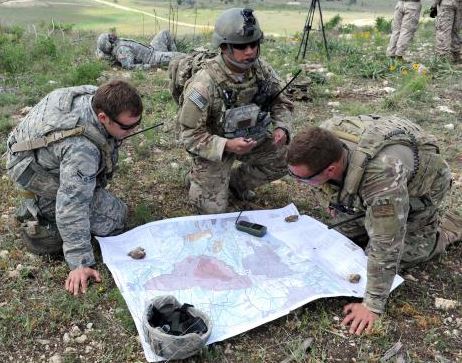
Air Force TACPs confirm target locations with their map
Air Force TACPs confirm target locations with their map and GPS

My friend Adina shared a splendid article from the American Thinker with me. People often ask me why I speak about policy and politics so much on a Christian apologetics blog. My usual answer is that things like money and religious liberty are central to how Christians run their lives. But this article made me think of a deeper reason, one that’s been the driving force in my life for a long time.

First, let’s see some of the article, then I’ll talk about why this article is a key to really understanding men like me.

Excerpt:

An ongoing mantra of the left is that everyone is a victim, with a singular carve-out for white men.  A large group of the female population has embraced this chant.

While there may be a number of grievances put forth by this movement, there also comes a theme that is particularly dangerous: the feminist attack on masculinity.  This is derived not only from feminists; it comes from the left in general.

There has emerged a war on masculinity.  Why?  Because masculine men are harder to control under tyrannical socialism.  The modern beta male, on the other hand, craves socialism.  This is why the left has branded masculinity as toxic: it stands as a roadblock to their endgame.

That’s the thesis of the article, and here is a snippet that I want to talk about:

The feminist hatred for masculinity is only another tool in the toolbox of communism.  Masculinity tends to make a man individualistic.  Individualistic men are capitalists, not communists.  They are men who cherish individual liberty, and they rely on themselves rather than on government.  Self-reliance is a four-letter word for leftists, and masculine men are generally self-reliant.  Beta males like Pajama Boy rely on government, and such modern men, devoid of any semblance of masculinity, are ideal for leftist indoctrination.

Were the frontiersmen communists or capitalists?  How about the cowboys?  How about the Navy SEALs or Army Rangers?  Sure, the press may find in the military a few Che Guevara t-shirt-wearing idiots and parade them all over the place, but I am willing to bet that the majority of SEAL Team 6 comprises masculine capitalists.

What games do young boys play?  They pretend to be cowboys.  They pretend to be soldiers.   They don’t pretend to be soviet textile workers slaving under Stalin’s system.  They don’t pretend to be entitled Millennial brats who congregate at Starbucks and talk about the wonders of socialism, either.  Most boys hit the ground embracing masculinity.  Some maintain it, but many have it berated out of them by the weak society they walk in or by their leftist parents.

Masculinity leads a man to seek to better himself in many regards, while collectivism thrives on mediocrity.  Collectivism in this country is sought by the lazy who don’t want to work but feel entitled to free handouts of all kinds.

I can confirm from my reading of SEAL and Ranger autobiographies that they are overwhelmingly conservative in their politics.

OK, so two points about this. First, I grew up in a very liberal environment where masculinity was already under attack starting from elementary school. It started in the public schools with the lazy public school teachers. In college, I saw lazy college students doing non-STEM degrees because they were easy. And then they wanted bailouts for their unpaid student loans.

I really noticed it when I worked for the government during a couple of summers. Most people in unionized jobs just don’t have the marketable skills to make it in the private sector, where people are paid based on performance and can easily be fired for failure to perform. Public schools and government are two places where people who can’t perform go in order to make money without having to perform. Even their raises are defined by collective bargaining, not individual merit. (My public school system even went on strike, and I would see the teachers holding signs in order to get paid more, instead of doing what normal people do, and producing more). Working in the public sector just not acceptable to people who want to work hard and advance by merit.

The more I experienced this, as a student and as a government employee, the more I realized that I wanted to get as far away as possible from laws and policies that reflect a desire to provide security for lazy people. I wanted these people out of my life. I didn’t want them getting my money. I did not want them making the rules that I had to live by. I wanted to cut government funding and enact right-to-work and school choice laws. Just to stop the forced funding of lazy people through mandatory taxes. I didn’t yet realize that there was any masculine-feminine distinction going on, I just knew that these were lazy people, they made poor choices because of their desire for fun and laziness, and they ought to be starving, not getting paid. And as the left started to crack down on free speech, guns, and other freedoms, I started a lifelong journey from blue states to red states. I just wanted nothing to do with these people interfering in my life, and leeching off of me. I wanted to post pictures of a Steyr Aug on Twitter and tag all my female public school teachers and their nanny state allies, who didn’t like guns because “they are loud and scary”. (Note: I do not yet own a Steyr Aug. Maybe some day.).

My second point is about how this denigration of masculinity works out in relationships.

I wanted to get married pretty much from high school. Since I didn’t have a stay at home mom, I decided early on that I wanted that for my children. I can remember thinking about this in my junior year of high school (grade 11). So, I talked to my Dad about it, and he suggested that I not follow my dream of becoming an English teacher, and instead focus on computer science. I was just as good at computer science as English literature in those days – good enough for the class awards every year in both subjects. So, I got the BS and the MS, and then moved to find work that would pay a lot. And I saved a lot of what I earned.

Fast forward to my relationships. What I found is that women who were influenced by leftism had zero respect for my ability to lead in areas like education, career and finance. Since they had been taught that masculinity was toxic, they would often prefer younger, penniless, unemployed students who were more easily manipulated. They resented that I would offer them advice about what to study, where to work, and how to save more, which – along with apologetics and raising parrots – is about the only stuff I’m qualified to give advice about! Basically, they had been trained to see male competence as toxic. Male leadership – even when it was clearly demonstrated from past success – was toxic. And the “best” men were the men who let them make decisions based on their feelings, which mostly involved pursuing fun and being irresponsible – and sometimes even immoral. Men exist to give women “feelings”, and for no other purpose than that.

Well, that’s what I wanted to say about how my experience with anti-masculinity in education, career and relationships has affected me. My masculinity came about naturally, as a result of encountering leftism in different areas of my life. And I think having to deal with it up close just pushed me further in the masculine direction. That is not to say that I am a promiscuous, risk-taking thug. I’m chaste, I’m a software engineer, I don’t drink, I have no tattoos or piercings, I’ve never been arrested, and I’ve saved most of what I earned. But if I could move to a place where government kept out of my business and out of my wallet, then I’d move. If I could find a woman who respected the strengths of men, then I’d marry her.

I basically want to be in a place where the government and the women around me are respectful of my different priorities and different life goals. Unfortunately, I’m living in a time of great foolishness, and much of that has been brought about by leftism. Much of my income is confiscated so that other people can spend it and call themselves “generous” with money they did not, and could not, earn themselves. My liberty is constrained, and the people who cost me money or do me harm – illegal immigrants, criminals, terrorists, etc. – are treated better than I am. All in the name of “compassion”. We are in a time and place where people in high places are at war with masculinity. I wish I could opt out of every nanny state policy, but there’s no opt-out.

Marine Captain earned Medal of Honor fighting communists in North Korea

First, let’s go from the top down to set the context for the profile of William E. Barber.

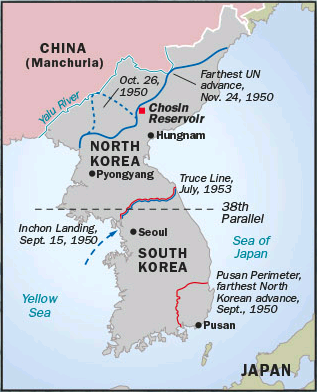
Map of the Korean War

In the summer of 1950, North Korean communists launch a completely unprovoked attack across the 38th parallel against their peaceful, democratic neighbors, the South Koreans. The Americans immediately sent an invasion force by sea to drive them out. The North Koreans easily manage to take over the capital Seoul, and the allies are left with only one port in the southeast – Pusan. In September of 1950, American forces land an invasion force at Inchon, cutting off the North Korean invasion force surrounding Pusan. The North Koreans retreat, and there is hope that American forces will be home by Christmas. But then, unbeknownst to the Americans, the Chines communists  invade North Korea from the north and surround the American forces near the Chosin reservoir, threatening to annihilate an entire Marine division.

The Marines at Yudam-Ni are surrounded and must retreat to Hagaru-Ri

As you can see from the map, there are a whole bunch of American troops fighting to the north/east and south/west of the Chosin Reservoir. The marines near Yudam-Ni need to retreat along a road called the MSR (main supply road) back to Hagaru-Ri. But in order to conduct that retreat, they have to hold onto the vital Toktong pass, which is overwatched by Fox company from their position on Fox Hill. Can Charlie company and Fox company hold off the entire Chinese 59th division (10,000 men) with only two companies (about 250 men each)?

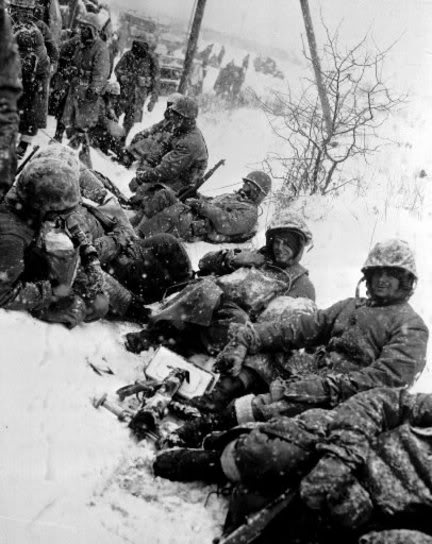
U.S. Marines "The Chosin Few", December 1950
U.S. Marines “The Chosin Few”, December 1950

Well, the book I read (which Dina gave me for Christmas), was about Fox company and their defense of the Toktong pass. This is what the leftist New York Times had to say about the man in charge of Fox company (“F company”) in a 2002 article:

Col. William E. Barber, who won the Medal of Honor for his leadership of a vastly outnumbered company under siege on a snowy hilltop in one of the worst defeats in Marine history, the Battle of the Chosin Reservoir in 1950, died on April 19 at his home in Irvine, Calif. He was 82.

The cause was bone-marrow cancer, said Jerry Courtier, a friend who hopes to write Colonel Barber’s biography.

The reservoir is south of the Yalu River, which separates North Korea from China. After the Americans had pushed the North Koreans almost to the Yalu, 150,000 Chinese troops unexpectedly crossed the river into North Korea. Colonel Barber’s unit, Company F of the Second Battalion of the Seventh Marines, First Marine Division, was on a hill that commanded the Toktong Pass, a vital gap between Yudam Ni and Hagaru Ri, two towns separated by 78 miles.

The stakes were huge. If F Company yielded its position, 8,000 marines at Yudam Ni would be cut off from the 3,000 at Haguru Ri by tens of thousands of Chinese troops.

Through five days and six nights in subzero weather and often swirling snow, Colonel Barber, then a captain, inspired his men, outnumbered more than five to one, to cling to their tenuous positions. He was shot in a bone near his groin on the second day but continued to make the rounds of the hill. He likened the wound to a bee sting.

When the unit was ordered to withdraw and fight its way to safety, Captain Barber refused. Three times, the enemy broke through the line, only to be repulsed.

”I knew that we could probably hold, and I knew that if we didn’t hold we could exact a very heavy toll,” he said in an interview in 1976 with The Los Angeles Times.

His citation for the nation’s top medal said that he commanded his men from a stretcher. But Hector A. Cafferata Jr., who as a rifleman won the Medal of Honor in the same battle, insisted that Captain Barber refused the stretcher.

”He walked the line, he kept us together,” said Mr. Cafferata, who was beside Captain Barber when he was shot.

In the mayhem, the Chinese blew whistles, beat cymbals and tooted bugles as they repeatedly attacked. Coffee froze before men could drink it, and some of the wounded died because plasma froze with no way to thaw it.

When the battle was over, more than 1,000 enemy soldiers were dead. Of Captain Barber’s original 240 men, 82 were able to walk away.

Gen. Raymond G. Davis, who was a lieutenant colonel in the Marines, received a Medal of Honor for leading the unit that rescued F Company.

William Earl Barber was born on Nov. 30, 1919, in Dehart, Ky. He attended what is now Morehead State University in Morehead, Ky., for two years and enlisted in the Marines, at the age of 21, in 1940.

He was so good at shooting a rifle that he was made a weapons instructor. After volunteering for parachute training, he demonstrated such proficiency that he became a parachute instructor.

In World War II, he was promoted to sergeant in 1942 and commissioned a second lieutenant in 1943. He was a rifle platoon commander at Camp Pendleton, Calif., when his unit was shipped to the Pacific.

Colonel Barber was in the first wave to hit Iwo Jima, where he was wounded twice. He received the Silver Star for bravery in addition to two Purple Hearts. At a ceremony on the 50th anniversary of the battle in 1995, he said:

”I am older now, as you are, but I can still see the colors of that February morning. The sky. The island. And sometimes I think I can hear the noise of battle.”

He was treated in Japan for his wounds and returned to the United States, where he worked as a recruiter, among other positions. He was promoted to captain in 1949 and was in the force that occupied Japan.

When he joined F Company in Korea, he saw a raggedy unshaven bunch and immediately ordered the the troops to shave, shine their shoes and look like marines. He suggested that his new charges resembled Pancho Villa’s bandits.

”He was one tough guy,” Mr. Cafferata said. ”He was by the book.”

He was by the book. He enlisted in the Marines because he was grateful to his country for allowing him to escape poverty and go into college, and he wanted to give something back.

You can read a review of the book I read about Fox company, and read about some of the details of what it was like for those men. You’ll never look at your own troubles the same way again. You can also read about Barber’s Medal of Honor citation here.

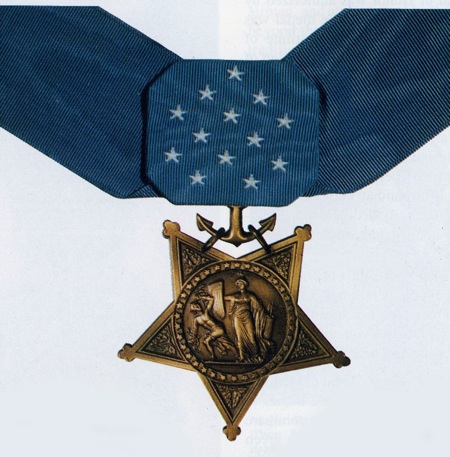
The Medal of Honor, Navy and Marines variant

So, now that I am done with that book, I have moved on to another Korean War book that Dina gave me, this one about George company. The Korean War might have been our most just war – defending a peaceful democratic ally from a totalitarian communist regime. You just have to compare North Korea and South Korea today to understand the stakes. North Korea is basically a godless concentration camp that tortures and murders its people if they so much as think the wrong thoughts about the atheist state. South Korea is free and prosperous, where the people have human rights, like the right to free speech and freedom of religion.

It’s important for me to read about the hardships that real heroes face, so that I don’t complain too much about my own tiny struggles. When you read about the struggles of great American soldiers, so many good things happen to you. Your own problems get smaller, your humility and gratitude get bigger. And you are reminded about why America is a great country, and what American character is really like. These things are not taught by leftists in the public schools. They are not talked about by leftists in the mainstream media. They are not presented by leftists in the Hollywood film industry. If you want to know the real America, you have to find it yourself.

The most important thing Christian parents need to focus on with their children

A family praying and reading the Bible

I know what you’re thinking – I’m going to say apologetics. But, in dealing with the new membership questions of my PCA Presbyterian church, I have moved to think that it might be something else. Sean McDowell has a recent post about it, and since he is an expert in apologetics, I’m inclined to agree with him.

He writes:

In his book The Four Loves, C.S. Lewis makes a distinction between “Gift-love” and “Need-love.” As for Gift-love, he gives the example of a father who works and plans for the future well being of his family, even though he will die without seeing them benefit. As for Need-love, Lewis gives the example of a lonely and frightened child who comes to its mother’s arms for comfort and protection. Such love is neither selfish nor improper, because children are intended to have nurturing mothers, and mothers are intended to care for their kids.

According to Lewis, God’s love for mankind is entirely Gift-love: “The Father gives all He is and has to the Son. The Son gives Himself back to the Father, and gives Himself to the world, and for the world to the Father, and thus gives the world (in Himself) back to the Father too.” God does not need our love or worship. Rather, He freely loves us as an extension of His grace.

But our love for God is different. While we may be able to offer God Gift-love, our love is primarily need based. Lewis explains: “But man’s love for God, from the very nature of the case, must always be very largely, and must often be entirely, a Need-love.” We desperately need God in both this world and the next.

And then Lewis makes an additional (and helpful) distinction—while our objective need for God will never change, our awareness of that need can. And if our awareness of the need for God fades, then so may our faith. Thus, Lewis says:

There seems no reason for describing as hypocritical the short-lived piety of those whose religion fades away once they have emerged from “danger, necessity or tribulation.” Why should they not have been sincere? They were desperate and howled for help. Who wouldn’t?

In other words, if someone believes in God because of an immediate need for safety or comfort, then as soon as the danger or pain ends, so may the faith. How does this relate to students? Think about it. If a young person believes in God for social or relational needs in the family, church, or school, then when those needs fade, so will his or her faith. If belief in God fulfills some external need, then as soon as that need fades, or another venue provides satisfaction of that need, the student will likely abandon his or her faith (or minimally, have a marginalized faith).

The whole post is worth reading, because no less than Sean McDowell himself had a moment like this where he realized his own sinfulness and had to rely on Jesus for his forgiveness.

Judging from his tweets, I know that Sean is obsessed with super-heroes like Spider-Man, and so he would not be comparing himself to his peers in terms of righteousness. That sort of distance between you and Spider-Man can be really grating for boys. Inside, we feel like we are meant to be super-heroes. Many young men go into apologetics because they see it as a super-power. The problem of not measuring up is very strong for us, because we see the demands of Christianity as much greater than mere church attendance. I imagine that as Sean engaged with people using his apologetics super-power, he probably realized how difficult it was to know everything and give an answer to everyone. That’s above and beyond the standard shortcomings or pride, anger, hatred, and so on that are inside of every person.

We are not super-heroes but we need to have super-human righteousness (that is, perfect righteousness) in order to stand before our Creator and Designer. The only solution is to rely on the imputed righteousness of Jesus for our super-hero status. It is a good and healthy thing to take on Jesus as King, and to imitate him. But when we fail, we must also rely on him as Savior. And thank God the Father for that provision of salvation. And indeed, I myself think of Jesus as Savior in the moments where I am conscious of my own sin. But I need to think about him more than that, and I’ll explain how next.

What I learned about myself while thinking deeply about the new member questions for the excellent PCA church is that I had pretty much forgotten the excitement of how God saved me by grace when I was little. I was saved in a non-Christian home where, thanks to my hands-off “parents”, I was on a very dark path to failure. When I look at my older brother now, I can clearly see where I would have ended up. It is a disastrous place to be. I get excited about God as initiator and architect of salvation (not without my free will to trust). When God architects a divine appointment for me to use my prepared abilities in his defense or in mentoring little ones, I praise God as author of salvation. But I forget that Christ is the one who allows me to be clean enough to participate in this plan.

My ambition from small was to be a super-hero, and this later turned into great respect for people in the military, especially those who are awarded the Medal of Honor, like Michael Murphy. I want God to give me the Medal of Honor, too. But sin ruins my ambition every day. When I am called out to serve and am found faithful and competent, I need to remember that what makes me fit for service is Christ’s sacrifice on the cross. His shed blood is the cape that I put on when it is my turn to come off the bench and be who I was designed to be.

Thank God that the PCA church made me reflect on this. I have never been in a place where the spiritual transformation was so strong. If you are not in church, because you hate church are disappointed in church, may I just suggest that you don’t hate church more than I do, and you are not more disappointed with church than I am. You need to give church another look. Go and find the church that is involved with Reasons to Believe, or Reasonable Faith, or apologetics conferences with evidentialists like Wallace and Turek and Craig. Then get in there try your best to tolerate it!