
Category Archives: News

Is the gospel of Mark early? Is it based on eyewitness testimony?

Investigation in progress

Sean McDowell tweeted this interesting article from BeThinking.org, written by New Testament historian Peter J. Williams. It contains reasons why Mark is early, eyewitness testimony. I want to focus on the criterion of embarrassment, which says that if a passage contains embarrassing information about the author or the author’s cause, then it’s likely to be historical.

Excerpt:

If it were not for Mark’s Gospel, Mark would be a very minor figure indeed in the beginnings of Christianity. He is certainly not someone you would ascribe Mark’s Gospel to in order to give it more authority, because according to the book of Acts (Acts 13:13 and 15:37) he abandoned Paul, one of the early Christian leaders, during a mission. We can take it therefore that the Gospel is ascribed to him because it genuinely is by him. If it is by him then it has to be written within the lifespan of someone who was an active adult in the 50s and 60s of the first century AD.

Yeah, if you’re going to make up a gospel, and you want people to believe it, then you pick an author who is more famous, like Peter.

More:

Though the Gospel makes extraordinary claims about Jesus’ miraculous activities, it seems to make no attempt to cover up the failures of the early Christian leaders. The disciples are said to misunderstand (8:14–217), argue about who is the greatest (9:34), get angry with two of the leading disciples (10:41), and ultimately abandon Jesus (14:50). The leading disciple, Peter, denied Jesus three times (14:66–72). The most unusual claim that it makes is that someone who underwent a shameful execution designed by the Romans to show that he was a loser, was in fact the Son of God.

It is not just the narrative which tells embarrassing stories, the things said by Jesus could also be profoundly embarrassing. According to 15:34 Jesus died asking why God had forsaken him. It is not likely that people would make up such a saying if it hadn’t really occurred. According to 7:27, Jesus told a non-Jewish woman (a Gentile) that it was not right to take that which belonged to the Jews and throw it to ‘dogs’, meaning Gentiles. This is not something you would make up if you were writing a Gospel and wanted gentiles to become Christians.

Although Williams is right to say that Mark is typically dated to the early 60s, the atheist historian James Crossley dates it 37-43 in his book about the gospel of Mark.

There is a podcast by J. Warner Wallace that has some more interesting information about the gospel of Mark.

The M4A file is here.

Details:

In this blast from the past, J. Warner examines the Gospel of Mark for signs of Peter’s influence. Papias, the early church bishop, claimed Mark’s Gospel was written as he sat at the feet of Peter in Rome. According to Papias, Mark scribed Peter’s sermons and created the narrative we now have in our Bible. In this audio podcast, J. Warner applies Forensic Statement Analysis to Mark’s text to see if Peter’s fingerprints are present.

You can also read a post on some of what is in the podcast, if you don’t want to listen to the podcast.

Here is the part I thought was most interesting:

The Omissions of the Gospel Are Consistent With Peter’s Influence

There are many details in the Gospel of Mark consistent with Peter’s special input and influence, including omissions related to events involving Peter. How can Mark be a memoir of Peter if, in fact, the book contains so many omissions of events involving Peter specifically? It’s important to evaluate the entire catalogue of omissions pertaining to Peter to understand the answer here. The vast majority of these omissions involve incidents in which Peter did or said something rash or embarrassing. It’s not surprising these details were omitted by the author who wanted to protect Peter’s standing in the Christian community. Mark was quite discreet in his retelling of the narrative (other Gospel writers who were present at the time do, however, provide details of Peters ‘indiscretions’ in their own accounts). Here are some examples of Petrine Omissions grounded in an effort to minimize embarrassment to Peter (see Cold-Case Christianity for a more detailed explanation of the events summarized here):

Peter’s shame at the “Miraculous Catch”
(Mark 1:16-120 compared to Luke 5:1-11)

Peter’s foolish statement at the crowded healing
(Mark 5:21-34 compared to Luke 8:42-48)

Peter’s lack of understanding related to the parable
(Mark 7:14-19 compared to Matthew 15:10-18 and Acts 10:9-16)

Peter’s lack of faith on the lake
(Mark 6:45 compared to Matthew 14:22-33)

Peter’s rash statement to Jesus
(Mark 8:31-33 compared to Matthew 16:21-23)

Peter’s statement related to money
(Mark 10:23-31 compared to Matthew 19:23-30)

Jesus’ prediction of Peter’s denial
(Mark 14:27-31 compared to Luke 22:31-34 and John 13:34-38)

Peter’s behavior at the foot-washing
(Mark 14:22-26 compared to John 13:2-9)

Peter’s denial and Jesus’ direct stare
(Mark 14:66-72 compared to Luke 22:54-62)

There are a number of places in the Gospel of Mark where details related specifically to the words and actions of Peter have been omitted in what appears to be an effort to protect Peter from embarrassment. This doesn’t mean Peter failed to talk about these things. He may very well have included them in his sermons and teachings. But Mark, his scribe and close friend, simply chose to omit these details related to Peter, either at Peter’s request or on his own initiative.

Mark doesn’t want to annoy his source, Peter, by calling him out for making mistakes. He has to include the embarrassing stories, but it’s less harsh than in other gospels.

Here’s another blog post from Cold Case Christianity on the same topic.

By the way, when you read the Bible, you should definitely try to put the character of Jesus into practice. My pastor has just been doing sermons on John 21 and he made a big deal out of the way that Jesus reconciles with Peter. What does Jesus do? Well, there is a charcoal fire nearby at the triple denial of Jesus scene. And when Jesus makes Peter and the others breakfast, there is a charcoal fire and a triple affirmation of Jesus. My pastor says that there are no other charcoal fires anywhere in the gospel. Jesus decided to make the restoration of Peter memorable for Peter.

So, when you have a chance to get someone back on board with a worthy mission, you should be thoughtful about how they gave it up, and take them back in a way that makes them feel that the past mistakes were canceled out.

New study: parrots have similar brain mechanisms to humans

A cockatoo uses a little tool he made to reach a snack

OK, it’s a fun Friday post. I guess most of my readers know that I love almost all the birds, and especially parrots. I have owned parrots most of my life, and want to get more, too. I also like to feed the wild birds who come to visit my house. One reason I like them so much is that they are very intelligent and obviously designed by a very clever engineer.

First, let me explain what convergence is, then we’ll look at a recent peer-reviewed scientific publication.

We have to start this Science Daily post with the definition of convergence in biology.

In evolutionary biology, convergent evolution is the process whereby organisms not closely related (not monophyletic), independently evolve similar traits as a result of having to adapt to similar environments or ecological niches.

It is the opposite of divergent evolution, where related species evolve different traits.

On a molecular level, this can happen due to random mutation unrelated to adaptive changes; see long branch attraction. In cultural evolution, convergent evolution is the development of similar cultural adaptations to similar environmental conditions by different peoples with different ancestral cultures. An example of convergent evolution is the similar nature of the flight/wings of insects, birds, pterosaurs, and bats.

All four serve the same function and are similar in structure, but each evolved independently.

So, naturalists say that if two organisms have traits that are similar, it must mean that the trait evolved once in their ancestors, and then the modern species inherited the trait from those ancestors. If evolution is true, the only mechanism they have to develop traits shared by two organisms is mutation and selection. The problems occur when two organisms share similar traits, but they have no recent common ancestor, and no recent shared evolutionary history of mutation and selection.

Here’s the latest study from the New Scientist:

To learn more how these birds’ brains develop, Mello and his team compared the genome of the blue-fronted Amazon parrot with that of 30 other birds. They found that regions of the parrot genome that regulate when and how genes for brain development are turned on are the same as those found in humans. These so-called ultra-conserved elements evolved in both species at different times, but with similar results.

Well, parrots and humans are completely different creatures, with no recent evolutionary history, and no recent common ancestors. So, if these changes are due to evolution, then we should see them in the very very very distance common ancestor shared by birds and humans. But then shouldn’t they be in all the other animals who descend from that very very very distant common ancestor to?

Watch this:

I’ll tell you what the real explanation is: the real explanation is that God created birds and humans. And, like a clever engineer, he re-used components that produced the behavior he wanted in his birds and his humans. We know how this works, because this is how intelligent agents write code today. Why do we need a naturalistic theory that requires magic to work, when we have a simple explanation that we can  observe every time someone writes a blog post, or some code, or anything with information in it?

Anyway, however you feel about that, try to be kind to birds, as they are much smarter and more sensitive than most people think. Put out some bird feeders in the yard, if you don’t have an outdoor cat. And if you do have a cat, then why not put a bell on it, or keep it indoors?

Related posts

Why should a woman marry a man while she’s still under 25?

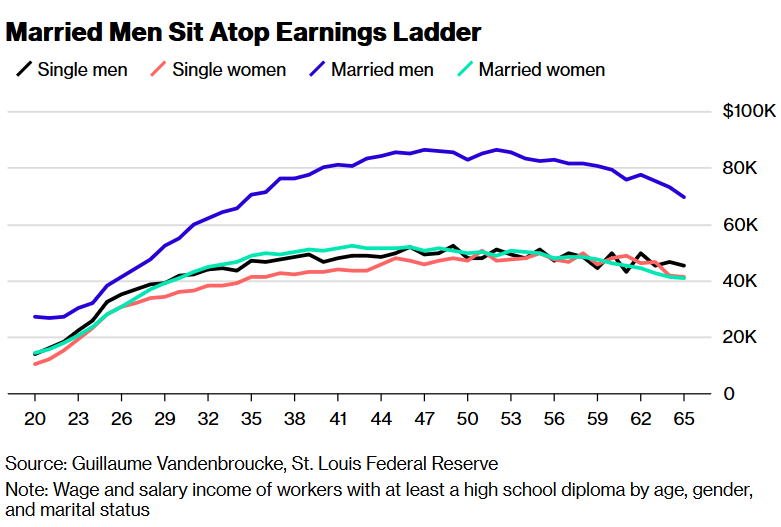
Married men seem to enjoy a boost in earnings from age 23-43
Married men seem to enjoy a boost in earnings between age 22-45

I saw a bunch of pro-marriage friends were tweeting about this article from the St. Louis Federal Reserve which talks about how well married men do financially compared to single men, and using it as a reason to argue that men should get married. The article from the St. Louis Reserve doesn’t have much commentary, but this article from the far-left Washington Post by Brad Wilcox has a lot to say.

Excerpt:

Marriage has a transformative effect on adult behavior, emotional health, and financial well-being—particularly for men.

[…]Men who get married work harder and more strategically, and earn more money than their single peers from similar backgrounds. Marriage also transforms men’s social worlds; they spend less time with friends and more time with family; they also go to bars less and to church more.

[…]Our research, featured in a recent report, “For Richer, For Poorer: How Family Structures Economic Success in America,” indicates that men who are married work about 400 hours more per year  than their single peers with equivalent backgrounds. They also work more strategically: one Harvard study found that married men were much less likely than their single peers to quit their current job unless they had lined up another job.

This translates into a substantial marriage premium for men. On average, young married men, aged 28-30, make $15,900 more than their single peers, and married men aged 44-46 make $18,800 more than their single peers.

That’s even after controlling for differences in education, race, ethnicity, regional unemployment, and scores on a test of general knowledge. What’s more: the marriage premium operates for black, Hispanic, and less-educated men in much the same way as it does for men in general.

For instance, men with a high-school degree or less make at least $17,000 more than their single peers.

So, what about these differences between married men and single men? Are men able to earn more if they have a wife to support them and care for their needs? Or is it just that women prefer men who are already able to take care of themselves?

Well, in most cases, it’s the former:

2. Married men are motivated to maximize their income. For many men, this responsibility ethic translates into a different orientation toward work, more hours, and more strategic work choices. Sociologist Elizabeth Gorman finds that married men are more likely to value higher-paying jobs than their single peers.

This is partly why studies find that men increase their work hours after marrying and reduce their hours after divorcing. It’s also why married men are less likely to quit a current job without finding a new job. Indeed, they are also less likely to be fired than their single peers.

3. Married men benefit from the advice and encouragement of their wives. Although there is less research on this, we suspect that men also work harder and more strategically because they are encouraged to do so by their wives, who have an obvious interest in their success. One study appears to buttress this point, finding that men with better-educated wives earn more, even after controlling for their own education.

4. Employers like married men with children.  There is evidence that employers  prefer and promote men who are married with children, especially compared to their childless male peers and to mothers. Married men are often seen as more responsible and dedicated workers and are rewarded with more opportunities by employers. While illegal bias and long-held stereotypes appear to play a role in this historic preference, it nonetheless helps explain why married family men get paid more.

Now what’s the purpose of me writing this? Well, I’m actually NOT writing this to pressure men to get married. Why not? Because although marriage was a pretty good deal 100 years ago, it’s not as good of a deal under the current laws and policies, e.g. – no-fault divorce, the threats of false accusations, the Sexual Revolution, etc. So I wouldn’t advise a man to rush into marriage to just anybody in order to get the financial (and health) benefits of having a wife. Marriage is only safe when you choose a woman carefully.

But I am writing this to women who are being told by the culture to delay marriage, and especially to delay marriage to use your youth and beauty to “have fun” with boys who won’t commit to marriage. If a woman loves a marriage-focused man and really wants to take care of him and support him, then early marriage is one of the very best ways to really help him during the years (22-45) when it really makes a difference. Marrying a man who wants marriage when you’re still young means that he will have many, many measurable benefits.

It’s important to marry a man when the marriage has the potential to do the most good for him in areas like health, career, finances and children. Men typically don’t want to marry women who are older, because they have more sexual experience and because they get used to giving a man sex in order to get him to do what she wants. Once a woman gets used to doing this, it becomes much harder to trust a good man to lead, and to give a man respect as a leader.

In addition, men know that women never change who they are really attracted to. If a woman chooses superficially attractive men who won’t commit over and over, then even if she “settles” for a man later on, she probably won’t be able to be attracted him. Men know not to choose women who won’t value them for their traditional moral values, conservative politics and ability to perform traditional male roles like providing. Men know that a woman who feels that she is “settling” for less than she deserves is more likely to disrespect him, and to withhold sex from him.

Now pro-marriage parents and pro-marriage pastors will typically tell you that they want to let their daughters decide when to marry, so that they will be happy having “fun” before marriage, and happy being provided for after marriage. But when those women are done playing the field and in their mid-thirties, their relatives and pastors are not thinking about what men’s interests are. They’re thinking about how to get this woman married, regardless of the man’s interests. And men know that. So they aren’t going to be bullied or shamed into a marriage after the window when it benefits them has closed. If parents and pastors want their daughters married AT ALL, then they need to encourage women to be self-controlled and marriage-focused EARLY.