Category Archives: Mentoring

Eight tips for talking to non-Christians about Christianity

From Stand to Reason – some excellent tactical advice from a master apologist.

Here’s the setup:

I overheard a conversation on the airplane coming back from my vacation in Wisconsin.  A Christian gentleman was vigorously sharing his faith with a gentleman in the seat directly behind me.  There are some things we can learn, both good and bad, from what I overheard and take his effort—which was a good one—and channel it in a little bit more constructive direction.

So I am going to give you eight points of application.

And here are my favorites from his list:

3.  Try to stay away from religious language, terminology, and religious affect. This person was very religious in his whole approach.  I think this is hard for us as Christians because we are brought up in a Christian environment and it’s natural for us to talk this way, but it sounds weird to people outside of that environment.  I think there are a lot of people who may be, in principle, interested in a bona fide, genuine relationship with God through Jesus Christ but who are not interested in the Christian religion as they perceive it.  This is where I think a lot of the emergent guys have a legitimate bone to pick with Evangelicalism.  Let’s try not to sound like Bible-thumping fundamentalists if we can avoid it, even if that’s what we are, because there’s no need to sound that way if it puts people off.  Find another way to communicate the message.  Just talk in a straightforward manner.  Be conscious of using religious language the other person may not understand or may think is strange.  Avoid all of that so they can hear the message you’re trying to communicate.

4.  Focus on the truth, not personal benefits of Christianity. I appreciated the gentleman’s approach in that he kept talking about truth.  One person he was talking to said he liked reincarnation.  The Christian man said that even if he liked reincarnation that that didn’t make it true if it’s not true.  Liking something is not going to change reality.  That’s a great point.  He was focusing on the truth claims of Jesus.  He wasn’t giving a bunch of promises.  He wasn’t saying, “Jesus is my ice cream.  He’s a great flavor.  Try him to see if you like him, too.”  Or, “Try Jesus because he’ll make your life so wonderful.”  Focus on truth and not personal benefits.

5.  Give evidence. This gentleman was giving all kinds of evidence for his seatmates to consider.  Good for him!  You should too.  You know why?  Because people in the Bible did, too.  Jesus, Paul, Peter, all the Apostles.  If you look at the details of how they communicated their faith they gave evidence for the truth of what they were saying about Jesus.  In fact, if you want to get the content of the Gospel, one of the most famous passages for the articulation of the Gospel is the beginning of 1 Corinthian 15.  Paul gives all kinds of evidence.  It’s all right there as he is explaining the Gospel.  We see that all through the New Testament.  So give evidences.  It’s appropriate.  People do respond to that even in a postmodern age.

I remember that I was once working in Chicago, and after a particular good apologetics discussion with a team of engineers, I apologized to them all for being so exclusive and a fundamentalist. These guys all had MS and PhD degrees in computer science from top schools like Stanford, Purdue, U of I, NIU and Northwestern. They said “you’re not a fundamentalist”. And I said, “but I am ultra-conservative in my theology!”. And they said “That’s ok – as long as you have considered different points of view and you have objective evidence, then somehow it doesn’t sound fundamentalist”.

I think that’s something that we need to work on. When Christianity is about truth, it’s open to investigation using public evidence. At work, I have explained the structure of DNA molecules in the office and had people rolling their chairs out of their cubicles to come and see me draw amino acid chains on a white board, and calculate the probabilities with a calculator. You can be a fundamentalist, without sounding like a fundamentalist. You just have to focus on public, testable evidence.

Look here:

Make religion about truth – not personal preferences. They respect that way of talking – as long as you bring the science and the history.
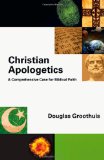
Douglas Groothuis’ 752-page Christian apologetics book is now under $22

Christian Apologetics

Looking for a good textbook on apologetics that covers everything you need to know? Check out Dr. Groothuis’ book. It’s now under $22 on Amazon.

Here are the chapters:

Part I: Apologetic Preliminaries
1 Introduction: Hope, Despair and Knowing Reality
2 The Biblical Basis for Apologetics
3 Apologetic Method: Evaluating Worldviews
4 The Christian Worldview
5 Distortions of the Christian Worldview–or the God I Don’t Believe In
6 Truth Defined and Defended
7 Why Truth Matters Most: Searching for Truth in Postmodern Times
8 Faith, Risk and Rationality: The Prudential Incentives to Christian Faith

Part II: The Case for Christian Theism
9 In Defense of Theistic Arguments
10 The Ontological Argument
11 Cosmological Arguments: A Cause for the Cosmos
12 The Design Argument: Cosmic Fine-Tuning
13 Origins, Design and Darwinism
14 Evidence for Intelligent Design
15 The Moral Argument for God
16 The Argument from Religious Experience
17 The Uniqueness of Humanity: Consciousness and Cognition
18 Deposed Royalty: Pascal’s Anthropological Argument
19 Jesus of Nazareth: How Historians Can Know Him and Why It Matters by Craig L. Bloomberg
20 The Claims, Credentials and Achievements of Jesus Christ
21 Defending the Incarnation
22 The Resurrection of Jesus

Part III: Objections to Christian Theism
23 Religious Pluralism: Many Religions, One Truth
24 Apologetics and the Challenge of Islam
25 The Problem of Evil: Dead Ends and the Christian Answer
26 Conclusion: Take It to the Streets

Appendix 1 Hell on Trial
Appendix 2 Apologetic Issues in the Old Testament by Richard S. Hess

Here’s a review of the book by Michael D. Stark.

Introduction:

Contemporary Christians interested in apologetics can now turn to another text that is bound to become one of the most-used textbooks in apologetics. Douglas Groothuis’ Christian Apologetics: A Comprehensive Case for the Biblical Faith (InterVarsity, 2011) may have more breadth both in content and wisdom than any apologetics text to date. The subtitle is justified as the book, over 700 pages and 26 chapters long (not including two appendixes), presents the need for apologetics and explores the main philosophical arguments for the existence of God. Unlike other apologetics texts, Groothuis includes chapters examining truth in postmodern society, religious pluralism, and a tactful approach to dealing with Islam. Furthermore, biblical scholars (and Denver Seminary colleagues) Richard Hess and Craig Blomberg build on an already strong text by writing chapters on apologetics in the Old Testament (Appendix 2) and a historical approach to the person of Christ and the gospels, respectively.

Here’s a snip from the review:

The chapter on cosmological arguments is superb and only further qualifies Groothuis as a proficient thinker. This chapter without question is the chapter I learned the most from. Groothuis engages very difficult scientific and philosophical concepts and communicates them in a way that even the beginner will be able to grasp. Though there are many different versions of the cosmological argument, the chapter hones in on the kalam cosmological argument as put forth by William Lane Craig. The kalam argument is superior to other cosmological arguments in that it supposedly secures the theistic doctrine of ex nihilo if the arguments proves successful (note: a minor quibble of this chapter is that Groothuis purports that the Thomistic cosmological argument does not endorse ex nihilo. I believe this to be false). This specific chapter was sensational – however I was left disappointed that no time was given to addressing the cosmological argument posited by Aquinas. In some respects, the Thomistic cosmological argument is the simplest form for people new to apologetics. The Thomistic version does not get into the technical issues of the metaphysics of time and Big Bang cosmology that the kalam version uses, nor does it require knowledge of the principle of sufficient reason that the Leibnizian version necessitates. While the kalam and Leibnizian versions are logical and sound arguments, they may confusing to people new to apologetics. Because of this, beginners ought to take the time to read this chapter slowly and more than once because of the finer technical details.

Chapters 12-14 are devoted to the design argument and issues relating to it. Groothuis opposes macroevolution and thus goes to great extent to battle Darwinism. Those interested in the philosophy of science will be drawn to these chapters. The chapter focused on intelligent design relies heavily on the work of William Dembski and Michael Behe. These chapters serve as a valuable introduction for those new to discussion between Christian and naturalistic sciences.

Chapter 15 is perhaps the most successful chapter of the entire book as it deals with the moral argument. It is my belief that the moral argument is the most successful argument for the existence of God as it appeals to everyone, Christian, atheist, and non-Christian religious persons. Ethical theory may perhaps be the most widely debated philosophical topic throughout history and thus Groothuis could have taken many approaches when discussing the moral argument. The way he structured his chapter, however, is nearly flawless. Building off his chapter examining truth in the postmodern culture (chapter 7), Groothuis correlates the denial of objective truth to the ridding of objective moral value. He unmercifully attacks moral relativism and brilliantly shows its dangers. He states that cultural relativism reduces to individual relativism, which, in turn, ultimately rests on nihilism. The setup of this reductio ad absurdum points the reader to a moral system that does not reduce to nihilism. Thus, a worldview that embraces objective moral truths must be embraced. Groothuis makes the claim that the source of objective moral truths is found in the absolute Being – God. Groothuis puts for the notion that God is the source of all perfect moral code because he himself is incapable of an evil act as it would be a contradiction of God’s Being.

I think that the big advantage you get from Doug Groothuis is his worldview. He has the most fully-integrated worldview of any Christian scholar I know.

I bought one copy of Dr. Groothuis’ book, but I gave it away. So I got myself another one. It’s a must have. My favorite four apologetics books are this one, “Philosophical Foundations for a Christian Worldview” by William Lane Craig and J.P. Moreland, Michael Licona’s “The Resurrection of Jesus” and Stephen C. Meyer’s “Signature in the Cell”. I think that if you add Wayne Grudem’s “Politics According to the Bible” to that list, then that’s a very practical set of tools.

Sarah Geis provides pointers for constructive debate and disagreement

From Sarah’s Think on These Things blog, a post about how to NOT argue contructively. If you don’t do any of the bad things on her list, you’ll be an excellent person to debate with. Consider this post your Saturday fun!

Excerpt:

1. Foster the conviction that all with whom you disagree are personally attacking you.
Even if the individual doesn’t know you, your ideas are your identity. Never mind the fact that this introduces all sorts of strange problems for understanding personal identity. That stuff is not important. What is important is that your very person, and all you hold dear, are being assaulted.

2. Don’t accept the author or speaker’s own definitions of his terms.
For instance, if someone is using the term “idealist” to mean a person who has lofty goals, you could show off your philosophical prowess and point out that he has gotten philosophical idealism (something else entirely) all wrong. It would also be fun to attack a Lutheran who believes in Christian orthodoxy  (small “o”) for being a closet Orthodox Christian!

3. Embrace category confusion.
Here is a time-tested example: If the argument is about economics, you may wish to respond by claiming that the author is just racist. You get bonus points here, as this tactic also functions as an ad hominem and as a red herring fallacy (look them up if you are curious).

4. Ignore all qualifiers.
This most often takes the form of responding with a counterexample to an admitted generalization. Example: Your interlocutor is evaluating the drawbacks to social media, and then says “interactions on social media tend to encourage more rudeness than would be likely in person.” You can fire back a response like this: “I’m always nice on Facebook! See? You’re wrong.” Or, “Uncle Joe uses Facebook to encourage invalids connecting to the world via laptop,” etc. You don’t want your counterexample to actually work. So, avoid using the skill in situations where the author has clearly made a universal statement such as, “There are no black swans.” Then, those who are still slaves to logic could refute the universal statement by saying– truthfully– that “Uncle Joe has a black swan.”

These are the things that happen to me daily in dealing with commenters like Sarah stone on this blog. If only Sarah had read this nice list!

I think #2 is the funniest.

The list contains 17 items. If you know someone who would benefit from it, please forward it along!