Category Archives: Mentoring

Pastor Matt discusses his past experiences as an atheist – part 1

Don’t worry, he was an atheist then, and now he’s pastor Matt, thanks to God’s grace.

This post Pastor Matt talks about why he was once an atheist.

Excerpt:

I am sometimes asked, by both skeptics and believers alike, why I was once an atheist and what convinced me to become a Christian.  I will answer the latter in another post but let me deal with the former now.

I am a “PK” or “preacher’s kid.”  My father served as the founding pastor of the largest church in southern Ohio.  It is a non-denominational, evangelical congregation that grew very quickly.

As a PK, I was privy to a lot of “inside information” and it was not encouraging.  I learned men and women who sang hymns with passion and shouted “Amen!” with gusto during the sermon were cheating on their spouse or on their taxes.

By the time I was a teenager I understood why those who called themselves Christians lived secret lives–they wanted to believe but really didn’t.  I understood because I became one of them.

I was an active member of an ’80′s evangelical youth group.  So, I rocked out to Stryper, had comedian Pat Hurley tapes and volunteered for the children’s ministry, which consisted of videotaping episodes of Superbook and The Flying House for the kids.  However, I actually seriously doubted if God even existed.

I was struggling with the normal sins of a teenager and begged for help in prayer.  I also petitioned God on a regular basis to feel His presence but that didn’t happen either.

I eventually came to the conclusion that Christianity simply didn’t work.  I declared myself an atheist at age fifteen and remained an unbeliever for the next ten years.

I ran away from home at age fifteen as well eventually making my way to Hollywood.  During those days I partied like it was 1999 (until 1997) and like Aldous Huxley is quoted as saying decades before, I came to not even want God to be real because even the possibility interfered with my desire to create my own morality.

Christianity is not something where you just profess it and suddenly you are automatically perfect. You get the gift of eternal life immediately by faith in Christ, but becoming more like Christ takes time. It’s easier to act consistently with the teachings of Christ if you have spent the time studying, practicing and growing as a Christian. You shouldn’t expect perfect behavior on day one – that is crazy. You should expect that as your beliefs become more solid, then your outward actions will change naturally. And often what you hear at home and in the church is not the best for finding truth through investigation and debate.

It would be terrible to have to put out “good” actions when you never settled the questions of what is true and how are we going to apply what is true in our own decisions. Sometimes, I think that young Christians face too much pressure to appear to be perfect when no one has been willing to help them work through the grounding for the behaviors they are expected to display. And I think a lot of the behaviors they are expected to display are either not important or not Biblical. Behaving like a  Christian should be natural – it should proceed from free inquiry, not dogmatism.

Now I’m skipping a lot, but here is his advice for people who were in his situation:

I’ll get to my conversion later but keep in mind: (1) just because a person attends a church, even if they are a PK, that he or she truly comprehends the Gospel because I didn’t a full understanding; (2) pastors need to constantly remind their parishioners that sin is easy and living for Christ is difficult because believers are part of a cosmic struggle; (3) the spiritual disciplines are invaluable especially so for young people; and (4) there are many solid arguments for the existence of God and few for materialism and all Christians deserve to know them.

I’ve spent some time mentoring young Christians who had fallen away for some period of  time, and I always make a point of asking them why. Their answer is usually something like this: “I knew that what I was doing was wrong, but I didn’t care because no one else cared.” The first thing to do with a person who is rebelling is to get in there and start to ask them questions and get involved in helping them to succeed in their lives. People do bad things because they feel that no one cares. So you better start caring for these young people, whether they are smart, dumb, pretty, ugly, poor, rich, popular, unpopular – it doesn’t matter. They all have souls, and they were all made to know God. Get in there and be real with them before they make a mess of their lives.
 

Courage under fire: Ronald Speirs and Easy Company at the Battle of Foy

I  try to occasionally post something that shows a particularly brave action from some time and place in military history. For example, I previously wrote about Medal of Honor winner Michael Murphy in 2011. Last year, his story was told more widely in the movie “Lone Survivor”, which I recommend to everyone. Today I want to highlight another hero: Ronald Speirs.

It is January 1945 and the famous “Screaming Eagles”, the 101st Airborne division, are about to turn the tide of the Battle of the Bulge in Bastogne.

Let’s read about the Battle of Foy courtesy of a scenario description from the wargame “Flames of War”. (Note: LMG = light machine gun, in this case, a .30 caliber machine gun)

Excerpt:

E or ‘Easy’ Company, 2nd Battalion, 506th Parachute Infantry Regiment, 101st Airborne Division, like the rest of the division, was ordered on to the attack on 9 January 1945 as part of a general offensive to drive back the Germans from Bastogne. In the following days the 506th Regiment, along with the 501st Parachute Infantry Regiment, cleared the forests around the town of Foy and pushed the Germans out. Their next objective was to take Foy to allow the 11th Armored Division to attack from Foy across the fields northeast towards Noville.

[…]At 0900 hours on 13 January Easy Company attacked along the western edge of Foy, along the road. The new year had brought heavy snow and the it blanketed the ground and had reduced temperatures to well below zero. 2nd Battalion commander, Captain Dick Winters, had two section of LMGs deployed on the edge of the woods facing Foy to give Easy Company covering fire while they crossed the 250 yards of open field between the forest and Foy’s buildings. There were just a few scattered trees and haystacks to give cover. As Easy Company advance the covering fire did its job, limiting the fire on the paratroopers to sporadic rifle shots. The approach on Foy made good pace under the cover of the LMG fire, but about 75 yards out from the edge of the village the skirmish line halted and the paratroopers hunkered down in the snow. Captain Winters stared in disbelief, wondering what was going on.

Lieutenant Dike, who was commanding Easy Company, had been overwhelmed with indecision. It became obvious to Winters that Dike didn’t know what he was doing, or had had a failure of confidence. His immediate impulse was to take command himself, but he noticed Lieutenant Ronald Speirs, a capable platoon commander from D Company, standing nearby. Winters ordered Speirs to take command of Easy Company and get the attack moving again. What Speirs did next amazed many of the paratroopers who witnessed it.

On receiving his orders from Winters, Speirs immediately ran at full speed down to where Dike and his HQ had taken cover behind a haystack and told Dike his orders, ‘I’m here to take over’. After quickly being told of the situation by the NCOs he ran off towards Foy. The men of Easy Company immediately followed. On reaching the outskirt buildings of Foy, Speirs immediately sought to link up with I Company of 3rd Battalion who, despite only having 25 men, were supporting the attack from the other flank of Foy. He set off running again, through the German lines, to find I Company’s commander. After consulting with its commander, Captain Gene Brown, he turned around and dashed back through Foy and the surprised Germans. Through all this the enemy fired on him with machine-guns, rifles and guns, but not a single shot hit its mark.

Now with all that said, watch the two clips below, and pay close attention the faces of the men under Lieutenant Dike, and then later under Lieutenant Speirs. Pay close attention to how Speirs’ courage inspires the men under him to also be courageous. Especially First Sergeant Lipton, who later risks his own life to draw fire from a German sniper so that Shifty Powers can prevent any other troops from being killed by the sniper.

The two clips are from “Band of Brothers”, the episode entitled “The Breaking Point“. There is some coarse language, but no sexual language in it. Really, if you are squeamish, do not watch it. However, if you can handle it, then buy the whole DVD set. It will inspire you, and help you to do things that you didn’t think were possible. If you really want to understand the men of E Company, you can read a book by Stephen E. Ambrose called Band of Brothers: E Company, 506th Regiment, 101st Airborne from Normandy to Hitler’s Eagle’s Nest (New York, 1992).

Low resolution clip, includes briefing at the beginning

This video is lower resolution, but show Winters reflecting on how Lipton had asked him not to let Dike lead the attack the night before, and also Winters carefully explaining to Dike that the American attack has to keep moving or they will get pinned down by machine guns and zeroed-in by mortars and destroyed.

I like that one because it shows the briefing, but the next clip is in 720HD.

High resolution clip, does not include briefing

This is a higher resolution version that is only 8.5 minutes long, but doesn’t have the briefing.

If you listen closely when Speirs explains what everyone is going to do, you can here one of the NCOs say “thank God” as he pats the other on the back.

Leadership

To be a good military leader, you have to know many things. A knowledge of strategy and tactics, a knowledge of military history, the ability to see the battlefield, knowledge of your opponent, knowledge of weapons, and so on. But surely the greatest of these is courage. As Von Clausewitz says in his famous book “On War”, “War is the province of danger, and therefore courage above all things is the first quality of a warrior.” Nothing inspires troops like a commander who is willing to take on the same risks that he asks his troops to take.

Take a look at this article from the Ivey School of Business journal, which talks about the characteristics of Canadian generals in Afghanistan.

Excerpt:

A leader must be in front of subordinates.  This takes courage.  Leadership from the front encapsulates the adage, never ask a subordinate to do something that you, the leader, wouldn’t do.  In Afghanistan, the leader must not only be in front, but he or she must be seen to be in front.  Subordinates seek this reassurance from their leaders at all levels.  Though they may be tentative, leaders must demonstrate character and moral strength.  Their credibility is inextricably dependent on their ability to do so..  During his frequent visits to Afghanistan, former Chief of Defence Staff (CDS), General Rick Hillier, made a point of visiting troops that were situated in some of the most IED-laden areas of the Canadian sector.  Through his demonstrated courage, he inspired leaders of all levels.  “If the CDS goes there, so can I” was the resulting mindset.  The current CDS, General Walt Natynczyk, has successfully continued this practice.

[…]All leaders need courage. It is the lynchpin of effective leadership.  No one respects a wimp who will buy in to any idea no matter how inane it might be.  Courage is having the strength of character to persist and hold on to ideas in the face of opposition.  Here, I’m not restricting my treatment of courage as it relates to fear.  It’s also about strength of character and devotion to causes and ideas.

As Christians, we have a leader who led by example. We all need to learn to not be so concerned with looking out for ourselves and our happiness first, but to instead be willing to take risks and sacrifice ourselves to do the right thing. We Christians should all be courageous, because we are led by a courageous leader.

That doesn’t necessarily mean going halfway across the world, it can mean reaching out to someone right there next to you who needs your help and support. Maybe that person has been running on an empty tank for a long time, but still trying to do the right thing. You never know when the opportunity to do something amazing will arise, but you won’t take it if you keep thinking of how you might get hurt. You have to reconcile yourself that you are not here to avoid every possible kind of suffering. It doesn’t mean that you take unnecessary risks, but it does mean not letting fear stop you from doing the right thing.

Now get out there and take that attack on in.

Are Christians responsible for making plans and making good decisions?

Here’s a wonderful post on decision making and the will of God posted on Neil’s blog. Neil links to another post where someone is trying to figure out what God wants him to do.

Excerpt:

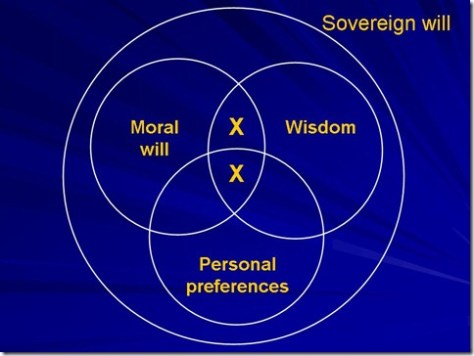
Really short version: Aside from direct and clear personal revelation from God, you don’t have access to his sovereign will when making decisions.  Therefore you must look at other factors.  If it isn’t moral, don’t do it.  If it is moral but not wise, don’t do it.  If it is moral and wise, then use your personal preferences.

Using this model you can end up with a wise and biblical decision, but you have avoided the traps of the “God told me to ____” routine.  People who run around saying that God told them this and that convey a super-spirituality that can leave less mature believers wondering if they really have a relationship with God (i.e., “God doesn’t tell me every little thing to do, so maybe I don’t really know him.”).

He has a helpful picture posted as well:

This is actually a very important topic for me, because I like making plans and making good decisions. I like being the quarterback or squad leader of my own life. I like to pick objectives and then make plans to achieve them. (Nothing too exotic, just simple stuff like saving money or reading more books)

Actually, I really oppose the idea that God has a magical fairy tale will for each person that will make them happy and fulfilled. For me, life isn’t like that. I don’t expect God to lead me along like a child at a scavenger hunt. I expect to survey the battlefield where I am and then do something to make a difference. There are lots of things you can do that will please God. Should you focus on your career and sponsor apologetics conferences? Or should you use your spare time preparing Sunday school lessons? There are lots of good things you could do to please God. Your job is to pick the one that will be the most effective. It doesn’t matter if it makes you happy, it only matters if it’s effective and if you are good at it.

Who is Rifleman Dodd?

A while back, I was busily working my way through the U.S. Marine Corps Official Reading List, and I came across a book by C.S. Forester called Rifleman Dodd, or alternatively titled Death to the French. It’s a work of historical fiction that takes place during the Napoleonic wars. The story is about a British marksman named Dodd, who is cut off from his own lines during a withdrawal maneuver. He is subsequently left to fend for himself behind enemy lines. An ordinary man might be full of despair and forget about his mission entirely. But Dodd is no ordinary man. Not only does he find a way to survive by finding food to eat, water to drink and places to sleep, but he also tries to remember his orders and to think about what he can do to advance the cause of his General, the Duke of Wellington.

Here’s an excerpt from a gritty book review:

It’s about a green-coated British infantry rifleman in the Napoleonic Wars, an age when rifles were a novelty and most of the army was red-coated and carried muskets. Private Matthew Dodd gets separated from his regiment during a retreat and finds himself stranded behind enemy (French) lines in Portugal. With the occasional aid of some natives, but mostly on his own, he harasses the French with his rifle and tries to prevent them from building a bridge across the Tagus River. It’s a remarkable tale of survival and solitary achievement, of a rank-and-file soldier who lives by his wits and slowly learns to make plans without orders, and shows leadership qualities and a knowledge of warfare.

I think we’re in the same situation as Dodd.

There is no point in us looking for breadcrumb trails to happiness at this point. That’s not the point of Christianity. The point of Christianity is friendship with God, imitation of Christ, honoring moral obligations, self-sacrificial love for your neighbor (and even your enemies!), and dedication to the truth – whether anyone else likes you or not. It’s not supposed to make you happy, and it’s not necessarily going to be a normal life like everyone else has. Things may not work out the way you’d like them to.

We seem to be making such a big deal about compassion and forgiveness in the Christian life these days – such a big emphasis on our feelings. Almost like we have forgotten that we have obligations to our friend – and his objectives. A relationship doesn’t mean that one person completely disregards the character and goals of the other person and then is automatically granted forgiveness whenever they want it. That’s not a friendship – that’s using someone else for your own ends. Maybe it’s time to remember what this is all about.