
Category Archives: Commentary

Six prominent Jews explain why most Jews are so liberal

From Commentary magazine. (H/T Robert Stacy McCain via ECM)

Excerpt:

Since nature abhors a spiritual vacuum, Podhoretz concludes that the religion of liberalism—that is, faith in the powers of government — has replaced Judaism in the hearts of Jews. . . .
Why, asks Podhoretz, do Jews cling to this belief if it no longer serves our interest? . . .
If I may be allowed so vast a sweep of generalization, Republicans, conservatives, are the party that feels comfortably at home. We need not attach a value to this observation; you may approve of this sensibility or not. But for Jews, unease is our mother tongue. . . .
David Wolpe

Jewish liberalism endures, Podhoretz concludes, because turning conservative, in liberal eyes, is nothing short of heresy—or worse, apostasy.
Jonathan D. Sarna

Most American Jews, on the other hand, seem to have learned from an early age that to be Jewish is to be a liberal Democrat, no matter what. . . . [T]he loyalty of American Jews to the Left has been unaffected by the failure of the Left to reciprocate that loyalty.
Jeff Jacoby

In many cases, Podhoretz notes, left-wing politics took the place of a Judaism that felt to new American immigrants like a business suit on a beach: conspicuous, constraining, ridiculously out of place. . . . On this reading, emotional, facts-be-damned Jewish liberalism is a gravestone marking the death of religious faith.
David Gelernter

But my own tentative personal resolution, reached after reading Why Are Jews Liberals?, is this: I’m going to stop worrying about American Jews. They’re not worth the headache. Either they’ll come to their senses or they won’t, and there’s not much I (or anyone else, I suspect) can do about it.
William Kristol

For most American Jews, the core of their Jewish identity isn’t solidarity with Israel; it’s rejection of Christianity. This observation may help to explain the otherwise puzzling political preferences of the Jewish community explored in Norman Podhoretz’s book. Jewish voters don’t embrace candidates based on their support for the state of Israel as much as they passionately oppose candidates based on their identification with Christianity — especially the fervent evangelicalism of the dreaded “Christian Right.”
Michael Medved

But what McCain writes himself is also worth noting:

Thus, for the past several years, we were treated to endless liberal jeremiads against “abstinence education,” as if the sex-ed curriculum in public schools were the single most important issue in national politics. The propaganda purpose of this liberal campaign was to suggest to people who think of themselves as sexual sophisticates that the GOP is actively promoting ignorance.

If you wish to identify the source of the Republican Party’s electoral weakness among under-30 voters, this is it — even though, as I say, this perception of the GOP as “anti-sex” (or “pro-ignorance”) is strictly a function of liberal propaganda. GOP leaders have failed to recognize the damage inflicted by this propaganda, have failed to clarify the policy issues involve and have, at times, unwittingly played to the negative stereotype of Republicans as uptight, repressed, and clueless about sex.

Depicting the “Christian Right” as an especially benighted and menacing component of the Republican Party has, as Medved notes, a particular value in discouraging Jewish Democrats from reconsidering their political loyalties. To any liberal, the conservative is always the Other. But by depicting the GOP as dominated by the “Christian Right,” the Otherness of conservatism is effectively doubled — if not, indeed, magnified exponentially.

Never mind that evangelical Christians are overwhelmingly pro-Israel and philo-Semitic. The liberal propaganda depiction of evangelicals as backward ignoramuses, taking their marching orders from a handful of TV preachers, accomplishes its intended purpose — to evoke a distinctive cultural revulsion among Jews, and to conjure up nightmare visions of an American Kristallnacht.

So, I think two of the problems are 1) religious bigotry and 2) fears of irrational policies. And I think I know how to fix that.

Where are the studies and arguments that socially conservative policies are actually good? Good for people’s happiness, good for reducing government expenditures, and good for individual liberty itself? I wonder whether any conservatives can even articulate the argument that strong families and abstinence are needed precisely to make sure that government doesn’t have to grow to deal with the consequences of family breakdown and pre-marital sex, such as violent children and STDs?

I have noticed the exact same thing that the article describes is happening with Hindus. A combination of religious bigotry and contempt for policy positions embraced on ignorance. It’s not the fault of Jews and Hindus – we in the conservative movement need to do a better job of explaining the reasons for our positions in non-sectarian terms. E.g. – if homeschooling really is better as a policy, then we should have the studies to show that it produces better grades.
Dennis Prager explains why big government means small citizens

I noticed this article by Dennis Prager that I highly recommend to all my readers. (H/T Muddling Towards Maturity, The Pugnacious Irishman)

The title is “The Bigger the Government, the Smaller the Citizen”.

Excerpt:

Here are five reasons why bigger government makes less impressive people.

1. People who are able to take care of themselves and do so are generally better than people who are able to take care of themselves but rely on others.

[…]2. The more people come to rely on government, the more they develop a sense of entitlement — an attitude characterized by the belief that one is owed (whatever the state provides and more).

[…]3. People develop disdain for work.

[…]4. People become preoccupied with vacation time.

[…]5. People are rendered more selfish.

What does it say about us, that were are willing to give up our own freedom in order to live off our neighbor’s hard work?

Here’s more stuff from Muddling:

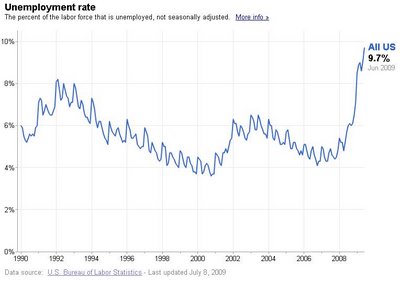
What lowers unemployment? Bush’s tax cuts or Obama’s spending?

Obama’s unemployment rate is now a 9.5% and heading over 10%. About 3.5 MILLION jobs lost by the President ACORN-lawyer.

This is the highest unemployment rate in at least 26 years. DON'T ELECT DEMOCRATS!

Let’s examine the numbers, and how the media reported on the numbers.

This video is from Hot Air.

Here’s what the Washington Post said after Bush’s tax cuts lowered the unemployment rate to 5.4%:

For President Bush, tax cuts have been an all-purpose elixir, a cure for budget surpluses and a bursting stock bubble, for terrorist attacks and boardroom scandals, for the march to war and a jobless recovery in peacetime.

Now, after three successive tax cuts, and after a record budget surplus has turned to a record deficit, the president faces an unenviable choice. He can either concede that his $1.7 trillion tonic has not worked as advertised, or he can insist that the economy is strong despite the slowdown in growth and job creation.

Bush cut taxes on the most productive job-creating parts of the economy by 2.2 trillion overall in his two terms.

But what about Obama? The Post writes:

The big news of the week should be Friday’s employment report, which many analysts suspect will show that the labor market, while still quite bad, continues on a path toward stabilization. Economists are expecting the unemployment rate to rise to 9.5 percent, from 9.4 percent, and for employers to have cut 228,000 net jobs in August, compared with the 247,000 jobs lost in March. That job loss number — or even better, a figure that starts with a “1,” would be strong evidence that improvement in the economy is finally filtering through to the job market in a serious way.

But there are reasons to doubt that will happen. Most notably, the rate of new jobless claims has failed to come down significantly in recent weeks, which suggests businesses are still eager to pare back their payrolls. Thursday, the Labor Department said 570,000 Americans put in new claims for unemployment insurance benefits, down only barely from 580,000 the previous week.

Surprise! Communism is bad for the economy! Who knew?

Economics in One Lesson

We are going to have to pay for all this spending on Obama’s favored special interest groups eventually, and that means that taxes will go up, or that the value of the dollar will go down, due to inflation. It has to be one or the other or both. There is no third way.

Perhaps it is time to review Henry Hazlitt’s Economics in One Lesson, chapter 4, entitled “Public Works Mean Taxes”.

Excerpt:

Therefore, for every public job created by the bridge project a private job has been destroyed somewhere else. We can see the men employed on the bridge. We can watch them at work. The employment argument of the government spenders becomes vivid, and probably for most people convincing. But there are other things that we do not see, because, alas, they have never been permitted to come into existence. They are the jobs destroyed by the $10 million taken from the taxpayers. All that has happened, at best, is that there has been a diversion of jobs because of the project. More bridge builders; fewer automobile workers, television technicians, clothing workers, farmers.

And consider Chapter 5 as well, entitled “Taxes Discourage Production”.

In our modern world there is never the same percentage of income tax levied on everybody. The great burden of income taxes is imposed on a minor percentage of the nation’s income; and these income taxes have to be supplemented by taxes of other kinds. These taxes inevitably affect the actions and incentives of those from whom they are taken. When a corporation loses a hundred cents of every dollar it loses, and is permitted to keep only fifty-two cents of every dollar it gains, and when it cannot adequately offset its years of losses against its years of gains, its policies are affected. It does not expand its operations, or it expands only those attended with a minimum of risk. People who recognize this situation are deterred from starting new enterprises. Thus old employers do not give more employment, or not as much more as they might have; and others decide not to become employers at all. Improved machinery and better-equipped factories come into existence much more slowly than they otherwise would. The result in the long run is that consumers are prevented from getting better and cheaper products to the extent that they otherwise would, and that real wages are held down, compared with what they might have been.

There is a similar effect when personal incomes are taxed 50, 60 or 70 percent. People begin to ask themselves why they should work six, eight or nine months of the entire year for the government, and only six, four or three months for themselves and their families. If they lose the whole dollar when they lose, but can keep only a fraction of it when they win, they decide that it is foolish to take risks with their capital. In addition, the capital available for risk-taking itself shrinks enormously. It is being taxed away before it can be accumulated. In brief, capital to provide new private jobs is first prevented from coming into existence, and the part that does come into existence is then discouraged from starting new enterprises. The government spenders create the very problem of unemployment that they profess to solve.

What Obama did, in effect, is to fire all of those millions of private sector people, so that he could reward the people who voted for him. And jobs are created far more efficiently by small businesses than they are by big government. This is the science of economics.

Let’s drop the Peter-Pan politically-correct policies of the left, and elect Republicans in 2010.