
Category Archives: Commentary

Five liberal Democrat policies that hurt minorities

Marriage and Poverty

The five policies are:

  • higher minimum wage rates
  • opposition to school voucher programs
  • releasing criminals from jail
  • affirmative action
  • single mother welfare

This article is by Jason L. Riley, and it appeared in the Wall Street Journal.

Excerpt:

At the urging of labor unions, President Obama has pushed for higher minimum wages that price a disproportionate percentage of blacks out of the labor force. At the urging of teachers unions, he has fought voucher programs that give ghetto children access to better schools.

Both policies have a lengthy track record of keeping millions of blacks ill-educated and unemployed. Since the 1970s, when the federal government began tracking the racial achievement gap, black test scores in math, reading and science have on average trailed far behind those of their white classmates. And minimum-wage mandates have been so effective for so long at keeping blacks out of work that 1930, the last year in which there was no federal minimum-wage law, was also the last year that the black unemployment rate was lower than the white rate. For the past half-century, black joblessness on average has been double that of whites.

Last week the Justice Department said it would release some 6,000 inmates from federal prison starting later this month. The goal, according to the White House, is to ease overcrowding and roll back tough sentencing rules implemented in the 1980s and ’90s.

But why are the administration’s sympathies with the lawbreakers instead of their usual victims—the mostly law-abiding residents in low-income communities where many of these inmates eventually are headed? In dozens of large U.S. cities, violent crime, including murder, has climbed over the past year, and it is hard to see how these changes are in the interest of public safety.

The administration assures skeptics that only “nonviolent” drug offenders will be released, but who pays the price if we guess wrong, as officials have so often done in the past?

When Los Angeles asked the Rand Corp. in the 1990s to identify inmates suitable for early release, the researchers concluded that “almost no one housed in the Los Angeles jails could be considered non-serious or simply troublesome to their local communities” and that “jail capacity should be expanded so as to allow lengthier incarceration of the more dangerous.”

A 2002 federal report tracked the recidivism rate of some 91,000 supposedly nonviolent offenders in 15 states over a three-year period. More than 21% wound up rearrested for violent crimes, including more than 700 murders and more than 600 rapes. The report also noted the difficulty of identifying low-risk inmates. Auto thieves were rearrested for committing more than a third of the homicides and a disproportionate share of other violent offenses.

Keep in mind that when criminals are release, they don’t go move into wealthy progressive neighborhoods. It’s not the wealthy leftists elites who have to deal with the released inmates. It’s the poor, low-income minority neighborhoods that have to deal with them.

By the way, I covered the minimum wage argument here, and I covered the school choice argument here.

That covers the first 3 policies. This article from The College Fix covers the fourth policy, affirmative action.

It says:

A UCLA law professor critiques affirmative action as detrimental to the very people it strives to aid: minority students.

Professor Richard Sander, though liberal-leaning, has deemed affirmative action practices as harmful, a notion that contradicts a liberal view in college admissions, said Stuart Taylor, a nonresident senior fellow at the Brookings Institution.

[…]Sander began teaching law at UCLA in 1989. After a few years he garnered an interest in academic support and asked permission to analyze which strategies most effectively assist struggling students.

After reviewing statistics on performance, especially those of students with lower academic merit, he noticed correlations between race and academic success.

“I was struck by both the degree to which it correlated with having weak academic entering credentials and its correlation with race,” Sander said in a recent interview with The College Fix. “And as I looked into our admissions process I realized that we were giving really a large admissions preference.”

Sander noticed that students admitted into the law school with lower academic credentials than their peers had significantly lower percentages of passing the Multistate Bar Examination, Sander said. This especially pertained to minority students who were given special consideration in the admittance process due to their race rather than their academic preparedness.

He then began thinking about whether or not these students would have better chances of succeeding if they went to a less elite university, he said.

He called this discrepancy a mismatch; when minority students with lower credentials than their peers are accepted into more challenging universities and then suffer academically as a result.

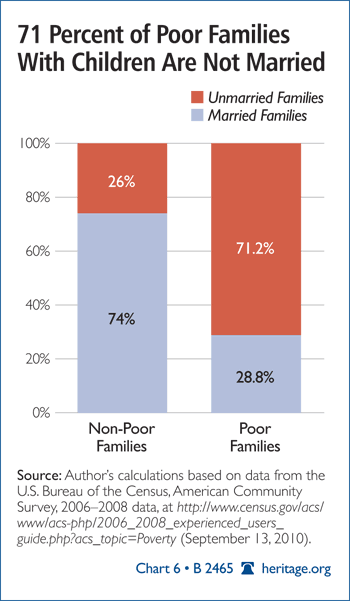
And the fifth policy is welfare. Welfare encourages women to not marry the men that they have sex with, since they will lose their single mother benefits if they do. Children who are raised fatherless are more likely to struggle in a number of areas, and they are especially likely to be poor. What we should be doing (if we really want to help the poor) is paying people to get married and stay married. But Democrats are opposed to that. The connection between welfare, fatherlessness, poverty and crime is explained in a previous post.


Making monergism make sense: a middle-knowledge approach to salvation

Lets take a closer look at a puzzle

This article at Free Thinking Ministries was written by my friend Tim Stratton. In it, he tries to rescue Calvinism from the horror of double-predestination.

Excerpt: (links removed)

Many reformed folks (freely?) choose to reject Molinism because they contend that this theological view “smells of synergism.” What is this stench that reportedly makes John Calvin turn over in his grave? Simply put, synergism is the view that man plays at least a small part in his own salvation process. Monergism, on the other hand, is the view that God is the author of salvation from beginning to end.

Since Molinism affirms that man is free to choose to reject God’s saving grace or not, many Calvinists jump to the conclusion and assume that Molinism must be synergistic. This does not necessarily follow.[1] Consider one possible model:

1- God, by nature, is a volitional unmoved mover who is free to choose between options in accord with His nature. (This is supported via the Kalam and the Argument from Time).

2- By God’s grace, humans are created in the “image of God.” By nature, then, we are free to choose between options in accord with our nature. (This is supported via the Freethinking Argument).

3- Adam & Eve freely chose to disobey God and this sin completely separates humanity from God. This is what it means to have a “totally depraved sin nature.” (Every aspect of man is separated from God).

4- In this state of depraved separation from God (sin nature), humans do not even know God exists if merely left to our own devices.

5- If humans do not even know God exists, then, left to our own devices and apart from God’s grace, it would be impossible to choose to love and follow God (thus, Pelagianism is impossible on this view).

6- God, in His love for all people, provides amazing prevenient grace to all people (Romans 1:20), writing the law on the human heart (Romans 2:15), conviction of the Holy Spirit (John 16:8-9), and draws all men (John 12:32). This is commonly referred to as “common grace.”

7- Therefore, by God’s grace, human nature has changed from a “totally separated from God nature” to a nature that has now experienced enough divine revelation (influences) allowing all mankind to start making some free and volitional choices in accord with our new nature; namely, to choose to resist God’s grace and revelation, or not.[2] Mankind is without excuse because we do not have to resist what God has made clear (Romans 1:18-20).[3]

[Note: According to Calvinist, Matt Slick (albeit inadvertently), Mark 4:10-12 implies that if an unregenerate person gets access to clear and accurate information, then they possess the ability to become Christians!]

8- If one does not reject or continually resist the grace and revelation God provides them, then God will continually provide more and more until the person reaches the point of “no return” and will become saved.

Thus, God does ALL the work in salvation from beginning to end on this Molinistic model; all the human can do is freely resist God’s grace and revelation, but he or she does not have to! The human does nothing to gain salvation apart from God’s grace on this Monergistic Model of Molinism.

I think that Stratton’s formulation above does indeed keep God as the sole initiator of salvation. And that’s good. But it also makes sure that human resistance to God is allowed, and that’s good. We want salvation to be 100% by faith alone in Christ alone. But we don’t want God to be the cause of people not being saved (because he is the ONLY ONE who can save them, and he chooses not to save them). On Stratton’s view, God wants everyone to be saved. If anyone is saved, it’s because God did ALL THE WORK to lead them and secure their salvation with the death of Jesus on the cross. But, on Stratton’s view, humans do get a choice – the choice to trust God or not. And so, if a person is not saved, then it’s their fault – not God’s. This works.

Read his whole post, and see what you think about it.

Wayne Grudem explains male leadership in marriage

Man helping a woman with proper handgun marksmanship

I’m not willing to take advice on this from most pastors, but Wayne Grudem is someone I respect because he does such a good job of applying the Bible to political issues. So he’s practical.

Anyway, here is something he wrote that was shared by a newlywed couple I am friends with.

Excerpt:

Someone might say, “Well, okay, fine. There’s a leadership role for Adam, and I guess that means husbands should have a leadership role in their marriage of some sort. But how does it work? How does it work in practice?”

In our own marriage, Margaret and I talk frequently and at length about many decisions. I can tell you that I wouldn’t be here tonight unless Margaret and I had talked about this and asked the Lord about it, and she had given blessing to it, and said, “Yes, I think that’s right.” Sometimes we make large decisions such as buying a house or a car, and sometimes they are small decisions like where we should go for a walk together. I often defer to Margaret’s wishes, and she often defers to mine because we love each other.

In almost every case, each of us has some wisdom and insight that the other does not have. Usually, we reach agreement on the decisions that we make. Very seldom will I do something that she doesn’t think is wise–I didn’t say never. She prays; she trusts God; she loves God. She is sensitive to God’s leading and direction, but in every decision, whether it large or small and whether we have reached agreement or not, the responsibility to make the decision still rests with me.

Now, I am not talking about every decision they make individually. Margaret controls a much larger portion of our budget than I do because all the things having to do with the household and food and clothing and house expenses and everything . . . she writes the checks and pays the bills. I take care of buying books and some things about the car. I have appointments during the day with students. She doesn’t get involved in that. She has her own appointments. She has her own calendar. I don’t get involved in trying to micromanage all of that. We have distinct areas of responsibility. I am not talking about those things. I don’t get involved in those things unless she asks my counsel.

But in every decision that we make that affects us together or affects our family, the responsibility to make the decision rests with me. If there is genuine male headship, I believe there is a quiet acknowledgement that the focus of the decision making process is the husband, not the wife. Even though there will often be much discussion and there should be mutual respect and consideration of each other, ultimately the responsibility to make the decision rests with the husband. And so, in our marriage the responsibility to make the decision rests with me.

This is not because I am a wiser or more gifted leader. It is because I am the husband. God has given me that responsibility. It is very good. It brings peace and joy to our marriage, and both Margaret and I are thankful for it. Now, I need to add very quickly, men, this does not mean that a husband has the right to be a selfish leader.

Just about three years ago, maybe four years ago now, we started the decision making process. Margaret had been in an auto accident in Chicago. As part of the aftermath of that accident, she was experiencing some chronic pain that was aggravated by cold and humidity, and Chicago is cold in the winter and humid in the summer. Chicago was not a good place for that. Some friends said to us, “We have a second house in Mesa, Arizona, if you would ever like to go there and just use it as a vacation place, we would like you to do that.”

So we did. We visited Arizona. Mesa is a suburb of Phoenix. Margaret felt better. It was hot, and it was dry. And so I said, “Wow, Margaret I would love to move here, but I am only trained to do one thing; I can teach at a seminary and that is it. There aren’t any seminaries here.” The next day Margaret was looking in the yellow pages–literally. She said, “Wayne, there’s something here called Phoenix Seminary.” One thing led to another and God was at work in that seminary, and it was starting to grow.

Then we went through a decision making process. When we were in the middle of that decision making process, on the very day that we were focusing on that, I came in my normal custom of reading through a section of scripture each day, I came to a Ephesians 5:28, “Even so husbands should love their wives as their own bodies.”

I thought if I would move to take a job in another city for the sake of my body, if I were experiencing the pain that Margaret had, and husbands should love their wives as their own bodies–then shouldn’t I move? Shouldn’t I be willing to move for Margaret’s sake? That was really why we moved to Phoenix.

Anyway, Dina and I were talking the other night about what would happen if – hypothetically – we suddenly found ourselves stuck with a child and responsible for it’s education. I said to Dina that I would have a meeting with her, and ask her to research all of the alternative forms of schooling, and look over the research on education and then come back with her recommendation about what would get us the most effectiveness for the least cost and risk. Dina said that she thought that was an excellent plan, but being the kind of person she is, she said that she would not wait to be asked to do this, but would instead pro-actively go and do the work and then present it to me to make the decision. A wife is a chief of staff, she does the research. She has to know all the politics. She has to do the face to face conversations. She has to make all the calculations. She has to be good at putting aside her feelings and being logical and analytical, in order to get results.

I think a lot of people worry that male headship means that husbands will micromanage like a tyrant, but that’s just wrong. That’s not at all what a man learns about how to lead others, in his workplace. A man looks for a wife with skills and experience to solve these sorts of problems for him while he is out working, and without needing a lot of guidance or monitoring from him. Micromanaging makes them both less efficient and more stressed. The more education and work history she has before she marries, the better she will be at solving problems on her own initiative. I always encourage young women to study hard things and to do hard jobs, but to stop working when young children appear (the first five years of the child’s life are critical). Learning hard things and doing hard jobs makes them more prepared for the roles of wife and mother.

Similarly, a wife does not want to choose a poor leader for a husband. She wants to choose someone who makes good decisions, and follows a plan through to a result. She should be looking at his decision making, especially in education, work and finances, and deciding whether he can do the male roles in a marriage.  She should be looking at his leadership style and communication ability. These things are well-defined, and she should be able to assess his ability by looking at his life to see if anyone follows his lead at work or outside of work on anything that matters. Does he reach the goals that he plans to reach? Is he realistic about risks and costs? She has to do an assessment of his leadership ability, because if she marries him, he will be leading her. Naturally, she will have to know something about leadership first, and know something about men, and what men expect to achieve with their marriages. What is his plan?

The easiest way for a man to avoid marrying a woman who resists his leadership is to not marry her. And the easiest way for a woman to avoid marrying a man who does not delegate tasks to her that she is better at is to not marry him. We are responsible for these decisions. As long as you don’t follow your feelings and intuitions, you’ll be fine. Don’t marry someone unless you have observed them demonstrating their ability to do the marriage roles cheerfully and well.