Category Archives: Commentary

Correcting four myths about the history of the Crusades

Crusader
Crusader

Here is an interesting article from First Principles Journal.

Intro:

The verdict seems unanimous. From presidential speeches to role-playing games, the crusades are depicted as a deplorably violent episode in which thuggish Westerners trundled off, unprovoked, to murder and pillage peace-loving, sophisticated Muslims, laying down patterns of outrageous oppression that would be repeated throughout subsequent history. In many corners of the Western world today, this view is too commonplace and apparently obvious even to be challenged.

But unanimity is not a guarantee of accuracy. What everyone “knows” about the crusades may not, in fact, be true. From the many popular notions about the crusades, let us pick four and see if they bear close examination.

The four myths:

  • Myth #1: The crusades represented an unprovoked attack by Western Christians on the Muslim world.
  • Myth #2: Western Christians went on crusade because their greed led them to plunder Muslims in order to get rich.
  • Myth #3: Crusaders were a cynical lot who did not really believe their own religious propaganda; rather, they had ulterior, materialistic motives.
  • Myth #4: The crusades taught Muslims to hate and attack Christians.

Here’s the most obvious thing you should know. The Crusades were defensive actions:

In a.d. 632, Egypt, Palestine, Syria, Asia Minor, North Africa, Spain, France, Italy, and the islands of Sicily, Sardinia, and Corsica were all Christian territories. Inside the boundaries of the Roman Empire, which was still fully functional in the eastern Mediterranean, orthodox Christianity was the official, and overwhelmingly majority, religion. Outside those boundaries were other large Christian communities—not necessarily orthodox and Catholic, but still Christian. Most of the Christian population of Persia, for example, was Nestorian. Certainly there were many Christian communities in Arabia.

By a.d. 732, a century later, Christians had lost Egypt, Palestine, Syria, North Africa, Spain, most of Asia Minor, and southern France. Italy and her associated islands were under threat, and the islands would come under Muslim rule in the next century. The Christian communities of Arabia were entirely destroyed in or shortly after 633, when Jews and Christians alike were expelled from the peninsula.6 Those in Persia were under severe pressure. Two-thirds of the formerly Roman Christian world was now ruled by Muslims.

What had happened? Most people actually know the answer, if pressed—though for some reason they do not usually connect the answer with the crusades. The answer is the rise of Islam. Every one of the listed regions was taken, within the space of a hundred years, from Christian control by violence, in the course of military campaigns deliberately designed to expand Muslim territory at the expense of Islam’s neighbors. Nor did this conclude Islam’s program of conquest. The attacks continued, punctuated from time to time by Christian attempts to push back. Charlemagne blocked the Muslim advance in far western Europe in about a.d. 800, but Islamic forces simply shifted their focus and began to island-hop across from North Africa toward Italy and the French coast, attacking the Italian mainland by 837. A confused struggle for control of southern and central Italy continued for the rest of the ninth century and into the tenth. In the hundred years between 850 and 950, Benedictine monks were driven out of ancient monasteries, the Papal States were overrun, and Muslim pirate bases were established along the coast of northern Italy and southern France, from which attacks on the deep inland were launched. Desperate to protect victimized Christians, popes became involved in the tenth and early eleventh centuries in directing the defense of the territory around them.

If you asked me what are the two best books on the Crusades, I would answer God’s Battalions: The Case for the Crusades by Baylor professor Rodney Stark and The Concise History of the Crusades by Professor Thomas F. Madden. If you get this question a lot from atheists, then I recommend you pick these up. Anything by Rodney Stark is useful for Christians, in fact.
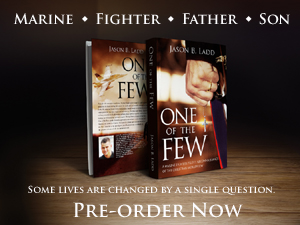

Fighter pilot discusses apologetics and Christian living in new book “One of the Few”

"One of the Few" by Jason B. Ladd
“One of the Few” by Jason B. Ladd

Here is the blurb for his new book:

Author, Marine, and Iraq War veteran Jason B. Ladd has just launched a pre-order campaign for his new book One of the Few: A Marine Fighter Pilot’s Reconnaissance of the Christian Worldview. He has until March 22 to reach his goal or it’s back to the drawing board. Read about him and the book below, and then check out his pre-order campaign at

http://publishizer.com/one-of-the-few

The link above has the table of contents and chapter summaries.

From the back cover:

“Unsatisfied with his secular worldview, Marine fighter pilot Jason B. Ladd shares the struggles he faced during his search for truth and a reasonable defense of the Christian faith.

His mission began with a realization: though ready to defend his country, he was unprepared for his most important missions as a husband and father. Drawing from his military experience, Ladd warn seekers about spiritual apathy and teaches Christians tactics for withstanding spiritual attacks. Birthed from a legacy of service, One of the Few speaks from the spirit of a man reborn—with the soul of a Marine, the mind of a fighter, the heart of a father, and a commitment to the Son. Join him as he uses fighter pilot fundamentals to embark on the greatest mission of all: the pursuit of truth.”

Jason B. Ladd is a Christian apologist, F/A-18 Weapons and Tactics Instructor, and Iraq War veteran. He received his Bachelor of Arts degree in Peace, War, and Defense from the University of North Carolina at Chapel Hill in 2001. Jason writes articles for FIGHTER FAITH, a website he founded to help others lead with conviction, embrace parenthood with joy, and develop a worldview capable of answering life’s biggest questions. He and his wife, Karalyn, are the parents of six children.

Here’s the aircraft that Jason flies:

F-18 Hornet configured for strike mission
F/A-18 Hornet configured for strike mission

I actually met Jason at a recent SES National Apologetics conference, and it was great fun talking to him. He has a real interest in Christian apologetics and he sees how important it is for Christians to have a defensible worldview.

If you want to see a sample of Jason’s writing, check out this post on his blog.

This is interesting:

Christianity is more than a belief system. It is a away of life. The principles derived from Scripture inform the head and guide the heart. The Christian worldview is one of the few where philosophy corresponds to the human experience with coherence and consistency.

But inevitably, events will occur which threaten to shake the foundations of our world. We lavish God with praise when his blessing fall upon us, but when tragedy strikes, praises turn into questions.

Why does there have to be suffering?

This is one of the most important question you can ask, and it’s the topic of a recent book by Ravi Zacharias and Vince Vitale titled “Why Suffering? Finding Meaning and Comfort When Life Doesn’t Make Sense”.

Abiding by a spiritual code means following a perpetual pattern of study and application. Once a search for truth yields the fruit of discovery, a growing hunger for more knowledge can threaten this balance.

The study of Christian apologetics is about the desire to give answers for anyone with questions. It’s about deepening your understanding of why you believe what you believe.

Just as a scientist must leave the lab and work in the field, the apologist must recognize when to stop studying and start applying what he or she has learned.

This happened to me recently. Life threw a curveball, and the questions started coming. It was the moment for which all previous studying, thinking, praying, and contemplating was intended: to help someone cope through a time of suffering.

Zacharias writes:

“At least as important as the question of why there is suffering is the question of how we will face the pain”1

The question is not just how we will face the pain, but whether we can help others through their own pain.


I’ve always understood my Christian faith augmented by my study of military history and military biography. Before I started meeting lots of Christian apologists on the Internet, I thought I was the only person who viewed living out a Christian life in strategic ways, where you make decisions about what you invest in and study with a view of knowing enough about what is true to render yourself impervious to the slings and arrows that life can throw your way. It’s interesting to see how people who are trained for actual war-fighting like Jason talks about his faith and how he built it up with apologetics. So you learn apologetics first to take care of yourself, and you make other moves to protect yourself from the things that take away people’s faith.

In my case, I play defense by saving money in case something happens to my health or my job. I try not attempt things that I can’t complete, and I have a pool of resources and a network of friends to support me. Once you have this foundation, you can then turn outward and build up other Christians – protecting them from challenges to their faith and unexpected losses and suffering. Supporting them, encouraging them and connecting them to other Christians to make them more resilient.

It’s really fascinating to be a Christian and take this tactical view of your life. You find yourself constantly reading and studying and earning and saving so that you are able to withstand threats and protect others from threats. It’s a very practical view of the Christian life, it’s not passive. I find that most often it’s those with a career in law enforcement (e.g. – J. Warner Wallace) and the military (e.g. – Jason Ladd) who take this tactical approach to their faith.

Woman reflects on her bio-parents’ divorce and growing up in two-lesbian home

The Public Discourse posted a really interesting letter from a woman whose biological parents divorced, and then she grew up with her mother and her mother’s lesbian partner. She addresses this post to Justice Kennedy, the swing vote on the Supreme Court.

She writes:

Children are the reason government has any stake in this discussion at all. Congress was spot on in 1996 when it passed the Defense of Marriage Act, stating:

At bottom, civil society has an interest in maintaining and protecting the institution of heterosexual marriage because it has a deep and abiding interest in encouraging responsible procreation and child-rearing. Simply put, government has an interest in marriage because it has an interest in children.

There is no difference between the value and worth of heterosexual and homosexual persons. We all deserve equal protection and opportunity in academe, housing, employment, and medical care, because we are all humans created in the image of God.

However, when it comes to procreation and child-rearing, same-sex couples and opposite-sex couples are wholly unequal and should be treated differently for the sake of the children.

When two adults who cannot procreate want to raise children together, where do those babies come from? Each child is conceived by a mother and a father to whom that child has a natural right. When a child is placed in a same-sex-headed household, she will miss out on at least one critical parental relationship and a vital dual-gender influence. The nature of the adults’ union guarantees this. Whether by adoption, divorce, or third-party reproduction, the adults in this scenario satisfy their heart’s desires, while the child bears the most significant cost: missing out on one or more of her biological parents.

Making policy that intentionally deprives children of their fundamental rights is something that we should not endorse, incentivize, or promote.

What about children who grow up with two gay adults? Aren’t they supportive of their gay guardians?

She writes:

I identify with the instinct of those children to be protective of their gay parent. In fact, I’ve done it myself. I remember how many times I repeated my speech: “I’m so happy that my parents got divorced so that I could know all of you wonderful women.” I quaffed the praise and savored the accolades. The women in my mother’s circle swooned at my maturity, my worldliness. I said it over and over, and with every refrain my performance improved. It was what all the adults in my life wanted to hear. I could have been the public service announcement for gay parenting.

I cringe when I think of it now, because it was a lie. My parents’ divorce has been the most traumatic event in my thirty-eight years of life. While I did love my mother’s partner and friends, I would have traded every one of them to have my mom and my dad loving me under the same roof. This should come as no surprise to anyone who is willing to remove the politically correct lens that we all seem to have over our eyes.

Kids want their mother and father to love them, and to love each other. I have no bitterness toward either of my parents. On the contrary, I am grateful for a close relationship with them both and for the role they play in my children’s lives. But loving my parents and looking critically at the impact of family breakdown are not mutually exclusive.

Now that I am a parent, I see clearly the beautiful differences my husband and I bring to our family. I see the wholeness and health that my children receive because they have both of their parents living with and loving them. I see how important the role of their father is and how irreplaceable I am as their mother. We play complementary roles in their lives, and neither of us is disposable. In fact, we are both critical. It’s almost as if Mother Nature got this whole reproduction thing exactly right.

So in same-sex marriages, either the father or the mother will be missing. I think that children can be a big responsibility, and they are challenging to the happiness of adults. The way that natural marriage solves this problem is by making both parents invested in the children biologically. That’s what causes mothers and fathers to keep trying and to not quit. They are biologically invested in their children. They are not accessories, they are little clones of their moms and dads.

Regardless of what Hollywood celebrities may tell us, studies show that fatherlessness is a disaster, and motherlessness is a disaster. And of course, studies show that same-sex parenting does not produce the positive outcomes for children that natural marriage does. There’s a conflict between children’s rights and adult’s rights in the same-sex marriage debate, just like their is in the no-fault divorce debate – and we need to side with the children in both cases.