
All posts by Wintery Knight

https://winteryknight.com/

Wayne Grudem explains what the Bible says about spending, saving and charity

Bible study that hits the spot

A practical lecture on money – spending, saving, charitable giving – from famous pastor Wayne Grudem.

I like the way that Wayne Grudem navigates the Bible finding the passages that tell you who God is, so that you can make better decisions by analyzing alternatives and choosing the one that gives your Boss a maximum return on investment. He’s very practical.

The MP3 file is here.

The PDF outline is here.

Spending:

  • Christianity does not teach asceticism (= don’t enjoy anything in this world), Paul condemns it in 1 Timothy 4:1-5
  • When you buy nice things, even if it is a little more expensive, it’s an opportunity to be thankful for nice things that God has provided
  • Even being rich is OK, but don’t let it make you haughty and arrogant, and don’t set your hopes on your money (see 1 Tim 6:17)
  • It is important for you to earn money, and you are supposed to use it to support yourself and be independent
  • It is possible to overspend and live recklessly (Luke 15:13) and it’s also possible to overspend and live too luxuriously
  • Increasing your income through career progression is wise, because it allows you to give away more and save more
  • God gives us freedom to decide how much we spend, how much we give away, and how much we save
  • every choice a Christian makes with money will give him or her more or less reward in his or her afterlife
  • Do not spend more than you have – you should make every effort to get out of debt as quickly as possible

Saving:

  • Saving money is wise so you can help yourself and others, and have money in your old age when you will not be working
  • If you do not save your own money, you end up being dependent on others (e.g. – family or taxpayers)
  • Not saving money for the future is a way of “putting God to the test” (Matt 4:7)
  • You are to “be dependent on no one”, to the extent that you can (1 Thes 4:12)
  • We don’t know the future, that’s why we should prepare for an emergency, and buy insurance to guard (James 4:13-17)
  • It’s right for us to learn how to save to be able to buy bigger assets, like a car or a college education
  • Saving and investing in stocks and bonds lets people in business start and grow companies, creating jobs and new products
  • Don’t over-save, trusting too much in money more than you trust in God (Ps 62.10; Matt 6:19,24; Luke 12:15-21)

Giving:

  • it is required for the people of God to give something out of what they earn, but no percentage is specified (Deut 26:12-13)
  • you do not give money to become right with God, you can’t earn your salvation
  • a Christian gives to show God that you trust him to take care of you, and to experience trusting him through your giving
  • the quality of your resurrection life with God is affected by giving you do for the Kingdom (Phil 4, Matt 6:19-21; 1 Tim 6:18-19)
  • when you get involved in the lives of others and give to them, you have the joy of experiencing caring for others (Acts 20:35)
  • it’s possible to give too little, but it’s also possible to give too much – be careful about pride creeping in as well

The first part of this lecture made me think of my treat for the week, which is to get a double chicken burrito bowl after my weight lifting. It is very easy to say grace when you are hovering over a double chicken burrito bowl. It is good to have nice things especially when it makes you thankful for what you have.

I was so happy listening to this talk because he was condemning bad stewardship, which I see in a lot of young people these days. I was happy until he got to the part about trusting in your savings for your security, and then I thought – that’s what I do wrong! I save a lot but it’s not just for emergencies and to share with others, like he was saying – I want a sense of security. This was more of a temptation in my 20s than it is now in my 30s, though.

Charity should hurt

I can remember being in my first full-time job as a newly hired junior programmer when the 2001 recession struck. I would cry while signing checks to support William Lane Craig’s Reasonable Faith ministry, because I was so scared. I had no family or friends where I lived to help me if anything went wrong, and that’s been the story of my working life. If anything goes wrong, there is no backup. But it’s that experience of crying when I gave that allows me to say today “that’s when I became the man I am, that’s what a man does when he is a follower of Jesus”. If you are not doing the actions of charity, then you will not having the experience of trusting God and letting him lead you. There is more to the Christian life than just saying the right things – you have to do the right things.

Don’t follow your heart

If you’re scared about giving when you are young, then do what I did in my 20s: work 70-hour weeks, get promoted often, and save everything you earn. I volunteered every Saturday for 9 months in order to get my first white-collar part-time job when I was still in high-school. The faster you increase your savings, the easier it’s going to be to take a genuine interest in caring for the people around you. Read Phil 1 (fellowship), Phil 2 (concern for others), and Phil 4 (charity). Turn off your emotions and desires when it comes to choosing what to study and what work to do, and put Philippians into practice. Your freedom to give is very much tied to the quality of your decisions of what to study, where to work, how much you spend on entertainment, and so on. That’s why you need to turn off your feelings and desires and do what works, even it it’s not fun, and even if it involves responsibilities, expectations and obligations.
Five liberal Democrat policies that hurt minorities

Marriage and Poverty

The five policies are:

  • higher minimum wage rates
  • opposition to school voucher programs
  • releasing criminals from jail
  • affirmative action
  • single mother welfare

This article is by Jason L. Riley, and it appeared in the Wall Street Journal.

Excerpt:

At the urging of labor unions, President Obama has pushed for higher minimum wages that price a disproportionate percentage of blacks out of the labor force. At the urging of teachers unions, he has fought voucher programs that give ghetto children access to better schools.

Both policies have a lengthy track record of keeping millions of blacks ill-educated and unemployed. Since the 1970s, when the federal government began tracking the racial achievement gap, black test scores in math, reading and science have on average trailed far behind those of their white classmates. And minimum-wage mandates have been so effective for so long at keeping blacks out of work that 1930, the last year in which there was no federal minimum-wage law, was also the last year that the black unemployment rate was lower than the white rate. For the past half-century, black joblessness on average has been double that of whites.

Last week the Justice Department said it would release some 6,000 inmates from federal prison starting later this month. The goal, according to the White House, is to ease overcrowding and roll back tough sentencing rules implemented in the 1980s and ’90s.

But why are the administration’s sympathies with the lawbreakers instead of their usual victims—the mostly law-abiding residents in low-income communities where many of these inmates eventually are headed? In dozens of large U.S. cities, violent crime, including murder, has climbed over the past year, and it is hard to see how these changes are in the interest of public safety.

The administration assures skeptics that only “nonviolent” drug offenders will be released, but who pays the price if we guess wrong, as officials have so often done in the past?

When Los Angeles asked the Rand Corp. in the 1990s to identify inmates suitable for early release, the researchers concluded that “almost no one housed in the Los Angeles jails could be considered non-serious or simply troublesome to their local communities” and that “jail capacity should be expanded so as to allow lengthier incarceration of the more dangerous.”

A 2002 federal report tracked the recidivism rate of some 91,000 supposedly nonviolent offenders in 15 states over a three-year period. More than 21% wound up rearrested for violent crimes, including more than 700 murders and more than 600 rapes. The report also noted the difficulty of identifying low-risk inmates. Auto thieves were rearrested for committing more than a third of the homicides and a disproportionate share of other violent offenses.

Keep in mind that when criminals are release, they don’t go move into wealthy progressive neighborhoods. It’s not the wealthy leftists elites who have to deal with the released inmates. It’s the poor, low-income minority neighborhoods that have to deal with them.

By the way, I covered the minimum wage argument here, and I covered the school choice argument here.

That covers the first 3 policies. This article from The College Fix covers the fourth policy, affirmative action.

It says:

A UCLA law professor critiques affirmative action as detrimental to the very people it strives to aid: minority students.

Professor Richard Sander, though liberal-leaning, has deemed affirmative action practices as harmful, a notion that contradicts a liberal view in college admissions, said Stuart Taylor, a nonresident senior fellow at the Brookings Institution.

[…]Sander began teaching law at UCLA in 1989. After a few years he garnered an interest in academic support and asked permission to analyze which strategies most effectively assist struggling students.

After reviewing statistics on performance, especially those of students with lower academic merit, he noticed correlations between race and academic success.

“I was struck by both the degree to which it correlated with having weak academic entering credentials and its correlation with race,” Sander said in a recent interview with The College Fix. “And as I looked into our admissions process I realized that we were giving really a large admissions preference.”

Sander noticed that students admitted into the law school with lower academic credentials than their peers had significantly lower percentages of passing the Multistate Bar Examination, Sander said. This especially pertained to minority students who were given special consideration in the admittance process due to their race rather than their academic preparedness.

He then began thinking about whether or not these students would have better chances of succeeding if they went to a less elite university, he said.

He called this discrepancy a mismatch; when minority students with lower credentials than their peers are accepted into more challenging universities and then suffer academically as a result.

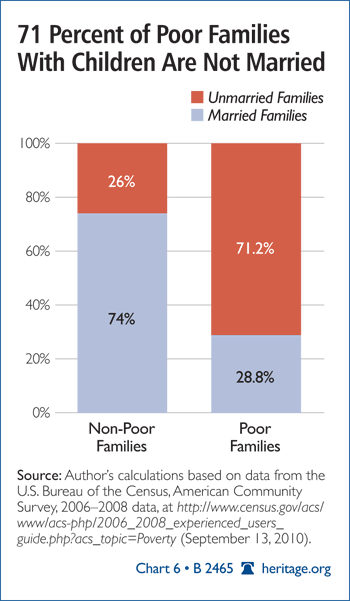
And the fifth policy is welfare. Welfare encourages women to not marry the men that they have sex with, since they will lose their single mother benefits if they do. Children who are raised fatherless are more likely to struggle in a number of areas, and they are especially likely to be poor. What we should be doing (if we really want to help the poor) is paying people to get married and stay married. But Democrats are opposed to that. The connection between welfare, fatherlessness, poverty and crime is explained in a previous post.

Women who delay marriage for casual sex surprised to be single in their mid-30s

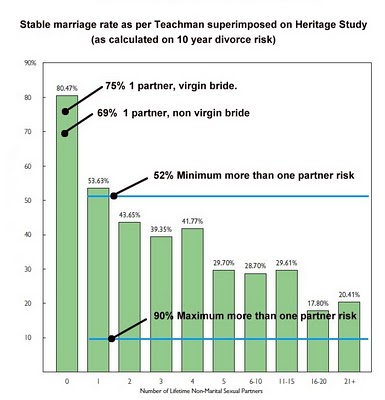
Divorce risk and number of pre-marital sex partners

Dr. Mark Regnerus is a sociologist at the University of Texas at Austin. He has published books on the changing nature of relationships with Oxford University Press. His newest book argues that the Sexual Revolution has caused men to lose interest in marriage because women are now giving them sex for free, without them having to prove their husband credentials first. This causes men to be disinterested in the traditional ways of impressing a woman, namely, getting a job, moving out, being willing to commit, and being able to provide for children who may appear.

The Daily Signal provides a case study taken from Regnerus’ latest book “Cheap Sex”, which illustrates the problem.

Excerpt:

Sarah is 32 years old and recently moved to Texas from New York, looking for a new start—in more ways than one.

Brooklyn had grown too expensive for her hipster pocketbook. A relationship she had hoped would blossom and mature there had instead withered. So to Austin she came, hoping she could improve upon her modest $22,000 annual earnings the previous year.

Her most recent sexual partner—Daniel—was not actually a relationship per se. He was not the reason she moved. Rather, he was a 23-year-old American she had met in China four years before during a three-week language immersion program.

[…]When they first met, and slept together, Sarah was in a relationship with David, the man for which she had moved to, and then away from, New York. She ended up “cheating on him,” that is, David, several times.

[…]If you’re having trouble keeping times, dates, and boyfriends straight, it’s understandable. Sarah herself laughs at the drama of it all.

[…]Getting serious was never much of an option. He was 23, and she was 32: “We both knew … he was graduating from college and, you know, like we both, at least I knew it was never gonna work out. I think he kind of felt the same way.”

[…]When asked how rapidly her relationships tend to become sexual, Sarah replied, “the first or second date.” That account did not stand out from those of many other interviewees.

The numbers are on her side, too. In the 2014 Relationships in America survey, sex before the relationship begins was the modal—meaning the most common—point at which Americans report having first had sex in their current relationships.

Is her timing of sex intentional? No. “It just happens,” she reasoned.

[…]This, she claims, is the standard approach to dating among her peers, if not necessarily the most optimal: “I don’t think it’s unusual, but I think that for a lasting relationship, it’s not the best approach.”

[…]Three years later, now 35, Sarah continues to live in Austin and continues to find commitment elusive. She does not dislike her life, but it is not the one she envisioned a decade earlier.

Daniel is a musician, which doesn’t surprise me at all. A musician, student or other unemployed penniless bad boy will not make any demands on the woman, because he almost certainly has no plan for the future.  This is what many women today want: someone for right now who doesn’t want her to do anything  to prepare for marriage, e.g. – get a real job, stop the thrill-seeking, stop traveling the world. No matter what a woman says about marriage,  if her actions now show an interest in fun and thrills, then she doesn’t want marriage.

The typical woman’s plan for marriage is simply to imagine marriage happening later somehow, without her having to do anything that she doesn’t feel like doing right now. It would be like “planning” for your retirement by taking trips all over the world right now, while imagining living off the interest from a million dollars in savings at age 55. This problem is what happens when the culture tells women that they should not aspire to marriage, and should not measure men to see if they will make good husbands and fathers. If a woman cannot expect a man to be a man (protector, provider, moral and spiritual leader), then she will choose men on other criteria.

This is what women today want:

  • hot appearance
  • confident words about the future
  • empty resume
  • empty bank account
  • several years younger than they are
  • no firm convictions about morality
  • no firm convictions about theology
  • progressive political views, especially on abortion

Men who have no jobs and no money don’t lead women, and are much easier for women to manipulate. The problem with these men is – as any married woman knows – is that those men do not commit. Why not? Because they cannot afford to commit. Marriage, put simply, costs money. Starter houses cost a quarter million. Children cost a quarter million each, not counting college. Retirement costs a quarter million per spouse. And so on. But there is no one in this society telling women that they need to care about choosing men who are serious about the objective duties of the husband role.

Women love to believe that they can choose a hot, irresponsible bad boy who gives them feelings, and then magically mold him into a husband: able to work hard, save money, be self-controlled, faithful and good with children. Feelings determine the choice of man, and feelings tell them that the man can be magically transformed into a husband somehow. Perhaps by giving him premarital sex! That will make him responsible. After all, you can put out a fire with gasoline, right? This is the most common approach women today take to relationships: get drunk, have sex with hot bad boy, shack up with him, wait for him to propose marriage.

I frequently tell my female friends about women I know like the one in the article – many raised by two married parents in Christian homes. They have arts degrees, empty resumes, empty bank accounts, and histories of alcoholism, bulimia, promiscuity and/or divorce. My female friends give me the same advice: “YOU NEED TO LOWER YOUR STANDARDS OR YOU’LL NEVER GET MARRIED”. If that’s the best that they can do, then it’s no wonder that men are not interested in marriage.

If you want men to be interested in marriage, fix the root cause. The root cause of the marriage rate declining is not men. The root cause is feminism.