All posts by Wintery Knight

https://winteryknight.com/

Christian case maker warns Christians to trust the evidence, not their feelings

A conflict of worldviews

Alisa Childers posted a review of a recent dialog between Dr. Sean McDowell and former-Christian Bart Campolo, son of far-left progressive fake Christian Tony Campolo. The dialog occurred on the Unbelievable radio show.

Here’s an exerpt from Alisa’s review:

Recently, the two came together to have a discussion on Premier Christian Radio entitled, “Why Bart Lost His Faith, Why Sean Kept His.” It was a fascinating discussion, and the thing that most struck me was the reason they each gave for having become a Christian in the first place. Campolo described how he converted to Christianity after finding a youth group he connected with and attending one of their retreats:

There’s hundreds of kids there. It’s Saturday night, there’s candlelight and firelight and everybody’s singing “Our God is an Awesome God,” and “We Love You Lord.” And in the midst of that kind of environment I had what I guess you would call a transcendent moment…I felt something. It felt like there was something happening  in that room that was bigger than the group. I felt like I was connecting to something. And in that moment ….that was God.

I heard something. It was real to me. People that don’t believe in transcendent experiences—I always think like, “You haven’t been to the right concert… You haven’t used the right drugs. You haven’t fallen in love with the right partner.”

These experiences are real, and I think whatever narrative you’re in when you have one, it confirms that narrative. If I would have had that same transcendent moment with my friends in a mosque in Afghanistan, it would have confirmed Islam to me. But I was in the Christian world, so from that point on, Jesus was real to me.

In Campolo’s own words, he became a  Christian because of a transcendent experience….a feeling that resonated deeply in his heart.

He had a feeling, and he took that feeling as a reason for believing propositional claims about the external world. God’s existence? He had a feeling. Christ’s resurrection? He had a feeling. The reliability of the Bible? He had a feeling. Instead of focusing on truth, he spent his early life pursuing social justice. He didn’t look at evidence, he just tried to have experiences. He tried to chase feelings by having little Christian ministry adventures. Missions trips. Volunteer work. Community. Charismatic speaking to crowds about things he knew literally nothing about.

Further on in the dialog, he explains that his standard for allegiance is not truth, it’s literally “what works”. And he clarifies “what causes [people] to thrive, what causes [people] to flourish”. His emphasis (in his ministry) was always on feeling good by being nice to people, because they liked him. This perspective is rampant in the evangelical church, especially among progressive young people. The idea of testing the Christian worldview against science and history to see if it is true is absolutely out. Instead, it’s all about feeling good and making people like you by being nice to them.

Experiences made him an atheist. He worked with poor people, and he decided that God didn’t exist because he wasn’t making these people happy. He had gay roommates in college, so he decided that the Bible’s rules around sexual morality had to be wrong. Never any investigation of economics to understand poverty, no investigation of homosexuality in the peer-reviewed literature, etc. It was feelings all the way. A bit later, Campolo extols the virtue of blind faith, and blasts apologetics as ineffective at changing minds. And then later, he has a bicycle crash, and he becomes convinced from that accident that “this life is all we have”. So he disproved substance dualism, which is consistent with the Bible and supported by multiple lines of philosophical argumentation and experimental evidence… by having feelings about a bicycle crash.

Now, on this blog, we despise feelings and experiences. We discuss scientific evidence for a Creator and a Designer all the time. The origin of the universe, the fine-tuning, the origin of life, the Cambrian explosion, the habitality requirements, etc. For Campolo, Christianity was never about truth, and so he never conducted an investigation about whether it was true. The only God he would accept was a god who “worked for him” – who made him feel good, and who made people (including non-Christians) like him. It was all about him, never about adjusting himself to an objective reality that might have involved obedience to God, having some bad feelings, and being disliked by non-Christians.

The more emphasis that a person places on feelings, intuitions, travel, adventure, and social justice, the farther away they tend to be from analytical philosophy, historical investigation, scientific evidence, etc. You cannot establish the truth of a worldview by going on a missions trip to Haiti, or by holding orphans in Bolivia. The truth of Christianity is known through study of reality, using logic, science and historical analysis. Making feelings the foundation for a worldview is just a disaster waiting to happen.

Alisa has some words of caution to young Christians and their parents about experience as the root of a Christian worldview:

  1. You can be talked out of an experience.
  2. Your heart and feelings lie.
  3. You can fall back on evidence in times of doubt or suffering.

Here is number 2:

The prophet Jeremiah described the human heart as “deceitful above all things and desperately sick.” Proverbs 3:5-7 tells us not to “lean on our own understanding.” Jesus described the human heart as being filled with thoughts like murder, adultery, sexual immorality, theft, false testimony, and slander. Proverbs 28:26 tells us that whoever trusts his own mind is a fool.

In other words, do not, under any circumstances, follow your heart.

This, of course, stands in stark contrast to the themes we are constantly encountering in entertainment and on social media. However, when it comes to spiritual beliefs, trusting our hearts and following our feelings can lead to all sorts of aberrant theology, sinful choices, and a distortion of true Christian faith.

See that?

“In other words, do not, under any circumstances, follow your heart.”

We need more Christians saying this in the church. Especially Christian women – it’s better when women put evidence at the center of the Christian life, and push feelings out to the edges.

By the way, she mentions a quotation from J. Warner Wallace about not being a Christian because “it works for me“. I wrote a whole post about this.

If you want to read another deconversion story that shows how a focus on feelings and experiences leads to atheism, check out the story of Dan Barker. I know so many people who were raised in the church by pastors who were anxious to “protect” Christian truth claims from  being proved or disproved by evidence. They thought that their approach was more pious – how dare we let science and history stand in judgment over the Bible? When I look at Dan Barker and Bart Campolo, I can see where that fideism ended up. Piety is a cheap way of gaining respect without having done any work. We need to demand better from pastors. They ought to be able to show their work. They ought to be able to demonstrate what reasoning and evidence led them to their convictions. Not their feelings and experiences, but actual reasoning and evidence.

The sooner we get to the point where Christianity is true because of reason and evidence, regardless of individual feelings, the better off we will be at being authentic followers of Jesus.

Finally, if you liked the Unbelievable show dialog between McDowell and Campolo, there is a 3-hour discussion on the same topic, which was held at the Faith Beyond Belief conference in Calgary, Alberta, Canada last week. The video has been posted on YouTube.

Positive arguments for Christian theism

Survey: young, unmarried women explain why they avoid having children

This article comes from the leftist Huffington Post.

They write:

The Huffington Post and YouGov asked 124 women why they choose to be childfree. Their motivations ranged from preferring their current lifestyles (64 percent) to prioritizing their careers (9 percent) — a.k.a. fairly universal things that have motivated men not to have children for centuries. To give insight into the complex, layered decisions women make, HuffPost asked childfree readers to discuss the reasons they have chosen not to have kids and gathered 270 responses here.

They grouped the responses into 5 categories:

  1. I want to prioritize my career
  2. I don’t like children
  3. I had a bad relationship with my parents
  4. I don’t want the financial responsibility
  5. I like my life as it is

And here are some interesting quotations:

Category 1:

I am a first-generation college graduate in my family. My mother was a single mom my entire childhood, and I was there to see that struggle. Being a parent, for a woman, means for life. Being a parent, for men, seems to be something very different. I understand raising children is a big life change and I don’t want to sell myself short on my potential to become something more and maybe even create change. I am childfree because I want to travel, move, pursue my career wholly and be able to push myself to be an inspiration to other women. If a child comes into my life, it won’t be until I am happy and successful in my work life, and not until I am secure with my finances and a marriage. I don’t want to one day wake up as an old woman wishing I had waited to have children so I could live my own life first, make mistakes, learn new things and find myself. Today kids are not for me.

Category 2:

I’m nearly 47; my boyfriend (domestic partner) of 17 years is nearly 50. I’ve never been pregnant and have taken every precaution to remain childfree. I tolerate other people’s children when I have to. I’m happiest when there are NO children around. I definitely don’t want them in my home. I like my life as it is. My boyfriend and I are both scientists. We also raise snakes and spiders! We like to travel. We travel to ride roller coasters (members of ACE — American Coaster Enthusiasts) and to attend rock concerts. I am also a performer in a senior winter guard. My plate overfloweth! I see no reason to procreate. I would be unhappy. Why be unhappy?

Category 3:

I have a great relationship with my husband. We have the time and money to travel, and that gives us precious memories. I had a bad relationship with my dad, and maybe I’m scared to treat my children like that. I’m very happy with my decision. I have a great relationship with myself too.

Category 4:

My spouse and I have talked in depth about having children. However, we both decided that our desire to travel the world is a financial burden in itself. If we have kids, we will never have the means to travel, and at the end of our life, we would rather be 100 percent committed to fulfilling our own realistic dreams rather than only able to provide a subpar life for a child. Comes down to the fact we are selfish, but at least we recognize this and made the choice early enough to avoid damaging a kid

Category 5:

The thought of having to do kiddie crap every weekend makes me want to shoot myself. I like having the extra money to save for retirement and not worry about braces, summer camp or college tuition. I can travel on a moment’s notice. I can give my all to my job and not have to worry about daycare, sick days, or having to leave my co workers to pick up my slack. I’m the “cool aunt” to all my nieces and nephews. I have more time to do the things that make me happy and productive. My relationship with my guy is not strained due to the constant neediness of children. I don’t want to put my body through pregnancy and childbirth. I can give my dog all the attention he needs and deserves.

If I had to choose one comment to represent the entire survey, it would be this one:

The moment you have children, you’re life ceases to be about yourself. Kids always take priority and I feel like I can do more for this world than just generate offspring.

I think this is the real reason why young, unmarried women choose not to prepare or plan for marriage and children . Marriage and children “some day” is like planning for your retirement by winning the lottery. It’s a way for the woman to signal to her family and friends that she will eventually want the responsibility of a husband and kids, but not right now.

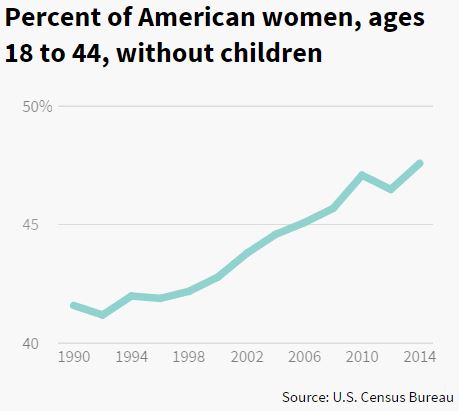
We need to move beyond a survey to quantify this, and this U.S. Census data does that:

Childless by choice, not because of men
Childless by choice, not because of men failing to “man up”

These quotations are very troubling to me. I’ve been serious about obtaining STEM degrees, saving money by not traveling, and making a plan to have a marriage and family that will serve God. I haven’t used my freedom to buy alcohol or to play the field sexually. I don’t see women being serious about choosing men who are serious about marriage – especially men who are financially prepared to pay for things like houses and children. A lot of women are even interested in men who are younger than they are, despite the fact that these men have not proven themselves in their careers and finances.

How can young, unmarried women be sincere about wanting marriage and children “some day” if they waste their 20s and 30s on men who aren’t prepared for the financial responsibility? And that’s not even to mention the fidelity responsibility – men who have self-control before marriage are more able to be faithful after marriage. It seems as if a faithful man who can provide for a family is that last thing that women want. Even if a man does find one who wants to get married, the financial situation between a marriage-minded man and a woman who has spent all her time traveling is going to be a huge mismatch.

Young, unmarried women seem to oppose marriage because they know it will impose responsibilities, expectations and obligations on them. And their parents, relatives, friends and co-workers are doing nothing to detect and counter this attitude. As Lindsay argued on this blog before, the marriage / children plan is an excellent way for Christians to make a difference. But it does take work – work that some young, unmarried women are deliberately avoiding.

Jordan Peterson tweets an article about the minimal facts approach to the resurrection

Jordan Peterson is aware of the best case for the resurrection of Jesus - are you?
Dr. Jordan Peterson is aware of the best case for the resurrection – are you?

Wow.

Jordan Peterson is now known to be aware of the strongest case for the resurrection, because he’s tweeted about it. Let’s see what he tweeted and what’s in the article.

It’s this article, written by Dr. Gary Habermas, which was published at The Stream:

Not too long ago I listed six of these events in a dialogue with an agnostic New Testament scholar. I used the historical facts that 1) Jesus died by crucifixion, 2) his early followers had experiences a short time later that they thought were appearances of Jesus, 3) and as a result, they were transformed to the point of being willing to die for this message. Further, two former unbelievers 4) James the brother of Jesus and 5) Saul of Tarsus (later the apostle Paul) both similarly thought that they had seen the risen Jesus, as well; and 6) This Gospel message of the death and resurrection of Jesus Christ began to be taught very soon after these events.

Some might be surprised to hear that the agnostic scholar with whom I was dialoguing not only agreed with the historical nature of these six events, without exceptions, but he even added that each one was very well-recognized.

How come?

Perhaps the chief reason for the widespread agreement comes from recent critical recognition that the New Testament contains dozens of brief snippets of information from the earliest church teaching — preserved from the first 20 years before the first canonical books were written. Scholars call these “creedal texts” or traditions. The best known of them is 1 Corinthians 15:3-7 which scholars agree originated no later than the early to mid-30s AD, or within just five years of the life of Christ. There is also 1 Corinthians 8:6 and 11:23-25, Romans 1:3-4, 10:9, and Philippians 2:6-11. That’s not all of them. Among the many others are Luke 24:34 and the Acts sermon summaries. These texts actually predate by many years the works in which they appear.

Another avenue comes from the regular use of different tools and rules used by historians and others to recognize the occurrence of past historical facts. These are often called the criteria of authenticity. Here are six of these that help explain how scholars come to this kind of agreement:

  1. Some events are established by the reliable testimonies from people who were close to or who even participated in the events.
  2. Sometimes the witnesses reported these things very soon afterwards, rather than waiting years to do so.
  3. On other occasions, these events are attested by two or even more independent sources.
  4. Sometimes, enemies who actually oppose the occurrences and would have preferred that they had not happened, might agree that they nonetheless did so.
  5. Or the accounts may be told in a way that is so embarrassing to those telling it, or to their loved ones or their cause, that the best explanation for them saying it is simply that it’s the truth.
  6. Another test preferred by some scholars is the result of an event fitting well with or exhibiting similarities to other occurrences that are known to have occurred (coherence).

There are other historical tools and rules as well, but these are among the best-known ones. Often, two or even several of these additional reasons are present and endorse the same event from different angles. Once in a while, the list of confirmatory reasons can get quite lengthy. In such cases, it becomes more and more difficult to deny the factual nature of the reports. So actually, agreement among dissimilar scholars can be fairly common.

If you’ve ever seen debates with atheist scholars like James Crossley, Bart Ehrman, Gerd Ludemann, etc., you know that they agree with some or all of these “minimal facts”.

Now, this post is about Jordan Peterson. How come he is tweeting this argument? Well, I think part of the reason is that Peterson is a brilliant scholar, and he’s going to find out about pretty much everything that he sets out to investigate. I have been told that the New Testament is an area of interest for him. I can’t help but believe that his recent dialog with the venerable Christian scholar William Lane Craig might have put him on the right track.

Here is that dialog, in case you missed it:

I would like all my readers to pray for Jordan Peterson. Ask God to do what God does best – putting people into a time and place where they can find out something about him that leads to a relationship with himself.

If you want a place to start, read Acts 17:24-26 and then ask God to engineer Jordan Peterson’s life in such a way that he finds the answers to his questions from the people he meets and situations he finds himself in. God is a master architect and a brilliant general.  Looking back on my life, I can clearly see how carefully he led me to know things about him, and then to know him. We just have to ask God to do what he does for Jordan Peterson. Asking is free. It might be a good idea to pray for wisdom for Dr. Peterson, as well.