
All posts by Wintery Knight

https://winteryknight.com/

Democrat senator imposes religious test to bar Christians from public office

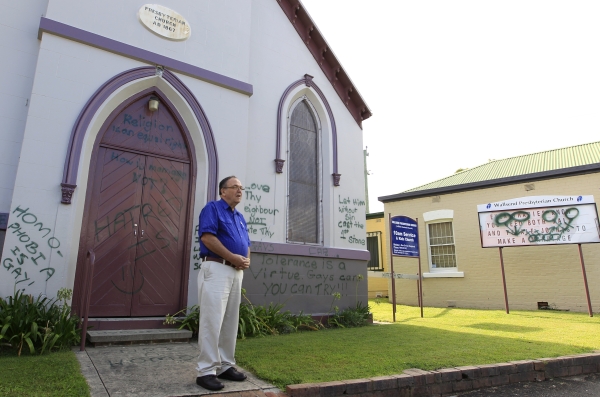
Anti-marriage gay activists vandalize church

CIA Director Mike Pompeo has been nominated to be Secretary of State. He would be a great pick, and you can already see from his previous job that he’s well qualified. But what if we decided not to care about his professional qualifications, and instead tried to oppose him based on his religious convictions?

That’s what Democrat Senator Cory Booker did, here’s the video: (and as you’re watching, consider what relevance this has to the job of Secretary of State)

Ben Shapiro, an orthodox Jew, reported on the exchange at the Daily Wire:

On Thursday, Senator Cory Booker (D-NJ) offered a bizarre critique of Secretary of State Mike Pompeo: Pompeo wasn’t sufficiently enthusiastic about homosexual sex.

Yes, this is a real thing.

Booker asked Pompeo, “Do you believe gay sex is a perversion?”

Pompeo is a religious Christian, so presumably he does. He answered, quite properly, “When I was a politician, I had a very clear view on whether it was appropriate for two same-sex persons to marry. I stand by that.” He also informed Booker, “My respect for every individual regardless of sexual orientation is the same.”

This isn’t the first time that prominent Democrat senators have attacked Christian nominees for their Christian religious beliefs.

Remember when Bernie Sanders did it?

Partial transcript:

Sanders: Let me get to this issue that has bothered me and bothered many other people. And that is in the piece that I referred to that you wrote for the publication called Resurgent. You wrote, “Muslims do not simply have a deficient theology. They do not know God because they have rejected Jesus Christ, His Son, and they stand condemned.” Do you believe that that statement is Islamophobic?

Vought: Absolutely not, Senator. I’m a Christian, and I believe in a Christian set of principles based on my faith. That post, as I stated in the questionnaire to this committee, was to defend my alma mater, Wheaton College, a Christian school that has a statement of faith that includes the centrality of Jesus Christ for salvation, and . . .

[…]Sanders (shouting): I understand you are a Christian, but this country are made of people who are not just — I understand that Christianity is the majority religion, but there are other people of different religions in this country and around the world. In your judgment, do you think that people who are not Christians are going to be condemned?

So basically, there is Bernie Sanders using the power of government force a Christian to deny the exclusivity of Christian theology. Something that no authentic Christian could do in good conscience. But he’s not the only one.

Here’s Democrat senators Dick Durbin and Diane Feinstein doing the same thing.

This is from National Review.

Excerpt:

This afternoon, during a confirmation hearing for 7th Circuit Court of Appeals nominee Amy Coney Barrett, Democratic senator Dianne Feinstein attacked the nominee for her Roman Catholic faith.

Barrett is a law professor at the University of Notre Dame who has written about the role of religion in public life and delivered academic lectures to Christian legal groups. Drawing on some of these materials, Feinstein launched a thinly veiled attack on Barrett’s Catholic faith, asserting that her religious views will prevent her from judging fairly.

“When you read your speeches, the conclusion one draws is that the dogma lives loudly within you,” Feinstein said. “And that’s of concern when you come to big issues that large numbers of people have fought for for years in this country.” Feinstein is clearly hinting here at the Supreme Court decision in Roe v. Wade, a ruling that Feinstein supports so vociferously that she has even called it a “super-precedent.”

[…]Other Democratic senators took issue with Barrett over her faith as well. Senate minority whip Dick Durbin criticized Barrett’s use of the term “orthodox Catholic,” insisting that it unfairly maligns Catholics who do not hold certain positions about abortion or the death penalty. (Durbin himself is a Catholic who abandoned his previous pro-life position.) “Do you consider yourself an orthodox Catholic?” he later asked Barrett point blank.

To me, the more important thing about these stories is how comfortable secular people are about forcing their secular convictions down the throats of others. What they’re essentially saying is this: “I can use power to push my worldview onto you, and I can use power to stop you from living according to your convictions”. You can be certain that Diane Feinstein has answers to all of the same big questions that theists have answers to: “does God exist?” “did Jesus rise from the dead?” “is there a purpose to suffering and evil?” “is there life after death?”, etc. She has different answers to those same questions, but she wouldn’t accuse herself of having dogma. She feels very comfortable pushing her worldview through political power, but doesn’t think that theists ought to be able to do the same. questions with their respective worldviews? The answer is simple.

Why are Christians perceived as irrational? Atheists perceive Christians as having a worldview that is not based on fact. And they perceive themselves as having a worldview that is based on fact. How did this happen?

Well, simply put, Christian leaders made it happen, by refusing to focus on apologetics and evangelism. For better or worse, Christian churches (from fundamentalist Pentecostal to conservative Presbyterian) have decided that evangelism and apologetics are not important enough to focus on at church. And the result of this is that as non-Christians work their way through school and into the workplace, they never encounter any intelligent Christians who have reasons and evidence for their beliefs. Not just Christian beliefs, but policy beliefs, too. The church has failed to teach their members and adherents the importance of having answers, and this (along with the Sexual Revolution) is one of the main reasons why America has gone secular.

Even if you spend your childhood and teen years in church, you will never hear serious discussion of whether God really exists or whether the Bible is historically reliable. These things will be assumed to be true. You will be shamed if you ask questions, and you will even be shamed if you study apologetics to know how to answer these questions. This is considered pious by most church leaders, no matter what denomination you’re in. Atheists are not blind to the fact that most people who profess Christ are ignorant of competing views, and cannot explain why they hold their views using reason and evidence. And that’s why they are comfortable bullying us.


Can a person believe in both God and Darwinian evolution?

Christianity and the progress of science

The term for a person who believes in fully naturalistic evolution but who also believes in God is “theistic evolutionist”.

Terrell Clemmons takes a look at one organization of theistic evolutionists “Biologos”, and makes a distinction between their public statements and the real implications of their public statements.

Here is the PR / spin definition of theistic evolution:

Evolutionary creation is “the view that all life on earth came about by the God-ordained process of evolution with common descent. Evolution is a means by which God providentially achieves his purposes in creation.” This view, also called theistic evolution, has been around since the late nineteenth century, and BioLogos promotes it today in a variety of religious and educational settings.

And here is the no-spin definition of theistic evolution:

As Dr. Stephen Meyer explains it, the central issue dividing Bio-Logos writers from intelligent design theorists is BioLogos’s commitment to methodological naturalism (MN), which is not a scientific theory or empirical finding, but an arbitrary rule excluding non-material causation from the outset. “Unfortunately,” Meyer writes,

methodological naturalism is a demanding doctrine. The rule does not say “try finding a materialistic cause but keep intelligent design in the mix of live possibilities, in light of what the evidence might show.” Rather, MN tells you that you simply must posit a material or physical cause, whatever the evidence.

What this means, according to BioLogos’s own epistemology, is that God is objectively undiscoverable and unknowable—a tenet that sits squarely at odds with Christian orthodoxy, which has for centuries held that God is clearly discernible in the natural world (e.g., Romans 1:20). Obviously, this is theologically problematic, but Meyer also points out that theistic evolution faces problems from a scientific standpoint as well, as the technical literature among evolutionary biologists is moving away from the Darwinian mechanism.

Whenever I talk to theistic evolutionists, I try to stop them from talking about the Bible or their faith, because that’s not what is interesting to me. I don’t really care about their history as a religious person, or where they go to church, or who their pastor is. When I talk about origins and evolution, I only care about the science. What the ordinary process of scientific inquiry tells us about nature? Does nature have the capacity to create all of the varieties of life without any intelligent agency playing a role? Or, are there parts of nature that are similar to computer programs, blog posts, and term papers, where the best explanation of the effect is an intelligent agent choosing how to arrange the parts to achieve functionality?

I don’t accept molecules-to-man unguided evolution. This is not because I start with faith and let faith override the findings of science. It’s because I think that if you look at specific areas of natural history, there is clear evidence of intelligent agency, such as in the origin of life, or the Cambrian explosion. These effects in nature are well-studied and well-understood, and they look much more like the code that a computer scientist (like me) writes than the simplistic “order” created by wind erosion or crystalline patterns or anything the blind forces of nature could produce. Blind forces are observed to make small changes – short or long finch beaks, fruit flies with 4 wings and no balancers, bacterial resistances.

What’s also interesting is how often theistic evolutionists drop the theism but keep the evolution.

Consider this article about Stephen Matheson from Evolution News:

Biologist Stephen Matheson is a longtime critic of the theory of intelligent design. His extensive attacks on Stephen Meyer’s Signature in the Cell, for one, ranged from the substantive to the trivial and personal. The tone was frequently…abrasive, and we responded at the time. With Arthur Hunt, Dr. Matheson has debated Dr. Meyer in a forum at Biola University. Formerly a professor at an Evangelical Christian school, Calvin College, Matheson is still listed as a Blog Author at the theistic evolutionary website BioLogos, where it notes that he enjoys “explor[ing] issues of science and Christian faith.”

Well, his theistic evolutionary explorations have now terminated. As he reports on his personal blog page, where he took a hiatus of more than five years along with a break from his teaching, he is “happily” no longer a Christian.

OK. Now that’s just one case, but what about Howard Van Till, also of Calvin College?

Salvo magazine takes a look at what he wrote in a recent book:

In what follows I shall use the term “naturalism,” when unqualified, to represent neither more nor less than the rejection of supernaturalism. Stated positively, naturalism is committed to the belief that all events that occur within this Universe are consistent with and adequately explained by the system of natural causes. This commitment necessarily entails the additional belief that the system of natural causes is fully adequate to account for all events that transpire. Focusing on the issue of the Universe’s formational economy, we can say that naturalism—as here defined -entails the RFEP.

He now gives presentations for atheist groups entitled “From Calvinism to Freethought”. Freethought is a euphemism for atheism.

Now, for the big three Western monotheistic religions: Christianity, Judaism and Islam. To deny supernaturalism IS to deny the robust theism present in the world’s big three monotheistic religions. Van Till denies theism as commonly understood now. And again, this isn’t because of the science. His heavy handed naturalistic assumption squashed out any kind of serious inquiry into areas like the origin of the universe, the cosmic fine tuning, the origin or life, the Cambrian explosion, biological convergence, so-called junk DNA, deleterious mutations, and so on. Places where you can see that naturalistic forces cannot do the creating that Van Till has faith that they can.

And for the record, I am an enthusiastic supporter of the standard Big Bang cosmology, and a 4.5 billion year Earth. My problem with evolution is not Bible-based, it’s science-based. If the science shows the need for intelligent causes, and I think it does, then I think that the naturalists need to adjust their assumptions and pre-suppositions to match the evidence. We have blog posts and computer science code, that’s evidence for a programmer. We have DNA and proteins and sudden origin of body plans, that’s evidence for a programmer, too.

Why does atheist historian Gerd Ludemann accept the post-mortem experiences of the risen Jesus?

A conflict of worldviews

William Lane Craig explains why even atheist historians like Gerd Ludemann accept that the earliest followers of Jesus had experiences in which Jesus appeared to them as resurrected Lord.

Excerpt:

Fact #3: On multiple occasions and under various circumstances, different individuals and groups of people experienced appearances of Jesus alive from the dead. This is a fact which is almost universally acknowledged among New Testament scholars, for the following reasons:

1. The list of eyewitnesses to Jesus’s resurrection appearances which is quoted by Paul in I Cor. 15. 5-7 guarantees that such appearances occurred.

2. The appearance traditions in the gospels provide multiple, independent attestation of such appearances.

With respect to the first supporting line of evidence, it is universally accepted on the basis of the early date of Paul’s tradition as well as the apostle’s personal acquaintance with many of the people listed that the disciples did experience postmortem appearances of Christ. Among the witnesses of the resurrection appearances were Peter, the immediate circle of the disciples known as “the Twelve,” a gathering of 500 Christian believers (many of whom Paul evidently knew, since he was aware that some had died by the time of his writing), Jesus’s younger brother James, and a wider group of apostles. “Finally,” says Paul, “as to one untimely born, he appeared also to me” (I Cor. 15.8).

The second supporting line of evidence appeals again to the criterion of multiple attestation. The Gospels independently attest to postmortem appearances of Jesus, even to some of the same appearances found in Paul’s list. Wolfgang Trilling explains,

From the list in I Cor. 15 the particular reports of the Gospels are now to be interpreted. Here may be of help what we said about Jesus’s miracles. It is impossible to ‘prove’ historically a particular miracle. But the totality of the miracle reports permits no reasonable doubt that Jesus in fact performed ‘miracles.’ That holds analogously for the appearance reports. It is not possible to secure historically the particular event. But the totality of the appearance reports permits no reasonable doubt that Jesus in fact bore witness to himself in such a way.38

The appearance to Peter is independently attested by Paul and Luke (I Cor. 15.5; Lk. 24.34), the appearance to the Twelve by Paul, Luke, and John (I Cor. 15.5; Lk. 24:36-43; Jn. 20.19-20), the appearance to the women disciples by Matthew and John (Mt. 28.9-10; Jn. 20.11-17), and appearances to the disciples in Galilee by Mark, Matthew, and John (Mk. 16.7; Mt. 28. 16-17; Jn. 21). Taken sequentially, the appearances follow the pattern of Jerusalem-Galilee-Jerusalem, matching the festival pilgrimages of the disciples as they returned to Galilee following the Passover/Feast of Unleavened Bread and traveled again to Jerusalem two months later for Pentecost.

Lüdemann himself concludes, “It may be taken as historically certain that Peter and the disciples had experiences after Jesus’s death in which Jesus appeared to them as the risen Christ.”39 Thus, we are in basic agreement that following Jesus’s crucifixion various individuals and groups of people experienced appearances of Christ alive from the dead. The real bone of contention will be how these experiences are best to be explained.

Triablogue notes that most historians accept these post-mortem experiences of the risen Jesus:

In their 2004 book, Gary Habermas and Michael Licona mention five facts accepted by the large majority of scholars:

1. Jesus died by crucifixion.
2. Jesus’ disciples believed that he rose and appeared to them.
3. The church persecutor Paul was suddenly changed.
4. The skeptic James, brother of Jesus, was suddenly changed.
5. The tomb was empty.

Habermas and Licona write:

“On the state of Resurrection studies today, I (Habermas) recently completed an overview of more than 1,400 sources on the resurrection of Jesus published since 1975. I studied and catalogued about 650 of these texts in English, German, and French. Some of the results of this study are certainly intriguing. For example, perhaps no fact is more widely recognized than that early Christian believers had real experiences that they thought were appearances of the risen Jesus. A critic may claim that what they saw were hallucinations or visions, but he does not deny that they actually experienced something….roughly 75 percent of scholars on the subject accept the empty tomb as a historical fact.” (The Case for the Resurrection of Jesus [Grand Rapids, Michigan: Kregel Publications, 2004], pp. 60, 70)

Habermas and Licona explain that even “the majority of nonbelieving scholars” (p. 149) accept such facts, not just Christian scholars. And even many professing Christian scholars are Christian in name, but reject much of what Christians have traditionally believed. Skeptics sometimes suggest that a scholarly consensus on facts related to Jesus’ resurrection isn’t of much significance, because so many of the scholars are Christians, but traditional Christians make up only a small percentage of scholarship.

When talking about the appearances, the challenge is always to make the move from “through they saw” to “they actually saw”. In chapter 6 of their introductory book on the resurrection of Jesus, “The Case for the Resurrection of Jesus“, Mike Licona and Gary Habermas give some reasons why the post-mortem appearances of Jesus were not hallucinations. First, they argue that hallucinations are had by individuals, not groups. Second, they argue that the hallucination hypothesis leaves the empty tomb unexplained. It also doesn’t explain the appearances to skeptical James and antagonistic Paul. Finally, the appearance narratives are too varied to be hallucinations, i.e. – individuals, groups, friends, enemies, different times and different places.

If you want to read a scholarly response to the hallucination hypothesis, it’s right in the article by Dr. Craig that I was quoting from above. He assesses the hallucination hypothesis as put forward by atheist scholar Gerd Ludemann against the standard criteria for judging multiple competing historical explanations. It’s too much to quote here, but click through and read it when you can. If you want to see a good summary of the arguments for the empty tomb, go right here.

See it used in a debate

You can see the arguments made and defended from criticism in this debate with the atheist scholar James Crossley.

This my favorite resurrection debate.