Previously, I blogged about how the Steele dossier that was used to get permission to spy on the Trump campaign was paid for by Democrats. The latest news is that the Steele dossier contained Russian disinformation. So, instead of Trump colluding with Russians, it was actually the Democrats colluding with Russians to get a fake dossier to allow spying on the Trump campaign.
At some point in 2017, the precise month is not clear, the FBI obtained evidence that Russian operatives fed disinformation to former British spy Christopher Steele.
That stunning revelation came on Friday, and not through a leak, as did so many of the anti-Trump and pro-Steele stories that have come out since the dossier was published in January 2017.
Instead, the disclosure was the product of an intense GOP-led fact-finding campaign to force U.S. intelligence officials to declassify information that the FBI had on Steele and his notorious dossier.
Sens. Chuck Grassley and Ron Johnson, the two Republicans who jogged loose the new information, noted the disparity in the type of information that has leaked out of the Trump-Russia investigation in the three-plus years since it began.
“For years, the public was fed a healthy diet of leaks, innuendo and false information to imply that President Trump and his campaign were part of a Russian conspiracy to spread disinformation,” they said in a statement upon the release of three footnotes from the Justice Department inspector general’s (IG) report on the FBI’s surveillance of the Trump campaign.
The previously-classified footnotes said that an organization not identified in the IG report provided the FBI evidence that Russian operatives fed disinformation that wound up in the dossier.
The disclosure is another stunning blow to the reputation of the FBI, which made Steele’s dossier a “central and essential” component of its surveillance warrants against Carter Page.
Actually, the Steele dossier was the ONLY source for the FISA warrant that allowed the Obama administration to spy on the Trump campaign.
Now I want to review who paid for the Steele dossier that contained Russian disinformation.
The Hillary Clinton campaign and the Democratic National Committee helped fund research that resulted in a now-famous dossier containing allegations about President Trump’s connections to Russia and possible coordination between his campaign and the Kremlin, people familiar with the matter said.
Marc E. Elias, a lawyer representing the Clinton campaign and the DNC, retained Fusion GPS, a Washington firm, to conduct the research.
After that, Fusion GPS hired dossier author Christopher Steele, a former British intelligence officer with ties to the FBI and the U.S. intelligence community, according to those people, who spoke on the condition of anonymity.
Elias and his law firm, Perkins Coie, retained the company in April 2016 on behalf of the Clinton campaign and the DNC. Before that agreement, Fusion GPS’s research into Trump was funded by an unknown Republican client during the GOP primary.
The Clinton campaign and the DNC, through the law firm, continued to fund Fusion GPS’s research through the end of October 2016, days before Election Day.
The FBI and DOJ didn’t tell the FISA court about who was funding the Steele dossier when they applied for the warrant. Because if they had, they would have been denied the warrant. No FISA court would approve surveillance of the Republican party if the sole basis for the warrant was uncorroborated opposition research funded by the Democrat party. In order to get the FISA warrant, the request had to be written in such a way that the funding of the Steele dossier was not revealed, and Steele was not declared to be the source of the news articles used as corroborating evidence.
Which passage of the Bible is the favorite of Christians who like to defend the Christian worldview? I don’t mean which one is most inspirational… I mean “which one is the most useful for winning arguments?” Well, when it comes to the historical Jesus, the most important passage has to be 1 Corinthians 15:3-7.
The tradition in 1 Corinthians 15 is an early creed that was received from the eyewitnesses Peter and John when Paul visited them several times in Jerusalem, as documented in Galatians 1 and 2, where Paul meets the eyewitnesses. And of course, Paul records his own eyewitness experience, documented in 1 Cor 15:8.
So, is this passage accepted as historically reliable by all ancient historians? Or only by the Bible-believing ones?
The evidence that Paul is not writing in his own hand in I Cor. 15.3-5 is so powerful that all New Testament scholars recognize that Paul is here passing on a prior tradition. In addition to the fact that Paul explicitly says as much, the passage is replete with non-Pauline characteristics, including, in order of appearance: (i) the phrase “for our sins” using the genitive case and plural noun is unusual for Paul; (ii) the phrase “according to the Scriptures” is unparalleled in Paul, who introduces Scriptural citations by “as it is written”; (iii) the perfect passive verb “has been raised” appears only in this chapter and in a pre-Pauline confessional formula in II Tim. 2.8; (iv) the phrase “on the third day” with its ordinal number following the noun in Greek is non-Pauline; (v) the word “appeared” is found only here and in the confessional formula in I Tim. 3.16; and (vi) “the Twelve” is not Paul’s nomenclature, for he always speaks of the twelve disciples as “the apostles.”
Now the visit during which Paul may have received this tradition is the visit you mention three years after his conversion on the road to Damascus (Gal. 1.18). This puts the tradition back to within the first five years after Jesus’ death in AD 30. So there’s not even an apparent inconsistency with Paul’s appropriating the language of the formula to encapsulate the Gospel he was already preaching during those first three years in Damascus.
Ancient historian Gary Habermas loves to read non-Christian scholars… and then he writes about what THEY think about Jesus in peer-reviewed articles, published in academic journals. Let’s look at this one: Dialog: A Journal of Theology, Vol. 45; No. 3 (Fall, 2006), pp. 288-297; published by Blackwell Publishing, UK.
He writes:
(1) Contemporary critical scholars agree that the apostle Paul is the primary witness to the early resurrection experiences. A former opponent (1 Cor. 15:9; Gal. 1:13-14; Phil. 3:4-7), Paul states that the risen Jesus appeared personally to him (1 Cor. 9:1; 15:8; Gal. 1:16). The scholarly consensus here is attested by atheist Michael Martin, who avers: “However, we have only one contemporary eyewitness account of a postresurrection appearance of Jesus, namely Paul’s.”[3]
(2) In addition to Paul’s own experience, few conclusions are more widely recognized than that, in 1 Corinthians 15:3ff., Paul records an ancient oral tradition(s). This pre-Pauline report summarizes the early Gospel content, that Christ died for human sin, was buried, rose from the dead, and then appeared to many witnesses, both individuals and groups.
Paul is clear that this material was not his own but that he had passed on to others what he had received earlier, as the center of his message (15:3). There are many textual indications that the material pre-dates Paul. Most directly, the apostle employs paredoka and parelabon, the equivalent Greek terms for delivering and receiving rabbinic tradition (cf. 1 Cor. 11:23). Indirect indications of a traditional text(s) include the sentence structure and verbal parallelism, diction, and the triple sequence of kai hoti Further, several non-Pauline words, the proper names of Cephas (cf. Lk. 24:34) and James, and the possibility of an Aramaic original are all significant. Fuller attests to the unanimity of scholarship here: “It is almost universally agreed today that Paul is here citing tradition.”[4] Critical scholars agree that Paul received the material well before this book was written.[5]
This is important:
The most popular view is that Paul received this material during his trip to Jerusalem just three years after his conversion, to visit Peter and James, the brother of Jesus (Gal. 1:18-19), both of whose names appear in the appearance list (1 Cor. 15:5; 7). An important hint here is Paul’s use of the verb historesai (1:18), a term that indicates the investigation of a topic.[6] The immediate context both before and after reveals this subject matter: Paul was inquiring concerning the nature of the Gospel proclamation (Gal. 1:11-2:10), of which Jesus’ resurrection was the center (1 Cor. 15:3-4, 14, 17; Gal. 1:11, 16).
He’s an eyewitness (verse 8), and he met with the other eyewitnesses, James and Peter. 1 Corinthians is early. Galatians is early. The creed is extremely early – right after the events occurred. There was no time for legends to develop.
And atheistic / critical historians agree, the creed is reliable:
Critical scholars generally agree that this pre-Pauline creed(s) may be the earliest in the New Testament. Ulrich Wilckens asserts that it “indubitably goes back to the oldest phase of all in the history of primitive Christianity.”[7] Joachim Jeremias agrees that it is, “the earliest tradition of all.”[8] Perhaps a bit too optimistically, Walter Kasper even thinks that it was possibly even “in use by the end of 30 AD . . . .”[9]
Indicating the wide approval on this subject, even more skeptical scholars frequently agree. Gerd Ludemann maintains that “the elements in the tradition are to be dated to the first two years after the crucifixion of Jesus. . . . not later than three years. . . . the formation of the appearance traditions mentioned in I Cor.15.3-8 falls into the time between 30 and 33 CE. . . .”[10] Similarly, Michael Goulder thinks that it “goes back at least to what Paul was taught when he was converted, a couple of years after the crucifixion.”[11] Thomas Sheehan agrees that this tradition “probably goes back to at least 32-34 C.E., that is, to within two to four years of the crucifixion.”[12] Others clearly consent.[13]
Overall, my recent overview of critical sources mentioned above indicates that those who provide a date generally opt for Paul’s reception of this report relatively soon after Jesus’ death, by the early to mid-30s A.D.[14] This provides an additional source that appears just a half step removed from eyewitness testimony.
(3) Paul was so careful to assure the content of his Gospel message, that he made a second trip to Jerusalem (Gal. 2:1-10) specifically to be absolutely sure that he had not been mistaken (2:2). The first time he met with Peter and James (Gal. 1:18-20). On this occasion, the same two men were there, plus the apostle John (2:9). Paul was clearly doing his research by seeking out the chief apostles. As Martin Hengel notes, “Evidently the tradition of I Cor. 15.3 had been subjected to many tests” by Paul.[15]
These four apostles were the chief authorities in the early church, and each is represented in the list of those who had seen the resurrected Jesus (1 Cor. 15:5-7). So their confirmation of Paul’s Gospel preaching (Gal. 2:9), especially given the apostolic concern to insure doctrinal truth in the early church, is certainly significant. On Paul’s word, we are again just a short distance from a firsthand report.
(4) Not only do we have Paul’s account that the other major apostles confirmed his Gospel message, but he provides the reverse testimony, too. After listing Jesus’ resurrection appearances, Paul tells us he also knew what the other apostles were preaching regarding Jesus’ appearances, and it was the same as his own teaching on this subject (1 Cor. 15:11). As one, they proclaimed that Jesus was raised from the dead (15:12, 15). So Paul narrates both the more indirect confirmation of his Gospel message by the apostolic leaders, plus his firsthand, direct approval of their resurrection message.
Now, some of the people he lists are really biased against the supernatural, and they really hate the idea that the claims of Christianity exclude other religions. And yet they don’t deny the historical reliability of 1 Corinthians 15, or that it is based on eyewitness testimony.
That’s why when you watch debates about the historical Jesus, you see skeptical historians like Bart Ehrman, Gerd Ludemann, James Crossley, Michael Goulder, etc. accepting that the disciples thought they saw Jesus after his death. They’re not just being nice to Dr. Craig when they give him that. They are forced to accept it, because it passes the historical tests. Every Christian ought to be aware of which passages of the New Testament are seen by the broad spectrum of ancient historians as “historical”, regardless of their various biases. You can believe everything in the Bible. But when you debate non-Christians, you have to use the historical core of Christianity which successfully passes historical analysis.
Man and woman working on a computer upgrade together
Mark Regnerus is a sociologist at the University of Texas, Austin. He publishes a lot of his books with Oxford University Press. So, his research methods are generally seen as reliable. I noticed that he had done a survey of views on religion, sexuality and marriage in 2018, and he published a popular level article about it earlier this week. I think it’s worth taking a look at his findings.
He writes:
Let me offer a word about the survey. I call it the American Political and Social Behavior survey, which interviewed 5,285 Americans in November 2018, just days after the midterm election. The data collection was conducted by Ipsos… a research firm with a very strong record of generating high-quality data for academic projects.
Here are his findings:
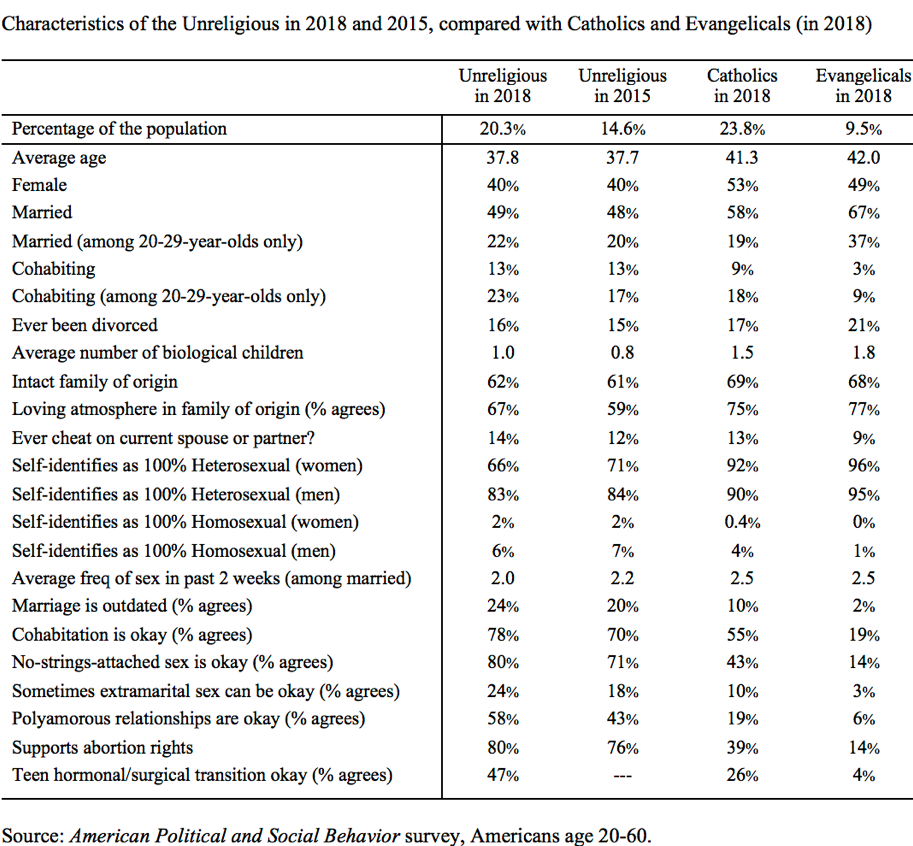
Views of unreligious, Catholic and evangelical Americans (click to expand)
This is interesting:
Even when I limit the group to respondents below age thirty—which is just north of the median age at marriage in the United States—it is notable that 22 percent of the unreligious are married and 23 percent are currently cohabiting, not radically different from the 19 and 18 percent of Catholics that are married and cohabiting, respectively. For comparison, 37 and 9 percent of younger evangelicals are married and cohabiting, respectively. The cohabiting habits of the unreligious, however, have shifted—note the uptick in cohabitation—six percentage points in just under four years. That amounts to a 35 percent increase. Since it’s unlikely that the unreligious have recently changed their minds about the morality or pragmatics of living together, my bet is in the other direction: cohabiting leads many to no longer identify as religious at all.
Got that part in bold? Their attitudes are changing because of their sexual behaviors. So, if you want to reverse the decline of Christianity, we’re going to need to come up with some arguments and evidence to counter the sexual revolution. And on this blog, we’ve done that many times, looking at studies showing the future instability of marriages that occur after cohabitation. I’ve never heard a church preach on that, though. And it’s not something that even many Christian apologists focus on. Most Christian apologists, particularly the women, tend to focus on soft arguments,. They stay away from arguments about morality, because it’s divisive and abrasive to their desired audience. However, if the goal is persuading people that Christianity is a viable worldview, then we need to focus more on sexuality.
More Regnerus:
[O]n each of seven attitude measures I examined, the unreligious are notably more permissive than even the spiritual-but-not-religious (not shown). Nearly 80 percent of unreligious Americans agree (or strongly agree) that cohabitation is okay, no-strings-attached sex is okay, and abortion should be a legal right. This is all unsurprising. But even some of the more radically “progressive” attitudes demonstrate strong support among the unreligious: 24 percent agree that it is “sometimes permissible for a married person to have sex with someone other than his/her spouse.” (I thought perhaps women would differ from men here, but they didn’t—or at least not by much.) Although few Americans are actually in polyamorous living arrangements, the unreligious would support them should someone choose such an arrangement; 58 percent of them agreed that “it is okay for three or more consenting adults to live together in a sexual/romantic relationship,” a percentage that is far more supportive than Catholics or evangelicals. Among the latter, only 6 percent thinks polyamory could be okay.
A more interesting theme, however, is the surge in support for such alternatives. On each statement, note the rise in agreement that has occurred in just under four years. Polyamory tops the list—a 35-percent leap in the share of unreligious who now endorse polyamorous arrangements (from 43 to 58 percent). Even support for extramarital affairs grew by one-third (from 18 to 24 percent). The unreligious aren’t alone here. Catholics, too, have witnessed liberalization in attitudes. Evangelical numbers display a more modest uptick, and from lower starting points.
The non-religious people in my office who were raised Christian like to tell me that the existence of the Christian God isn’t important to them, because they can achieve marriage via cohabitation, and behave like good people without the need for any sort of framework to rationally ground it. They think that you can just pull out God, and the marriage will stay the same. They expect the people they start relationships with to act on Christian morality, even if the worldview was rejected as superstitious nonsense. But as you can see from the data, removing God has an enormous effect on the person’s ability to be stable and faithful. The truth is that when you take out the vertical relationships with God, then the blueprint for the relationship becomes completely different. Relationships used to be seen as an enterprise where each person’s primary commitment was to lead and protect their spouse before delivering them to God with faith intact. Now, relationships are contingent on continuous happiness.
More Regnerus:
Only 66 percent of unreligious women say they are “100% Despite the permissive reputation of the unreligious, their actual marital sexual frequency is lower than that of Catholic and evangelical couples—at two instances in the past two weeks. As has been documented extensively in the past few years, the frequency of sex among American couples—whether cohabiting or married—has been declining at statistically significant rates. This pattern has not spared the godless.
I think this is interesting. I believe that men are facing an epidemic of sex-withholding from their wives, and I have an idea why that is. Today, women most commonly use sex to “jump start” a relationship with men who they perceive as “high value”, but who refuse to commit to them. This behavior is not focused on men who have commitment abilities, e.g. – provider, moral leader, spiritual leader, accurate worldview rooted in logic and evidence. Instead, most women use sex to get men who have the appearance of high value, e.g. – tall, tattoos, piercings, violent tendencies, exciting, fun, etc. Having established that pattern over and over with no-commitment bad boys, they marry someone who they see as beneath them, and then withhold sex. Commitment isn’t worthy of sex. It’s the man’s appearance and entertainment value that makes him worthy of sex. The comparison of this low-quality man to previous partners makes women more likely to initiate divorce for “unhappiness” later on.