All posts by Wintery Knight

https://winteryknight.com/

Thinking practically about the gospel with an illustration from a war movie

The city of Mogadishu, in Somalia, Africa

I decided to re-post one of my favorite posts for Memorial Day.

First, let’s get an overview that helps us understand the context and goals of the mission we are going to discuss.

The scene is set in Somalia, Africa, in 1992. There a civil war between two warlords: Ali Mahdi and Mohammed Farah Aidid. The war has destroyed agricultural operations, and the people are starving. The United Nations are trying to help, but Aidid hijacks the food from UN aircraft so that he can use the food to gain control of the people. Hundreds of thousands of Somalis are dying of starvation. The UN requests American military forces to secure the air-dropped supplies so they can be distributed to the starving people.

In December 1992, President George H.W. Bush answers the call, sending 25,000 troops to Somalia to protect the food from the Somali warlords. However, in 1993, Bill Clinton is elected. He orders that the number of U.S. troops be reduced to 12,000. Following an attack by Aidid on Pakistani peace-keepers, the U.N. issues a resolution to capture those responsible. The U.S. armed forces have the arms and training to battle evil, so they get the call to capture Aidid and his lieutenants.

In late August 1993, Task Force Ranger is deployed to Mogadishu to capture Aidid and his lieutenants at the Olympic Hotel. The U.S. force consists of 440 troops from the Army Rangers and Army Delta Force special forces, commanded by General William Garrison. Garrison requested light armored units (Bradley Infantry Fighting vehicles) that would offer more protection than the unarmored HMMWV Humvees. Garrison was denied the light armor by the Clinton administration. Garrison requested heavier air support (AC-130 Spectre gunships) that would offer better fire support than the UH-60 Blackhawk miniguns. Garrison was denied the air support by the Clinton administration. The Clinton administration did not want the American forces to appear too heavily armed for the peace-keeping role.

The actual mission turned out to be much harder than it needed to be, because of the resources denied by the Clinton administration. Although the Aidid lieutenants were captured, Aidid himself escaped. Eighty-four American soldiers were wounded. Eighteen American soldiers were killed, and their bodies were dragged through the streets of Mogadishu. This was shown over and over by the media, and it undermined American resolve to help the Somali people. As a result, Clinton had the excuse he needed to retreat the American military.

(Source: Nova Online)

Two heroes lost their lives

Today, I want to talk about two of the men who lost their lives in Operation Gothic Serpent. They are Master Sergeant Gary I. Gordon and Sergeant First Class Randall D. Shughart – a Delta Force sniper team.

Here is a clip from the movie Blackhawk Down, which shows what happened to them:

The pilot of the downed Blackhawk was protected by the two men who volunteered to go in after him. They requested that they be inserted at the crash site, even though they knew that reinforcements were likely not going to be there in time to save them. They made the request to go and help the pilot three times before being allowed to go in. Their first two requests were denied by their commanding officer, because the odds against their survival were so overwhelming. The rescued pilot was later released by his captors, and the two heroes were awarded the Medal of Honor for their brave actions.
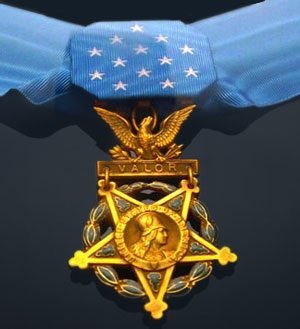
A Congressional Medal of Honor

Here is a description of the requirements to be awarded a Medal of Honor:

The Medal of Honor is the highest military decoration that may be awarded by the United States government. It is presented by the President of the United States, in the name of Congress, and is conferred only upon members of the United States Armed Forces who distinguish themselves through conspicuous gallantry and intrepidity at the risk of life above and beyond the call of duty:

  • While engaged in action against an enemy of the United States;
  • While engaged in military operations involving conflict with an opposing foreign force; or
  • While serving with friendly foreign forces engaged in an armed conflict against an opposing armed force in which the United States is not a belligerent party.

You can read the official details of their actions.

The point of this post

It is important for Christians to be familiar with real-world examples of people giving their lives in order to save the lives of others. When we see real-world examples of self-sacrifice, it helps us to understand what Jesus really achieved for us, and what he must have felt making that hard choice to volunteer to go in and rescue us. In general, my philosophy when it comes to the Bible is to make every effort to connect what the Bible says to the real world. We must not push Christianity into some far-off world of piety and feelings. We must make connections to real evidence and real life, so that what the Bible says becomes practical, and so that we have a deep friendship with and sympathy for God revealed in Jesus Christ. In real life, being willing to give your life to save someone else is hard. Understanding how that really happens will help us to value what Jesus has done for us.

Bible verses

I saw this verse on the ground outside the Airborne & Special Operations Museum in Fayetteville, NC, where I went for my summer vacation in 2015.

Isaiah 6:8:

8 Then I heard the voice of the Lord saying, “Whom shall I send? And who will go for us?”

And I said, “Here am I. Send me!”

Here is the picture I took (yes, that is my running shoe):
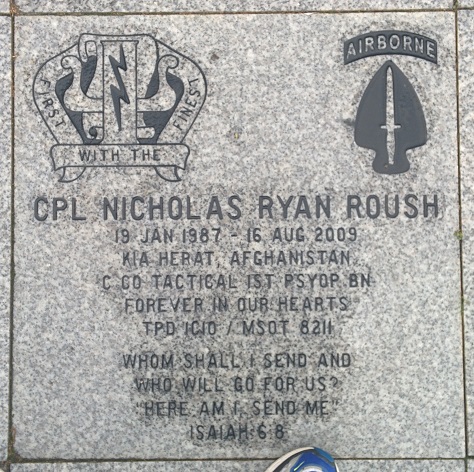
“Here am I, send me” Isaiah 6:8

When confronted with an opportunity to imitate Christ in his self-sacrifice, we should think less about ourselves and our own desires, and take the opportunity to serve others effectively. We do not do what makes us happy, and we do not pursue fun and thrills. We do what heals, we do what helps others. We do not push away our responsibility to imitate Christ by caring for those in danger. Christianity is not just about “not doing bad things”. It’s the good things you do because of your relationship with Jesus that show your real allegiance, and give you the experience of being a Christian in deed.

And here is another good verse:

John 15:13:

13 Greater love has no one than this: to lay down one’s life for one’s friends.

If you get a chance to watch the movie Blackhawk Down, then do so. I highly recommend it. You can also read the book that the movie is based on.

I love the Medal of Honor books by Edward F. Murphy. He writes about all the people who have been awarded the Medal of honor in different wars: World War II, the Korean War, and the Vietnam War.

If you check my reading list, you’ll find that I usually read two military books for every one book on another subject.
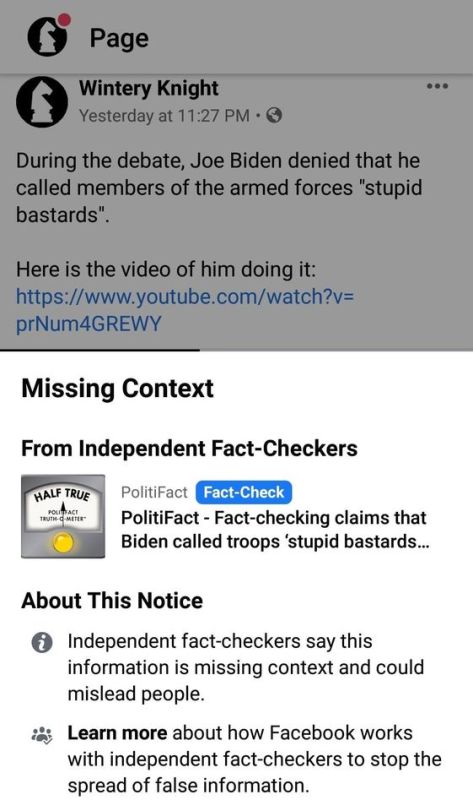
How reliable are Politifact fact checks? A review of past rulings

FacebookElectionInterferencePolitifact is a web site run by some left-wing journalists at the Tampa Bay Times. As you might expect from academic studies of media bias, their content might as well be written by the Democrat Party. But it’s not enough to just declare Politifact a Democrat propaganda operation – I need to actually give you details and examples. And so I will, in the rest of this post.

Let’s start with two recent examples, then I’ll show you the worst example of media bias I have ever seen from Politifact.

Missouri Senate Race

Here’s one analysis from the Daily Wire:

On Tuesday, Politifact, which purports to be a neutral fact-checking website but in fact leans heavily to the left, got caught protecting a member of the Democratic Party: Democratic Missouri Sen. Claire McCaskill.

Politifact took issue with the ad from The Senate Leadership Fund, a pro-Republican super PAC, that claimed that McCaskill said “normal people” could afford private planes.

[…]After they were corrected, Politifact acknowledged the mistake, writing,

Initially, we published this fact-check with a rating of False, because based on the video available, it did not appear that McCaskill was talking about private planes. After publication, we received more complete video of the question-and-answer session between McCaskill and a constituent that showed she was in fact responding to a question about private planes, as well as a report describing the meeting. We re-assessed the evidence, archived the original version here, and published the version you see here with a new rating of Half True. We apologize for the error.

Daily wire also linked to some more failed Politifact “fact checks”:  here, here, and here.

Arizona Senate Race

Politifact also screwed up their fact-check for the Arizona Senate race.

The Daily Caller explains:

PolitiFact incorrectly labeled it “mostly false” that Democratic Senate candidate Kyrsten Sinema “protested troops in a pink tutu” during its live fact-check of the Arizona Senate debate Monday night.

It’s an established fact that Sinema, a former Green Party activist who co-founded an anti-war group, wore a pink tutu at one of the multiple anti-war protests she attended in 2003.

“While we were in harm’s way, she was protesting our troops in a pink tutu,” Republican candidate Martha McSally, a former Air Force fighter pilot, said during Monday night’s debate.

Here’s their Politifact’s evaluation of McSally’s claim:

Who are you going to believe? Politifact, or your own eyes?

And here’s the photo of Kyrsten Sinema, protesting the troops, in a pink tutu:

Anti-war Democrat Senate candidate Kyrsten Sinema
Anti-war Democrat Senate candidate Kyrsten Sinema in a pink tutu

The Daily Caller notes:

A 2003 Arizona State University news article at the time described Sinema wearing “something resembling a pink tutu” at one of the protests.

[…]Sinema openly associated with fringe elements of the far-left during her anti-war activism.

She promoted an appearance by Lynne Stewart, a lawyer who was convicted of aiding an Islamic terrorist organization, in 2003.

Sinema also reportedly partnered with anarchists and witches in her anti-war activism and said she did “not care” if Americans wanted to join the Taliban.

Colonel Martha McSally, as I’ve blogged about before, is a former U.S. Air Force A-10 fighter pilot, and squadron commander. She logged a lot of hours leading actual combat missions against America’s enemies – the sorts of people who sell and rape Yazidi girls. She fought them.

And now for the big one: Politifact’s fact-checking of Obamacare.

Obama’s claims about Obamacare

Avik Roy, health care policy expert at Forbes magazine, wrote about Politifact’s assessment of Obama’s promise to Americans about keeping their health plans after Obamacare.

In 2008, before the presidential election, PolitiFact rated Obama’s claims about Obamacare “True”:

Roy writes: (links removed)

On October 9, 2008, Angie Drobnic Holan of PolitiFact published an article using the site’s “Truth-O-Meter” to evaluate this claim: “Under Barack Obama’s health care proposal, ‘if you’ve got a health care plan that you like, you can keep it.’”

And she concluded:

[…]…people who want to keep their current insurance should be able to do that under Obama’s plan. His description of his plan is accurate, and we rate his statement True.”

Roy notes:

PolitiFact’s pronouncements about Obamacare were widely repeated by pro-Obama reporters and pundits, and had a meaningful impact on the outcome of the election. Indeed, in 2009, PolitiFact won the Pulitzer Prize for its coverage of the 2008 campaign.

Here’s the screen capture from 2008:

Politifact caught with its pants on fire
Politifact says that everyone who likes their health care plan can keep it

Before the election, it’s true! And Obama got re-elected, because people believed that. But what happened after the election?

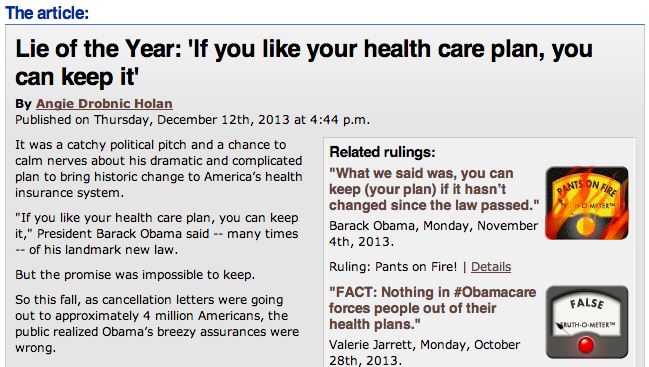
In 2013, after the 2012 election, PolitiFact rated Obama’s claims about Obamacare “Pants On Fire”:

Roy writes: (links removed)

On December 12, [2013] the self-appointed guardians of truth and justice at PolitiFact named President Obama’s infamous promise—that “if you like your health care plan, you can keep it”—its 2013 “Lie of the Year.”

[…][N]one of the key facts that made that promise “impossible” in 2008 had changed by 2013. The President’s plan had always required major disruption of the health insurance market; the Obamacare bill contained the key elements of that plan; the Obamacare law did as well. The only thing that had changed was the actual first-hand accounts of millions of Americans who were losing their plans now that Obamacare was live.

And the screen capture from 2013:

Politifact says: we were just kidding! Kidding!
Politifact said one thing before the election, and the opposite afterwards

So when Politifact rates a statement by a Democrat as true, what they really mean is that it’s pants-on-fire-false, but it’s election time so they don’t say that. It’s not like the critical assessments of Obamacare from health policy experts were not out there between 2007-2012. I know, because I blogged on every study and report on the predicted effects of the law that I could find. But the intellectually lazy journalism-major clowns at Politifact couldn’t be bothered to read those studies and reports.

Don’t dismiss best practices for Christian living as “legalism” and “denying grace”

Telling a woman how to make wise decisions protects her

On Sunday, I listened to a very interesting discussion between Sean McDowell and Jessica van der Wyngaard on Justin Brierley’s Unbelievable show. The topic was on the pros and cons of purity culture. I didn’t know a thing about “purity culture”, and had never read any books about it. I didn’t really disagree with anyone on the podcast, but I did want to say something about it in a blog post.

Description:

20 years ago Joshua Harris was the poster boy of the evangelical ‘purity movement’ having authored the bestselling book ‘I Kissed Dating Goodbye’. Today, Harris regrets writing the book, and has also recently changed his mind about Christianity.

Justin is joined by Jessica van der Wyngaard, director of the documentary film ‘I Survived I Kissed Dating Goodbye’, and Christian apologist Sean McDowell, to discuss purity culture, singleness and the Joshua Harris story.

The MP3 file is here.

First, here’s a brief summary of what everyone said on the podcast:

  • JW: the book urged people to give up dating in favor of courting and suggested other rules that would guarantee a successful marriage to your soul-mate
  • JW: some of the rules proposed by the book were not Biblical
  • JW: I’m not a virgin and I’m in early-30s, but I accept that we should teach what the Bible says about abstinence
  • SM: purity culture is the idea that if you remain sexually pure, God will give you a spouse and bless you in the future
  • SM: purity culture is the idea that if you have premarital sex, you will be tainted forever
  • SM: I’m afraid that those reacting against purity culture will build a sexual ethic solely based on their shame, their hurt, their concern about legalism, and this will not help the next generation
  • SM: let’s have a balanced Biblical approach to sexuality instead
  • SM: there is scientific data to back up the Bible’s teaching that marriages work better when sex occurs only within a marriage
  • SM: it’s a mistake to define your spiritual standing based on whether you are a virgin or not
  • SM: following the Bible’s rules for sexuality is an important part of discipleship
  • SM: the Bible is replete with examples of people restoring their standing before God through forgiveness and redemption

Right now, we are living in a secular culture where people are hooking up, having premarital sex, living together, and breaking up far more often than in the past. There is this pattern of choosing partners based on secular criteria: outward appearance and ability to entertain. And this approach to dating – choosing people for the wrong reasons, and trying to force a commitment using premarital sex – is now common practice, even among Christians.

I think people should have a plan to counter this trend that’s realistic and guided by studies and evidence. For example, studies show that people who have no sexual partners before marriage are more likely to still be married 10 years later. Studies show that cohabitation negatively impacts the stability of a future marriage. It’s difficult to accept that this is the way the world is, but if a stable marriage is a goal for you, then you should care about the best practices for having a stable marriage.

Take a different example. Suppose you have a lot of shame and bad feelings over having run up $90,000 of student loans. Now your retirement will be much more difficult. The answer to these feelings of shame is not to say that you can invoke “grace” and that will make everything OK. It won’t. It might help you to make better decisions going forward, but that debt is going to affect your future spouse, your future marriage and your future children.

There are real costs to these behaviors for your future, and being forgiven through Jesus’ atonement isn’t going to instantly make the effects of those choices disappear. It’s good to warn young people about these costs. It’s also good to help people who have made mistakes undo the damage by investing in them. I don’t want us to throw out evidence-based best practices as “legalism”, because they help us to reach the discipleship goals specified for us in the Bible.

The goals of the Bible (e.g. – not aborting, not divorcing) are good goals. If we find out from science that premarital promiscuity or cohabitation reduce our odds of achieving that goal, then it’s a mistake to dismiss that evidence because it make us feel bad about our past. It’s not legalism to investigate evidence and consult wise advisors in order to choose how best to achieve goals like marriage. That’s actually being wise.  Making good decisions doesn’t give you the right to be proud and compare yourself to others, but it is good to make good decisions for yourself, and to share your reasoning with those who ask you.

I agree with the speakers that purity culture is wrong to promise people a happy marriage if they only keep their virginity. That’s just the prosperity gospel, and it really is not a Biblical view of the Christian life.

People who choose to have premarital sex haven’t separated themselves from marriage. But studies indicate that they have damaged the stability of their future marriage if they do nothing to counteract the effects of their choices. And I think there is more to counteracting these bad effects than just stating to your partner “Jesus forgives me, so you can’t judge me”. The focus of the “no-rules because I feel ashamed” crowd doesn’t seem to be on taking the damage seriously and fixing it. Their focus seems to be on not being judged.

I don’t think that a cursory response (“don’t judge me!”) is adequate to undo the damage from premarital sex. But if a person is willing to be honest about their past, and put in the work to understand the effects of premarital sex on their future marriage, renew their minds, and re-establishing their bonding ability, then they should be able to fully counteract the damage. I have met people who have done this, and you can see in their choices and lifestyle that there’s been a complete turning against their former use of sex for fun and attention and self-esteem. It’s not “idolizing virginity and idolizing marriage” to look at the data, and make choices that are likely to lead to a stable marriage.