All posts by Wintery Knight

https://winteryknight.com/

Should Christian men consider single mothers for marriage?

Why Christians object to warning men about high-risk relationships?
Why do Christians object to warning men about high-risk relationships?

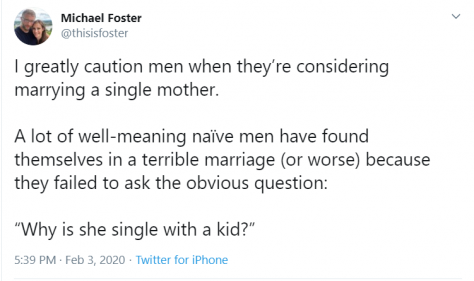
A while back, I explained my three concerns about attending church. One of them was that male pastors and church leaders have adopted the priorities of radical feminism, and have turned against men who want a traditional marriage in which the man leads and the wife supports. Well, I found something that really illustrates what I mean by that, so that everyone will understand it.

Above, you can see a tweet by Michael Foster, a pastor who hosts a podcast called “It’s Good to be a Man”. His web site states that his goal is: “Extending God’s house & father-rule by helping men to establish their own houses in strength, workmanship & wisdom.”

He explains in subsequent tweets that he is just urging men to ask questions to find out how the woman became a single mother.

Reactions to the tweet

Here are some reactions to the tweet:

The negative reactions are all anti-intellectual and childish, especially trying to refute statistics with “you hurt my feelings” or telling a single personal story as a counterexample.

Here’s a disclaimer. In this post, I am talking about single mothers by choice, and single mothers who initiated divorce. Widows are excluded.

The risks posed by single mothers

Now, let’s improve Foster’s warning, by looking at some evidence – is a marriage to a single mother really more likely to result in a bad outcome?

First of all, women initiate 70% of divorces. If you meet a woman who divorced her husband, she either had a defect in her ability to evaluate and choose a man, or she had a defect in her ability to maintain a commitment to the man she chose. Either way, a woman who divorced her previous husband has red flags. There are two possibilities. She either chose a good man or she chose a bad man. If she chose a bad man, then it shows that she didn’t choose a man with good moral character and spiritual leadership. That means that those things were low priorities for her when deciding who to get naked with. Alternatively, she married a good man, and failed to maintain the commitment. Then she has different problems: problems with male leadership, problems with responsibilities, problems with commitment, problems with contentment, etc. You need to ask questions to get to the bottom of what happened, and more importantly, what she has studied and done to change her worldview. Don’t take her words for it, look at her actions.

Second, the number of premarital sex partners a woman has makes her a higher risk of divorce. The more sex partners, the more risk. The problem with women who engage in sex with men who don’t commit to them is that they necessarily don’t see a man’s willingness and ability to commit as valuable when choosing a man. Women who have premarital sex with men who don’t commit see OTHER THINGS as more valuable. They are rewarding the man for his height, his muscles, his tattoos, his piercings, his entertainment of her, etc. A good man should be very wary when a woman who gave her best youth, beauty and sexual interest to men like that now want to “settle” for a boring, unattractive provider who they see as having lower value than the men they gave sex to without requiring a commitment. What they really wanted was bad boys, and they threw sex at those bad boys without asking for commitment. With the man they perceive as low-level, they are insisting on commitment first, because they don’t want this low-level man as badly as they wanted the bad boy. They are settling for less than they feel they deserve. This is where sex-withholding, feelings of unhappiness, and frivolous divorces come from. And by the way, hollering Jesus doesn’t fix that risk any more than hollering Jesus fixes student loans accumulated for a useless non-STEM degree. Jesus-hollering isn’t evidence that a woman has persuaded herself to change her view of which men are the most attractive. A woman’s lack of respect for men who prepare for commitment and who keep their commitments is dangerous for marital stability. The hysterical reactions to a man’s judging a woman for her past mistakes don’t cancel the damage and risks caused by those mistakes. They simply tell the man that this woman is unrepentant, and therefore unteachable, and likely unsuitable for goal-oriented marriage. She is not qualified for the job of wife: self-sacrificial love for her husband, respect for her husband, and supporting her husband in what he is trying to achieve for God.

Here’s what the Bible says about sex outside of heterosexual marriage and about frivolous divorce. Read the critical replies to Foster’s tweet. The critical responses show the default position of church-attending Christian women and pastors to the Bible in this culture. First, the critics don’t accept the Bible as an authority over women’s choices in any area of life. Second, the critics don’t believe that women should bear any responsibility for their past actions. Nobody believes that women choosing bad men is the woman’s fault in this society. So you should assume that single mothers don’t take responsibility for their own failures. And that means that she will have taken no steps to repent of her mistake, and change her character so that she doesn’t make the same mistake again. It’s up to you to look at what she has been reading, listening to, watching, etc. and to check her actions in order to find out what she really thinks about what the Bible says. You can’t marry a woman who responds to any mention of the moral law and moral obligations with denial of responsibility and insults. If she hasn’t become an active crusader against women who choose bad men, and women who choose premarital sex, and women who choose divorce, then you can’t really believe that there’s been any real repentance. The risks to you are too high to take a chance on someone who is not certain. I’ve only ever met one single mother (Kerri) who blamed her own divorce on her own bad decisions.

The culture opposes male leadership

Foster’s warning is intended to help men to make better decisions, so that their relationships will produce results for God. But his critics aren’t interested in what men are trying to achieve for God. They are only concerned that women get what they want, regardles of their past actions. In their opinion, men exists solely to serve the needs of women. Women don’t have to be good enough for marriage, men just have to give them what they want regardless of the woman’s suitability for wife and mother roles. The role of men in any relationship is not to lead and achieve goals for God. Their role is to let women rule over them, disposing of their earnings as they see fit, for the benefit of the woman.

When women are young and pretty, they are entitled to hot bad boys to entertain them. When they are older, have tons of sexual experience, and children from different fathers, they are entitled to a husband to financially support them. But a husband with no power to lead the home, since their past choices of man showed they have no interest in following a man who has good character. And the churches, pastors, courts, schools, hospitals, etc. are all there to enforce this view of men as clowns / slaves.

This is what women are told about the role of men in every area of society. This society, including the Christian parents, Christian pastors, Christian culture, etc. do not produce women who prefer early marriage to men who are good at moral leadership and spiritual leadership. Therefore, men who are chaste, sober, have good educations, good private sector jobs, good savings, etc. need to be extremely careful. Look at the responses to Foster’s tweet, and think: do these people care about providing you with a good wife? Or is their concern all about how to insult you and shame you, until you are submissive to her needs?

Your marriage is your enterprise for serving God

My advice to men right now is to read over every single critical tweet in that thread that Foster started. Imagine that you are trying to get these women to do something in a marriage that is part of your plan to make the marriage serve God. You’re trying to get her to watch a William Lane Craig debate. You’re trying to get her to stop spending money on 50 Shades of Grey and Harry Potter. You’re trying to get her to stop smoking and drinking. You’re trying to get her to talk about the sermon instead of essential oils. You’re trying to get her to read a Thomas Sowell book. You’re trying to get her to not put the kids in day care or public schools.

You need to assume that her response to male leadership like this will be the exact same as the responses that Foster is getting to his tweet. And then after you have assumed it, then you need to keep your hands off that woman. Keep your distance, and ask her questions to find out what her real views are, and whether she is interested in growing into the kind of person who is safe for you to marry. Don’t forget that chastity and sobriety are important during the evaluation process, so that you aren’t influenced away from your leadership role. Don’t listen to her words, look at her actions.

New study: women who have fewer premarital sex partners have lower risk of divorce

Consider this article from Family Studies that talks about how the number of pre-marital sex partners that a woman has increases her risk of divorce.

It says:

American sexual behavior is much different than it used to be. Today, most Americans think premarital sex is okay, and will have three or more sexual partners before marrying. What, if anything, does premarital sex have to do with marital stability?

This research brief shows that the relationship between divorce and the number of sexual partners women have prior to marriage is complex. I explore this relationship using data from the three most recent waves of the National Survey of Family Growth (NSFG) collected in 2002, 2006-2010, and 2011-2013. For women marrying since the start of the new millennium:

  • Women with 10 or more partners were the most likely to divorce, but this only became true in recent years;
  • Women with 3-9 partners were less likely to divorce than women with 2 partners; and,
  • Women with 0-1 partners were the least likely to divorce.

Earlier research found that having multiple sex partners prior to marriage could lead to less happy marriages, and often increased the odds of divorce.

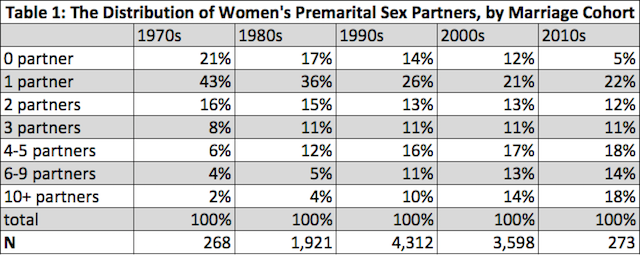
[…]Even more noteworthy has been the decline in the proportion of women who get married having had only one sex partner (in most cases, their future husbands). Forty-three percent of women had just one premarital sex partner in the 1970s.

[…]By the 2010s, only 5 percent of new brides were virgins. At the other end of the distribution, the number of future wives who had ten or more sex partners increased from 2 percent in the 1970s to 14 percent in the 2000s, and then to 18 percent in the 2010s. Overall, American women are far more likely to have had multiple premarital sex partners in recent years (unfortunately, the NSFG doesn’t have full data on men’s premarital sexual behavior, and in any event they recall their own marital histories less reliably than do women).

Here’s the change:

Women have freely chosen to dismiss the Bible and the moral law

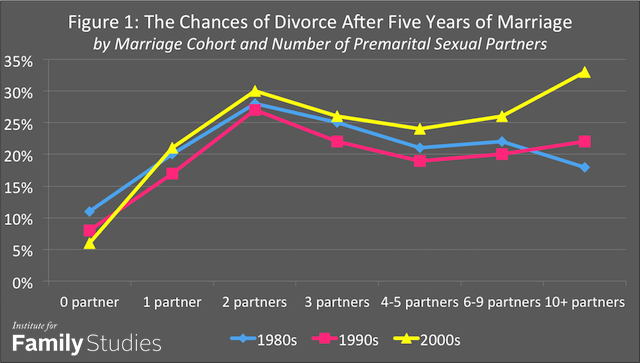
And the problem with this, of course, is that more premarital sex partners means a higher risk of divorce:

Even one non-husband premarital sex partner raises risk of divorce

Why is the 2-partner number so high?

In most cases, a woman’s two premarital sex partners include her future husband and one other man. That second sex partner is first-hand proof of a sexual alternative to one’s husband. These sexual experiences convince women that sex outside of wedlock is indeed a possibility. The man involved was likely to have become a partner in the course of a serious relationship—women inclined to hook up will have had more than two premarital partners—thereby emphasizing the seriousness of the alternative.

The Christian Post had an article about some recent numbers from the Centers for Disease Control about virgins.

Excerpt:

A new Centers for Disease Control study examines teenage health behaviors in connection to their self-reported sexual activity and shows those who remain abstinent are much healthier on many fronts than their sexually active peers.

The report, titled “Sexual Identity, Sexual Contacts, and Health-Related Behaviors Among Students in Grades 9-12, United States and Selected Sites,” showcased the results from a 2015 survey that monitored several categories of health-related behaviors like tobacco usage, drug and alcohol use, sexual habits, unhealthy dietary behaviors, and behaviors that contribute to unintentional injuries and violence.

The report concludes “that students who had no sexual contact have a much lower prevalance of most health-risk behaviors compared with students” who had sexual contact.

The article quotes Dr. Jennifer Roback Morse, who I have featured on this blog many times:

In a Monday interview with The Christian Post, Jennifer Roback Morse, founder and president of the Ruth Institute, said, “this study is remarkable because it asks questions and reports the answers, rather than avoiding questions or assuming answers.”

As Glenn Stanton noted last week in The Federalist, the results from those questions and answers are remarkable.

With regard to smoking, teenage virgins are 3,300 percent less likely to smoke daily than their peers who are sexually involved with someone of the opposite sex, Stanton computed from the report’s data. Teen virgins are 9,500 percent less likely to smoke daily than their peers who are sexually involved with someone of the same sex or in a bisexual relationship, he added. Chaste young people are also extremely less likely to use indoor tanning beds, binge drink, smoke marijuana, ride in cars as passengers with a drunk driver, and get into physical fights than their sexually active peers. Abstinent youth are also more likely to get a solid eight hours of sleep every night and eat breakfast daily.

[…]The CDC report also included findings from 25 state surveys, and 19 large, urban school district surveys conducted among students in grades 9–12 which took place between December of 2014 and September of 2015.

Now, many pro traditional marriage people will tell young men “feminism and the sexual revolution change nothing about a woman’s suitability for marriage, so go out there and get married to these women anyway”. In my experience, no one is telling women NOT to follow their hearts, and explaining to them the harm that they do by allowing their feelings to determine who they will engage in relationships.

I would like to see women make better decisions with men before they marry, rather than be influenced by their peers and culture to give themselves to men who are not marriage-minded. Maybe a little skepticism should be shown to “follow your heart”? Women need to understand what they are losing when they choose to have premarital sex.

In my group of friends, the men are aware of the Biblical prohibition on premarital sex. My friends know about the research on marriage, and what it takes to make a marriage work. We don’t follow our hearts, because we do what we know will work to achieve the results we want. We don’t listen to the culture, and we don’t listen to radical feminists. Men generally take an engineering approach to marriage – we want to know what the best practices and tradeoffs are, and then we plan and act to succeed.

New study: 1 in 8 divorces is caused by student loan debt

I like to make plans in advance and calculate everything out before I try to do anything. This is the curse of being a software engineer. We’re taught to take a test-first approach to design. So, when I think about marriage, I naturally think about what tests marriage is supposed to pass, and work backwards from there to requirements for each of the spouses.

Here’s some research from CNBC that might help young people to avoid a divorce, if they respect the research in their choices.

Excerpt:

When it comes to student loan debt, “for richer, for poorer” doesn’t quite cut it.

In general, finances are the leading cause of stress in a relationship, according to a study by SunTrust Bank, but student debt takes a particularly hard toll on a marriage.

More than a third of borrowers said college loans and other money factors contributed to their divorce, according to a recent report from Student Loan Hero, a website for managing education debt.

In fact, 13 percent of divorcees blame student loans specifically for ending their relationship, the report found. Student Loan Hero surveyed more than 800 divorced adults in June.

Here is a link to the full study from Student Loan Hero.

I think in general, you can’t just do whatever you want before marrying and jump into it unprepared. Marriage involves specific requirements in order to work, such as being faithful to your spouse, and buying things that you need for the marriage enterprise, like a home, and baby stuff. It doesn’t make any sense to say “I want to get married” and then not prepare for marriage by being careful about preparing for the behaviors marriage that requires of you. Being debt-free is one of those behaviors that marriage requires of you.

So how can we be debt-free, so that the marriage will be stable? Well, one way to be debt-free is to find a way to learn skills that will allow you to get a job without going to college, like being a self-taught software engineer. One of my friends actually did that, and now he’s with a very good software company as a remote worker. But if you’re going to go to college, you can avoid debt by studying something that will get you a high-paying job when you graduate.

This 2017 article from Harvard Business Review is interesting.

It says:

Examining 46,934 resumes shared on Glassdoor by people who graduated between 2010 and 2017, the researchers looked at each person’s college major and their post-college jobs in the five years after graduation. They then estimated the median pay for each of those jobs (also using Glassdoor data) for employees with five years of experience or less. Their key finding: “Many college majors that lead to high-paying roles in tech and engineering are male dominated, while majors that lead to lower-paying roles in social sciences and liberal arts tend to be female dominated, placing men in higher-paying career pathways, on average.”

Here’s the plot, and you can click it to expand it:

Starting salaries by major, broken out by gender
Median salaries by major, broken out by gender – don’t study things at the bottom!

As you can see from the graph, it’s especially important to share the message about choosing a major, salaries and student loan debt with WOMEN, because as the graph shows, they tend to choose the wrong majors, if the goal is to pay off student loans and avoid divorce. Everyone who wants marriage to go smoothly needs to choose majors that are near the top of the graph, like nursing, chemical engineering, computer science, or mechanical engineering. It doesn’t make sense to go to college if you aren’t going to graduate in one of these high-paying fields.

As you might expect from the graph, women hold the majority of student loan debt, according to the Boston Globe, and that’s because women tend to choose majors that don’t result in good-paying jobs. And we already saw how this becomes a risk factor for divorce.

Student loans delay marriage and children

Another interesting piece of data, reported by The Consumerist, is that people with student loans tend to delay marriage, which means the couple has fewer children:

As consumers navigate life’s financial journey, they are faced with major financial milestones, like buying a home. But student loans are also delaying consumers from reaching these goals.

Survey respondents report delaying homeownership (23 percent), buying or leasing a car (23 percent), having children (10 percent) and getting married (9 percent) because of their student loan burdens.

So, it’s not just that there is an increased risk of divorce from student loans, but there’s also fewer children, which means a diminished legacy. I can’t speak for how others would see this, but for myself, I want to pass on my beliefs to as many effective, influential Christian children as I can.

Anyway, I feel obligated to post a relevant Dave Ramsey video, just to remind everyone that stewardship of money is a Christian virtue, and that being forgiven by Jesus for your sins doesn’t automatically make you good with money. It takes planning and stewardship.

This one from 2014: (H/T Robb)


When I was in high school, I was far more interested in becoming an English teacher than I was in becoming a software engineer. It was my Dad who overruled my choice of college major when I was still in high school. He had me take a first-year English course at a local university. When I saw how politicized and useless it was (they were studying all sorts of politically correct postmodern relativist stuff, instead of the Great Works, and they weren’t trying to learn any wisdom from any of it), I chose computer science. I did what was likely to avoid divorce, and likely to support having many children.