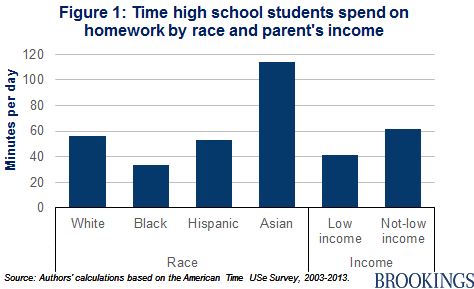
The Brookings Institute is a left-wing think tank that nevertheless does some research that’s interesting to conservatives. In a recent article, they talk about a disturbing difference between children of different races. Specifically, black children do far less homework than Asian children.
In this blog post, we will look at time spent outside of school–specifically time spent doing homework–among different racial and socio-economic groups. We will use data from the American Time Use Survey (ATUS) to shed light on those differences and then attempt to explain those gaps, using ATUS data and other evidence.
And here’s what they found:
Graph of Homework Time vs Race
So, how come Asians do so much better than blacks?
This article is written by the far-left radical Nicholas Kristof, writing in the radically-leftist New York Times. (A former newspaper)
Asians don’t blame other people for their own success of failure, they think that their outcomes are based on how hard they work:
There’s also evidence that Americans believe that A’s go to smart kids, while Asians are more likely to think that they go to hard workers… Asian-American kids are allowed no excuse for getting B’s — or even an A-. The joke is that an A- is an “Asian F.”
Asians also believe in keeping two biological parents in the home:
Strong two-parent families are a factor, too. Divorce rates are much lower for many Asian-American communities than for Americans as a whole, and there’s evidence that two-parent households are less likely to sink into poverty and also have better outcomes for boys in particular.
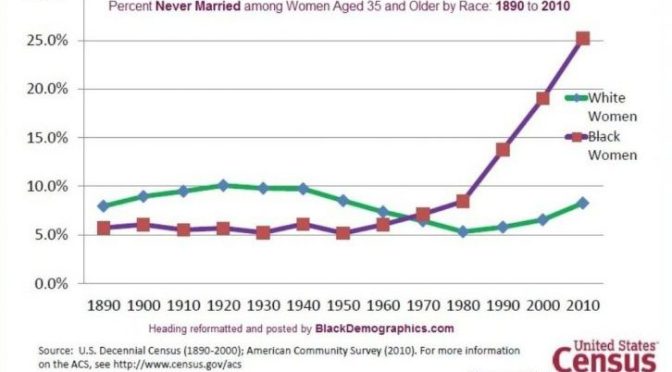
Do black women believe those things? Not the ones I’ve met.
And not according to statistics:
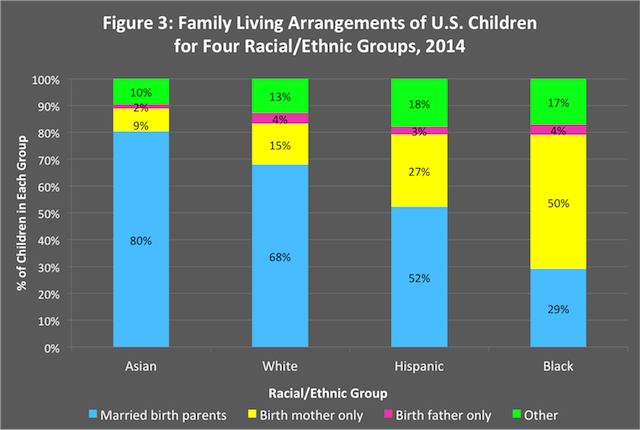
Asians marry before they have children, so the kids have two parents
So how will we help black students to do better in school? We need two parents in every home. And school choice, obviously. We have to let black children escape the failing unionized public schools that only want to teach atheism, premarital sex, evolution, global warming alarmism, transgenderism, gay marriage, socialism, BLM and CRT instead of math, science, technology and engineering. I don’t think that public school teachers can do any math, science, engineering or technology, so how could they teach it.
Also, we need to start shaming women of all races who choose to have sex with men who are not ready for marriage. There are lots of men out there who are willing to marry, and that should be what women are looking for most if all in a man. That change alone will probably erase most of the achievement gap between different racial groups. Does anyone have the courage to tell young women (of all races) to be more responsible with their sexual decisions? The out-of-wedlock birth rate for blacks is over 70%. This causes massive poverty and crime in the black community. Does anyone have the courage to tell blacks that they are doing this to themselves?
I get into conversations with young people about what policies they think would work best. Inevitably, they support policies where the government takes money out of the pockets of people who work, and hands it out (regardless of individual choices) in the form of social programs. Their favorite government-run program is government-run health care. How is that working?
So, in Canada, they have a 100% government-run health care system. Let’s see how well it works, using this article from The Post Millennial.
Excerpt:
2019 and 2020 were tough on Canadians awaiting surgery, a procedure, scan, or an appointment with a specialist. According to government data, over 10,000 patients died on the waitlist or from excessive waiting periods.
[…]Canada is unique in the world when it comes to access to health care services. Our governments often give patients only two choices: Either sit on a government waiting list or leave the country — an ultimatum that led to far too many senseless tragedies.
It’s not just old people being allowed to die, but young people too:
Laura Hillier’s tragic case is a good example. The 18-year-old Ontario student was fighting cancer and had a bone marrow donor lined up, but passed away while waiting seven months for a bed and a surgeon to become available. The province had only rationed enough funds for five transplants per month and Laura was forced to wait. This case became famous not because of proactive government disclosure, but because the young patient’s public cry for help went viral.
Here’s a report on single-payer health care in Canada, from the Heritage Foundation. I’ll focus on the differences between their health care system and American health care.
Canadians pay slightly less in out of pocket costs:
The OECD calculates that Canadians spend 1.6 percent of GDP on out-of-pocket health spending, compared to 1.9 percent in the U.S.
[…]While these numbers are very close, they are actually getting closer. Since 1970, U.S. out-of-pocket spending as a percentage of total medical spending has been falling steadily, from 33 percent in 1970 to about 10 percent in 2017.19
Meanwhile, Canadian out-of-pocket spending has been falling much slower, so that by 2016 it totaled 15 percent of total medical spending—a higher proportion than in the U.S.20
As a result, Statistics Canada warned in early 2020 that the percentage of Canadians experiencing large out-of-pocket burdens is growing, writing that “[b]etween 1998 and 2009…the percentage of households spending more than 10% of their total after-tax income on health care rose by 56%.”
Canadians pay more in federal and state taxes:
Federal taxation excluding social security contributions, then, comes to 28 percent of GDP in Canada, compared to just 19 percent in the U.S.—meaning 51 percent more.
[…]This excess taxation is largely a result of health spending, which has bloated provincial budgets to nearly three times the taxes of U.S. states.
Provincial taxes have grown to nearly the same level as federal taxation. Meanwhile, provincial health costs have risen to fully 37 percent of provincial budgets in 2016—up from 33 percent in 1993 – —and range as high as 42 percent.
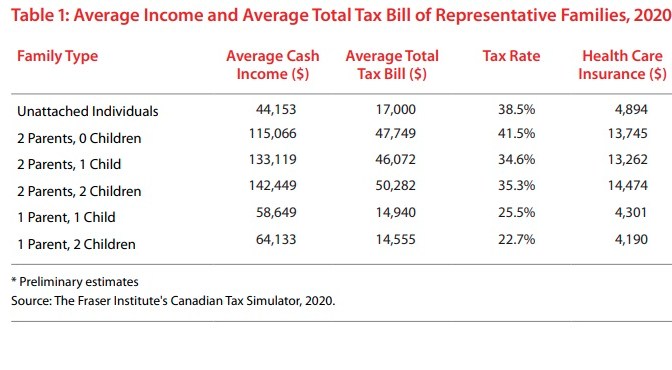
Canada’s Fraser Institute has estimated this excess tax burden from public health costs at roughly $9,000 for a household of two adults with or without children or $750 per month in additional taxes.
When I wanted an MRI I was scheduled the same week
Canadians wait far longer for treatment than Americans:
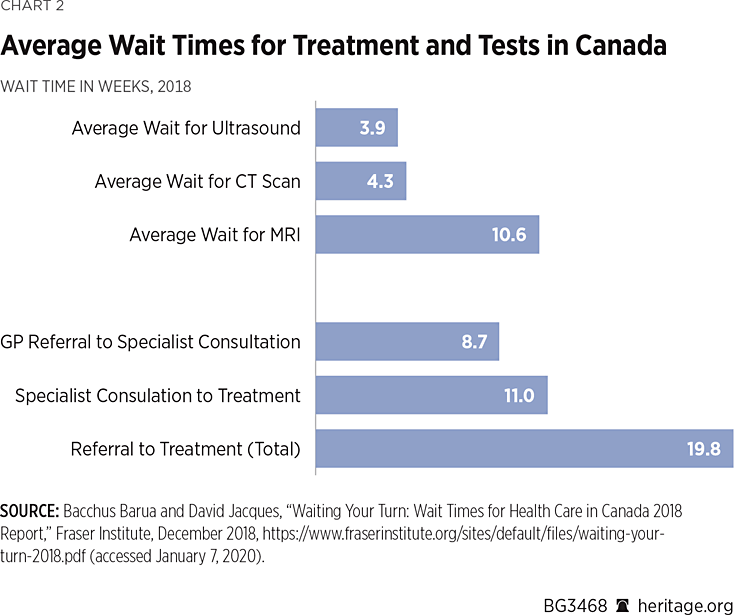
Medical waiting times have become a national crisis in Canada, and continue to worsen. The average wait time for medically necessary treatment between referral from a general practitioner and a consultation with a specialist was 8.7 weeks in 2018, 136 percent longer than in 1993. Patients then have to wait again between seeing the specialist and the actual treatment, another 11 weeks on average, 97 percent longer than in 1993.
From referral to treatment, then, it takes an average of 19.8 weeks (see Chart 2) to be treated, in addition to the original wait to see the family doctor in the first place—this for “medically necessary” treatment, not cosmetic surgery.
In contrast, nearly 77 percent of Americans are treated within four weeks of referral, and only 6 percent of Americans report waiting more than two months to see a specialist.
As for appointments, a 2017 survey of American physicians in the 15 largest U.S. cities found that it took just 24 days on average to schedule a new-patient physician appointment, including 11 days for an orthopedic surgeon and 21 days for a cardiologist.
As a result of these long waits, by one recent estimate, at any given moment, over one million Canadians—3 percent of the entire population—are waiting for a medical treatment.
These lists can average six months, and often much longer in rural areas, which tend to suffer from doctor shortages so severe that many do not even have a family doctor. Overall, 15 percent of Canadians did not have a regular health care provider in 2017.
The shortages ripple through the system; one doctor in Ontario called in a referral to the local hospital, only to be told there was a four-and-a-half year wait to see a neurologist.
In Canada, people die or become inoperable on waiting lists:
A Montreal man was finally called for his long-delayed urgent surgery two months after he had died. One 16-year-old boy in British Columbia waited three years for an “urgent” surgery, during which time his condition deteriorated so much that he became a paraplegic.
Canadians have to travel abroad to countries with functioning health care systems in order to be treated:
These cases are, unfortunately, not isolated; a survey of specialists found that average wait times exceed what is deemed clinically “reasonable” for fully 72 percent of conditions in Canada. The situation continues to worsen every year: In 1994, the average gap between clinically reasonable delay and actual delay was only four days, and by 2018 had grown to 23 days.
[…]With one million waiting, many Canadians turn in desperation to U.S. health care—the very system some U.S. policymakers propose to transform. In 2017 alone, Canadians made 217,500 trips to other countries for health care, of which 52,500 were to the U.S., paying out of pocket to skip the waiting.
While the average employer-sponsored private insurance plan in Canada covers between 10,000 and 12,000 drugs, most public plans in Canada only cover 4,000. Canada has 35 percent fewer acute care beds than the U.S., and only one-fourth as many magnetic resonance imaging (MRI) units per capita—indeed, it has fewer MRI units per capita than Turkey, Chile, or Latvia.
[…]Some common treatments are simply unavailable to Canadians. For new pharmaceuticals, for example, Canada’s policy of forcing down prices so that American consumers essentially pay for Canada’s research and development has led to years-long delays for Canadian patients.
[…]Cutting corners on facilities and using outdated drugs show up in Canadian mortality rates. Thirty-day in-hospital mortality rates in Canada are 20 percent higher than in the U.S. for heart attacks, and nearly three times the U.S. level for strokes. Cancer age-standardized mortality is 10 percent higher in Canada than in the U.S.—despite far healthier lifestyles.
[…]When it comes to personnel, Canada underspends on medical staff and doctors, ranking 29th out of 33 among high-income countries for doctors per 1,000 population, accounting for a large part of those wait times. Canada has half as many specialist physicians per capita as the U.S.
[…]With such shortages and waiting lists, Canadian emergency rooms are packed. So packed that Canadians sometimes just give up and go home. Of Canadian ER visitors who are seen, 29 percent report wait times of over four hours, three times the U.S. level.
[…]Canadian seniors are 65 percent more likely to have visited the emergency room (ER) four or more times in the past year than American seniors.
Ultimately, nearly 5 percent of Canadian ER visitors end up leaving without ever being treated, giving up on a medical system that is perennially “free” but out of stock at the moment. In one study at two ERs in Alberta, 14 of the 498 walkaways were subsequently hospitalized, and one died within the week.
And keep in mind how things work in a single payer system. You pay up front through your taxes. The harder you work, the more you pay into the system. When you want treatment, you just get in line behind people who never paid one dime into the system – like all those low-skill refugees that Canada imports from Middle Eastern countries to build up the socialist voting bloc.
Washington crosses the Delaware river before the Battle of Trenton
My favorite book about the American Revolutionary war by far is called “1776”. It’s written by famous historian David McCullough. The part of the book that really stuck out to me was the Battle of Trenton. I think that this battle really defines the essential character of America, as seen in the decision-making of its great general and first President, George Washington.
In the book, I learned about how George Washington and his revolutionary army had suffered a string of defeats at the hands of the powerful Commonwealth army, and their mercenary allies. It was the middle of a freezing cold winter, and the many of the sickly and ill-equipped American troops were just days from having their enlistment contracts run out. Some of the troops were not waiting for their enlistments to expire, they were just deserting. In droves.
Washington was losing, and was just days from losing his Continental Army. If the Americans lost the revolutionary war, then it would mean that every man who signed the Declaration of Independence would be hanged as a traitor. The American revolutionaries had risked everything for liberty, and they were about to lose everything – their money, their property and even their lives.
With the British army maneuvering to make his Harlem Heights position untenable, George Washington withdrew from the island of Manhattan, and established a new encampment further north near White Plains, New York.
On October 28, 1776, a flank attack by the British on this new position resulted in the collapse of Washington’s line. Thankfully, he was able to orchestrate an orderly withdrawal that preserved the army. Unfortunately, Washington’s retreat further exposed Fort Washington, which remained garrisoned on Manhattan.
Next, another defeat for Washington:
The Battle of Fort Washington
November 16, 1776
RESULT: BRITISH VICTORY
Following the defeat of George Washington’s army at White Plains, New York, British General William Howe focused his army’s attention on Fort Washington, the last post defended by the Continental army on Manhattan. Although Washington hoped to abandon the fort, his officers convinced him that it needed to be held in order to keep British ships from ascending the Hudson River.
During a carefully-orchestrated, all-out attack on November 16, 1776, British and Hessian forces overwhelmed the fort’s garrison after vicious fighting. When he heard the attack begin, Washington, who had stationed himself across the Hudson River in New Jersey, travelled across the river to the enter the fort and personally inspect its defenses. Several officers accompanied Washington, including Generals Israel Putnam, Hugh Mercer, and Nathanael Greene. They convinced Washington to leave the fort just 30 minutes before it was surrounded.
And then, another defeat for Washington:
Evacuation of Fort Lee
November 20, 1776
RESULT: BRITISH VICTORY
After the fall of Fort Washington, George Washington made plans for the evacuation of Fort Lee, which stood across the Hudson River in New Jersey. In a letter written to John Hancock on November 19, 1776, the general wrote that “…Fort Lee was always considered as only necessary in conjunction with [Fort Washington]…,” and that it would be abandoned as soon as provisions and other supplies were removed.
Unfortunately, a large British force succeeded in scaling the heights close to the fort on November 20, 1776. Faced with superior numbers, Washington called for the immediate evacuation of the fort, which resulted in the loss of dozens of cannon, 2-300 tents, and 1,000 barrels of flour.
That brings us to the Battle of Trenton. Across the Delaware river from Washington’s army was an encampment of Hessian mercenaries, fighting for the British. The Hessians believed that Washington’s Continental army was in full retreat. The British generals had already written home to the King to tell him that the war was nearly over, and that they had won. But had they?
General George Washington’s commitment to cross the Delaware River on Christmas 1776 foreshadowed the many hardships faced as well as the eventual victory of the Continental Army during the American Revolution. At first glance, the decision to transport 2,400 Continental soldiers across an icy river in one night, directly into a severe winter storm of sleet and snow seems irrational.
Washington’s decision, however, was based on strategic motivation, understanding that the Continental Army desperately needed a victory after months of intense fighting with several significant defeats and no major victories. Washington also understood that the element of surprise was the only way that he and his army stood a chance of defeating the highly trained Hessian mercenaries.
On the morning of December 25, 1776, Continental soldiers woke up in their camps along the Delaware River to a frozen, snowy covered ground. Weather conditions worsened and temperatures continued to drop throughout the day. Late in the afternoon, the Continentals left their tents and began to form along the river in anticipation of the night’s events. Washington kept almost all of the details of the crossing a secret; as a result, none of the soldiers knew anything about their upcoming mission.
Washington’s crossing of the Delaware River on December 25, 1776 allowed his army to strike the Hessians at Trenton the next morning.
Washington’s plan was to cross the river at night, march to the nearby town of Trenton, New Jersey, and attack the Hessian garrison right before dawn. Time was Washington’s greatest enemy; to combat it his orders called for the various regiments to assemble at their designated crossing points no later than sunset. The close proximity to the crossing points allowed the soldiers to begin the journey immediately after nightfall struck and complete the crossing no later than midnight. Once across, Washington intended for the armies to reassemble and march approximately ten miles to Trenton, arriving there no later than five o’clock in the morning to achieve surprise. Despite his meticulous planning, the schedule failed almost before it even began.
Many of the regiments did not arrive at the river until well after dark. Additionally, a severe winter storm that included wind, rain, snow, hail, and sleet met the soldiers at the banks of the river significantly slowing their crossing. Many of the boats had to combat ice jams and unfavorable currents. To make matters even worse, the extreme darkness caused by the storm made it hard for the boatmen to see the opposite shore.
The necessity of using larger ferries to carry pieces of artillery across the river caused even more delays. Washington crossed the river with John Glover’s Marblehead mariners and upon arrival debated whether or not to cancel the entire operation because it was more than three hours behind schedule. Washington decided it was too costly to retreat and he painfully watched as his army continued to trickle across the river.
If you were standing by the river along with Washington watching his sick, frozen, ill-equipped army struggle across the Delaware, then you would probably think that Washington had lost the element of surprise. This attack was just taking too long to happen. Maybe Washington would give up his plan, because things hadn’t gone his way. But Washington didn’t quit – he persisted.
The Battle of Trenton, December 25, 1776 (click for larger image)
Immediately following his famous crossing of the Delaware River, General George Washington marched the Continental Army to Trenton, New Jersey. The army’s forces included horses, guns, wagons, and soldiers, stretching for nearly one mile. The weather was worse than it had been crossing the river, but the army continued to proceed as Washington rode up and down the column pressing his men to carry on.
Shortly after eight o’clock on the morning of December 26, 1776, the Continental Army started its charge on the city. Three columns marched through thick snow with Washington personally leading the middle charge. As the soldiers pushed forward, artillery began to fire. At the same time, German drums urgently called the Hessians to arms. To his astonishment, Washington had maintained the element of surprise.
Immediately after the firing began, three Hessian regiments ran from their quarters ready to fight, quickly forming ranks. As the Hessians grouped, the Continental Army entered the city at two points: John Stark marched into the city on River Road from the west, while Nathanael Greene and Washington arrived from the north.
Andreas von Wiederholdt, a Hessian lieutenant, incorrectly reported to Colonel Johann Rall that the Continental Army had surrounded Trenton and there was no available route for retreat. As a result, Rall decided to counterattack Washington within the city and not retreat across Assunpink Creek. This proved to be costly as Washington’s forces occupied the highest ground in the city and had clear views of all of Rall’s movements.
Time after time, Washington countered Rall’s efforts to outflank the Continentals. Eventually, Washington’s forces overpowered the Hessians. Rall was mortally wounded and many of his soldiers broke ranks, fleeing from the fighting. Normally very disciplined, Rall’s regiment was confused and disoriented without their commander. They retreated to an orchard east of Trenton where they were forced to surrender.
Despite the large number of Hessians that escaped Trenton, Washington still won a crucial strategic and material victory. In only one hour of fighting, the Continental Army captured nearly nine hundred Hessian officers and soldiers as well as a large supply of muskets, bayonets, swords, and cannons. Washington ordered his soldiers to treat the Hessian prisoners in a humane manner, and the general quickly focused his attention on what to do next. Washington assembled all of his officers in Trenton to discuss whether they should attack another post, hold their position in Trenton, or retreat back across the Delaware. Washington decided that because of the condition of his army, the best move was to return to their camps across the River.
When the Continental Army returned to camp on the Pennsylvania side of the Delaware River, soldiers were exhausted. They had marched and fought for two straight days through rain, snow, sleet, and hail. Washington knew that his army had far exceeded expectations at Trenton and that they faced many more challenges going forward.
Washington won two more battles in rapid succession. Many of his troops re-enlisted because of these victories. There were many battles remaining to fight, and many hardships such as the winter at Valley Forge. But the Battle of Trenton was the turning point of the revolution. George Washington would not let a string of defeats stop him.