All posts by Wintery Knight

https://winteryknight.com/

Study: non-STEM college programs make students less religious

Lets take a closer look at a puzzle

Why do students turn away from Christianity in college? It might have something to do with what they choose to study.

Rice University reports on a new study conducted by sociologist Elaine Howard Ecklund.

Excerpt:

The public’s view that science and religion can’t work in collaboration is a misconception that stunts progress, according to a new survey of more than 10,000 Americans, scientists and evangelical Protestants. The study by Rice University also found that scientists and the general public are surprisingly similar in their religious practices.

The study, “Religious Understandings of Science (RUS),” was conducted by sociologist Elaine Howard Ecklund and presented today in Chicago during the annual American Association for the Advancement of Science (AAAS) conference. Ecklund is the Autrey Professor of Sociology and director of Rice’s Religion and Public Life Program.

“We found that nearly 50 percent of evangelicals believe that science and religion can work together and support one another,” Ecklund said. “That’s in contrast to the fact that only 38 percent of Americans feel that science and religion can work in collaboration.”

The study also found that 18 percent of scientists attended weekly religious services, compared with 20 percent of the general U.S. population; 15 percent consider themselves very religious (versus 19 percent of the general U.S. population); 13.5 percent read religious texts weekly (compared with 17 percent of the U.S. population); and 19 percent pray several times a day (versus 26 percent of the U.S. population).

[…]RUS is the largest study of American views on religion and science.

Meanwhile, Reasonable Faith has a podcast about the study, and what they discuss is how students who go into non-STEM university programs lose their interest in religion at a much higher rate than people who study STEM.

Here is the MP3 file.

And the relevant portion of the transcript:

DR. CRAIG: Right. If you look at their chart they give, where it shows the changes in religiosity by college major, it shows that in biology, engineering, and physical science and math they were mixed. The overall effect was neither negative nor positive. For some it was positive, some negative. But those majors did not seem to have a very significant effect upon the person’s religious behavior. The majors that had a very positive impact on religiosity were education, vocational or clerical education, business, and what is classified as “other.” All of those majors – whatever those are – have an overall positive impact upon students’ religiosity.

KEVIN HARRIS: And attendance as well – attendance to church services.

DR. CRAIG: Yes.

KEVIN HARRIS: The big fly in the ointment here is that “both the Humanities and the Social Sciences see dramatic declines in attendance and even more in religious beliefs.” It lowers church attendance, synagogue attendance, and even more in religious beliefs. What do we mean by the humanities and the social sciences?

DR. CRAIG: Humanities would include your non-scientific areas; for example, literature (hence the title of the article), politics.[3] I don’t know if they would include economics in this or not. Religious studies. In the social sciences are things like anthropology and sociology would be included there.

KEVIN HARRIS: The study of art?

DR. CRAIG: Yes, I suppose the arts would be in the humanities – that would be music and graphic arts. It is a big, big catch-all category.

And why does Dr. Craig think this is happening?

DR. CRAIG: […]It could well be that it is because it is in the humanities that the radicals of the 1960s were able to find a place in the university and become ensconced as professors with the relativism that they were championing. In areas like anthropology and sociology you find tremendous relativism where you simply study these cultures and societies without making any sort of judgment as to truth with regard to what they believe. This leads to the belief that it is all relative; there isn’t anything that is objectively true. John Searle is a very prominent philosopher at the University of California, Berkeley. Searle says that he believes that because of the commitment to the objectivity of truth and logic and the scientific method the hard sciences were barred to these radicals of the 1960s – getting into them and influencing them. But where they found an opening was in things like the Women’s Studies Department, Religious Studies, Anthropology, Sociology. These soft sciences. He says the professors in these disciplines are the children of the 1960s that have carried into it their relativistic views of truth. I noticed here the conclusion by the researchers of the University of Michigan (apparently who did this study), “Our results suggest that it is Postmodernism, not Science, that is the bête noir [the black beast or the hated thing] of religiosity.” The enemy of religiosity is postmodernism, not science.

KEVIN HARRIS: Postmodernism, as you’ve pointed out, was mainly a thing confined to literature and the soft sciences.

DR. CRAIG: Right. Women’s Studies, Religious Studies is rampant with Postmodernist perspectives. That has a real ring of truth to it, and could be the reason behind these statistics.

And this is why I recommend that people not drop math in high school, and pick a STEM field to study in college (or a trade in trade school). You are wasting your money when you let people in non-STEM areas indoctrinate you in fact-free irrationality. By the way, I love business administration as a major, for those who do not want to do the lab work. It attracts a lot of conservatives and entrepreneurs.

If you’re not worried about your faith, then you should at least be worried about your wallet:

Should you study philosophy?
STEM degrees are good for your finances as well

It’s much easier to have an influence as a Christian if you get your financial house in order. Having a degree that leads to a good paying job is certainly a good way to fund your life plan. Money also helps you to not worry too much about what the secular left can do to you. It’s good for offense and defense, in short.

What should Christians do in order to reduce fatherlessness and abortion?

Last week, I tweeted something that was very popular, although I got some disagreements with it. I tweeted that if we encouraged women to not have sex with men before the men married them, then there would be almost no fatherless children.

Here’s the exact tweet:

Fatherlessness is caused by women’s poor choices about men, sex, and marriage. If women married good men before having sex, there would be almost no fatherlessness. Strange that some “Christians” have sex before marriage, when that is prohibited in the Bible.

Now, the reason I focused on women in this tweet is because many women expect premarital sex to lead to a relationship, and eventually marriage. It is good for them to want a relationship and marriage. But the bad boys that many women tend to prefer aren’t choosing premarital sex in order to get to marriage or children. They have no desire for anything beyond the premarital sex. It seems reasonable to me that if I help women to see their mistaken view, then it would prevent a lot of fatherlessness (not to mention abortion and divorce) later on. If women prefer men who commit first instead of those who want commitment-free sex then we will see less sex outside marriage, less fatherlessness, and less abortion.

I decided to expand on my tweet in this post.

We need to teach young women that premarital sex does not cause men to become faithful husbands

Even women who have recreational sex with a lot of different men have this expectation that it will lead to relationships and eventually a committment, in which the man makes all their dreams come true and does whatever they want to make them feel happy at all times. This isn’t marriage, of course, but it is what they imagine that giving a hot bad boy premarital sex will lead to.

Here is what one 26-year-old writes: (language warning)

Age 19-22 Some boyfriends are somewhere in here. But it was where my body count really took off. If a guy liked me, which I now understand, was simple attraction, I thought sex would seal the deal, and they would get to know me more after, and fall in love with me. Let’s all pause to laugh together at my naivete. I promise you every (almost) guy, I thought I could have a relationship with. It never happened. At best they were regulars. Long-term I had 2 serious boyfriends.

A lot of women choose hot bad boys because the hot bad boys give them feelings “in the moment”, and impress their friends. They think that marriage is supposed to make them happy all the time, and so they want the bad boy to commit. This is why so many young women give the bad boys sex, to make the happy feelings last. And many think that they are on a path to marriage with the hot bad boy if they can keep him around by giving him premarital sex, or cohabitation.

But is this what marriage is about – making the woman feel happy in the long-term? Of course not. Marriage is about self-sacrificial love, self-denial, self-control, faithfulness, and raising children. So, women should be taught to choose men who prepare for actual marriage (men who have chosen chastity, gap-less resume, frugality, mentoring, no drugs or alcohol, apologetics). These traits are directly related to the responsibilities of a husband and father in a marriage (fidelity, love, fatherhood, provider, pastoring, etc). Fathers and pastors should be aware of the research about what traits and skills lead to stable and successful marriages, and be able to support their claims with studies when teaching women. For example, they should know about the studies showing how women’s number of premarital sex partners affects her contentedness in her marriage, the marriage quality, and the marriage stability.

That’s the point I was trying to make in my tweet.

Marriage requires self-sacrificial moral behavior

Fathers and pastors need to teach young people how to check a mate for the ability to behave morally, which is a necessary pre-requisite for a marriage commitment. The bare minimum foundation for moral behavior is a theistic worldview. A Designer of the universe. Objective moral laws. An immaterial soul that allows free choices. Accountability when you die. And meaningfulness of moral choices because of that ongoing relationship with the Designer in the afterlife. Moral behavior depends on the existence of God, so the mate-chooser should know evidence for that too, and be able to evaluate the mate on his knowledge of that evidence. People shouldn’t take the claim to be religious or spiritual at face value, they should want to see the reasons and evidence that support the claim. The rational grounding of moral behavior is important for marriage, and it needs to be checked, instead of just felt with intuitions. Young people should be taught to prefer mates who have demonstrated the ability to act morally in situations where it goes against their self-interest to be moral. After all, once the mate-chooser chooses a mate, every immoral thing he/she suffers from their chosen mate was a result of his/her choice of mate.

The goal is to prevent harm to children

Some Christian women disagree with my goal of stopping fatherlessness and abortion by telling women to make better choices. Instead, they want to support women who use premarital sex to try to land a hot bad boy.  They say that if the woman’s sex-first plan doesn’t work out, that’s not her fault, because all hot bad boys should feel obligated to marry after being given premarital sex. One woman wrote me 2500 words in response to my tweet to tell me (repeatedly, and in great detail) that the Bible is seen as  an authority even by hot non-Christian bad boys. If this is the kind of advice that young women are getting from older women, then it’s no wonder we have a 42% out-of-wedlock birth rate, and 1 million unborn children being killed every year.

But I don’t think that encouraging women to make feelings-based choices will work to reduce fatherlessness. When you’re dealing with hot bad boys, they don’t care about the Bible, and so you can’t try to convince them to do anything that the Bible says. The only solution is for good women to pass them by, and instead choose good men who want to make a commitment first. If women leave the hot bad boys alone, and concentrate on marriage-minded men, then we won’t have so much fatherlessness or abortion.

Have you ever read the Bible in order to find out what God thinks?

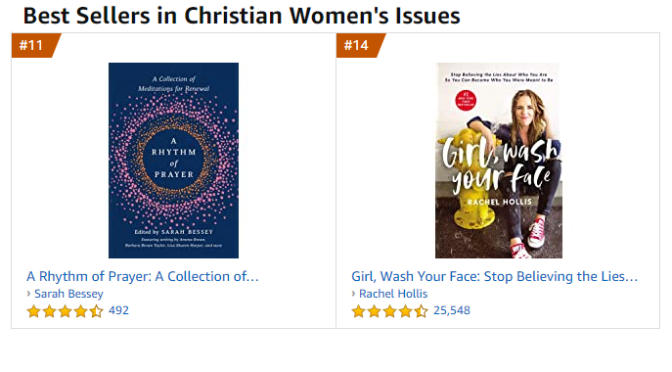
Two authors came to my attention while browsing tweets this week. The first is Rachel Hollis, who presents herself as a Christian but who isn’t (see below). The second is by Sarah Bessey, whose book contains a chapter where the author urges God to help her to hate a certain group of people solely because of their skin color. What is causing people who claim to be Christian to buy these books?

I found this list of progressive Christians on Alisa Childers’ blog. Childers is very reliable, having written a detail-filled book about attempts by progressives to distort the gospel.

She writes this about Jen Hatmaker, a progressive:

Since its launch in 2017, Hatmaker’s podcast has been a veritable “who’s who” of progressive Christian leaders such as Sarah Bessey, Rachel Held Evans, Pete Enns, Nadia Bolz-Weber, Richard Rohr, Jeff Chu, Mike McHargue (“Science Mike”), Barbara Brown Taylor, Austin Channing Brown, Lisa Sharon Harper, Rachel Hollis, and Glennon Doyle.

I want to talk about Sarah Bessey and Rachel Hollis. Are these authors working from within a Christian worldview?

Hollis:

Anne Kennedy was bemused to find Rachel Hollis’ best-selling book, Girl, Wash Your Face, in the Christian living section of the bookstore next to the Bibles. Hollis describes herself as a Christian but her self-help advice is anything but Christian, Kennedy believes.

“She does mention Christianity and her faith in Jesus but in terms of the book itself, there’s really nothing that would distinguish it from any other kind of self-help thing that’s on the market and there’s lots of them. She quotes some Bible verses but she doesn’t really rely on a Christian worldview at all to motivate behavior,” Kennedy… said on a recent Christian Research Institute podcast.

[…]“I don’t think she’s a Christian at all,” she commented.

[…]“Her worldview is in no way representative of classical Christianity. She’s inclusive, affirming of LGBT, all religions are fine, doesn’t have any even vague understanding of what redemption and the cross and faith in Jesus were to actually look like. She invokes the name of Jesus periodically, she quotes some verses but nothing that she says at all represents a Christian worldview. So it is interesting to me that she is marketed as a Christian.”

And the Bessey devotion book has this:

“Dear God,

Please help me to hate wh1te people. Or at least to want to hate them. At least, I want to stop caring about them, individually and collectively. I want to stop caring about their misguided, racist souls, to stop believing that they can be better, that they can stop being racist.”

[…]”Lord, if it be your will, harden my heart. Stop me from striving to see the best in people. Stop me from being hopeful that White people can do and be better.

[…]”Let me see them as hopelessly unrepentant, reprobate bigots who have blasphemed the Holy Spirit and who need to be handed over to the evil one.”

Why are these books so popular? I think that the problem is that we’re not reading our Bibles to get the author’s intended meaning. Instead, we’re selecting the parts of the Bible that affirm what makes us feel good and look good to others.

Consider this post from Alan Shlemon of Stand to Reason:

You never open the email, skip the first three pages, and read just one line on the fourth page. No one, in fact, takes that approach with their mail. By skipping the context of the email and ignoring the flow of thought, you wouldn’t know what that line meant on the fourth page. If it’s wrong to read your friend’s mail that way, then why do we read God’s mail that way?

We open the letter to the Philippians, skip the first three chapters, and read verse 13: “I can do all things through Christ who strengthens me.” Message received. Close the letter. We’re done here!

We even plaster that verse on a mug, publicizing our mistake. I call this “Coffee Cup Christianity,” and it’s killing our biblical literacy. We’ve become accustomed to seeing isolated Bible verses and presume we know their meaning. Too often, however, we merely insert our own meaning into a Bible verse, thereby overwriting what God was trying to tell us.

[…]Sadly, Coffee Cup Christianity violates one of the most basic and well-known principles of interpretation: context. It’s a principle known not only among Bible readers. Many people in our culture understand it. Tragically, we apply it when reading man’s word but neglect it when reading God’s word. Coffee Cup Christianity leads to three dangerous problems.

Here are the problems:

  • Coffee Cup Christianity overwrites God’s intended meaning with your own
  • Coffee Cup Christianity leads to missing important lessons from God
  • Coffee Cup Christianity models bad interpretive methods

So, here’s what I recommend. My Bible study partner and I are going through New Testament letters. Our goal is to find out what God wants us to be doing by reading the advice given to early church Christians. We’re trying to learn how to recognize life situations that God has an interest in, and make decisions that respect his values and goals. We want to put ourselves second in those situations. And we’re holding each other accountable to the author’s intent in those books of the Bible.

For each book, we always pick out a good commentary. For 1 Peter, we’re using Joel B. Green’s “1 Peter“, which we got free from Logos Bible study. We read the full chapter, then the commentary, prepare our points in advance. Then meet to compare. We always pray first, and often afterwards. Here’s what we did for 1 Peter 1.

So, that’s our approach. If your Bible study just has people showing up without reading anything, without preparing anything, and then twisting the text to make them feel good or look good, then I think you need to get out of that Bible study. Do better.