
All posts by Wintery Knight

https://winteryknight.com/

New survey: 43% of millennials “don’t know, don’t believe” God exists

A new survey reported in Christian Post. Let’s see the numbers, then I’ll recommend a solution.

Excerpt:

The American Worldview Inventory 2021, a survey of the philosophy of life on American adults from Arizona Christian University, assessed the worldviews of four generations: millennials (born 1984-2002), Gen X (1965-1983), baby boomers (1946-1964) and builders (1927-1945).

Researchers found that among other recent generations, millennials have gone farther in cutting ties with traditional Christian views and normative biblical teaching.

[…]43% of millennials stated they either don’t know, don’t care or don’t believe God exists compared to 28% of boomers, and 44% of millennials believe Satan is a real and influential, compared to 64% of boomers.

The study also found that overall, younger Americans are significantly more likely than the two previous generations to embrace horoscopes as a guide and Karma as a life principle, to see “getting even” with others as defensible, to accept evolution over creation, and to view owning property as fostering economic injustice.

On spiritual matters, Americans younger than 55 are far more likely to distrust the Bible and to believe God is uninvolved in people’s lives.

So first point about this… just as with the recent election, the first thing that occurred to me is “what are Christian parents and Christian pastors doing to counter this?” It seems like we’ve been living with this problem for some time, but we just keep trying the same old approaches. Missions trips. Hearing the voice of God. Prosperity gospel. Chasing Democrat priorities like BLM and CRT and global warming and socialism and amnesty for illegal immigrants (see Russell Moore). Youth groups filled with entertainment and pizza. Pious Reformed theology that emphasizes fideism (presuppositionalist apologetics). Young-Earth creationism of the Ken Ham variety. Fact/Value splits with no rational grounding for any of the values in fact. There’s no point trying to convince anyone of the truth, because we are in the “last days” and everyone just wants to be evil.

I attend PCA and SBC churches, and there is zero emphasis on training church people to have conversations about basic questions like “does God exist?”, “is the Bible historically reliable?”, and “did Jesus rise from the dead?”. In these churches, we have very conservative leaders and parents. Parents and pastors are “competent” if they are married, have lots of children, kids in private Christian schools, hearing the voice of God. No one is able to have conversations with atheists that are persuasive. That would be “arguing” and “arguing” is bad.

I’ve spent YEARS trying to get debates and lectures from Christian academics who debate non-Christians into the church. Not just material from apologetics organizations, but mainstream training from groups like Focus on the Family. Nobody wants to watch debates with people like William Lane Craig. And nobody wants to read any books about science or history. That would be “testing God” with our “fallen reason”. And so, the exodus of young people from Christianity continues. I have to work with the people who were born into Christian homes and who went to youth group and Christian schools – I know how they lost their faith. I ask them.

Solving the Problem

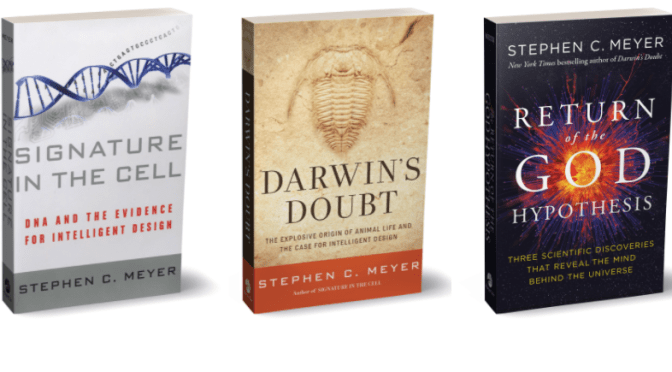
Anyway, with that said, I listened to a nice podcast from Apologetics 315 yesterday where they interviewed Dr. Stephen C. Meyer. In my opinion, no one does a better job of approaching the most core issues of the Christian faith with evidence that is convincing to open-minded non-Christians.

Here’s the podcast.

And they have an outline:

Episode 021 – Return of the God Hypothesis with Stephen C. Meyer

In this episode, Brian Auten and Chad Gross interview Dr. Stephen C. Meyer on his latest book Return of the God Hypothesis.

0:43 – Intro to Dr. Stephen Meyer, author of Return of the God Hypothesis, Signature in the Cell, and Darwin’s Doubt.
3:00 – Dr. Meyer’s background, education, and how he got interested in the question of intelligent design.
9:58 – Meyer’s view of science and philosophy of science, the importance for understanding philosophy when doing science.
16:28 – reviewing five centuries of the history of science, the false idea that science and religion have always been at war.
23:49 – The reason for telling the story of the rise of science, the rejection of the God hypothesis, and its subsequent return based on the most recent scientific discoveries.
28:15 – Explaining the methodology of inference to the best explanation. How this fits within theistic apologetics.
36:30 – Is our goal truth, or a pre-commitment to naturalism? What challenges has Meyer faced when arguing for intelligent design?
39:45 – Are there problems with postulating a mind as an intelligent cause? Are certain explanations “out of bounds” when doing science?
43:00 – Shannon information
43:55 – The origin of the universe, the fine-tuning of the universe, and the information in the cell. Resistance to change from a materialistic worldview.
47:40 – Huge theistic implications and the corresponding push-back to them.
49:15 – Helpful illustrations to explain the fine-tuning of the universe for life.
53:38 – Douglas Adams’ “puddle objection” to the fine-tuning argument; the response, and a counter-analogy. The weak-anthropic principle.
58:50 – How might these arguments fit into an apologetic for Christianity? The role of natural theology and the need for special revelation. The false dichotomy between evidentialism and presuppositional apologetics.

In the podcast, Dr. Meyer talks about evidence that bears on the question of God’s existence from science. Specifically, the origin of the universe, the cosmic fine-tuning, the origin of life, and the sudden origin of body plans in the fossil record. This is mainstream evidence from mainstream science that points to a Creator and Designer.

This podcast is not for beginners, it’s more for intermediate-level Christians. If you’re looking for something for beginners, I recommend the True U DVDs, which feature Dr. Meyer talking to college students.

Alexander Vilenkin: “All the evidence we have says that the universe had a beginning”

I’ve decided to explain why physicists believe that there was a creation event in this post. That is to say, I’ve decided to let famous cosmologist Alexander Vilenkin do it.

From Uncommon Descent.

Excerpt:

Did the cosmos have a beginning? The Big Bang theory seems to suggest it did, but in recent decades, cosmologists have concocted elaborate theories – for example, an eternally inflating universe or a cyclic universe – which claim to avoid the need for a beginning of the cosmos. Now it appears that the universe really had a beginning after all, even if it wasn’t necessarily the Big Bang.

At a meeting of scientists – titled “State of the Universe” – convened last week at Cambridge University to honor Stephen Hawking’s 70th birthday, cosmologist Alexander Vilenkin of Tufts University in Boston presented evidence that the universe is not eternal after all, leaving scientists at a loss to explain how the cosmos got started without a supernatural creator. The meeting was reported in New Scientist magazine (Why physicists can’t avoid a creation event, 11 January 2012).

[…]In his presentation, Professor Vilenkin discussed three theories which claim to avoid the need for a beginning of the cosmos.

The three theories are chaotic inflationary model, the oscillating model and quantum gravity model. Regular readers will know that those have all been addressed in William Lane Craig’s peer-reviewed paper that evaluates alternatives to the standard Big Bang cosmology.

But let’s see what Vilenkin said.

More:

One popular theory is eternal inflation. Most readers will be familiar with the theory of inflation, which says that the universe increased in volume by a factor of at least 10^78 in its very early stages (from 10^−36 seconds after the Big Bang to sometime between 10^−33 and 10^−32 seconds), before settling into the slower rate of expansion that we see today. The theory of eternal inflation goes further, and holds that the universe is constantly giving birth to smaller “bubble” universes within an ever-expanding multiverse. Each bubble universe undergoes its own initial period of inflation. In some versions of the theory, the bubbles go both backwards and forwards in time, allowing the possibility of an infinite past. Trouble is, the value of one particular cosmic parameter rules out that possibility:

But in 2003, a team including Vilenkin and Guth considered what eternal inflation would mean for the Hubble constant, which describes mathematically the expansion of the universe. They found that the equations didn’t work (Physical Review Letters, DOI: 10.1103/physrevlett.90.151301). “You can’t construct a space-time with this property,” says Vilenkin. It turns out that the constant has a lower limit that prevents inflation in both time directions. “It can’t possibly be eternal in the past,” says Vilenkin. “There must be some kind of boundary.”

A second option explored by Vilenkin was that of a cyclic universe, where the universe goes through an infinite series of big bangs and crunches, with no specific beginning. It was even claimed that a cyclic universe could explain the low observed value of the cosmological constant. But as Vilenkin found, there’s a problem if you look at the disorder in the universe:

Disorder increases with time. So following each cycle, the universe must get more and more disordered. But if there has already been an infinite number of cycles, the universe we inhabit now should be in a state of maximum disorder. Such a universe would be uniformly lukewarm and featureless, and definitely lacking such complicated beings as stars, planets and physicists – nothing like the one we see around us.

One way around that is to propose that the universe just gets bigger with every cycle. Then the amount of disorder per volume doesn’t increase, so needn’t reach the maximum. But Vilenkin found that this scenario falls prey to the same mathematical argument as eternal inflation: if your universe keeps getting bigger, it must have started somewhere.

However, Vilenkin’s options were not exhausted yet. There was another possibility: that the universe had sprung from an eternal cosmic egg:

Vilenkin’s final strike is an attack on a third, lesser-known proposal that the cosmos existed eternally in a static state called the cosmic egg. This finally “cracked” to create the big bang, leading to the expanding universe we see today. Late last year Vilenkin and graduate student Audrey Mithani showed that the egg could not have existed forever after all, as quantum instabilities would force it to collapse after a finite amount of time (arxiv.org/abs/1110.4096). If it cracked instead, leading to the big bang, then this must have happened before it collapsed – and therefore also after a finite amount of time.

“This is also not a good candidate for a beginningless universe,” Vilenkin concludes.

So at the end of the day, what is Vilenkin’s verdict?

“All the evidence we have says that the universe had a beginning.”

This is consistent with the Borde-Guth-Vilenkin Theorem, which I blogged about before, and which William Lane Craig leveraged to his advantage in his debate with Peter Millican.

The Borde-Guth-Vilenkin (BGV) proof shows that every universe that expands must have a space-time boundary in the past. That means that no expanding universe, no matter what the model, can be eternal into the past. No one denies the expansion of space in our universe, and so we are left with a cosmic beginning. Even speculative alternative cosmologies do not escape the need for a beginning.

Conclusion

If the universe came into being out of nothing, which seems to be the case from science, then the universe has a cause. Things do not pop into being, uncaused, out of nothing. The cause of the universe must be transcendent and supernatural. It must be uncaused, because there cannot be an infinite regress of causes. It must be eternal, because it created time. It must be non-physical, because it created space. There are only two possibilities for such a cause. It could be an abstract object or an agent. Abstract objects cannot cause effects. Therefore, the cause is an agent.

Now, let’s have a discussion about this science in our churches, and see if we can’t train Christians to engage with non-Christians about the evidence so that everyone accepts what science tells us about the origin of the universe.

Some tips for women to test a marriage candidate for relationship skills

A while back, I blogged about a series of 10 posts by a lady Christian apologist about her advice for young women on how to choose a husband. You can find the links to the 10 posts on her blog. Recently, she updated part 7 of the series (about relationship skills). So, I decided to share some advice with women about how I engineer situations like the ones she is looking for.

First, let’s see her updated post:

In the pathetically superficial age in which we live, women tend to place an inappropriately high value on qualities like height, muscles, and a handsome face, but these characteristics absolutely will not sustain a marriage.

[…]The far more important qualities for sustaining a healthy and thriving marriage for the long haul are relationship skills. Can he carry a conversation? Is he thoughtful and interesting? Does he share his thoughts? Does he ask open-ended questions and listen to the answer? When he is asked open-ended questions, does he have something to say?

You can’t possibly know the answer to these questions if you spend your dating relationship in front of a screen, at sporting events, or making out on a couch. It is absolutely critical to spend the relatively short season of dating doing the harder work of trying to figure out whether this person is someone you can enjoy being with for the rest of the your life, even when he loses his hair, his figure, and even his teeth!

The concern she has – and she has seen this with her competent Christian friends – is that women will mistake passive validation of their communication as proof of a man’s relationship skills.

She writes:

… I’ve heard from woman after woman who enjoyed having the mic while dating, and then realized a few years (or months) into marriage that she had committed to spending the rest of her life with a passive man who had no plan for engineering interactions that develop her personally and help her to achieve goals. This, my friends, is a sure way to find yourself in one of the loneliest situations imaginable…for life!

So, today, I wanted to talk about some different things that I do to engineer “interactions that develop her personally and help her to achieve goals”.

1. Discussions about movies

So, the first one is movies. I don’t think it’s a good idea to go to the theater for movies, because you can’t talk, and they don’t let you stop the film to talk. I have a list of a few movies I like in my About WK page, and I talked about my favorite movie of all time in my interview with Apologetics 315.

Recently, I watched a movie called “A Patch of Blue” with a woman I’m friends with. It’s a movie featuring Sidney Poitier, who is a black actor. He befriends a blind white woman who is growing up fatherless in an abusive environment. I chose this movie because I felt we would each have a lot to say about it, and it would help us to work together. My female friend had a lot to say about the female character, who grew up in a bad environment with lots of yelling. And I had a lot to say about the male character, contrasting his mentoring of her with the qualities that women seem to prefer in men today.

I think it’s very easy for a woman to ask a man what his favorite movies are, and why. If a man’s favorite movies are just entertaining movies, that’s a good sign that the woman needs to move on.

2. Discussions about books

My “What I am Reading” page contains a lot of books that I am reading. I try to read a good mix of Christian apologetics, economics, social issues and military history. I try to read only non-fiction books, because fiction is just more useless entertainment that doesn’t build character.

If you’re a woman considering a man for marriage, you should ask a man which book he has read that formed his views on male / female roles and the marriage enterprise. Ask him: 1) what’s your plan for marriage and parenting, and 2) why me? what is it about me in particular that makes you think I would be good for your plan, and 3) what sorts of activities are we going to do that build me up, so that I am equipped to help you with your plan? It’s even better if he can explain how trends in popular culture, laws and policies are affecting his plans for his marriage and children.

When I was reading two famous books about American submarine captains Dudley “Mush” Morton and Richard “Dick” O’Kane, I learned that these men made good decisions because when they got back to Pearl Harbor from a war patrol, they requested all the after action reports of all the other submarine commanders. A good man makes good decisions because he can read the culture. And that only comes from learning from the experiences of others.

3. Co-operative problem solving

If a man has a serious marriage plan, then it’s likely that you’re not going to be the perfect plug and play fit for it. It’s likely that he will need to build you up a bit. Men are actually pretty good at this in the video game world – we are always picking battles to fight, and leveling up our characters to face even bigger challenges. Your job as a woman is to find out whether he has any plan to level you up. In fact, dating is not about fun at all – it’s about a man explaining his plan to you, demonstrating his ability to make you better, and to help you achieve more than you could on your own. Communication is a big part of this leading process.

Co-operative problem solving will show you whether a man is good at communicating with you to involve you in solving problems. I got a female friend of mine to help me build a desk and some exercise equipment. She was able to observe how I work together with her, and how I lead. She could see I communicated, and how I responded to her communication. And she could observe my tone and responses to successes and failures. Co-operative online games are great for practicing communication. You can learn a lot about a person’s relationship skills (and willingness to learn) by playing “Keep Talking and Nobody Explodes“.

4. Interview questions

Women should look for men who ask them questions to evaluate them for the tasks he has in mind for them. I have a list of 10 questions I ask to see if a woman even understands what marriage is about. Then I have another list of 10 questions to check if a woman is suitable for my marriage plan in particular.

Most women I show these questions to object to them. They don’t like the idea that women are being judged by a man, and possibly excluded by a man. Many women see men as accessories, and they think that handbags shouldn’t judge. They want a man who spends money to entertain them, makes their friends envious, makes them feel good, etc. They don’t want a man who will impose structure on them, and give them work to do to achieve specific marriage goals. Women with STEM degrees and private sector jobs seem to have this problem less than other women, in my experience.

When asked what they are bringing to the table, many women answer “I am the table”, which is just a way of saying “I am already fully equipped for marriage to any man, because I have a vagina. My job is to be cute, fun, and give positive vibes”. Men pick up on this, and they stop asking women questions. A man who asks questions has relationship skills.

Conclusion

So, the author of the post I linked to is concerned that women will be tricked into mistaking passive validation for actual relationships skills. Women really need to stop going along with their peers and culture, and think for themselves about what they are looking for in a long-term relationship. Men are not clowns. Relationships are not entertainment. What fulfills a woman in the long run is feeling that she is part of a unit that achieves goals, that the people she has relationships with value her contributions, and that the goals she is achieving are  meaningful. Men need to evaluated for their ability to lead well. Communication is a huge part of leadership.

A woman cannot easily convince a non-communicative man to change into a communicative man. That’s why she has to look past what her peers and culture says about which man is best, and choose what is best for her. Start by asking the man what movies and books formed his views on important topics. Then ask him what co-operative activities you can do together to solve a problem.