Atheist Luke Muehlhauser interviews well-respect cosmologist Luke Barnes about the fine-tuning argument, and the naturalistic response to it.
Luke M. did a good job explaining the outline of the podcast.
Details:
In one of my funniest and most useful episodes yet, I interview astronomer Luke Barnes about the plausibility of 11 responses to the fine-tuning of the universe. Frankly, once you listen to this episode you will be better equipped to discuss fine-tuning than 90% of the people who discuss it on the internet. This episode will help clarify the thinking of anyone – including and perhaps especially professional philosophers – about the fine-tuning of the universe.
The 11 responses to fine-tuning we discuss are:
“It’s just a coincidence.”
“We’ve only observed one universe, and it’s got life. So as far as we know, the probability that a universe will support life is one out of one!”
“However the universe was configured, evolution would have eventually found a way.”
“There could be other forms of life.”
“It’s impossible for life to observe a universe not fine-tuned for life.”
“Maybe there are deeper laws; the universe must be this way, even though it looks like it could be other ways.”
“Maybe there are bajillions of universes, and we happen to be in one of the few that supports life.”
“Maybe a physics student in another universe created our universe in an attempt to design a universe that would evolve intelligent life.”
“This universe with intelligent life is just as unlikely as any other universe, so what’s the big deal?”
“The universe doesn’t look like it was designed for life, but rather for empty space or maybe black holes.”
“Fine-tuning shows there must be an intelligent designer beyond physical reality that tuned the universe so it would produce intelligent life.”
Download CPBD episode 040 with Luke Barnes. Total time is 1:16:31.
There is a very good explanation of some of the cases of fine-tuning that I talk about most on this blog – the force of gravity, the strong force, etc. as well as many other examples. Dr. Barnes is an expert, but he is also very very easy to listen to even when talking about difficult issues. Luke M. is very likeable as the interviewer.
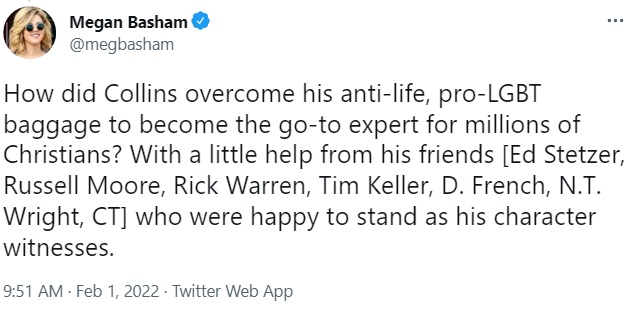
Megan Basham is an evangelical Christian writer who has gotten my attention by her challenges to anti-conservative evangelicals, such as David French, Russell Moore, Tim Keller, etc. She’s written some amazing articles for the Daily Wire, but her latest is the most important one yet. In it, she talks about how Biden Democrats used woke evangelicals to spread propaganda to conservative churches.
In September, Wheaton College dean Ed Stetzer interviewed National Institutes of Health Director Francis Collins on his podcast, “Church Leadership” about why Christians who want to obey Christ’s command to love their neighbors should get the Covid vaccine and avoid indulging in misinformation.
[…] Stetzer is… the executive director of the Billy Graham Center and the editor-in-chief of Outreach media group. He was previously an editor at Christianity Today and an executive director at LifeWay, one of the largest religious publishers in the world. That’s to say nothing of the dozen-plus books on missions and church planting he’s authored.
During their discussion, Collins and Stetzer were hardly shy about the fact that they were asking ministers to act as the administration’s go-between with their congregants. “I want to exhort pastors once again to try to use your credibility with your flock to put forward the public health measures that we know can work,” Collins said. Stetzer replied that he sometimes hears from ministers who don’t feel comfortable preaching about Covid vaccines, and he advises them, in those cases, to simply promote the jab through social media.
“I just tell them, when you get vaccinated, post a picture and say, ‘So thankful I was able to get vaccinated,’” Stetzer said. “People need to see that it is the reasonable view.”
[…]Stetzer… ended the podcast by announcing that the Billy Graham Center would be formally partnering with the Biden administration. Together with the NIH and the CDC it would launch a website, coronavirusandthechurch.com, to provide clergy Covid resources they could then convey to their congregations.
Much earlier in the pandemic, as an editor at evangelicalism’s flagship publication, Christianity Today (CT), Stetzer had also penned essays parroting Collins’ arguments on conspiracy theories. Among those he lambasted other believers for entertaining, the hypothesis that the coronavirus had leaked from a Wuhan lab. In a now deleted essay, preserved by Web Archive, Stetzer chided, “If you want to believe that some secret lab created this as a biological weapon, and now everyone is covering that up, I can’t stop you.”
Only two days before Stetzer published his essay, Collins participated in a livestream event, co-hosted by CT. The outlet introduced him as a “follower of Jesus, who affirms the sanctity of human life” despite the fact that Collins is on record stating he does not definitively believe, as most pro-lifers do, that life begins at conception, and his tenure at NIH has been marked by extreme anti-life, pro-LGBT policies. (More on this later).
Megan has a lot more to say about other pious, charismatic useful idiots in the article.
Joe Carter
Here’s Joe Carter, who writes for the woke evangelical publication “The Gospel Coalition”:
Certainly The Gospel Coalition, a publication largely written for and by pastors, didn’t probe beyond the “facts” Collins’ offered or consider any conflicts of interest the NIH director might have had before publishing several essays that cited him as almost their lone source of information. As with CT, one article by Gospel Coalition editor Joe Carter linked the reasonable hypothesis that the virus might have been human-made with wilder QAnon fantasies. It then lectured readers that spreading such ideas would damage the church’s witness in the world.
Joe Carter has been far-left for some time. Another person who climbed the church hierarchy through piety and charisma, but doesn’t know anything about the real world.
Russell Moore
If you’re looking for the truth about how to handle a virus, you won’t get it from a pious, charismatic pastor:
[T]he Ethics and Religious Liberty Commission (ERLC), an organization funded by churches in the Southern Baptist Convention, the largest Protestant denomination in the U.S.
While a webinar featuring Collins and then-ERLC-head Russell Moore largely centered, again, on the importance of pastors convincing church members to get vaccinated, the discussion also moved on to the topic of masks. With Moore nodding along, Collins held up a basic, over-the-counter cloth square, “This is not a political statement,” he asserted. “This is not an invasion of your personal freedom…This is a life-saving medical device.”
Former megachurch pastor Tim Keller’s joint interview with Collins included a digression where the pair agreed that churches like John MacArthur’s, which continued to meet in-person despite Covid lockdowns, represented the “bad and ugly” of good, bad, and ugly Christian responses to the virus.
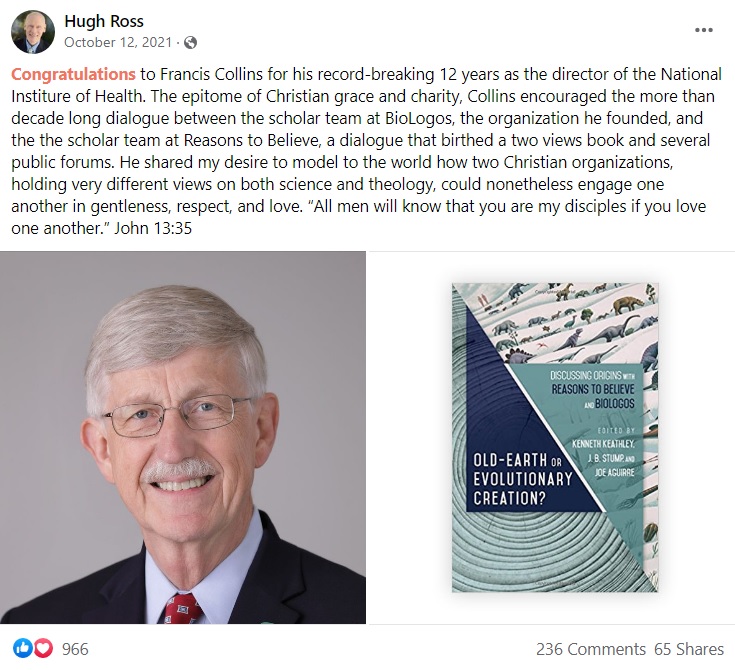
Haven’t paid any attention to him recently because of his views on evolution, socialism, and critical race theory.
I don’t think anyone would call Hugh Ross a very politically-aware person, but this was ridiculous. Francis Collins isn’t automatically a good person just because he has elite degrees and political power. Elite degrees and political power are great, but they don’t automatically make you a good Christian. Hugh Ross has never been very intelligent about policy or politics. He was careless about Collins and it is a huge mistake.
Further reading
If you don’t know much about Francis Collins, you should read this article about him from Evolution News. They go over his record on abortion, experimenting on aborted babies, LGBT activism and theistic evolution.
Have you ever heard someone say that if God existed, he would give us more evidence? This is called the “hiddenness of God” argument. It’s also known as the argument from “rational non-belief”. You have have seen Dr. Theodore Drange use the argument in his debate with Dr. William Lane Craig.
Basically the argument is something like this:
God is all powerful
God is all loving
God wants all people to know about him
Some people don’t know about him
Therefore, there is no God.
In this argument, the atheist is saying that he’s looked for God real hard and that if God were there, he should have found him by now. After all, God can do anything he wants that’s logically possible, and he wants us to know that he exists. To defeat the argument we need to find a possible explanation of why God would want to remain hidden.
What reason could God have for remaining hidden?
Christian scholar Dr. Michael Murray has found a reason for God to remain hidden.
He argues that if God reveals himself too much to people, he takes away our freedom to make morally-significant decisions, including responding to his self-revelation to us. Murray argues that God stays somewhat hidden, so that he gives people space to either 1) respond to God, or 2) avoid God so we can keep our autonomy from him. God places a higher value on people having the free will to respond to him, and if he shows too much of himself he takes away their free choice to respond to him, because once he is too overt about his existence, people will just feel obligated to belief in him in order to avoid being punished.
But believing in God just to avoid punishment is NOT what God wants for us. If it is too obvious to us that God exists and that he really will judge us, then people will respond to him and behave morally out of self-preservation. But God wants us to respond to him out of interest in him, just like we might try to get to know someone we admire. God has to dial down the immediacy of the threat of judgment, and the probability that the threat is actual. That leaves it up to us to respond to God’s veiled revelation of himself to us, in nature and in Scripture.
(Note: I think that we don’t seek God on our own, and that he must take the initiative to reach out to us and draw us to him. But I do think that we are free to resist his revelation, at which point God stops himself short of coercing our will. We are therefore responsible for our own fate).
The atheist’s argument is a logical/deductive argument. It aims to show that there is a contradiction between God’s will for us and his hiding from us. In order to derive a contradiction, God MUST NOT have any possible reason to remain hidden. If he has a reason for remaining hidden that is consistent with his goodness, then the argument will not go through.
When Murray offers a possible reason for God to remain hidden in order to allow people to freely respond to him, then the argument is defeated. God wants people to respond to him freely so that there is a genuine love relationship – not coercion by overt threat of damnation. To rescue the argument, the atheist has to be able to prove that God could provide more evidence of his existence without interfering with the free choice of his creatures to reject him.
Murray has defended the argument in works published by prestigious academic presses such as Cambridge University Press, (ISBN: 0521006104, 2001) and Routledge (ISBN: 0415380383, 2007).