All posts by Wintery Knight

https://winteryknight.com/

New study: galactic habitable zone depends on fine-tuning of cosmological constant

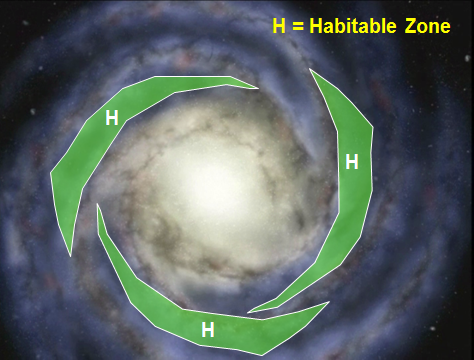
The galactic habitable zone (GHZ) is shown in green against a spiral galaxy
The galactic habitable zone (GHZ) is shown in green superimposed on a spiral galaxy

This is going to be old news to readers of this blog who are familiar with the Michael Strauss, Walter Bradley and Guillermo Gonzalez lectures on habitability and fine-tuning. But, it’s nice to see these ideas show up in one of the most prestigious peer-reviewed science journals in the world (if not the most prestigious).

Here’s the article from Science.

It says:

Scientists have known for several years now that stars, galaxies, and almost everything in the universe is moving away from us (and from everything else) at a faster and faster pace. Now, it turns out that the unknown forces behind the rate of this accelerating expansion—a mathematical value called the cosmological constant—may play a previously unexplored role in creating the right conditions for life.

That’s the conclusion of a group of physicists who studied the effects of massive cosmic explosions, called gamma ray bursts, on planets. They found that when it comes to growing life, it’s better to be far away from your neighbors—and the cosmological constant helps thin out the neighborhood.

“In dense environments, you have many explosions, and you’re too close to them,” says cosmologist and theoretical physicist Raul Jimenez of the University of Barcelona in Spain and an author on the new study. “It’s best to be in the outskirts, or in regions that have not been highly populated by small galaxies—and that’s exactly where the Milky Way is.”

Jimenez and his team had previously shown that gamma ray bursts could cause mass extinctions or make planets inhospitable to life by zapping them with radiation and destroying their ozone layer. The bursts channel the radiation into tight beams so powerful that one of them sweeping through a star system could wipe out planets in another galaxy. For their latest work, published this month in Physical Review Letters, they wanted to apply those findings on a broader scale and determine what type of universe would be most likely to support life.

The research is the latest investigation to touch on the so-called anthropic principle: the idea that in some sense the universe is tuned for the emergence of intelligent life. If the forces of nature were much stronger or weaker than physicists observe, proponents note, crucial building blocks of life—such fundamental particles, atoms, or the long-chain molecules needed for the chemistry of life—might not have formed, resulting in a sterile or even completely chaotic universe.

Basically, the best place for a galaxy that permits complex, embodied life to exist is one where you can pick up enough heavy elements from dying stars nearby, but not be in an area that is so crowded by stars that you will be murdered by intense gamma radiation when they die.

The cosmological constant has to be set just right so that we spread out enough to make space between spiral arms for life-permitting solar systems, but not so spread out that we cannot pick up the heavy elements we need for a metal-rich star, a moon, and the bodies of the intelligent agents themselves.

More:

As it turns out, our universe seems to get it just about right. The existing cosmological constant means the rate of expansion is large enough that it minimizes planets’ exposure to gamma ray bursts, but small enough to form lots of hydrogen-burning stars around which life can exist. (A faster expansion rate would make it hard for gas clouds to collapse into stars.)

Jimenez says the expansion of the universe played a bigger role in creating habitable worlds than he expected. “It was surprising to me that you do need the cosmological constant to clear out the region and make it more suburbanlike,” he says.

Remember, this is only one of many characteristics that must obtain in order to have a location in the universe that can support complex, embodied life of any conceivable kind.

Let’s review the big picture

Time for me to list out some of the things that are required for a galaxy, solar system, and planet to support complex embodied life. Not just life as we know it, but life of any conceivable kind given these laws of physics.

  • a solar system with a single massive Sun than can serve as a long-lived, stable source of energy
  • a terrestrial planet (non-gaseous)
  • the planet must be the right distance from the sun in order to preserve liquid water at the surface – if it’s too close, the water is burnt off in a runaway greenhouse effect, if it’s too far, the water is permanently frozen in a runaway glaciation
  • the solar system must be placed at the right place in the galaxy – not too near dangerous radiation, but close enough to other stars to be able to absorb heavy elements after neighboring stars die
  • a moon of sufficient mass to stabilize the tilt of the planet’s rotation
  • plate tectonics
  • an oxygen-rich atmosphere
  • a sweeper planet to deflect comets, etc.
  • planetary neighbors must have non-eccentric orbits

It’s not easy to make a planet that supports life. For those who are interested in reaching out to God, he has left us an abundance of evidence for his existence – and his attention to detail.

And remember, these requirements for a habitable planet are downstream from the cosmic fine-tuning of constants and quantities that occurs at the Big Bang. No point in talking about the need for plate tectonics if you only have hydrogen in your universe. The habitability requirements are a further problem that comes after the fine-tuning problem.

Resources

The best book to read on this topic is “The Privileged Planet“, by Guillermo Gonzalez and Jay W. Richards. The latter is one of my absolute favorite Christian scholars, a real renaissance man. If the book is too much, there is a DVD by the same name that covers everything you need to know at a high level. Just FYI, Gonzalez made the cover of Scientific American in 2001, for his research on habitable zones. This is real evidence you can discuss with anyone, anywhere.

You can also watch the DVD for FREE on YouTube. Not sure how long that will be there. If you like it, buy the DVD, so you can show your friends.

Related posts

William Lane Craig debates Daniel Came: Does God exist?

Dr. Craig's opening speech summary slide
Dr. Craig’s opening speech summary slide

The video of the debate was posted by ReasonableFaith.org – Dr. Craig’s organization. This debate occurred in March 2017 at the University of Dublin, in Ireland.

The video: (91 minutes)

My non-snarky summary is below.

Dr. Craig’s opening speech

Two claims:

1. There are good reasons to think that theism is true.
2. There are not comparably good reasons to think that atheism is true.

Five reasons for God’s existence:

1. The beginning of the universe
– actual infinite past is mathematically impossible
– BGV theorem: any universe that is on balance expanding in its history (like ours) cannot be past eternal

2. Fine-tuning of cosmic quantities and constants
– slight changes to quantities and constants prevent a universe from supporting complex embodied life
– the multiverse response of atheists conflicts with observations, e.g. the Boltzmann Brains problem

3. Objective moral values
– God’s existence is required to ground objective moral values and duties

4. Minimal facts case for the resurrection of Jesus
– there are good reasons to accept the most widely accepted facts about the historical Jesus (empty tomb, appearances, early widespread belief in the resurrection)
– the best explanation of these minimal facts is that God raised Jesus from the dead

5. Experience God directly
– in the absence of any defeaters to belief in God, a person can experience God directly

Dr. Daniel Came’s opening speech

1. The hiddenness of God
– if God wants a personal relationship with us, and a relationship with God would be the greatest good for us
– God ought to reveal himself to us, but he does not  reveal himself to many people, the “non-resistant non-believers”

2. The inductive problem of evil
– many evil events occur that are pointless – there is no morally sufficient reason why God would allow them to occur
– examples: animal suffering, children born with disease, tsunamis
– the theistic response to this is that humans are not in a position to know whether there are morally sufficient reasons, due to our limitations of knowing the consequences
– but this ripple effect defense has 4 possible outcomes, 3 of which don’t do the job of justifying

Dr. Craig’s first rebuttal

1. The hiddenness of God
– God’s goal is not to make his existence known, but to draw them into a love relationship
– it’s speculative that overt displays of God’s existence would draw people to him in a love relationship, they might resent his bullying
– atheist would have to prove that God could draw more people into a love relationship with him by revealing himself more overtly

2. The inductive problem of evil
– as humans, we are not in a position to know for certain that any apparently pointless evil really is pointless
– William Alston article: 6 limitations of human knowing make it impossible to judge that an evil is actually “pointless”
– Dr. Came says that there are 4 possibilities for the ripple effects, and since 3 are bad, it’s likely that there are not morally sufficient reasons for a apparently pointless evil
– it is logically fallacious to assert probability conclusions without knowing the probabilities of those 4 options
– there is actually an argument from evil: since the problem of evil requires an objective standard of good and evil by which to measure, and God is the only possible ground of objective morality, then pressing the problem of evil actually requires the atheist to assume God, in order to ground this objective moral standard

Dr. Came’s first rebuttal

3. Objective moral values
– there are naturalistic theories of moral realism where objective moral duties and objective moral values exist in a naturalistic universe
– I’m not saying that any of them are correct, but there are many theories about object morality in a naturalistic universe

There are naturalistic theories for all of the 5 arguments that Dr. Craig presented. It is Dr. Craig’s responsibility to present those naturalistic theories and prove that they are not as good as his explanations. I’m not going to defend (or even name!) a single naturalistic theory for any of these 5 arguments by Dr. Craig.

Dr. Craig’s explanations for the 5 evidences he gave can’t be admitted, because we have to know how God did something in naturalistic terms before we can know that God did it supernaturally. Explanations are only valid if they are naturalistic.

1. The beginning of the universe
– naturalism explains how the universe expands after it came into being, so that explains how it came into being
– the God explanation, that God created the universe out of nothing, is not admissible, because it is not naturalistic
– how does God, as an unembodied mind interact with the physical world?
– the only agency that we know about is human agents, and we have bodies, so how could God perform actions without having a body?

The theistic hypothesis does not make any predictions, but naturalism makes lots of testable predictions. God could do anything, so he is not constrained and is therefore untestable. We can’t infer God as an explanation in principle because we can’t predict what is more probable if God exists than if he does not.

2. Fine-tuning of cosmic quantities and constants
– the university was not set up to make embodied intelligence plausible, because the vast majority of the universe is hostile to life
– there are models of the multiverse that escape the Boltzmann Brains problem that Dr. Craig raised

Dr. Craig’s second rebuttal

Some of Dr. Craig’s arguments are deductive (e.g. – the beginning of the universe, objective moral values), so that the conclusion follows from the premises if the premises are true. The resurrection passes the standard tests for historical explanations.

1. The beginning of the universe
– the whole point of the argument is that there is no naturalistic explanation for an ultimate beginning of the universe

2. Fine-tuning of cosmic quantities and constants
– the whole point of the argument is that there is no naturalistic explanation for a design of the universe to support life
– he has to prove that intelligences has to be attached to bodies
– human beings are non-physical minds united to physical bodies
– naturalistic attempts to explain mental operations fail
– the arguments prove that unembodied minds exist
– the vast expanse of the universe is required in order to form the galaxies, stars and heavy elements needed for complex life
– why expect that the entire universe should be small, or that life would be everywhere?
– a non-fine-tuned world is more likely in the multiverse, and in a multiverse, we are more likely to have a Boltzmann brain world than a world with complex, embodied life
– Dr. Came has not advanced any naturalistic explanation for the fine-tuning

3. Objective moral values
– non-theistic ethical theories cannot account for the ontological foundations of objective moral values and duties
– atheistic theories of moral realism simply assume objective moral values out of thin air
– it is especially hard to find any basis for objective moral duties in the absence of God

Dr. Came’s second rebuttal

5. Religious experience
– Dr. Craig should not bring up religious experience in a debate where arguments and evidence are central
– people who have dreams, hallucinations and psychotic delusions could appeal to religious experience
– religious experience is by no means universal, and it is possible to doubt it

3. Objective moral values
– there are lots of atheists who hold to objective moral values
– Dr. Craig has to explain how God grounds objective moral values and duties
– Dr. Craig has to explain why atheist moral realist theories don’t work to ground objective moral values and duties

1. The beginning of the universe
– Dr. Craig claims that something can’t come from nothing, that’s not an argument
– there are numerous models that don’t require an absolute beginning of the universe
– Dr. Craig cites the BGV theorem, but Guth (one of the authors) says that only the inflation has a beginning, not the whole universe

Dr. Craig’s conclusion

1. The beginning of the universe
– on theism, there is an efficient cause, but no material cause, for the origin of the universe
– on atheism, there is neither an efficient cause nor a material cause, for the origin of the universe: that’s worse!
– if he thinks that there are models of the universe that don’t require a beginning, then let him name a viable eternal model of the universe
– he never refuted the mathematical argues against an infinite past

2. Fine-tuning of cosmic quantities and constants
– nothing to refute

3. Objective moral values
– God is a better ground for morality than humans, because he is ultimate, and not contingent and arbitrary
– God is a being who is worthy of worship, and therefore command his creatures with moral duties

4. Minimal facts case for the resurrection of Jesus
– nothing to refute

5. Religious experience
– only justified because there are no defeaters to it

1. The hiddenness of God
– atheist has to show that if God’s existence were more obvious, that it would result in more people being drawn to him

2. The inductive problem of evil
– Dr. Came’s argument was logically fallacious, and makes errors in probability theory

Dr. Came’s conclusion

Sometimes, people can’t prove something, but lack of evidence is a justification for doubting it, e.g. – werewolves.

If none of Craig’s arguments work, then it follows that it is not rational to believe that God exists, and it is rational to believe that God does not exist.

Atheists shouldn’t have a burden of proof for what they know, only theists have a burden of proof for what they know.

My thoughts

One quick point. If life were common everywhere then atheists would infer that God wasn’t involved in it. Period. “Life is everywhere, so it’s common, why do we need a designer?” they’d say. I agree with Dr. Came about denouncing religious experience in a formal debate. I don’t like when Dr. Craig brings this up, but I see why he does it – he’s an evangelist, and that’s a good thing, too. I just worry about how it looks to atheists, although it’s good for sincere seekers. I’m not the one on the stage, though, Dr. Craig is.

I think the point about more overt revealing by God would annoy people and make them turn away. Think of how gay people respond to the suggestion that there is anything wrong with them, with rage, vandalism, threats, coercion, attempts to get you to lose your job and business, and using government as a weapon to fine and imprison you. It’s really obvious to me that more God does not mean more love of God. For those who don’t want God, the hiddenness is respect for their choice to put pleasure above the search for truth. (I mean the gay activists – I have great sympathy for people who struggle with same-sex unwanted attractions because they were impacted by a failed bond with their parent of the same sex as they are).

Whenever I meet people like Dr. Came, I always urge them to keep investigating and pursuing truth, because they will find it if they are sincerely seeking after God. Some atheists do sincerely seek God, but I don’t know any who haven’t found him. I’m not sure if that’s because those atheists who claim to be non-resistant and rational are in fact resistant and non-rational, or what the real reason is. If you believe the Bible, all unbelief is non-rational and resistant (see Romans 1). Regarding the werewolves, we don’t have any good arguments for werewolves, we do have good arguments for God. Dr. Came didn’t refute the arguments that Craig raised, nor did his own arguments for atheism work. And there are many, many more arguments (origin of life, Cambrian explosion, habitability-discoverability, molecular machines) that Craig did not raise, too.

Bible study: what difference does the resurrection of Jesus make?

Here’s an article from Bible.org, written by famous New Testament manuscript expert Dan Wallace.

What does the Old Testament say about the doctrine of the resurrection in Judaism?

He says:

The resurrection of the dead was not plainly revealed in the OT until very late in salvation history. It was not until the Jews were taken in captivity, in the sixth century BC, that this was clearly articulated. Daniel 12:1-2 is the principal text: it speaks of the resurrection of both the righteous and the unrighteous:

At that time shall arise Michael, the great prince who has charge of your people. And there shall be a time of trouble, such as never has been since there was a nation till that time; but at that time your people shall be delivered, every one whose name shall be found written in the book. And many of those who sleep in the dust of the earth shall awake, some to everlasting life, and some to shame and everlasting contempt. (RSV)

Why was it not clearly revealed till then? It was not revealed until there was a felt need for it. When the Jews had no present (because of the captivity) they had to look to the future. The revelation of the resurrection came at precisely the time when the people of God needed hope for the future.

What is significant about this is how masterful are God’s insights into human nature. In the NT era, one religious group in Palestine did not embrace the resurrection as a true doctrine: the Sadducees (cf. Mark 12:18)–that is why they were “sad, you see!” The Sadducees were in charge of the temple. They derived their income from the sacrifices. In a sense, they were the precursors to modern TV evangelists. They had it good! They were the rich aristocracy that ran the place.

Those who have it good in this life don’t often long for the next. The Sadducees illustrate this. The resurrection is a truth especially precious to those who are poor and those who are hopeless. It is precious to those who long for heaven enough that earth holds no sway over them.

This means something to me. I didn’t grow up with parents who had any plan for me. I had to figure out what I was supposed to be doing with my life on my own, because they were both too busy doing their own things. This is true even to this day. After I became a Christian, there were many things that I wanted to achieve in this life. But for a variety of reasons, those most of those things never happened. I wanted to do great things for God, like getting married, having a family, getting a PhD and teaching computer science in a secular university. But things that I had intended to do for God just didn’t happen the way I had hoped.

I often find myself thinking of Heaven, and having that eternal perspective on this life. One of the things that is the hardest to accept is that being a Christian makes many things I’d like to do a lot harder. It certainly didn’t open any doors at school, or now, at work. I’m glad my salvation doesn’t depend on achieving anything in particular. And I’m especially glad that my salvation doesn’t depend on what anyone thinks of me. I find it almost impossible in this culture to get any respect by doing the things that I think are really important.

I think if a person were really successful at what they tried to do, then it would be really hard for them to give up living and go to be with Jesus.

What did Jesus intend to achieve with his resurrection?

Did you know that Jesus provided the resurrection as evidence for those who were skeptical of his claims to be God stepping into history?

Here’s an article from Got Questions? on the “Sign of Jonah”, which appears in the gospels of Matthew and Luke.

It says:

The phrase “sign of Jonah” was used by Jesus as a typological metaphor for His future crucifixion, burial, and resurrection. Jesus answered with this expression when asked by the Pharisees for miraculous proof the He was indeed the Messiah. The Pharisees remained unconvinced of Jesus’ claims about Himself, despite His having just cured a demon-possessed man who was both blind and mute. Shortly after the Pharisees accused Jesus of driving out demons by the power of Satan, they said to Him, “Teacher, we want to see a sign from you.” He answered, “A wicked and adulterous generation asks for a sign! But none will be given it except the sign of the prophet Jonah. For as Jonah was three days and three nights in the belly of a huge fish, so the Son of Man will be three days and three nights in the heart of the earth. The men of Nineveh will stand up at the judgment with this generation and condemn it; for they repented at the preaching of Jonah, and now something greater than Jonah is here” (Matthew 12:38–41).

To fully appreciate the answer that Jesus gave, we must go to the Old Testament book of Jonah. In its first chapter, we read that God commanded the prophet Jonah to go to the city of Nineveh and warn its people that He was going to destroy it for its wickedness. Jonah disobediently ran from the Lord and headed for the city of Tarshish by boat. The Lord then sent a severe storm that caused the crew of the ship to fear for their lives. Jonah was soon thrown overboard and swallowed by a great fish where he remained for “three days and three nights” (Jonah 1:15–17). After the three-day period, the Lord caused the great fish to vomit Jonah out onto dry land (Jonah 2:10).

It is this three days that Jesus was referring to when He spoke of the sign of Jonah.

I often bring up the Sign of Jonah when I am dealing with Christians who don’t want to learn how to explain their faith to non-Christians persuasively. I’m glad that story is in there!

The resurrection is a very important part of the life of the Christian. I argued in this post that it makes a difference to your feelings about your own life, and it makes a difference to your case-making with non-Christians.