All posts by Wintery Knight

https://winteryknight.com/

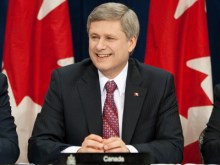
Canadian prime minister Stephen Harper interviewed by Larry Kudlow

Canadian Prime Minister Stephen Harper

Larry Kudlow sat down with Canadian prime minister Stephen Harper and had a conversation about Canada’s economic situation and policies. (Video here)

Kudlow first asks Harper about the banking situation in Canada. Harper says that the banks are run much more tightly in Canada. Harper explains that there are no bailouts planned for Canadian banks because Canadian banks are private institutions.

KUDLOW: Let me begin with an interesting subject here, banking. Everybody’s talking about banking. The Canadian banks appear to be in much better shape than the American banks. They have fewer toxic assets. Their losses aren’t nearly as bad. No one’s talking about bankruptcy up there. I want to learn from our northern cousins. What can you tell us? Why are Canadian banks looking better than our banks?

HARPER: Well first of all I can tell you, it is true. We have, I think, the only banks in the western world where we’re not looking at bailouts or anything like that.

KUDLOW: No TARP money sir, if I’m not mistaken? No TARP money?

HARPER: We haven’t got any TARP money. We’ve gone in and done some market transactions with our banks to improve liquidity. But I think the reasons are really complex, Larry. You know, first of all, our banks are private. We don’t have a Fannie Mae or Freddie Mac equivalent mucking around in the system.

KUDLOW: Is that a lesson right there Prime Minister?

HARPER: Well, I think my observation is those are institutions with a difficult private/public mix. And sometimes private/ public mixes have benefits and sometimes they have the worst of both worlds. We don’t have anything like that. We do have though, a strong system of regulation, and activist regulators, who go and meet with the sector. But they’re macro, prudential kind of regulations. They don’t try and micromanage banks’ decisions. We try and establish good oversight and transparency.

KUDLOW: Do you have leverage and borrowing ratios that might have been enforced? Because that’s clearly one of the breakdowns here in the states?

HARPER: Well, we do have leverage ratios. What’s ironic is that our own banks had not actually achieved those ratios. They were actually working under them. Part of what we…

KUDLOW: They were under leveraged?

HARPER: They were under leveraged.

KUDLOW: Wait, wait. Canadian banks were under leveraged?

HARPER: Under what they could have been.

KUDLOW: I didn’t know there was such a thing on this entire planet earth.

HARPER: Well I think part of what we have done is through the system of regulation we’ve had, we’ve encouraged a fairly cautious culture in the banks. For example, our banks, when they sign mortgages, largely hold those mortgages rather than trading them. So they have a lot more interest in the underlying quality of those mortgages. And we avoided the sub-prime kind of problem.

Kudlow goes on to quiz Harper on individual income tax rates, corporate income tax rates, tax cuts, Canadian energy production, carbon emissions, protectionism/free trade and auto-union bailouts. If you want to know what it is like to have an F.A. Hayek-admiring economist running your country, (BA and MA in Economics from the University of Calgary), read the whole thing!

UPDATE: More interviews with Stephen Harper with CNN, Wall Street Journal and Fox Business are here!

Does the origin of the first living organism require an intelligent designer?

I found a good debate on this question here on the Unbelievable radio show, which is broadcast in the UK. The argument is specifically about the first replicating organism.

The first replicating organism would have to have had a number of characteristics of living things, such as the ability to store its own genetic information and replicate that information. The first living organism cannot be built up by mutation and selection, because mutation and selection require that replication already be in place. So, where did the information in the first replicator come from?

If you imagine that the simplest organism is a functional computer program, you have to ask yourself – how much code is needed to provide that minimal functionality for a living system? Whatever that amount of code is, it would have to come together all at once, because having only a part of the program in place means that the program doesn’t compile and it doesn’t run!

Here is the link to the debate audio. The debate starts at 15 and half minutes into the show, and is 1 hour long. And here is the blurb introducing the topic and speakers:

Unbelievable? – 21 February 2009
Could the DNA that makes up the building blocks of life of every living thing on the earth be the clue to a cosmic designer?

That’s the view of Christian guest Perry Marshall. An electrical engineer by background, he is now a leading authority on information systems and the internet. He says that anybody who comes at the topic of how life originated from an engineering background will see that DNA is a code that needs a designer to create the information it transmits.

Peter Hearty is an atheist biologist. He says that science does not work when you dispense with the search for a naturalistic explanation for the origin of DNA. [Note from Wintery Knight: Peter Hearty has a Ph.D in computer science!]

This is a fun and easy-to-understand debate, especially for those of us coming from a computer science or engineering background. I think it’s fun to argue with my friends about what kind of professional God would be if he had to get a job. Naturally, I always argue that God is a computer scientist, because he designed the genetic code of the first replicator. If you have a different answer, leave a comment!

For more on science and faith, see my (snarky, mean, satirical) articles on the origin of the universe and the fine-tuning of the physical constants of the universe in order to permit the minimal requirements for complex living systems of any kind.

Porkulus-2 bill would destroy school choice in Washington D.C.

I already blogged about the new 410 billion dollar omnibus bill here, but on John Boehner’s blog, I found out more about it. It’s not just that it contains 9000 earmarks, as Michelle Malkin noted. On John Boehner’s blog, he argues that the bill also contains a hidden provision that would destroy the voucher program in Washington, D.C..

This post states:

Congressional Democrats are scheming to deny low-income parents and students in the nation’s capital a popular school choice program by inserting a provision mandating Congress renew the program before more money is spent on it.  While this may sound innocuous enough, it would serve as a death blow to the groundbreaking D.C. school choice program – a goal Congressional Democrats have sought since taking control of Congress in 2007.

The post also links to a video produced by the Heritage Foundation that shows some of the affected students pleasing with Obama to let them attend private schools using vouchers, instead of attending defective public schools.

You may have heard that Washington, D.C. spends the most amount of money per pupil, but gets the least return on their investment. Andrew Coulson of the libertarian Cato Institute calculates the cost per student per year as $24,600. That is not a typo. The Washington Times notes that the voucher system cost only $7500 per year, and produced far better results than the government-run, union-staffed public schools.

The Opportunity Scholarship Program that Congress established allows more than 1,900 low-income D.C. children to receive vouchers so they can attend the private school of their parents’ choosing. The scholarships are good for up to $7,500. So, the best bet is obvious: a $7,500 voucher that caters to children – not a one-size-fits-all $24,600 per-pupil plan. The former has measurable academic success and incredible parental demand; the latter consistently places children at the bottom rungs of the academic ladder. In fact, D.C. ranked the lowest in math and reading, according to results of the National Assessment of Educational Progress tests released in September.

The Boston Globe summarizes the numbers on reading and math here:

According to the authoritative National Assessment of Education Progress, only one in seven fourth-graders is ranked at grade-level (“proficient”) or better in reading and math. Among eighth-graders, only one in eight is proficient in reading; only one in 12 can handle eighth-grade math.

John Boehner is quote in his blog post as follows:

The D.C. school choice program has provided hope for thousands of low-income children in the District of Columbia since it was established, and has been demonstrating results when it comes to parental satisfaction and increased parental involvement.  Eliminating this program would represent an irresponsible and shameful act on the part of the Democratic leadership in Congress, and the children of the District of Columbia deserve better.

If the Barack Obama is willing to take away school-choice from the poorest students in the nation in order to satisfy the teachers unions that got him elected, then what hope do the rest of us have of keeping our liberty?