All posts by Wintery Knight

https://winteryknight.com/

Frank Turek and Wayne Grudem think you should go vote today!

EVERYONE  PLEASE GO VOTE TODAY! (NOVEMBER 2nd, 2010)

Here’s Frank Turek’s post on Jesus, Christians and politics on the Cross Examined blog.

Excerpt:

I often hear Christians claiming that we ought to just “preach the Gospel” and not get involved in politics.  This is not only a false dilemma; it’s stupid (how’s that for direct?).   If you think “preaching the Gospel” is important like I do, then you ought to think that politics is important too.  Why?  Because politics and law affects your ability to preach the Gospel! If you don’t think so, go to some of the countries I’ve visited—Iran, Saudi Arabia, China.  You can’t legally “preach the Gospel” in those countries—or practice other aspects of your religion freely—because politically they’ve ruled it out.

It’s already happening here. There are several examples where religious freedoms are being usurped by homosexual orthodoxy. This summer a Christian student was removed from Eastern Michigan University’s (a public school) counseling program because, due to her religious convictions, she would not affirm homosexuality to potential clients.  A judge agreed (a similar case is pending in Georgia).  In Massachusetts, Catholic charities closed their adoption agency rather than give children to homosexual couples as the state mandated.  In Ohio, University of Toledo HR Director Crystal Dixon was fired for writing a letter to the editor in her local newspaper that disagreed with homosexual practice.

More violations of religious liberty are on the way from the people currently in charge.  Lesbian activist Chai Feldbaum, who is a recess appointment by President Obama to the EEOC, recently said regarding the inevitable conflict between homosexuality and religious liberty, “I’m having a hard time coming up with any case in which religious liberty should win.” So much for tolerance.  The people who say they’re fighting for tolerance are the most intolerant, totalitarian people in politics.

Getting involved in politics is necessary if for no other reason to protect your religious liberty, and the liberties of us all.  So if you’re a Christian, follow the example of Christ—call out hypocrites and fools, and vote them out on Tuesday!

Religious liberty is my top priority and my core value. You can’t preach the gospel without religious liberty – so don’t just stand there and watch it slip away! Get out there and vote! The right to evangelize and discuss Christianity in public is already under attack in places like Canada and the UK! Don’t think that it can’t happen here – it can! Today is the day that you defend the gospel by defending your right to even talk about the gospel in public without having to worry that someone will censor or sue you for offending them. Get out there and vote for your liberty!

Wayne Grudem also encourages you to vote

Should Christian beliefs impact politics?

Do pastors have the right to speak from the pulpit about political, social or cultural issues?

What about the so-called “separation of church and state”?

You can find out more about Grudem’s new book here – it’s a 50+ page excerpt from the book! I’ve got my copy! And you can listen to podcasts from his Sunday School class here.

Frank Pastore thinks that politics flows from theological convictions

Frank Pastore has a Christian radio show on KKLA in Los Angeles.

Here is his post on Crosswalk.com about Christians and politics – specifically, he is responding to critics who say that he should not talk so much about politics on his Christian radio show, and that he should especially not argue about politics.

Excerpt:

Perhaps many Christians believe these things because they don’t understand politics is really an exercise of theology applied—one way we love our neighbors as ourselves. Our political and social policies should grow out of our theology, not vice versa. We are not to reverse engineer our theology based upon our political and social agendas. Our faith is foundational to everything else. For Christians, theology creates and shapes our approach to politics; for non-Christians, politics creates and shapes their approach to theology—or at least their worldview.

A Christian becomes too political when their politics is no longer rooted in their theology, when their faith becomes merely peripheral and unnecessary to their political agenda, rather than the one thing that is fundamental and essential.

How we vote to spend our tax dollars, what economic and social policies we hope to advance through votes for particular candidates, and what domestic and foreign policies we hope our government advances—these things are the applications of the values rooted in our Christian worldview.

Just as how I choose to invest my time and treasure is the best expression of whether I’m living out my Christian values, so too what the government spends money on and what policy preferences it pursues is the best expression of our true American values.

The best way for me to love my neighbor is through those things I choose to do personally. The second best way is through votes for candidates who support policies that I believe will promote the common good. Thus, I am political because I am loving, and I am loving because I am Christian. Therefore, I should argue—albeit in a God-glorifying manner—about politics.

Get out there and vote, people! And make all your friends and family vote, too!

Related posts

Harvard economist says stimulus was designed to reward Democrat constituencies

EVERYONE  PLEASE GO VOTE TODAY! (NOVEMBER 2nd, 2010)

Hans Bader at the Competitive Enterprise Institute comments on a new published paper by Harvard economist Jeffrey Miron, which explains why the stimulus failed to stimulate the economy and to create more jobs.

The paper is here. (PDF)

Excerpt:

Harvard economist Jeffrey Miron explains why the $800 billion stimulus package failed in a recent article.

What’s interesting about Dr. Miron’s critique is that he shows how the stimulus was a failure even if you take for granted liberal assumptions about economic policy (such as Keynesian economic theory), since it was so badly designed and executed that it failed to achieve its goals, spending wastefully while failing to revive the economy.  Indeed, the stimulus was so poorly tailored to the economy (and the goal of reducing unemployment) that Miron concludes that it was designed to reward politically connected “constituencies” and special-interest groups, like public-employee unions, rather than being focused on ”economic stimulus.”

Other Harvard economics professors like Robert Barro have also criticized the stimulus package. Barro called it “the worst bill that has been put forward since the 1930s.”  Former Obama economic advisor Martin Feldstein, a Harvard professor who is a big believer in stimulus packages in principle, said that the stimulus designed by Obama and congressional Democrats was “poorly done”

Much stimulus money has been wasted.  It has gone to prisoners and dead people, wasteful welfare spending, abandoned bridges to nowhere, and unnecessary government buildings.  The stimulus subsidized foreign green jobs and wiped out jobs in America’s export sector.

The “’stimulus’ is not the road to economic recovery. It’s the problem, not the solution, writes Nobel Prize winning economist Vernon L. Smith.” Other Nobel Laureates like Gary Becker have also criticized the stimulus package.  200 economists signed a statement publicly opposing the stimulus package in an ad published in the Washington Post and New York Times.

So the stimulus bill was a failure because it was not designed to grow the economy or create jobs.

What was the real purpose of the stimulus bill?

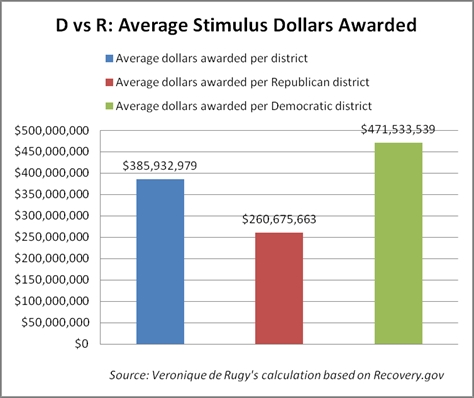
George Mason University professor Veronique de Rugy looked at recovery.org and found that Democrat districts got more stimulus money than Republican districts.

Here’s the first chart:

Stimulus spending by voting district affiliation

She writes:

…based on my new analysis of the Recovery.org data, Democratic districts are getting 1.8 times more money on average than Republican districts. Using Recovery.gov data, and cleaning it up seriously to be able to use it, we find that Republican districts are getting on average $260.6 million in stimulus awards while democratic districts are getting on average $471.5 million. The average is award per district is $385.9 million.

Interestingly, my data also confirms that the stimulus funds are not allocated based on unemployment rates or even variations in unemployment rates. So basically,  if the administration believes that government spending can create jobs, the allocation of the funds doesn’t show it.

And here’s the second chart showing which government departments got stimulus money.

Stimulus spending by government department
Stimulus spending by government agency

She writes:

Based on the Recovery.gov data, more than two third of the 594,754.3 jobs “created or saved” with the stimulus funds were “created or saved” in the Department of Education (see chart).  Basically, what the administration meant by shovel ready projects was funding for your next door teacher.

[…]A third of all union jobs are in Education

33 percent of the education industry is unionized

The union boss, Andy Stern, was appointed to be on the president’s debt commission.

The stimulus bill was never about stimulating the economy. It was about rewarding Democrat special interest groups. Remember, people who disagree with Obama are his “enemies”. And that means he isn’t there to govern for all the people equally. He’s there to reward his people. With Your Money.

Is Barack Obama a socialist? What is his connection to socialism?

Are Barack Obama and Hugo Chavez very different?

Here is an interview with Stanley Kurtz of National Review regarding his new book exploring the real Barack Obama and his past interest in socialism.  (H/T Muddling Towards Maturity)

The answers to this interview are too awesome to quote here. So I will quote some of the questions, and you should click through and read the WHOLE THING.

Questions:

LOPEZ: Why was the 1983 Socialist Scholars Conference “so formative an influence on Obama’s political career”?

LOPEZ: What actual evidence do you have that Obama attended the annual Socialist Scholars Conferences in New York between 1983 and 1985?

LOPEZ: What is socialism? What is socialism to Barack Obama? How has that changed since 1983? How has it stayed the same?

LOPEZ: How important is black liberation theology to understanding Barack Obama? And where does Jeremiah Wright fit in here?

LOPEZ: Was Bill Ayers his mentor or not?

LOPEZ: How important is ACORN to understanding Barack Obama and the Democratic party today? Is ACORN still a factor?

LOPEZ: Barack Obama wrote in Dreams from My Father: “Political discussions, the kind that at Occidental had once seemed so intense and purposeful, came to take on the flavor of the socialist conferences I sometimes attended at Cooper Union or the African cultural fairs that took place in Harlem and Brooklyn during the summers — a few of the many diversions New York had to offer, like going to a foreign film or ice-skating at Rockefeller Center.” You read a lot into “diversions.” How? Why? Is he really that smart?

LOPEZ: So is Saul Alinsky really, truly important to understanding our president?

LOPEZ: What does the Midwest Academy have to do with the milestone health-care legislation the president signed this March?

LOPEZ: Do you have insights into what exactly Barack Obama makes of the abortion debate and where that fits into a full picture of him? Despite a radicalism there, he’s been stealth about it, somewhat consistently, in his national career.

OK, here is an excerpt from the interview.

LOPEZ: What actual evidence do you have that Obama attended the annual Socialist Scholars Conferences in New York between 1983 and 1985?

KURTZ: Obama tells us himself in Dreams from My Father that he attended socialist conferences at the Cooper Union. Detailed evidence from socialist archives shows that there was only one socialist conference at the Cooper Union, and that was the Socialist Scholars Conference of 1983. Obama’s name also appears on a list of pre-registrants for the 1984 Socialist Scholars Conference. There is less evidence that he attended the Socialist Scholars Conference of 1985, although I think it’s likely that he did. Not only did Obama attend the previous two conferences, evidence indicates that in 1985 he was studying the writings of Harry Boyte, an important theorist of community organizing who spoke at the 1985 conference. Boyte, by the way, advised Obama’s 2008 presidential campaign. I carefully dissect the evidence for Obama’s conference attendance in the book.

LOPEZ: What is socialism? What is socialism to Barack Obama? How has that changed since 1983? How has it stayed the same?

KURTZ: These are the big questions. In the 1980s, the failure of Sixties and Seventies radicalism and the ascent of Ronald Reagan forced America’s socialists to take another tack. They de-emphasized strategies of nationalization and focused instead on local organizing as the way to move the country toward socialism. Now, instead of nationalizing a company, the idea was to get community organizers onto boards of directors, or to force banks to run loans through groups like ACORN. This was socialism “from below,” and it is the strategy that captivated Obama.

Obama’s socialist community-organizing colleagues followed French Marxist theorist André Gorz. Gorz advocated a strategy he called “non-reformist reforms,” proposing a series of seemingly minor tweaks to the system that were in fact designed to undermine capitalism and usher in socialism over time. This led Obama’s socialist mentors to devise an early version of the “public option,” although at the time they applied the idea to the energy sector, not health care. The socialism of Obama’s mentors was incremental and intentionally disguised. In the book, I argue that Obama follows many of his socialist mentors’ ideas to this day.

OK, here is ONE MORE answer at the end of the interview.

LOPEZ: If there’s one thing you could drive home to Americans about the president, what would it be?

KURTZ: He hasn’t been telling us the truth about his political convictions.

We need to start to understand Democrats by looking at their voting records, the policies they push, their positions, their past affiliations, and their life experiences. You don’t know anything about Barack Obama until you read books like these that go beyond the mainstream media puff pieces and Comedy Central slapstick interviews. You need to delve into who the man really is and what he intends to do to this country. The prosperity, liberty and security of your children depends on your diligence today. Inform yourself and persuade others.

And don’t forget to vote on Tuesday, and then buy the Stanley Kurtz book and the David Freddoso book. Then read them.