
All posts by Wintery Knight

https://winteryknight.com/

Some arguments for substance dualism, and one objection

Philosophy of mind is not something I’ve studied very much, but I do know about the different views like physicalism, epiphenomenalism, property dualism and substance dualism. I also know some of the basic arguments for and against each view.

In this post, I just wanted to show people a little bit about how you argue for substance dualism, using philosophical and scientific arguments. I find this topic to be really really dry, and I can barely stay awake when J.P. Moreland talks about it in lectures. But I hope a little bit of exposure won’t put you all to sleep.

Philosophical arguments

Let’s start with this old paper by John Depoe.

He writes about the persistent identity argument:

Another argument supporting substance dualism is that one maintains personal identity through change. Even though one is continuously going through physical changes and experiencing different mental states, a person continues to be the same person. If persons were identical with their physical parts or mental states, they would cease to be the same persons as these changes occurred. Therefore, it is necessary to postulate an immaterial, substantial self that endures through change.

Suppose that someone believes that people do not maintain identity through change and concludes that the previous argument for substance dualism fails. This denial of personal identity through change, I contend, presents untenable difficulties. First, there is one’s own awareness of being the same person through change. Moreover, if one is not literally the same person through these changes, how can a person maintain long-term goals and desires?

If you are your body, and your body is always changing, then you aren’t the same person now as 5 minutes ago.

There are more arguments for substance dualism here, from J.P. Moreland.

Experimental evidence

Doug Groothuis talks about some experimental evidence in this paper.

Excerpt:

Dr. Wilder Penfield was known for his ground-breaking work with epilepsy. His work involved stimulating brain tissue in conscious patients in order to find the causes of epilepsy. During these sessions Penfield found that the prodding of certain areas of the brain triggered vivid memories of past events. The patients reported remembering clearly such things as the taste of coffee. One patient, while on an operating table in Montreal, Canada, remembered laughing with cousins on a farm in South Africa. What amazed Penfield was that his patients, who were not under anesthetic, were simultaneously conscious of the re-experienced memories and of being prodded by an electrode in an operating room. Penfield called this a “double consciousness” wherein a memory was stimulated physically but was attended to and recognized as a memory by a conscious patient. Penfield likened this to the patient watching a television program while remaining aware that it wasn’t now happening.

Penfield repeated these results on hundreds of epileptic patients and concluded that a separable mind was able to track what the brain was doing as a result of the artificial stimulation. One’s mind in a sense could transcend the operations of the brain, monitoring memories without actually placing oneself in the situation remembered. Penfield noted that “The mind of the patient was as independent of the reflex action as was the mind of the surgeon who listened and strove to understand. Thus, my argument favours independence of mind-action.” Penfield also stated that if we liken the brain to a computer, it is not that we are a computer, but that we have a computer.

Penfield, who began his research as a materialist, switched to dualism after extensive research with epileptic patients. He said, “Something else finds its dwelling place between the sensory complex and the motor mechanism. . . . There is a switchboard operator as well as a switchboard.”

Although nonepileptic patients do not respond similarly to brain stimulation, other researchers, such as Sir John Eccles, a neurobiologist, have similarly concluded that the brain alone cannot account for a many phenomena. Eccles’ hypothesis is that the self-conscious mind is an independent entity that is actively engaged in reading from the multitude of active centres in the modules of the liaison areas of the dominant cerebral hemisphere. The self-conscious mind selects from these centres in accord with its attention and its interests and integrates its selection to give unity of conscious experience from moment to moment.

Thus, Eccles’ conclusions agree with Penfield’s, and his areas of research extend farther than that of epileptic patients. Eccles deems the “monist materialist” hope for an eventual physical explanation for mental events as wrongheaded in principle because mental events are not “simply derivative of aspects of nerve endings. There is no evidence for this whatever.” Further, Eccles argues that his “strong dualist-interactionist hypothesis . . . has the recommendation of its great explanatory power. It gives in principle at least explanations of the whole range of problems relating to brain-mind interaction.”Eccles notes that it has been impossible to develop a materialist explanation of “how a diversity of brain events come to be synthesized so that there is a unified conscious experience of a global or gestalt character.” Given this impasse, Eccles proposed that “the self-conscious mind” serve to integrate the apparently disparate brain processes into a unified consciousness.

I think that Alvin Plantinga, Keith Yandell, J.P. Moreland, William Lane Craig, Stephen Davis, John Depoe, Douglas Groothuis and Charles Taliaferro all defend substance dualism. I’m a substance dualist, myself.

What’s the objection to substance dualism?

The big objection to substance-dualism is the problem of how you get the non-physical substance to interact with the physical substance. It’s like how people put forward the grounding objection when talking about middle knowledge and where God’s knowledge of counterfactuals of creaturely freedom comes from. I wonder if anyone can post a comment for me to point me to a resource on answering the interaction problem in the comments.

UPDATE: One of my elite special forces ninja commenters writes:

Here’s Ed Feser on the Interaction Problem:

http://edwardfeser.blogspot.com/2008/10/interaction-problem.html

and

http://edwardfeser.blogspot.com/2009/04/interaction-problem-part-ii.html

The thrust of his argument is that, if the soul is the extension of the body’s “form” without matter, then it interacts with the more material parts of us in the same way that forms in general interact with matter- this approach involves rethinking our metaphysical understanding of matter, rather than coming up with a clever idea of the soul, and it does get rather involved in Thomistic metaphysics, but I think it’s pretty interesting.
Video and summary of the Cain-Gingrich Lincoln-Douglas-style debate in Texas

Here’s the video of the debate.

And some reactions below.

Jeff G. from Protein Wisdom:

First, let me say that I very much liked the format — and my wife, whom I made watch it with me (SEXUAL HARASSMENT!) said after that she learned a whole lot more than she thought she would. The format was far more useful for vetting a potential President than is the soundbite format the mainstream media prefers — the end result of the latter being that an activist press gets to shape both the debate and the field by way of their “moderation” and their control over the length and breadth of answers, and as a result, it has become more important for a candidate to learn 30-second canned answers and fend off gotcha questions than it is that he or she can offer and then defend ideas that require more time to explain.

[…]What most impressed me — and perhaps this is merely because it is something I’ve been writing on for years — was that the entire debate exposed a truly conservative / classical liberal governing strategy for the long term: solutions offered were not only practical, from the standpoint of economics and fiscal sanity, but as importantly they outlined in broad strokes a plan to change the political and civil culture, creating in the aggregate a paradigm shift away from statism and back toward individual ownership and autonomy, self-reliance, and limited government as an inevitable result of the rebirth of personal responsibility and economic accountability.

That is is to say, what Gingrich and Cain both posited repeatedly last evening were solutions that empowered the individual to make choices, to see clearly the flow of money for services and goods, and to feel the effects of big government by allowing them to recognize how the government’s centralized administration of programs through the bureaucracies is a poorly-run, wasteful, and largely unaccountable middle stage that, in addition to being ineffectual, is also completely unnecessary.

[…]So while others take away from last night’s debate yet another supposed gotcha moment — which of course plays into old paradigms and explains why election cycle after election cycle we in the GOP nominate polished career politicians whose most impressive attributes are that they can remain largely gaffe free and can effectively pander — what I took away is that, finally, we are seeing what conservatism means and how it can and should be applied to thinking through problems to their solutions, and how its reintroduction into the culture can, as a function of sheer momentum, turn back the tide of statism that threatens to turn the US into a post-Constitutional soft tyranny.

I don’t care how much a particular candidate has memorized to meet the demands of a thirty-second answer to a loaded question from Anderson Cooper or Chris Wallace; we give the media far too much power by allowing them to shape our political culture. Instead, I want to see a set of core convictions — adherence to the Declaration and Constitution and the unalienable rights of the individual — and an overarching strategy for its implementation.

Last night, I was greatly pleased with what I saw.

And John Hayward from Human Events:

As it turned out, Cain and Gingrich had substantially fewer disagreements than Lincoln and Douglas did.  In fact, they had only minor differences of opinion on how to go about implementing their reforms.  Both were firmly in agreement on the importance of block-granting Medicaid funds to the states, abolishing ObamaCare in favor of market-based health care reforms, and providing a way for younger workers to opt out of Social Security and into privately owned accounts.  Cain, of course, believes Social Security privatization will require his 999 Plan as a runway in order to achieve takeoff, as the 999 Plan does away with payroll taxes.

Neither candidate began a response with an express or implied cry of “You’re wrong!” or engage in the sort of verbal frenzy that ends with heated accusations about the sinister forces providing Mitt Romney with lawn care services.  These two were so collegial that I couldn’t help thinking they’d look great on a ticket together.  Cain had the most riotously funny line of the evening when, given an opportunity to ask a single question of his opponent, he thought for a moment and inquired: “If you were Vice President of the United States, what would you want the President to assign you to do first?”

[…]The most strongly emphasized Big Idea from Gingrich tonight was the fallacy of allowing Big Government to measure its own performance, and predict the future costs and benefits of tax and spending policies, when its predictions of cost and benefit have never come anywhere near reality.  (Cain buttressed this point by relating the amazing history of Medicare, originally sold to the public with a price tag of $6 billion, and projected to cost no more than $12 billion by 1990.  The actual cost of the program in 1990 was $109 billion.)

[…]Another major point from Gingrich was the absurdity of money-for-nothing welfare-state programs.  “Nobody should get something for nothing unless they have a very severe disability,” he declared.  “If you’re an able-bodied person, and you’re getting something for nothing, we’re pretty stupid for giving it to you.”  Among the tough-love proposals he suggested was attaching a mandatory training requirement to unemployment benefits.  As he noted with both acid and accuracy, people could be earning college degrees in the time they’ve been sitting around and waiting for Barack Obama to create jobs.

[…]Cain strongly believes in the importance of moving Americans from “entitlement to empowerment.”  Block granting both money and responsibility for programs like Medicaid to the states is part of this strategy, as is the creation of a private account option for Social Security recipients.  “People spend other people’s money recklessly than they spend their own,” he observed, brilliantly condensing much of the Obama disaster into a single sentence.

Looking back on his transition from private-sector business success into the politics, Cain made the interesting observation that it’s “dangerous” for businessmen to stay out of public debates, confident they can mitigate the damage from legislation with good lobbyists somewhere down the line.  When the government becomes as large and intrusive as ours has, politics must be practiced defensively.  It’s really not possible for a high-level businessman to declare himself uninterested in the affairs of government, because the government is most certainly interested in him.

I would like to see MORE debates like this – something more like what William Lane Craig does where people get 20 minutes for an opening speech. Cain and Gingrich both seem to have a dislike of the media, and that’s a good thing. I don’t like Gingrich as the nominee for president, because of his habit of trying to appear as a centrist by dealing with people like Nancy Pelosi. But I would be supportive of a Cain/Gingrich ticket. Heck, I’ve read Newt’s “Winning the Future” a half-dozen times. He’s a smart guy – he just needs to be in a supporting role.

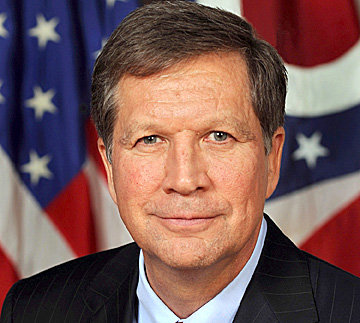
John Kasich signs pro-life parental consent bill

Gov. John Kasich
Gov. John Kasich

John Kasich, Republican governor of Ohio has signed another pro-life bill into law.

Excerpt:

Governor John Kasich of Ohio has signed into law a bill meant to strengthen the parental consent law in place that prohibits teens from getting an abortion without their parents’ consent is moving along in the legislative process.

House Bill 63 and Senate Bill 8 would revise Ohio’s current judicial bypass provision in the parental consent on abortion law. This bill will strengthen current law by requiring a “clear and convincing evidence” standard, require judges to specifically inquire about the minor’s understanding of the possible physical and emotional complications of an abortion, and require judges to question how much the minor has been prepped to respond to such questions.

[…]“We thank Governor Kasich, Senate President Tom Niehaus, and Speaker Bill Batchelder who continue to advance life-saving policies,” said Mike Gonidakis, Executive Director of Ohio Right to Life. “H.B. 63 strengthens parents’ ability to care for their children and prevents lawyers and others from taking mom and dad’s place when their child needs them most.”

[…]In July, Kasich signed into law a bill to ban late-term abortions in Ohio — something Gonidakis applauded.

“2011 has been a banner year for significant and responsible pro-life legislation.  Ohio is witnessing the blessings of having the most pro-life Governor and General Assembly in our state’s history working together to save lives,” said Gonidakis.

This is good news for pro-lifers voters in Ohio. Ohio voters were careful to choose a pro-life candidate for governor, and now they are reaping the rewards for all of their hard work. The important thing is to choose the right candidate – someone who means business on social issues.