All posts by Wintery Knight

https://winteryknight.com/

The seven fatal flaws of moral relativism

Moral relativism is the view that moral values and moral duties do not exist in reality, but only exist as opinions in people’s minds. When you ask a moral relativist where the belief that stealing is wrong comes from, he may tell you that it is his opinion, or that it is the opinion of most people in his society. But he cannot tell you that stealing is wrong independent of what people think, because morality (on moral relativism) is just personal preference.

So what’s wrong with it?

I found this list of the seven flaws of moral relativism at the Salvo magazine web site.

Here’s the summary:

  1. Moral relativists can’t accuse others of wrongdoing.
  2. Relativists can’t complain about the problem of evil.
  3. Relativists can’t place blame or accept praise.
  4. Relativists can’t make charges of unfairness or injustice.
  5. Relativists can’t improve their morality.
  6. Relativists can’t hold meaningful moral discussions.
  7. Relativists can’t promote the obligation of tolerance.

Here’s my favorite flaw of relativism (#6):

Relativists can’t hold meaningful moral discussions. What’s there to talk about? If morals are entirely relative and all views are equal, then no way of thinking is better than another. No moral position can be judged as adequate or deficient, unreasonable, acceptable, or even barbaric. If ethical disputes make sense only when morals are objective, then relativism can only be consistently lived out in silence. For this reason, it is rare to meet a rational and consistent relativist, as most are quick to impose their own moral rules like “It’s wrong to push your own morality on others”. This puts relativists in an untenable position – if they speak up about moral issues, they surrender their relativism; if they do not speak up, they surrender their humanity. If the notion of moral discourse makes sense intuitively, then moral relativism is false.

I sometimes get a lot of flack from atheists who complain that I don’t let them make any moral statements without asking them first to ground morality on their worldview. And that’s because on atheism morality IS NOT rationally grounded, so they can’t answer. In an accidental universe, you can only describe people’s personal preferences or social customs, that vary by time and place. It’s all arbitrary – like having discussions about what food is best or what clothing is best. The answer is always going to be “it depends”. It depends on the person who is speaking because it’s a subjective claim, not an objective claim. There is no objective way we ought to behave.

So, practically speaking, everyone has to decide whether right and wrong are real – objectively real. If they are objectively real, that means that there is a right way for human beings to behave, and a wrong way for human beings to behave. It means that things that are really objectively wrong like rape are wrong for all times and all places, regardless of what individuals and societies might think of it. In order to rationally ground that kind of morality, you have to have a foundation for it – a cosmic Designer who decides for all times and places what the conduct of his creatures ought to be. And then our moral duties are duties that are owed to this Designer. It is like playing football or playing a boardgame – the person who invents the game decides the rules. But if there is no designer of the game, then there are no rules.

Without a designer of the universe, the question of how we ought to act is decided by people in different times and different places. It’s arbitrary and variable, and therefore it doesn’t do the job of prescribing behavior authoritatively. It’s very important not to get involved in any serious endeavor with another person or persons if they don’t have a sense of right and wrong being absolute and fixed. A belief in objective moral values is a necessary pre-requisite for integrity.

Should the Gospel of Thomas be included in the New Testament?

Should the Gospel of Thomas be included with the four canonical gospels? Is it early? Is it the same historical genre as the four gospels? Does it give us eyewitness evidence of the life and teachings of Jesus? Here’s an article about it that references the chapter from Lee Strobel’s “The Case for the Real Jesus”.

First reason, Thomas has literary dependence on TONS of other New Testament books, which favors a date for Thomas AFTER the books it quotes:

The Gospel of Thomas Cites Too Much Of The New Testament.

Publishing writings in the first century was nothing like it is today. If you want a copy of something, you take a quill and some papyrus and you just copy it. That is how the books of the New Testament circulated. It was a very slow process. By the early second century, only a few of the books of the New Testament were in full circulation. Christians of that time only had a few of the books of the New Testament to reference. The epistles of Ignatious, written in AD 110, does not even quote half of the New Testament.

But the gospel of Thomas shows familiarity with 15 of the 27 books of the New Testament! Doctor Craig Evans pointed out that he was not aware of any Christian writing which referenced this much of the New Testament prior to AD 150. The Gospel of Thomas simply references far too many books to be dated early. But despite that, the Jesus Seminar attempts to date Thomas between AD 60 and 70.

Further, this gospel not only cites too much New Testament material. It cites the later New Testament material. Mark was not very strong in Greek grammar and etiquette, so when Matthew and Luke quoted Mark, they polished his wording. The gospel of Thomas quotes the polished wording, the later version. In fact, Thomas even has material from the gospel of John – penned in about AD 90. How can a book from AD 60 or 70 quote a book from AD 90? Thomas is not independent of the other gospels, it quotes the later ones and it is not early, it quotes too much of the New Testament to be considered early.

Second reason, Thomas shows signs of being based on a Syriac translation:

The Gospel of Thomas Shows Syrian Development.

The gospels are published in the Koine Greek language, which was the most conventiant language of that time if the goal was to spread them far and wide. But when Christianity began to spread eastward, the gospels were translated into Syriac. But this did not happen immediately.

A student of Justin Martyr named Tatian compiled a Syriac translation of the four gospels in AD 175, which was named the Diatessaron (meaning ‘through the four’). He made the four gospels available to those who spoke Syriac. What makes this significant is that the gospel of Thomas shows traces of the Syrian language forms! Indeed, the gospel of Thomas adopts concepts that were only found in the Syrian church. It refers to Thomas as Judas Thomas, which was a concept that began with the Syrian church. The Syrians did not like ascetics, wealth, businessmen, commercialism, and were interested in elitism and mysticism. Precisely everything that the Syrians were not interested in, the gospel of Thomas was not interested in, and that which they were interested in, the gospel of Thomas was interested in.

Further, and critically, if we read the gospel of Thomas in English, it sort of looks like a non-contextual group of proverbs and sayings. It is just randomly assorted. It appears randomly assorted in Koine Greek as well. But if you translate it to Syrian, it is not random at all. There are literally hundreds of catchwords in Syrian that are meant to help people memorize the gospel. There are memory aids written in Syrian. The gospel of Thomas was written in Syrian.

Two other reasons would be:

  • it contains gnostic overtones, and that movement started in the 2nd century
  • none of the early Church Fathers quote it, but they quote the four gospels and the letters of Paul, etc.

I really enjoyed the Case for the Real Jesus, and if you like audio books, you can get it as an audio book. By the way, the audio versions of the unabridged “Case For” books are read by Lee Strobel himself – HIGHLY recommended. You will not lose interest.

Is there evidence of systemic racism in the United States?

Systemic racism is the idea that people can’t lift themselves out of poverty by making good decisions, because powerful groups in society that hold the poor down, regardless of their decisions. Do you think that America is a place where no matter what choices you make, you’ll never be able to be more prosperous? That’s what the leaders of Black Lives Matter think.

Here’s what Nikole Hannah-Jones, creator of the 1619 Project, says in the New York Times (a former newspaper):

To summarize, none of the actions we are told black people must take if they want to “lift themselves” out of poverty and gain financial stability — not marrying, not getting educated, not saving more, not owning a home — can mitigate 400 years of racialized plundering.

Got that? It doesn’t matter what individual choices a non-white person takes in America, they’re going to be poor. The “systemic racism” of the powerful whites will always keep them down. Single motherhood doesn’t make people poor, and marriage doesn’t make people wealthier. Dropping out of high school doesn’t make you poor, and getting a Masters degree in computer science won’t make you wealthier.

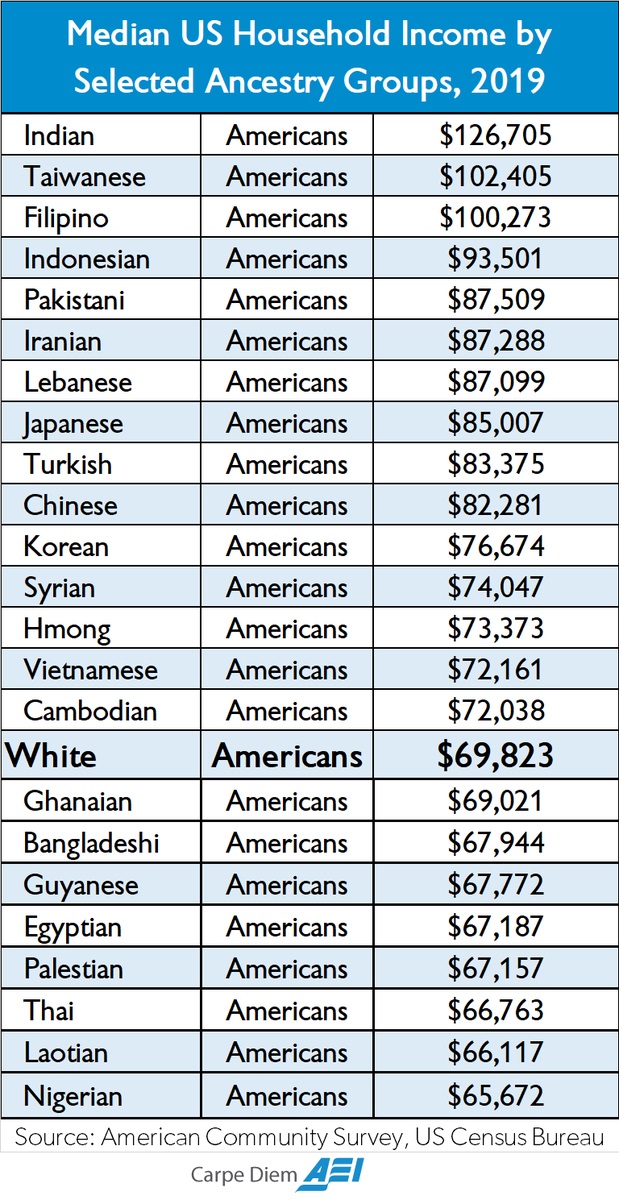
But let’s take a look at the data from the 2019 Census, and see the evidence:

Income By Ethnicity in America

White people are doing a bad job of keeping non-whites down

Well, it looks like at least SOME people of color are able to do well in America despite all the “systemic racism” that keeps non-whites down. And do you know what those non-white groups at the top have in common? They’ve made good decisions, they’ve worked hard, they haven’t blamed other people when they fail, and they’ve saved their money instead of spending it on shiny junk.

Let’s look at some decisions that the non-whites who are prosperous have made, that those further down have not.

Asians marry before they have children, so the kids have two parentsAsians marry before they have children, so the kids have two parents

Education and marriage

This article is written by the far-left radical Nicholas Kristof, writing in the radically-leftist New York Times (a former newspaper).

Excerpt:

A new scholarly book, “The Asian American Achievement Paradox,” by Jennifer Lee and Min Zhou, notes that Asian-American immigrants in recent decades have started with one advantage: They are highly educated, more so even than the average American. These immigrants are disproportionately doctors, research scientists and other highly educated professionals.

It’s not surprising that the children of Asian-American doctors would flourish in the United States. But Lee and Zhou note that kids of working-class Asian-Americans often also thrive, showing remarkable upward mobility.

[…]There’s also evidence that Americans believe that A’s go to smart kids, while Asians are more likely to think that they go to hard workers… Asian-American kids are allowed no excuse for getting B’s — or even an A-. The joke is that an A- is an “Asian F.”

One reason Asians students do so well is because their parents are usually married:

Strong two-parent families are a factor, too. Divorce rates are much lower for many Asian-American communities than for Americans as a whole, and there’s evidence that two-parent households are less likely to sink into poverty and also have better outcomes for boys in particular.

American blacks have a 73% out-of-wedlock birth rate. A huge difference compared to Asians.

So, when Nikole Hannah-Jones tells you that education and marriage don’t matter, she’s just wrong.

Compound interest

Education and marriage are important, but so is saving your money. The wealthiest people in America are typically the ones who are experts at saving money early, and investing it. They know about the law of compound interest. If you invest money early and leave it alone, then it will grow into a fortune by the time you are read to stop working.

This graph explains compound interest:

Don't trust people with non-STEM degrees to tell you how to get richInvesting $24,000 from age 21 to 41 vs investing $24000 from age 47 to 67

What does Nikole Hannah-Jones say when she looks at that graph? She doesn’t think that saving money makes a difference to having more or less wealth. She thinks skin color determines whether saving money makes you wealthy or not. The graph clearly shows what we should be recommending to young people of color. They need to stop spending money and start saving it, and the earlier the better. It doesn’t matter what your skin color is, saving money early JUST WORKS.

Similarly, when she says that home ownership doesn’t make you more wealthy, this is just terrible advice. It’s always better to pay down your own mortgage (at least when interest rates are low like they are now) than to pay someone else rent. You have to live somewhere, and paying for your own home is better because it costs about the same as rent, and then you get to keep the home when you’re done paying for it.

Communism

Nikole Hannah-Jones does have a “solution” to disparities in wealth. Her solution is communism. She wants to transfer money from those who earn, to those who don’t. But we already have tried that in the 20st century and it resulted in the deaths of over 100 million people. That’s not my opinion, that’s all documented in a book published by Harvard University Press.

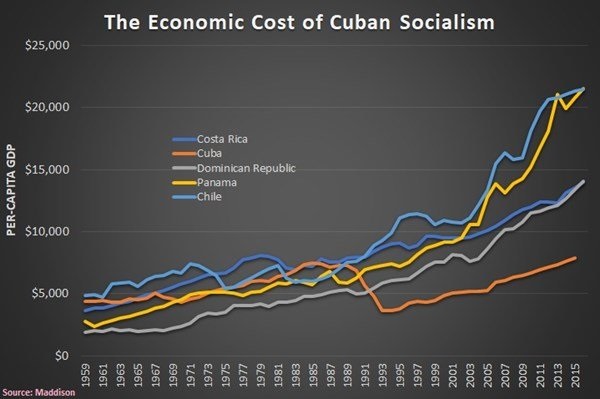
Socialism Communism Countries Per Capita GDP Income

You don’t even have to read the book to know the truth – just look at countries that score low on the Index of Economic Freedom, and compare their GDP per capita to countries that score high on the Index of Economic Freedom. The more communist a nation goes, the less wealth there is for the citizens. That’s why people in Venezuela are eating zoo animals and selling their bodies in prostitution for food, while nearby capitalist countries like Panama and Chile prosper. Nikole Hannah-Jones wants to reduce economic freedom, but we know by looking at other countries that this lowers per-capita GDP.

There’s a lot more than could be said here, but the point is that we need to be telling American blacks to make decisions that match the decisions of other successful non-white communities in America. We need to start teaching young people basic economics so they don’t fall prey to charlatans.