All posts by Wintery Knight

https://winteryknight.com/

Progressive white women report high levels of mental illness in 2020 Pew survey

I have the most amazing video for you to see. It’s a crazy left-wing activist doxing a libertarian lesbian woman wearing a breathe-through mask. First, let’s take a look at the video. Then, we’ll look at a recent survey reported by Pew Research in 2020, which assesses how mentally stable far-left feminist women are (self-reported). Then, I’ll make some comments for unmarried men.

OK, so here is the video, which was shared by the woman who was doxed. So it’s OK for me to share it, since the doxed woman didn’t care about it.

So, is this crazy woman rare? Or is she common?

Progressive white women and mental illness

Feminist web site Evie Magazine reported on the some 2020 findings by Pew Research (left-wing pollster):

A 2020 Pew Research study reveals that over half of white, liberal women have been diagnosed with a mental health condition at some point.

[T]he study, which is titled Pew American Trends Panel: Wave 64, was dated March 2020 — over a year ago.

The study, which examined white liberals, moderates, and conservatives, both male and female, found that conservatives were far less likely to be diagnosed with mental health issues than those who identified as either liberal or even “very liberal.”

[…]White women, ages 18-29, who identified as liberal were given a mental health diagnosis from medical professionals at a rate of 56.3%, as compared to 28.4% in moderates and 27.3% in conservatives.

Here’s the part of the data I thought was most interesting:
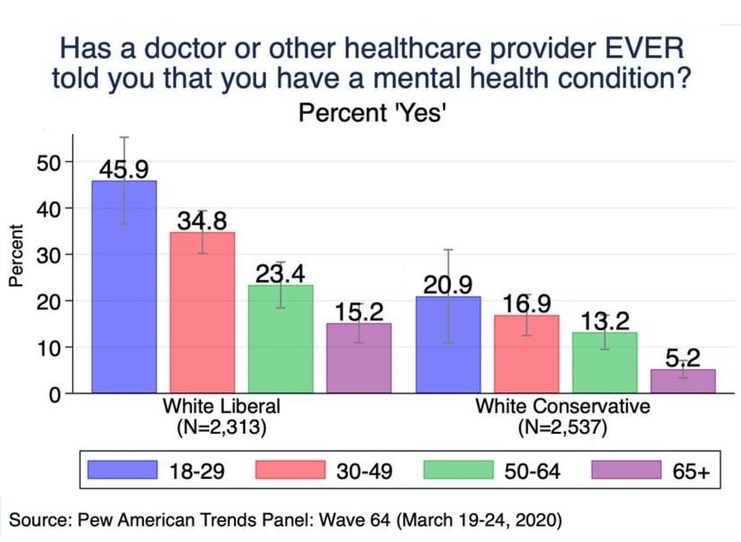
White Liberal Women

Who would marry a crazy person?

So, the point about this that I want to make is… who is going to marry these mentally ill progressive white women? Being a good wife and mother takes a certain amount of connection to reality. It takes a certain amount of empathy, compassion, and rationality. These progressive white women don’t have any of that. So, who is going to marry them? I know that there are thirsty progressive men (and thirsty conservative men who fake being progressive), who will go ahead and hit it and quit it. Pump it and dump it. But how many men would commit to someone who’s mentally ill?

And in fact, that’s exactly what we’re seeing with the marriage rates:

Marriage rates in the United States over time

That’s for America, but things are even worse in countries that have slid further toward the secular left edge of the political spectrum.

When you look at marriage rates in Canada and Europe, you understand that men are even LESS likely to choose marriage when they have to pay over 50% of what they earn in taxes. And so the marriage rate is declining. I think young, unmarried women in Canada and Europe want to raise taxes in order to get free stuff from government. Single mother welfare, food stamps, abortions, contraceptives, IVF, breast enlargements, etc. Some feminists are even asking for free cosmetic surgery. With a big enough government, they don’t have to marry at all. Big government leaves them free to play the field, without having to care about finding a good man. But what if taxes get so high that the few good men those women passed over for 40 years simply can’t afford to take on a wife and support multiple children he didn’t father? Paying for things like a stay-at-home wife and homeschooling, etc. is expensive. Men can’t afford a wife, and also pay for goodies for all the single progressive women with mental illnesses.

Conservative men want nothing to do with daycare and public schools – we know that those facilities are dominated by progressive women. And we don’t want trouble from feminist lawyers and feminist judges in the divorce courts. Divorce is very expensive for men. And we may never see our children again. Then there are the progressive white women in the workplace, who get very bitter with men as a result of getting wrecked by bad boys. Even if we find a good wife, we still have to deal with all these progressive white women with mental illnesses in positions of power. Is it worth it to take risks like this? It depends on the reward, I guess. There comes a point where the juice isn’t worth the squeeze.

Poll: few Millennials describe belief in God as “very important”

Beliefs of millennials and boomers

I saw a very interesting article that compared the attitudes of young people about things like patriotism, religion, freedom, etc. The numbers are very discouraging.

So, here’s the article from the Washington Examiner:

The importance of patriotism, faith in God, and having children is significantly lower among millennials and Generation Z, compared to previous generations.

In a new poll conducted by the Wall Street Journal and NBC News, nearly 80% of people aged 55-91 said being patriotic is important to them, while only 42% of millennials and Generation Z, or those aged 18-38, said the same. Thirty percent of millennials and Generation Z said religion was important, compared to the over 75% of baby boomers, with just over 30% of millennials and Generation Z saying it was important to have children.

Areas where the younger generations had placed higher importance compared to boomers were tolerance for others and self-fulfillment, with financial security being almost tied between the two age groups.

I’m sure that everyone has seen other polls showing the decline of Christianity, especially in mainline and Catholic churches. Evangelicals are declining less, but they are still declining.

The reason I linked to this post is because I’ve noticed that some Christians don’t really think that there is anything to be concerned about. Everything is working fine, they say. Whatever we’re doing right now must be working, because there is no decline. We’re winning, and if you think otherwise, then you’re just complaining.

Well, I don’t really know why there is this decline, all I can do is speak from my experiences. I’ve met people through my blog who did lose their faith in college, and I’ve met ex-Christians in my office, too. I asked them what the problem was, and it seems to be that when they were growing up, they often bullied into behaving like a Christian without being able to ask any questions about whether it was true. And then as soon as they got to college away from their parents and pastors, they just dumped the whole thing.

I remember listening to an amazing lecture a while back by Dr. Scott Waller. I think it was a lecture he gave for the Stand to Reason “Masters Series in Christian Thought” in 2003. The lecture was about Postmodernism in the University. Postmodernism is the view that there are no true or false views, especially with “soft” issues like religion and morality. In the lecture, he talked about how a father had sent his devout Christian son to university, and the son had returned an atheist after one semester. I remember Dr. Waller quoting the son telling his parents “I have come to think of my time growing up in this house as the dark period of my life”. The father was very upset. So Dr. Waller told him what to do. He said, you’re going to need to read a few books on the most common questions that your son has, and then work through the answers with him. And he made a little pile of books about common questions that college students ask, and pushed the pile across the table to the father. And the father pushed the books back across the table to Dr. Waller, and said “well, I don’t have time for reading so many books… but could you just talk to him instead?”

Another thing that seems to cause a lot of young people to  leave the faith in college is sex. Now if I were trying to convince someone to be responsible about sex, I’d try to show them studies and statistics to explain why there really are best practices to relationships and marriage. For example, I’d might show them that the number of premarital sex partners increases marital instability, or that sliding into cohabitation early tends to make marriages less stable. But this takes a bit of work, and you have to work through it with the young people. I just don’t know if parents really reason with their kids like this. But in churches, I’ve noticed that trying to make an argument using evidence isn’t very popular. To me, if I were trying to be convincing to someone about something, I would use evidence. It’s just natural to me to make a case if I’m trying to be persuasive. But making a case just hasn’t been a really big priority in the churches I’ve attended.

So, I guess if I had to give any advice to parents of children, or pastors in churches, it would be that Christianity is in decline, and we need to do more than just order people to memorize Bible verses and creeds, go to church, etc. It’s hard for me to know what’s really going on in everyone’s home, and in everyone’s church. But I don’t think that whatever we’re doing in our homes and churches is working to convince young people that belief in God is very important.

Two chapters from Megan Basham’s new book “Shepherds for Sale”

Megan’s new book is popular that it’s up to #11 on Amazon as of Sunday night, when I am writing this post. The book talks about how some popular evangelical pastors and teachers have aligned themselves with the secular left on issues like abortion, LGBT, immigration, global warming, health care, etc. I got the audio version, read by the author, and I’m enjoying it immensely.

So what’s in the book? Here is one article in First Things containing a sample chapter about how some evangelical pastors and leaders align themselves with the secular left on LGBT policy.

It says:

In 2000, Jon Stryker, gay heir to a one-hundred-billion-dollar surgical supply conglomerate, launched the Arcus Foundation, a grant-making institution that soon became the largest funder of LGBTQ initiatives in the United States. But after legislative defeats like the passage of a 2008 California law banning gay marriage, Stryker’s foundation began devoting tens of millions of dollars to, in its words, “challenging the promotion of narrow or hateful interpretations of religious doctrine” within every major Christian denomination.

[…]Between 2014 and 2018, the Reformation Project, a brand-new organization led by twenty-three-year-old Harvard dropout Matthew Vines, received $550,000 in grants. The purpose of the funding, according to Arcus, was to “reform church teaching on sexual orientation and gender identity among conservative and evangelical communities.”

[…]Enter Greg and Lynn McDonald. In 2015, they founded Embracing the Journey, an organization for Christian parents of LGBTQ children, at the urging of North Point’s executive director, Bill Willits. They had recently relocated to the Atlanta area and had begun attending services at the church. Over a breakfast meeting with Willits early in the year, Greg happened to share that his son had come out as gay in 2001, and he described how his and Lynn’s process of acceptance eventually led them to become informal counselors to other parents of gay and transgender kids. Willits was “captivated” by their story and revealed that North Point had already begun exploring new ministries in that vein. He urged them to film a video for Stanley’s Drive Conference that May.

As Stanley introduced the McDonalds’ video to approximately two thousand church leaders from all over the country, he urged those leaders not to view homosexuality through a “political” lens. Instead of suggesting that ministers use the Bible as their foremost frame of reference, he urged the audience to approach the issue through a “relational lens.” His example for relational was the McDonalds’ story.

And this part was interesting. As someone who has tried and tried and tried to get evidential apologetics into churches, I was astonished to see how churches approached Vines’ teaching material on LGBT:

As might be expected, given how seriously he takes his mission, Vines’s courses are far more rigorous than the kind of light, Wednesday night discussions the typical evangelical church offers on such subjects, if it offers them at all. Over a period of three months, the Reformation Project requires participants of one program to complete the equivalent of an advanced college course, all for the purpose of preparing to subvert the faithful churches Vines has called “the last stronghold of homophobia.”

When I was reading this article, I could not help but think of the episodes of Knight and Rose Show that Rose and I did about the definition of marriage, and then our interview with Dr. Frank Turek about LGBT as a whole. Naturally, our conversations were about evidence. We wanted to follow the advice of 1 Peter 3:15, and give an evidential defense of Jesus’ views on these issues, that would be convincing to non-Christians. But Andy Stanley doesn’t like evidence, he wants to be “relational”. You know, “don’t judge”.

Here’s another article in The Federalist with a sample chapter about evangelical pastors and immigration.

It says:

In January 2020, Baptist Press, the house organ of the Southern Baptist Convention, published a lie. The question is whether the outlet knew at the time that it was a lie.

The article was not attributed to any specific author and was labeled an “explainer.” It claimed to debunk reporting from the conservative news outlet Breitbart, which revealed that the Evangelical Immigration Table, a group that lobbies for various amnesty policies in the name of Jesus, was funded by left-wing, atheist billionaire George Soros. This was not a small matter because, largely under the direction of, first, Richard Land, and then Russell Moore, the SBC’s Ethics and Religious Liberty Commission had become a key leader in the EIT. Nor were Land and Moore alone. Leadership for a host of trusted evangelical organizations, including the Council for Christian Colleges and Universities, the NAE, World Relief, InterVarsity Christian Fellowship, Focus on the Family, Prison Fellowship Ministries, and the Wesleyan Church, had joined hands with the EIT. If it was being bankrolled by Soros, they would all have a lot of explaining to do.

[…]From the outset, the group focused not on encouraging Christians to meet the material and spiritual needs of immigrants in their own communities, something few would object to, but on pushing them to lobby lawmakers for specific legislation.

[…]By late 2013, the group was soliciting proposals for “mobilizers” to “activate” pastors and congregations, explaining that “81 Republicans in the House who may vote for immigration reform represent districts whose population is at least 20% evangelical Christian. Over the last year, the [EIT] has worked to engage pastors and congregants in 16 of the 20 states that are home to these districts.”

[…]The EIT’s efforts to see the bill passed began in earnest in January 2013, as the group pushed churches to join a 40-day study of cherry-picked Bible verses, titled “I Was a Stranger,” that they insisted applied to U.S. immigration law. Instead of studying the Bible, churches involved with the EIT began recruiting their congregants for political activism.

The first thing that popped into my head reading these chapters was “why haven’t evangelical churches been teaching their congregants evidence to confirm Biblical positions on issues like atheism, feminism, socialism, sexuality, Darwinian evolution, abortion, marriage and divorce, etc.” These evangelical churches seem to be fine with persuading Christians to accept the politics of the secular left. Where is the effort from these shepherds to get Christians to defend the truth claims of the Bible with evidence?

By the way, there is a good conversation on the book here with Dr. Frank Turek and Alisa Childers, and another good conversation here with Krista Bontrager and Monique Duson.