All posts by Wintery Knight

https://winteryknight.com/

Is the definition of atheism “a lack of belief in God”?

I have a key that will unlock a puzzling mystery

First, let’s see check with the Stanford University Encyclopedia of Philosophy:

‘Atheism’ means the negation of theism, the denial of the existence of God.

Stanford University is one of the top 5 universities in the United States, so that’s a solid definition. To be an atheist is to be a person who makes the claim that, as a matter of FACT, there is no intelligent agent who created the universe. Atheists think that there is no God, and theists think that there is a God. Both claims are objective claims about the way the world is out there, and so both sides must furnish forth arguments and evidence as to how they are able to know what they are each claiming.

Philosopher William Lane Craig has some thoughts on atheism, atheists and lacking belief in God in this reply to a questioner.

Question:

In my discussions with atheists, they  are using the term that they “lack belief in God”. They claim that this is different from not believing in God or from saying that God does not exist. I’m not sure how to respond to this. It seems to me that its a silly word-play and is logically the same as saying that you do not believe in God.
What would be a good response to this?
Thank you for your time,

Steven

And here is Dr. Craig’s full response:

Your atheist friends are right that there is an important logical difference between believing that there is no God and not believing that there is a God.  Compare my saying, “I believe that there is no gold on Mars” with my saying “I do not believe that there is gold on Mars.”   If I have no opinion on the matter, then I do not believe that there is gold on Mars, and I do not believe that there is no gold on Mars.  There’s a difference between saying, “I do not believe (p)” and “I believe (not-p).”   Logically where you place the negation makes a world of difference.

But where your atheist friends err is in claiming that atheism involves only not believing that there is a God rather than believing that there is no God.

There’s a history behind this.  Certain atheists in the mid-twentieth century were promoting the so-called “presumption of atheism.” At face value, this would appear to be the claim that in the absence of evidence for the existence of God, we should presume that God does not exist.  Atheism is a sort of default position, and the theist bears a special burden of proof with regard to his belief that God exists.

So understood, such an alleged presumption is clearly mistaken.  For the assertion that “There is no God” is just as much a claim to knowledge as is the assertion that “There is a God.”  Therefore, the former assertion requires justification just as the latter does.  It is the agnostic who makes no knowledge claim at all with respect to God’s existence.  He confesses that he doesn’t know whether there is a God or whether there is no God.

But when you look more closely at how protagonists of the presumption of atheism used the term “atheist,” you discover that they were defining the word in a non-standard way, synonymous with “non-theist.”  So understood the term would encompass agnostics and traditional atheists, along with those who think the question meaningless (verificationists).  As Antony Flew confesses,

the word ‘atheist’ has in the present context to be construed in an unusual way.  Nowadays it is normally taken to mean someone who explicitly denies the existence . . . of God . . . But here it has to be understood not positively but negatively, with the originally Greek prefix ‘a-’ being read in this same way in ‘atheist’ as it customarily is in . . . words as ‘amoral’ . . . . In this interpretation an atheist becomes not someone who positively asserts the non-existence of God, but someone who is simply not a theist. (A Companion to Philosophy of Religion, ed. Philip Quinn and Charles Taliaferro [Oxford:  Blackwell, 1997], s.v. “The Presumption of Atheism,” by Antony Flew)

Such a re-definition of the word “atheist” trivializes the claim of the presumption of atheism, for on this definition, atheism ceases to be a view.  It is merely a psychological state which is shared by people who hold various views or no view at all.  On this re-definition, even babies, who hold no opinion at all on the matter, count as atheists!  In fact, our cat Muff counts as an atheist on this definition, since she has (to my knowledge) no belief in God.

One would still require justification in order to know either that God exists or that He does not exist, which is the question we’re really interested in.

So why, you might wonder, would atheists be anxious to so trivialize their position?  Here I agree with you that a deceptive game is being played by many atheists.  If atheism is taken to be a view, namely the view that there is no God, then atheists must shoulder their share of the burden of proof to support this view.  But many atheists admit freely that they cannot sustain such a burden of proof.  So they try to shirk their epistemic responsibility by re-defining atheism so that it is no longer a view but just a psychological condition which as such makes no assertions.  They are really closet agnostics who want to claim the mantle of atheism without shouldering its responsibilities.

This is disingenuous and still leaves us asking, “So is there a God or not?”

So there you have it. We are interested in what both sides know and what reasons and evidence they have to justify their claim to know. We are interested in talking to people who make claims about objective reality, not about themselves, and who then go on to give reasons and evidence to support their claims about objective reality. There are atheists out there that do make an objective claim that God does not exist, and then support that claim with arguments and evidence. Those are good atheists, and we should engage in rational conversations with them. But clearly there are some atheists who are not like that. How should we deal with these “subjective atheists”?

Dealing with subjective atheists

How should theists respond to people who just want to talk about their psychological state? Well, my advice is to avoid them. They are approaching religion irrationally and non-cognitively – like the person who enters a physics class and says “I lack a belief in the gravitational force!”.  When you engage in serious discussions with people about God’s existence, you only care about what people know and what they can show to be true. We don’t care about a person’s psychology.

Dealing with persistent subjective atheists

What happens when you explain all of that to a subjective atheist who continues to insist that you listen to them repeat over and over “I lack a belief in God, I lack a belief in God”? What if you tell them to make the claim that God does not exist, and then support it with arguments and evidence, but instead they keep leaving comments on your blog telling you again and again about their subjective state of mind: “I lack a belief in cupcakes! I lack a belief in icebergs!” What if they keep e-mailing you and threatening to expose you on Twitter for refusing to listen to them, or denounce you via skywriting: “Wintery Knight won’t listen to me! I lack a belief in crickets!”. I think at this point you have to give up and stop talking to such a person.

And that’s why I moderate and filter comments on this blog. There are uneducated people out there with access to the Internet who want attention, but I am not obligated to give it to them. And neither are you. We are not obligated to listen to abusive people who don’t know what they are talking about. I do post comments from objective atheists who make factual claims about the objective world, and who support those claims with arguments and evidence. I am not obligated to post comments from people who refuse to make objective claims or who refuse to support objective claims with arguments and evidence. And I’m not obligated to engage in discussions with them, either.

Related posts

Why sexual permissiveness is not compatible with the welfare of children

A long journey through the night

Here is a striking essay from the Public Discourse. It talks about how we, as a society, have generally taken on an anything-goes approach with respect to sex. The one exception (for now) is pedophilia, which is the sexual abuse of children by adults. The essay points out that there is no moral reason for having this one exception, on secularism. The exception exists because of a sort of “ick” factor – not because we have a moral framework that makes anything right or wrong objectively. The essay argues that we are not shy about harming children in a million other ways, and lists some examples. I just want to quote a few and then I’ll comment about my own moral views around sexuality.

Quick summary of his argument:

The moral structure of pedophilia is simply this: the welfare of children is subordinate to the sexual gratification of adults.

[…]We should be thankful that the Sanduskys and Laheys are still considered monstrous. But in contemporary America that condemnation rests on sentiment and not on moral reasoning. No one can simultaneously explain why their actions were so vile and uphold the first commandment of the sexual revolution: fulfill thy desires.

[…]No, it isn’t how Sandusky and Lahey did what they did, or under what circumstances, that explains the disgust. It’s what they did—but nobody wants to acknowledge that.

The reason for that reluctance becomes clear, if we keep in mind the moral structure of pedophilia. Sexual gratification trumps. Thank goodness that for now, there aren’t many men who are sexually attracted to youngsters. In that single case, we raise the banner for the children. But in no other case.

That’s his argument.

Now, a quick excerpt:

If we altered the question, and asked not how many people have done sexually abusive things with children, but how many people have done sexual things that redounded to the suffering of children, then we might confess that the only thing that separates millions of people from Jerry Sandusky is inclination. Everything that was once considered a sexual evil and that is now winked at or cheered, everything without exception, has served to hurt children, and badly.

We might point here to divorce. Unless it is necessary to remove oneself and one’s children from physical danger and moral corruption, the old wisdom regarding divorce should hold, if children themselves have anything to say about it. Parents will say, “My children can never be happy unless I am happy,” but they should not lay that narcissistic unction to their souls. Children need parents who love them, not parents who are happy; they are too young to be asked to lay down their lives for someone else. It is not the job of the child to suffer for the parent, but the job of the parent to endure, to make the best of a poor situation, to swallow his pride, to bend her knees, for the sake of the child.

We might point to births out of wedlock. The child has a right to enter more than a little nursery decorated with presents from a baby shower. He should enter a human world, a story, a people. He should be born of a mother and a father among uncles and aunts and cousins and grandparents, stretching into the distant past, with all their interrelated histories, with his very being reflected in all those mirrors of relation, not to mention his eyes and his hair, the talents in his fingers and the cleverness in his mind. This belonging to a big and dependable world can be secured only in the context of the permanent love of his mother and father, declared by a vow before the community and before the One in whom there is no shadow of alteration.

And now my comments about this article.

So pretty much all my regular readers know that I take extremely conservative views on social issues, since I am an evangelical Protestant Christian. But I don’t just have conservative views – I am also chaste at a personal level. I am not one of these re-virgins – I have never had sex. Not once. And I don’t mean I have never had sexual intercourse only, I mean that I have never even kissed a woman on the lips. I am a radical on the issue of chastity. I don’t view chastity as depriving oneself of something good, I view it is as a thing that serious Christian men do when we want to enable and develop other capabilities. It’s my conviction that chastity enables the capability to see women as God sees them, which is a precursor to growing them up to serve him. That’s what women are for, on my view – exactly like men are for knowing and serving God. It’s my belief that once a man has premarital sex, it becomes much harder for him to view women that way.

So, I am really really really against any kind of sexual activity of any kind prior to marriage. I think that if a man wants to show affection to a woman, then sex before marriage is not the way to do that. There are other ways, and men ought to know how to speak the language of love to a woman in many different ways apart from sex, assuming that this is his goal for her. A man needs to create a context for sex before he can have it. Marriage is how a man provides a context for sex. Not just by giving a woman safety, but by specifying a shared vision which the woman agrees to support when she agrees to marriage. Men shouldn’t have intimate experiences with women who are not committed to a constructive partnership with specific goals, e.g. – birthing or adopting children in order to give them a stable, loving sane environment to grow up in. That is so rare nowadays, especially on college campuses which are inundated with sexual liberalism, thanks to radical feminism. My conviction that sex is not something that should be done before marriage emerges partly from a concern that children should have the best opportunity for that stable environment. And that’s what I want to focus on – sexual restraint as a means of providing for children and protecting children.

First, premarital sex creates a situations where abortion happens. Men and women should not engage in activities for recreational reasons that could possibility lead to the death of another human being, period. I am not one of these people who thinks “oh, poor woman who is pregnant, what a beastly man who did that to her – but she can do the right thing and keep the baby”. I think that women are equally to blame with men for even having sex before marriage – the mistake was having sex in the first place. So getting pregnant and keeping the baby is good, but preventing fatherlessness and not putting burdens on taxpayers is much, much better. People who engage in premarital sex are not only selfish, immature and irresponsible, but they are actually acting in a negligent fashion towards the child that may result from their choices. We should not make choices that put innocent children at risk. Premarital sex can be compared with driving while drunk in that regard. You might think it’s fun, but it’s not a good, moral thing to do because of the harm that may result. Saying “but I didn’t mean to” after the fact doesn’t change the harm.

Second, I’ve blogged before about many studies (like this one) that show that premarital sex reduces relationship stability, duration, and quality. Another study I blogged about showed that the number of sexual partners that a man or woman has before marriage directly affects the probability that the relationship will provide a stable environment for raising children. So one of my reasons for being chaste is to maximize the probability of giving my future children that stable environment. Another reason to be chaste is to give my future wife that gift of fidelity. When a man has proven that he has the ability to restrain himself with his wife during the courtship, that is a signal to her that he is good at self-control. The ability to court without premarital sex shows her that he is able to think about her as a person, and that he is able to evaluate her objectively for the purpose of filling the roles of wife and mother. And that this is, in fact, his whole purpose for her. A purpose that will survive the decline of her appearance and youth. Security is another gift that a chaste man gives his wife, so that she can age confidently.

Thirdly, I have in the past blogged about research on gay unions showing how various factors that are more probable in gay relationships, (e.g. – elevated rates of domestic violence, low relationship stability, drug abuse, high rates of promiscuity, etc.), undermine the stability of the environment in which children grow up. More here. Dr. Ryan Anderson has argued that the norms present in gay relationships will undermine the norms of traditional marriage, (permanence, sexual exclusivity, etc.), if marriage is redefined to eliminate the gender requirement. I think we need to keep the traditional definition of marriage because it’s better for children if we do (and there are other reasons to prefer natural marriage, as I’ve written about before).

I think I’ve said enough here to show that very often when it comes to sexual activity what is driving my conservative views is concern for others. Concern not just for the future children, but for the future wife. And not just for them, but for society as a whole, who would have to pay the social costs of things like divorce, and the social costs of children of divorce, etc. And not just for society, but also for God, who intends sexuality for a very specific purpose – it is a form of communication for two people who have been bonded to each other for life. Marriage has to count for God and achieve his goals. One of those goals is raising up children well for his sake. And adults need to control themselves in order to provide children with what they need.

State Department Inspector General: Clinton e-mail use violated Federal Records Act

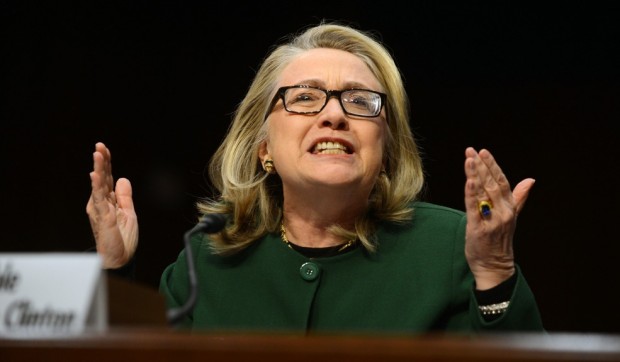
Hillary Clinton look bored about the deaths of 4 Americans who asked for her help

The Weekly Standard reports:

A State Department watchdog denounced Hillary Clinton’s lax use of a private email server Wednesday, writing that Clinton did not properly preserve correspondence and subjected herself to security risks without seeking counsel.

The report revealed that the former secretary of state did not comply with the Federal Records Act.

[…]”Secretary Clinton should have preserved any Federal records she created and received on her personal account by printing and filing those records with the related files in the Office of the Secretary,” the report said, according to Politico. “At a minimum, Secretary Clinton should have surrendered all emails dealing with Department business before leaving government service and, because she did not do so, she did not comply with the Department’s policies that were implemented in accordance with the Federal Records Act.”

[…]The IG also condemned Clinton for not seeking counsel on whether to handle work-related emails on her cell phone. Information officers “would have refused the request because of security risks,” according to the Associated Press.

NBC’s Ken Dilanian said that the IG report shows that “key information technology officials” were “not aware” of Clinton’s use of the server, though the former secretary of state’s office has claimed otherwise.

“They had never approved it, she never asked them. And they’re saying that she should have gotten approval from them, they probably wouldn’t have granted it actually,” Dilanian said.

Another Weekly Standard article lists EIGHT TIMES where Clinton said everyone knew about her private e-mail server.

And her “fact sheet” on her campaign web site says this:

“Her usage was widely known to the over 100 State Department and U.S. government colleagues she emailed, consistent with the practice of prior Secretaries of State and permitted at the time. […] The laws, regulations, and State Department policy in place during her tenure permitted her to use a non-government email for work.”

Whenever a politician says that “everyone” knows something, or “everyone” believes something, it’s a good idea to ask them for one name. Because once they give you a name, they are opening themselves up to fact-checking. This also works when you’re discussion the Christian worldview with a skeptic. Skeptic: “I have read so many smart people with so many arguments against Christianity that I can’t believe in it”. You: “OK, go ahead and name your best argument and tell me who wrote it”.

Now, the obvious question is this – why did Hillary want to have a private e-mail server? All of my e-mails are on my company’s corporate server, and if I leave, they keep them. Why? Because it is important to company business that a record be kept, in case I was taking bribes, or exchanging favors for money. Clinton decided not to let her employers see her e-mails, or have records of them. Why do you think she did that? Remember that all the time that she was Secretary of State, she was taking donations to her “Clinton Foundation” from foreign donors. Do you think that maybe she was exchanging political favors for donations, and didn’t want anyone else to have a record of her communication about that?

What difference does national security make?

Look at this article from the leftist Washington Post, of all places.

They write:

The Clinton Foundation accepted millions of dollars from seven foreign governments during Hillary Rodham Clinton’s tenure as secretary of state, including one donation that violated its ethics agreement with the Obama administration, foundation officials disclosed Wednesday.

[…]In one instance, foundation officials acknowledged they should have sought approval in 2010 from the State Department ethics office, as required by the agreement for new government donors, before accepting a $500,000 donation from the Algerian government.

[…]Some of the donations came from countries with complicated diplomatic, military and financial relationships with the U.S. government, including Kuwait, Qatar and Oman.

[…]The Washington Post reported last week that foreign sources, including governments, made up a third of those who have given the foundation more than $1 million over time. The Post found that the foundation, begun by former president Bill Clinton, has raised nearly $2 billion since its creation in 2001.

[…]Foreign governments and individuals are prohibited from giving money to U.S. political candidates, to prevent outside influence over national leaders. But the foundation has given donors a way to potentially gain favor with the Clintons outside the traditional political limits.

[…]Foreign governments had been major donors to the foundation before President Obama nominated Clinton to become secretary of state in 2009. When the foundation released a list of its donors for the first time in 2008, as a result of the agreement with the Obama administration, it disclosed, for instance, that Saudi Arabia had given between $10 million and $25 million.

[…]Qatar, for instance, spent more than $5.3 million on registered lobbyists while Clinton was secretary of state, according to the Sunlight Foundation.The country’s lobbyists were reported monitoring anti-terrorism activities and efforts to combat violence in Sudan’s Darfur region. Qatar has also come under criticism from some U.S. allies in the region that have accused it of supporting Hamas and other militant groups. Qatar has denied the allegations.

Now I know that Hillary Clinton says that she is very concerned about women’s rights, but then one has to wonder how well she translates those happy sounding words in her speeches into actions with these nations like Saudi Arabia. I don’t think that the women in these countries saw much help from Hillary when she was Secretary of State.