All posts by Wintery Knight

https://winteryknight.com/

Psychiatrist Paul McHugh explains the troubles with transgender activism

Lets take a closer look at a puzzle

In the Wall Street Journal.

Excerpt:

The transgendered suffer a disorder of “assumption” like those in other disorders familiar to psychiatrists. With the transgendered, the disordered assumption is that the individual differs from what seems given in nature—namely one’s maleness or femaleness. Other kinds of disordered assumptions are held by those who suffer from anorexia and bulimia nervosa, where the assumption that departs from physical reality is the belief by the dangerously thin that they are overweight.

With body dysmorphic disorder, an often socially crippling condition, the individual is consumed by the assumption “I’m ugly.” These disorders occur in subjects who have come to believe that some of their psycho-social conflicts or problems will be resolved if they can change the way that they appear to others. Such ideas work like ruling passions in their subjects’ minds and tend to be accompanied by a solipsistic argument.

For the transgendered, this argument holds that one’s feeling of “gender” is a conscious, subjective sense that, being in one’s mind, cannot be questioned by others. The individual often seeks not just society’s tolerance of this “personal truth” but affirmation of it. Here rests the support for “transgender equality,” the demands for government payment for medical and surgical treatments, and for access to all sex-based public roles and privileges.

With this argument, advocates for the transgendered have persuaded several states—including California, New Jersey and Massachusetts—to pass laws barring psychiatrists, even with parental permission, from striving to restore natural gender feelings to a transgender minor. That government can intrude into parents’ rights to seek help in guiding their children indicates how powerful these advocates have become.

How to respond? Psychiatrists obviously must challenge the solipsistic concept that what is in the mind cannot be questioned. Disorders of consciousness, after all, represent psychiatry’s domain; declaring them off-limits would eliminate the field. Many will recall how, in the 1990s, an accusation of parental sex abuse of children was deemed unquestionable by the solipsists of the “recovered memory” craze.

You won’t hear it from those championing transgender equality, but controlled and follow-up studies reveal fundamental problems with this movement. When children who reported transgender feelings were tracked without medical or surgical treatment at both Vanderbilt University and London’s Portman Clinic, 70%-80% of them spontaneously lost those feelings. Some 25% did have persisting feelings; what differentiates those individuals remains to be discerned.

We at Johns Hopkins University—which in the 1960s was the first American medical center to venture into “sex-reassignment surgery”—launched a study in the 1970s comparing the outcomes of transgendered people who had the surgery with the outcomes of those who did not. Most of the surgically treated patients described themselves as “satisfied” by the results, but their subsequent psycho-social adjustments were no better than those who didn’t have the surgery. And so at Hopkins we stopped doing sex-reassignment surgery, since producing a “satisfied” but still troubled patient seemed an inadequate reason for surgically amputating normal organs.

It now appears that our long-ago decision was a wise one. A 2011 study at the Karolinska Institute in Sweden produced the most illuminating results yet regarding the transgendered, evidence that should give advocates pause. The long-term study—up to 30 years—followed 324 people who had sex-reassignment surgery. The study revealed that beginning about 10 years after having the surgery, the transgendered began to experience increasing mental difficulties. Most shockingly, their suicide mortality rose almost 20-fold above the comparable nontransgender population. This disturbing result has as yet no explanation but probably reflects the growing sense of isolation reported by the aging transgendered after surgery. The high suicide rate certainly challenges the surgery prescription.

We seem to have this popular idea in our culture now that the loving thing to do in every case is to just affirm whatever anyone feels like doing. Want to have sex-reassignment surgery? No problem. Want to be surgically altered to look like a cat? No problem. Want to have an amputation because you don’t like your arm? No problem. Want to have taxpayer-provided heroine injected by nurses? No problem. Want to adopt a lifestyle that involves having risky sex with hundreds of unprotected partners? We’ll wave a rainbow flag for you. Want to get drunk and have sex before you (and they) have even graduated high school? Here are free condoms and free abortions to fix anything that might go wrong.

The really, really bad thing that we must never, ever do, apparently, is to tell someone “it’s wrong”.

I am really struggling to understand why telling people NOT to do things that are bad for them is a bad thing. I set boundaries on myself to keep myself out of trouble. Why can’t I let other people know what they are? Why do I have to pay taxes so that other people can afford to do risky and/or immoral things that I would never do?

Democrat operative resigns after being exposed by Project Veritas hidden cam sting

Let’s talk about the videos. There are two so far that have been released, with more to come.

The first video is about Democrats manufacturing violence at Trump rallies. (Warning: vulgar language)

Description:

Published on Oct 17, 2016

In this explosive new video from Project Veritas Action, a Democratic dirty tricks operative unwittingly provides a dark money trail to the DNC and Clinton campaign. The video documents violence at Trump rallies that is traced to the Clinton campaign and the DNC through a process called birddogging.

Video:

The second video is about Democrats engaging in voter fraud. (Warning: vulgar language)

Description:

Published on Oct 18, 2016

In the second video of James O’Keefe’s new explosive series on the DNC and Hillary Clinton campaign, Democratic party operatives tell us how to successfully commit voter fraud on a massive scale. Scott Foval, who has since been fired, admits that the Democrats have been rigging elections for fifty years.

Video:

When O’Keefe mentioned that he was going to post these videos, Twitter suspended O’Keefe’s Twitter account. He was able to get it reactivated after a massive landslide of complaints by his supporters.

Google, a far-left organization that censors conservatives, decided to keep this video off of their YouTube Trending section.

O’Keefe tweeted:

Google censors O'Keefe video from YouTube Trending section
Google censors O’Keefe video from U.S. YouTube Trending section

(Click for larger image)

I personally verified this on Tuesday afternoon, confirming that videos with far fewer hits (around 100,000 views) were listed in the trending section, but not O’Keefe’s first sting video, which had over 2.6 million views in only 24 hours . The page view count is much higher now: 3.4 million for the first video, and 564K for the second video, as of Tuesday night.

What about leftist CNN?

Well, I have blogged about CNN’s record of supporting the Democrats with biased coverage dozens of times on this blog. But there is one person at CNN who is not a complete hack, and that’s Anderson Cooper. He covered the videos on Tuesday night:

Anderson Cooper covers James O'Keefe video on CNN
Anderson Cooper covers James O’Keefe video on CNN

And the story was actually posted on CNN at the time that I was writing this post:

A Democratic operative whose organization was helping Hillary Clinton’s campaign announced Tuesday that he would be “stepping back” from the campaign after an edited video suggested that he and other staffers hired people to attend Donald Trump’s campaign rallies and incite violence.

Robert Creamer — husband of Illinois Rep. Jan Schakowsky — announced his resignation in a statement after conservative activist James O’Keefe released a video under his organization Project Veritas Action, which showed Creamer and other operatives purportedly discussing methods for inciting violence at rallies for the Republican nominee.

[…]Creamer was helping the Democratic National Committee with Clinton’s campaign while working for Democracy Partners, a progressive consulting group. He is also the head of a group called Mobilize, which contracted with the DNC.

[…]He confirmed that he was referring to the Clinton campaign, with which he was “fully integrated.”

[…]”I mean, honestly, it’s not hard to get some of these a——- to pop off,” [Scott] Foval purportedly says at one point in the video. “It’s a matter of showing up, to want to get into their rally, in a Planned Parenthood T-shirt. Or ‘Trump is a Nazi,’ you know. You can message to draw them out, and draw them out to punch you.”

In the past, Cooper has responded to calls by conservatives to cover stories that are only being covered by individual bloggers, conservative talk shows, and maybe Fox News Channel.

Sean Carroll debates William Lane Craig on cosmology and God’s existence

British Spitfire and German Messerschmitt Me 109 locked in a dogfight

Here’s the video of the debate:

Carroll was as good of a speaker as Craig in terms of style. Very easy to listen to, very quick on his feet, very civil. There was no clear winner on style.

It was difficult to assess the truth value of scientific points being made, especially for the layperson. I explained a few of them in my posts earlier this week, but I think laypeople might struggle with them if they are hearing about these things for the first time.

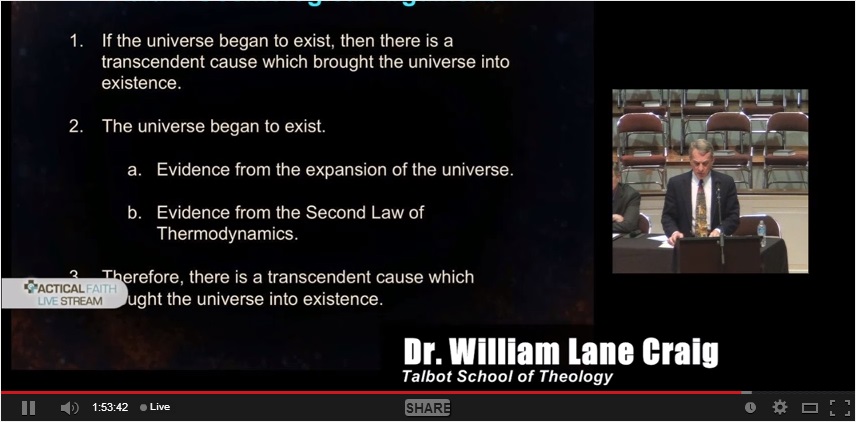
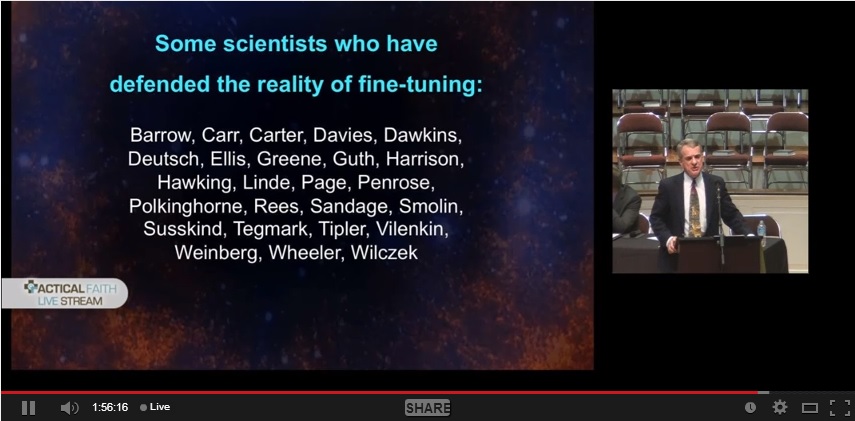
A couple of Craig’s slides: (click for larger images)

Slide 1 of 2:

Dr. Craig slide #1 of 2

Slide 2 of 2:

Dr. Craig slide #2 of 2

Quick summary: (this is not complete, because I couldn’t get everything they were saying noted)

Dr. Craig defended two arguments: 1) the kalam cosmological argument and the fine-tuning argument.

Dr. Craig supported the origin of the universe with 1) the expansion of the universe and 2) the second law of thermodynamics.

Dr. Craig said that the BGV theorem supports a beginning for the universe.

Dr. Craig said that the consensus of scientists did not accept Carroll’s naturalistic cosmology, quoting Stephen Hawking in support.

Dr. Craig said that multiverse models fall victim to the Boltzmann brain problem, where we should observe Boltzmann brains coming into existence and then phasing out again far more probably than embodied minds. But we observe embodied minds, and no Boltzmann brains.

Dr. Carroll said that science cannot study metaphysical questions.

Dr. Carroll said that science is about making models that may or may not be consistent with the experimental data.

Dr. Carroll said that the BGV theorem does not support a beginning for the universe.

Dr. Carroll proposed 17 alternative cosmologies, but did not provide a shred of scientific evidence for any of them, the way that Craig did for the standard model.

Dr. Carroll refuted Dr. Craig’s citation of Stephen Hawking, and Craig yielded the point.

Dr. Carroll speculated that science might progress to the point where the fine-tuning can be explained without an intelligent cause, and he gave an example of where that happened (inflation).

Dr. Craig argued that all 17 of the models suggested by Carroll either conflicted with evidence, had serious problems or did require a beginning.

Dr. Craig argued that Carroll’s own model required a beginning.

Dr. Craig argued that Carroll’s own model fell victim to the Boltzmann brain problem.

Dr. Craig argued that Carroll’s own model violated the second law of thermodynamics.

Dr. Craig re-stated his point that the baby universe spawning in Carroll’s model was speculative and incomplete, and cited Christopher Weaver’s work.

Dr. Carroll denied that things that pop into being out of nothing require a transcendent cause.

Dr. Carroll reiterated that science can only make naturalistic models, and that he did not have to answer questions about ultimate causes.

Dr. Carroll showed a photo of Alan Guth expressing his opinion that the universe is “probably” eternal. No evidence was given for this assertion.

Dr. Carroll said that the fine-tuning was not done in an optimal way, because one fine-tuned value was lower than it needed to be, and it should be exactly what it needed to be if God did it.

Dr. Carroll said that a finely-tuned universe is more probably in naturalism than in theism, because God can do anything he wants and doesn’t need a fine-tuned universe.

Dr. Carroll said he would stop defending his model now, and would instead defend Aguirre-Gratton.

Dr. Craig gave three reasons why the universe popping into being out of nothing requires a transcendent cause.

First, he said that nothing cannot cause anything to happen, because nothing is nothing.

Second, he said that if things pop into being out of nothing, then why don’t we see it happening all the time with other things.

Third, he said that we have no reason to dismiss the causal principle, especially when it is the basis of scientific inquiry and has been so fruitful in the progress of science.

Dr. Craig reiterated that baby universes in Carroll’s model would be dominated by Boltzmann brains, and we don’t observe that.

Dr. Craig said that even on the quantum gravity models that Carroll mentioned, there would still be a beginning.

Dr. Carroll said that Craig mustn’t say “popped into being” but instead that “there was a first moment of time”.

Dr. Carroll said that his model does indeed violate the second law of thermodynamics “YES!”.

At this point Carroll stopped talking about the topic of the debate and started expressing personal opinions about religion. It’s funny how often atheists do this in debates.

Dr. Carroll said that most theists don’t believe in God because of cosmology, but because of community and feelings.

Dr. Carroll said that science had learned a lot in the last 2000 years, so theism was false.

Dr. Carroll said that most philosophers don’t think that God exists, so theism was false.

Dr. Carroll said microscopes and telescopes were absent 2000 years ago, so theism was false.

Dr. Carroll said that religion should be about community and feelings, not about what is true.

Conclusion:

My conclusion was that Carroll lost because he is just satisfied to throw theories out and not to argue that they are true by citing evidence. Carroll never seemed to be interested in finding out what is true, but instead he just wanted to tell a story that didn’t include God, and assert that by Occam’s Razor, his story was a better explanation. I am not impressed with theoretical speculations, although the layperson might be. I kept waiting for him to respond to Craig’s points about how his model was falsified by experimental evidence and observations, e.g. – the Boltzmann brains or the baby universe generation, and he never cited the evidence I wanted him to cite. Craig did have some evidence for his views, but he could have been stronger in making his case. He could have shown the e-mail from Vilenkin that stated that he had understood the BGV theorem, and was using it correctly, for example.

For me the winning side comes down to evidence. The standard model is the standard model because of scientific evidence. Until that evidence is overturned, then speculative models are of no interest to anyone who is evidence-driven. Speculations are not science. A philosophical presupposition of metaphysical naturalism is not science.

If you want to see a good lecture on scientific evidence related to cosmology, then there is the particle physicist Michael Strauss lecture on cosmology and fine-tuning at Stanford University and his more recent lecture at the University of Texas. Note that Strauss is an experimental physicist, not a theoretical physicist like Carroll.

Here’s another review of the debate by Randy Everist of Possible Worlds blog. He explains the back-and-forth over Boltzmann brains and the BGV theorem in more detail.