
A lesson about men for marriage-minded women from the movie “High Noon”

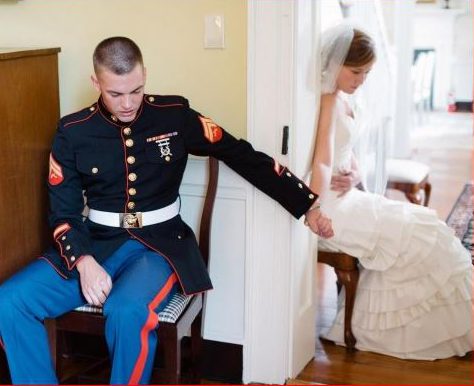
Marine prays with his wife on their wedding day

One of my favorite movies for explaining the differences between men and women is “High Noon” (1952).

Here’s the summary from IMDB:

Former marshal Will Kane (Gary Cooper) is preparing to leave the small town of Hadleyville, New Mexico, with his new bride, Amy (Grace Kelly), when he learns that local criminal Frank Miller has been set free and is coming to seek revenge on the marshal who turned him in. When he starts recruiting deputies to fight Miller, Kane is discouraged to find that the people of Hadleyville turn cowardly when the time comes for a showdown, and he must face Miller and his cronies alone.

The main theme of the film concerns Amy’s decision to break her wedding vows the very day that she makes them. She tells her new husband that he must bow to her will, and give up his male role as protector. When he explains his reasons for standing his ground to her practically (Miller will hunt them down) and morally (he has a duty protect the town), she dismisses both. She tells him that if he doesn’t run away from Miller and his gang with her, that she will get on the train and leave town by herself.

The intro of film shows the member’s of Miller’s gang assembling, and the words of the song explain the central conflict between husband and wife:

Here’s the part of the lyrics we care about:

The noonday train will bring Frank Miller.
If I’m a man I must be brave
And I must face that deadly killer
Or lie a coward, a craven coward,
Or lie a coward in my grave.

O to be torn ‘twixt love and duty!
S’posin’ I lose my fair-haired beauty!
Look at that big hand move along
Nearin’ high noon.

He made a vow while in State’s Prison,
Vow’d it would be my life or his’n
I’m not afraid of death, but O,
What will I do if you leave me?

Do not forsake me O my darlin’
You made that promise when we wed.
Do not forsake me O my darlin’
Although you’re grievin’, I can’t be leavin’
Until I shoot Frank Miller dead.

What’s interesting is that his new wife Amy apparently does not understand the meaning of wedding vows or the natural roles of good men as protectors of the weak, and fighters against evil. Although she vowed to stick by him and help him, the minute anything threatening appears that makes her feel unhappy, she abandons her vows and abandons her man. Let’s break down her mistakes now, using actual conversations from the movie.

First, she doesn’t understand or respect the man she married as a man:

Kane: [while riding out of town] It’s no good. I’ve got to go back, Amy.

Amy: Why?

Kane: This is crazy. I haven’t even got any guns.

Amy: Then let’s go on. Hurry.

Kane: No, that’s what I’ve been thinkin’. They’re making me run. I’ve never run from anybody before.

Amy: I don’t understand any of this.

Kane: [after looking at his vest watch] Well, I haven’t got time to tell ya.

Amy: Then don’t go back, Will.

Kane: I’ve got to. That’s the whole thing. [He turns the buggy around and rides back into town]

Her feelings and her desires for the world to be a happy place for her are so strong that they cloud her judgment.

Second, she doesn’t understand the threat posed by evil men:

More:

Kane: I sent a man up five years ago for murder. He was supposed to hang. But up North, they commuted it to life and now he’s free. I don’t know how. Anyway, it looks like he’s coming back.

Amy: I still don’t understand.

Kane: He was always wild and kind of crazy. He’ll probably make trouble.

Amy: But that’s no concern of yours, not anymore.

Kane: I’m the one who sent him up.

Amy: Well, that was part of your job. That’s finished now. They’ve got a new marshal.

Kane: He won’t be here until tomorrow. Seems to me I’ve got to stay. Anyway, I’m the same man with or without this. [He pins his badge on his vest]

Amy: Oh, that isn’t so.

Kane: I expect he’ll come lookin’ for me. Three of his old bunch are waiting at the depot.

Amy: That’s exactly why we ought to go.

Kane: They’ll just come after us, four of ’em, and we’d be all alone on the prairie.

Amy: We’ve got an hour.

Kane: What’s an hour?…What’s a hundred miles? We’d never be able to keep that store, Amy. They’d come after us and we’d have to run again, as long as we live.

Amy: No we wouldn’t, not if they didn’t know where to find us. Oh Will! Will, I’m begging you, please let’s go.

Kane: I can’t.

Amy: Don’t try to be a hero. You don’t have to be a hero, not for me.

Kane: I’m not trying to be a hero. If you think I like this, you’re crazy.

Instead of recognizing how her feelings are deceiving her about the threat and trusting her husband, she tries to force him to accept her mistaken view of reality by threatening to abandon him.

One of Kane’s ex-girlfriends has a talk with Amy, which helps her to understand who Kane is, and what is expected of her:

Amy: That man downstairs, the clerk, he said things about you and Will. I’ve been trying to understand why he wouldn’t go with me, and now all I can think of is that it’s got to be because of you…Let him go, he still has a chance. Let him go.

Helen: He isn’t staying for me. I haven’t spoken to him for a year – until today. I am leaving on the same train you are…What kind of woman are you? How can you leave him like this? Does the sound of guns frighten you that much?

Amy: I’ve heard guns. My father and my brother were killed by guns. They were on the right side but that didn’t help them any when the shooting started. My brother was nineteen. I watched him die. That’s when I became a Quaker. I don’t care who’s right or who’s wrong. There’s got to be some better way for people to live. Will knows how I feel about it.

Helen: I hate this town. I always hated it – to be a Mexican woman in a town like this.

Amy: I understand.

Helen: You do? That’s good. I don’t understand you. No matter what you say. If Kane was my man, I’d never leave him like this. I’d get a gun. I’d fight.

Amy: Why don’t you?

Helen: He is not my man. He’s yours.

Helen understands the need for a wife to stand by her man. But Amy’s response to evil is to shut her eyes and focus on feeling good and being happy. Notice that her “better way” is unspecified – it’s just a feeling she has that pacificism and no-violence will somehow “work” to stop evil. But in reality, pacifism is not a “better way” of dealing with evil – it does not work. Her pacifist response not only does not make evil go away, it actually encourages more evil. Weakness emboldens evildoers, and laying down your arms provokes them to do more evil. Will Kane knows this, but she won’t listen to him.

You can watch the final gunfight here, as well as Amy’s final decision:

So, this is why I really recommend this movie as a discussion-starter when you like a girl and are thinking of marrying her. It clarifies the essential problem with many young women today not being ready for marriage. To be fair, most women come around to respect their husbands and his different roles after they get married. However, the risk of divorce is so dangerous that it makes sense to bring it up for discussion before the marriage happens. Marriage is supposed to be an engine to serve God, and the success of that enterprise cannot be left to chance. You can’t just rely on the fact that she says the words of the vow, you have to check to see if she has a habit of keeping her promises when it goes against her own self-interest.

Ask yourself: Who are you, as a man? And does your woman accept that you have obligations to stand up to evil and do good ? Will she support you in your battle against evil, or will the marriage just be about her feelings and desires? I would especially beware of women who think that God is speaking to them through their feelings and desires. Look at her friends: are they practical and successful? Or are they irresponsible, unaccountable and reckless? Look at her father: does he have a plan for her, and does he lead her to be practical, frugal and hard-working? If you are not going to get an ally and a supporter in a wife, then you will not be able to serve God well, as a married man. Think about it.

The psychological motivation of those who embrace postmodernism

Can a person be postmodern and a Christian? Not for long

Famous analytical philosopher John Searle has written a book “Mind, Language And Society: Philosophy In The Real World”, explaining what’s factually wrong with postmodernism. In the introduction, he explains what postmodernism is, and what motivates people to accept postmodernism.

He writes:

[…][W]hen we act or think or talk in the following sorts of ways we take a lot for granted: when we hammer a nail, or order a takeout meal from a restaurant, or conduct a lab experiment, or wonder where to go on vacation, we take the following for granted: there exists a real world that is totally independent of human beings and of what they think or say about it, and statements about objects and states of affairs in that world are true or false depending on whether things in the world really are the way we say they are. So, for example, if in pondering my vacation plans I wonder whether Greece is hotter in the summer than Italy, I simply take it for granted that there exists a real world containing places like Greece and Italy and that they have various temperatures. Furthermore, if I read in a travel book that the average summer temperature in Greece is hotter than in Italy, I know that what the book says will be true if and only if it really is hotter on average in the summer in Greece than in Italy. This is because I take it for granted that such statements are true only if there is something independent of the statement in virtue of which, or because of which, it is true.

[…]These two Background presuppositions have long histories and various famous names. The first, that there is a real world existing independently of us, I like to call “external realism.” “Realism,” because it asserts the existence of the real world, and “external” to distinguish it from other sorts of realism-for example, realism about mathematical objects (mathematical realism) or realism about ethical facts (ethical realism). The second view, that a statement is true if things in the world are the way the statement says they are, and false otherwise, is called “the correspondence theory of truth.” This theory comes in a lot of different versions, but the basic idea is that statements are true if they correspond to, or describe, or fit, how things really are in the world, and false if they do not.

The “correspondence theory of truth” is the view of truth assumed in books of the Bible whose genre is such that that they were intended by the authors to be taken literally, (with allowances for symbolism, figures of speech, metaphors, hyperbole, etc.).

But what about the postmodernists, who seek to deny the objectivity of external reality?

More Searle:

Thinkers who wish to deny the correspondence theory of truth or the referential theory of thought and language typically find it embarrassing to have to concede external realism. Often they would rather not talk about it at all, or they have some more or less subtle reason for rejecting it. In fact, very few thinkers come right out and say that there is no such thing as a real world existing absolutely, objectively, and totally independently of us. Some do. Some come right out and say that the so-called real world is a “social construct.”

What is behind the denial of objective reality, and statements about external reality that are warranted by evidence?

It is not easy to get a fix on what drives contemporary antirealism, but if we had to pick out a thread that runs through the wide variety of arguments, it would be what is sometimes called “perspectivism.” Perspectivism is the idea that our knowledge of reality is never “unmediated,” that it is always mediated by a point of view, by a particular set of predilections, or, worse yet by sinister political motives, such as an allegiance to a political group or ideology. And because we can never have unmediated knowledge of the world, then perhaps there is no real world, or perhaps it is useless to even talk about it, or perhaps it is not even interesting.

Searle is going to refute anti-realism in the rest of the book, but here is his guess at what is motivating the anti-realists:

I have to confess, however, that I think there is a much deeper reason for the persistent appeal of all forms of antirealism, and this has become obvious in the twentieth century: it satisfies a basic urge to power. It just seems too disgusting, somehow, that we should have to be at the mercy of the “real world.” It seems too awful that our representations should have to be answerable to anything but us. This is why people who hold contemporary versions of antirealism and reject the correspondence theory of truth typically sneer at the opposing view. 

[…]I don’t think it is the argument that is actually driving the impulse to deny realism. I think that as a matter of contemporary cultural and intellectual history, the attacks on realism are not driven by arguments, because the arguments are more or less obviously feeble, for reasons I will explain in detail in a moment. Rather, as I suggested earlier, the motivation for denying realism is a kind of will to power, and it manifests itself in a number of ways. In universities, most notably in various humanities disciplines, it is assumed that, if there is no real world, then science is on the same footing as the humanities. They both deal with social constructs, not with independent realities. From this assumption, forms of postmodernism, deconstruction, and so on, are easily developed, having been completely turned loose from the tiresome moorings and constraints of having to confront the real world. If the real world is just an invention-a social construct designed to oppress the marginalized elements of society-then let’s get rid of the real world and construct the world we want. That, I think, is the real driving psychological force behind antirealism at the end of the twentieth century.

Now, I’ll go one step further than Searle.

People, from the Fall, have had the desire to step into the place of God. It’s true that we creatures exist in a universe created and designed by God. But, there is a way to work around the fact that God made the universe and the laws that the universe runs on, including logic, mathematics and natural laws. And that way is to deny logic, mathematics and natural laws. Postmodernists simply deny that there is any way to construct rational arguments and support the premises with evidence from the real world. That way, they imagine, they are free to escape a God-designed world, including a God-designed specification for how they ought to live. The postmoderns deny the reliable methods of knowing about the God-created reality because logic and evidence can be used to point to God’s existence, God’s character, and God’s actions in history.

And that’s why there is this effort to make reality “optional” and perspectival. Everyone can be their own God, and escape any accountability to the real God – the God who is easily discovered through the use of logic and evidence. I believe that this is also behind the rise of atheists, who feign allegiance to logic and science, but then express “skepticism” about the origin of the universe, the fine-tuning of the universe, objective morality, the minimal facts concerning the historical Jesus, and other undeniables.

Why did European countries import millions of unskilled Muslim immigrants?

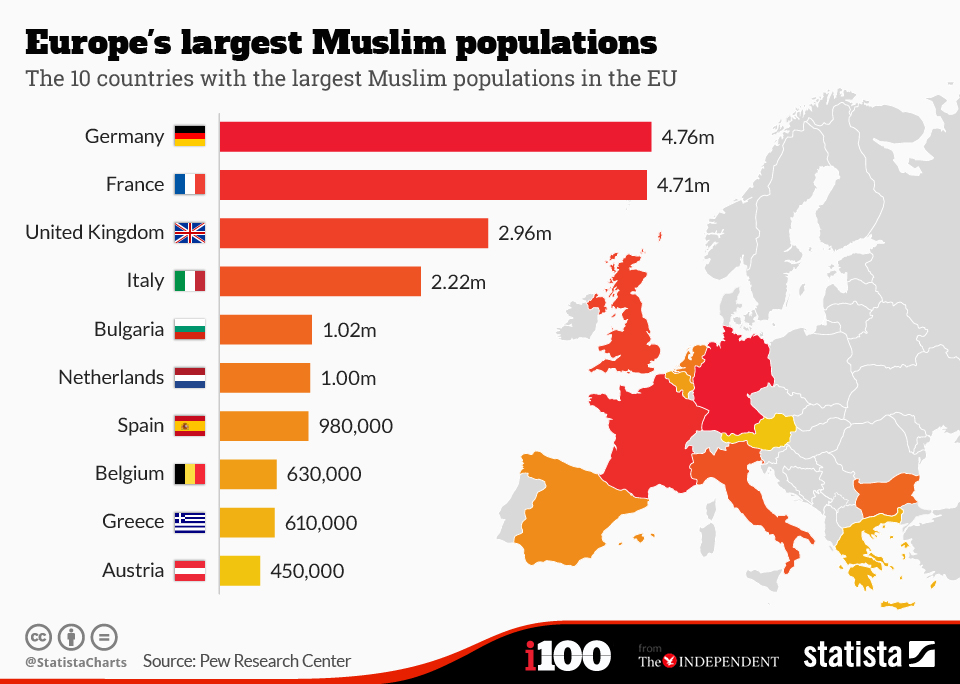
Muslim populations in Europe

As you can see in the right column of the blog, I am currently reading a book recommended to me that Dina, my wise advisor. The book is amazing. I want to put it in the hands of all the naive, leftist Christian leaders and Republicans who favor amnesty, and not building a border wall. If I can’t convince you to read the book right now, at least take a look at this review of it in The Federalist.

Excerpt:

The Strange Death of Europe” is a polemical but perceptive book culled from Murray’s extended sojourns across Europe’s frontiers – from the Italian island of Lampedusa, a flyspeck in the Mediterranean closer to the shores of North Africa than it is to Sicily, and to Greek islands that sit within sight of the Turkish coastline. These places have borne the brunt of the recent exodus from the Middle East and North Africa, but the author has also ventured to the remote suburbs of Scandinavia and Germany and France where many of these ­migrants end up. The resulting portrait is not a happy one.

[…]The distinguishing feature of modern Europe is its persistent ennui, shown in the inability or unwillingness “to reproduce itself, fight for itself or even take its own side in an argument.” What’s more, Europeans seem less stirred to face these unpleasant facts than they are fearful of interpreting them too precisely.

The book analyzes how the secular left “argued” for more immigration of low-skilled Muslims from countries that do not accept Western views on things like the respectful treatment of women.

The never-slacking thirst among Europe’s political class for more immigration has rested on two flawed assumptions, one economic and the other normative (and usually in that order). The economic assumption cites the benefits of immigration without accounting for its costs, and seldom acknowledges that benefits accrue chiefly to the migrants themselves and to highly compensated native inhabitants. Most of the rest of society is left to foot the bill for this immense regressive redistribution of wealth from the poor (who are squeezed out of the labor force) to the rich (who benefit from cheap labor).

Any public concerns about the financial downsides of this immigration – from increased pressure on housing markets to depressed wages – have been swept aside in deference to Europe’s dwindling fertility rates. (In a classic instance of one erroneous public policy begetting another, Murray shrewdly notes that the political left encouraged a “one-child policy” in order to attain an “optimum global population” only later to demand mass immigration in order to lift birthrates back to replacement levels.) The problem of Europe’s birth dearth is very real. The working-age population of Western Europe peaked in 2012 at 308 million – and is set to decline to 265 million by 2060.

So how will immigration schemes alleviate Europe’s fertility-driven strain on the welfare state? It is not clear that they will. Advocates of the rejuvenating effects of immigration are seldom obliged to spell out the wisdom of importing the poor and dispossessed of the world who generally lack the skills required for success in an advanced market economy. Can these migrants reliably be expected to contribute more in taxes than they consume in state aid? (They wouldn’t be alone in their dependence on government largesse: plenty of native workers, too, are struggling mightily to cope with the creative destruction unleashed by the march of globalization and technology.)

When advocates of open borders are pressed on these points, they generally repair to the normative argument. It has been claimed that when a flood of migrants started to pile up at Europe’s frontiers in 2015, the issue ceased to be economic and instead became moral: tending to the needs of beleaguered strangers. Thus Europe’s longstanding debate over immigration suddenly transformed into a contest between head and heart, and in a stampede of sanctimony it was decided that soft-heartedness was better hard-headedness.

What was amazing to me, is that people from these Islamic countries were able to just walk in to Europe and claim asylum. This put them on an immediate path to citizenship. Since there were so many people coming, their claims were not vetted. The immigrants would destroy their own identity documents after arriving in Europe, and then claim to be coming from whatever nation had a war going on, e.g. from Syria. Even if they could not speak any Syrian, they would still be let in and put on a path to citizenship! Incredible.

I have to include this:

After the 7/7 bombings in London, polls revealed that 68 percent of British Muslims believe that British citizens who “insult Islam” should be arrested and prosecuted.

See, no problem at all integrating into Western civilization. It’s not like their just going to start raping and murdering 14-year-old Jewish girls, or start up underage sex-trafficking rings. But the people making the immigration policy don’t care about public safety. They want to appear compassionate. And they do it by spending other people’s money and by risking other people’s safety. There is no concern for the money and safety of taxpayers, the important thing is that the politicians feel good about themselves. They’re better than the people who they stick with the bill. Or the people they stick with the machete. I know that compassionate leftists like Russell Moore want me to think that they are good people, but I don’t. Because I always think of the victims of their compassion. Anyone who votes for more immigration without oversight and accountability is responsible for the harm.

For me, the most interesting part of the book was not about why secular leftist politicians decided to open up the borders, how many Muslim immigrants commit crimes against their welcoming hosts, how European activists subvert the law to welcome in more immigrants (including lying about their own rapes at the hands of Muslim refugees, to cover for the rapist), or how the police cover up crimes committed by Muslim refugees and immigrants. The most interesting part was how anyone who tries to make public safety or fiscal arguments against the mass importation of low-skilled Muslims was vilified. Careers were ended. Reputations were ruined. And then the Muslims themselves would launch lawsuits or take more violent, and even murderous, measures to silence their critics.