
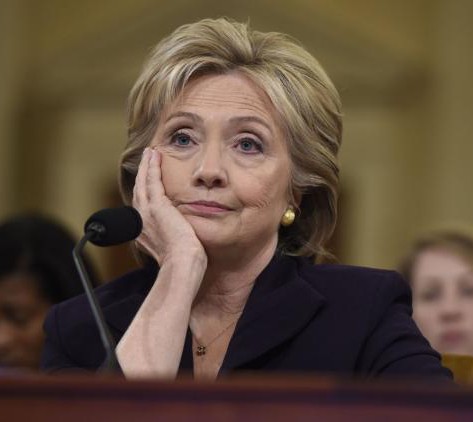
FBI report: Clinton team smashed her old devices and wiped server hard drives

Hillary Clinton look bored about the deaths of 4 Americans who asked for her help

I’m not really as interested in politics any more since we don’t have a conservative running as the Republican candidate, but I do still listen to podcasts and read some news stories.

Here is a news story from the Boston Globe that I felt that I had to blog about.

It says:

The Democratic presidential nominee told the FBI she never sought or asked permission to use a private server or email address during her tenure as the nation’s top diplomat from 2009 to 2013. A prior review by the State Department’s internal watchdog concluded the practice violated several polices for the safekeeping and preservation of federal records.

Clinton has repeatedly said her use of private email was allowed. But over a 3 ½ hour interview in July, she told investigators she ‘‘did not explicitly request permission to use a private server or email address,’’ the FBI wrote. They said no one at the State Department raised concerns during her tenure, and that Clinton said everyone with whom she exchanged emails knew she was using a private email address.

[…]Large portions of the FBI documents were censored. The FBI cited exemptions protecting national security and investigative techniques. Previous government reviews of the 55,000 pages of emails Clinton returned to the State Department found that about 110 contained classified information.

Clinton and her legal team deleted thousands more emails she claimed were personal and private. The FBI report details steps taken by Clinton’s staff that appear intended to hamper the recovery of deleted data, including smashing her old Blackberry smartphones with a hammer and using special software to wipe the hard drive of a server she had used.

Funny video of CNN leftists reacting to reality:

The Weekly Standard has been comparing Clinton’s public statements with what she told the FBI, and there headline is “Hillary Signed She Received Briefing on Classified Info, But Told FBI She Hadn’t“.

Look:

Either Hillary Clinton lied to the FBI or she lied on a State Department form as she began her tenure as Secretary of State. This conclusion appears inescapable after Friday’s FBI document release related to the Clinton email investigation.

As revealed by those FBI documents, Clinton told agents that she could not recall “any briefing or training by State related to the retention of federal records of handling of classified information”.

But the second paragraph of the Classified Information Nondisclosure Agreement—which she signed on January 22, 2009—states that “I hereby acknowledge that I have received a security indoctrination concerning the nature and protection of classified information.”

[…]The form also notes that classified information is not always so marked, but is still regulated by the agreement.

Wow, that sounds to me like the transparency that Obama promised us in his campaign speeches. He was going to lead the most transparent administration ever, remember? And what is his method of holding his staff accountable for these lies? Well, it’s to not prosecute them.


Why doesn’t God make his existence more obvious to people?

Sherlock Holmes and John Watson are going to take a look at the data

Have you ever heard someone say that if God existed, he would give us more evidence? This is called the “hiddenness of God” argument. It’s also known as the argument from “rational non-belief”.

Basically the argument is something like this:

  1. God is all powerful
  2. God is all loving
  3. God wants all people to know about him
  4. Some people don’t know about him
  5. Therefore, there is no God.

In this argument, the atheist is saying that he’s looked for God real hard and that if God were there, he should have found him by now. After all, God can do anything he wants that’s logically possible, and he wants us to know that he exists. To defeat the argument we need to find a possible explanation of why God would want to remain hidden when our eternal destination depends on our knowledge of his existence.

What reason could God have for remaining hidden?

Dr. Michael Murray, a brilliant professor of philosophy at Franklin & Marshall College, has found a reason for God to remain hidden.

His paper on divine hiddenness is here:
Coercion and the Hiddenness of God“, American Philosophical Quarterly, Vol 30, 1993.

He argues that if God reveals himself too much to people, he takes away our freedom to make morally-significant decisions, including responding to his self-revelation to us. Murray argues that God stays somewhat hidden, so that he gives people space to either 1) respond to God, or 2) avoid God so we can keep our autonomy from him. God places a higher value on people having the free will to respond to him, and if he shows too much of himself he takes away their free choice to respond to him, because once he is too overt about his existence, people will just feel obligated to belief in him in order to avoid being punished.

But believing in God just to avoid punishment is NOT what God wants for us. If it is too obvious to us that God exists and that he really will judge us, then people will respond to him and behave morally out of self-preservation. But God wants us to respond to him out of interest in him, just like we might try to get to know someone we admire. God has to dial down the immediacy of the threat of judgment, and the probability that the threat is actual. That leaves it up to us to respond to God’s veiled revelation of himself to us, in nature and in Scripture.

(Note: I think that we don’t seek God on our own, and that he must take the initiative to reach out to us and draw us to him. But I do think that we are free to resist his revelation, at which point God stops himself short of coercing our will. We are therefore responsible for our own fate).

The atheist’s argument is a logical/deductive argument. It aims to show that there is a contradiction between God’s will for us and his hiding from us. In order to derive a contradiction, God MUST NOT have any possible reason to remain hidden. If he has a reason for remaining hidden that is consistent with his goodness, then the argument will not go through.

When Murray offers a possible reason for God to remain hidden in order to allow people to freely respond to him, then the argument is defeated. God wants people to respond to him freely so that there is a genuine love relationship – not coercion by overt threat of damnation. To rescue the argument, the atheist has to be able to prove that God could provide more evidence of his existence without interfering with the free choice of his creatures to reject him.

Murray has defended the argument in works published by prestigious academic presses such as Cambridge University Press, (ISBN: 0521006104, 2001) and Routledge (ISBN: 0415380383, 2007).

Positive arguments for Christian theism

Should Christians be committed to small government conservatism?

A conflict of worldviews

I found a paper (PDF) on the University of Washington web site that makes the case for why Christians ought to care about more than just social issues.

Here’s the abstract:

What accounts for cross-national variation in religiosity as measured by church attendance and non-religious rates? Examining answers from both secularization theory and the religious economy perspective, we assert that cross-national variation in religious participation is a function of government welfare spending and provide a theory that links macro-sociological outcomes with individual rationality. Churches historically have provided social welfare. As governments gradually assume many of these welfare functions, individuals with elastic preferences for spiritual goods will reduce their level of participation since the desired welfare goods can be obtained from secular sources. Cross-national data on welfare spending and religious participation show a strong negative relationship between these two variables after controlling for other aspects of modernization.

Here’s the conclusion:

It is quite apparent that there is a strong statistical relationship between state social welfare spending and religious participation and religiosity. Countries with higher levels of per capita welfare have a proclivity for less religious participation and tend to have higher percentages of non-religious individuals. People living in countries with high social welfare spending per capita even have less of a tendency to take comfort in religion, perhaps knowing that the state is there to help them in times of crisis.34 As laid out in the theory above, there is likely a substitution effect for some individuals between state-provided services and religious services. Religion will still be there to serve the spiritual needs of people seeking answers to the philosophic mysteries of life, but those who value those spiritual goods less than the tangible welfare benefits churches provide will be less likely to participate in religious services once secular substitutes become available. Given that religious practice and values are often passed down from generation to generation, the weakening of practice in one generation will likely translate into weaker practice in subsequent generations. Does this mean that secularization theory is correct in its prediction that religion will gradually fade away? Doubtful. Realizing that there is still a yearning among many people to understand the mysteries of life, religion is not likely to dissipate at any time soon. Government simply cannot offer credible substitutes for these less tangible, supernatural goods. The explosion in spirituality once religion was made legal in former Soviet bloc countries lends credence to this assertion (Greeley 1994). As religious markets become more deregulated in various parts of the world, it is likely that new religious movements will take advantage of increased liberty and discover ways to expand.

Perhaps one of the most important lessons from the findings above is that the religiosity of a society is not simply determined by sociological factors. Government policy can play an important role in shaping the religiosity of a nation. Policies aimed at regulating the activities of religious organizations — from tax laws to zoning regulations — have important effects on the firms that supply religious goods and services. Many of these policies are designed consciously to promote or inhibit religious practice. Alternatively, welfare policy has been shown here to unintentionally affect the demand for religious services, likely over the course of generations. And, finally, since an extensive welfare state is considered by many to be a hallmark of modernized societies, the microfoundational analysis presented above provides a way of incorporating a component part of the secularization thesis (which relies heavily on notions of modernization) into the religious economy perspective.

Have you ever heard a sermon that addresses the size of government and individual liberty and prosperity? I haven’t. You’d have to be reading Wayne Grudem or Jay Richards to find that. The typical church you attend either praises big government or says nothing about it. After all, we can keep making withdrawals on the liberties we have right now without ever worrying about having to make any deposits, right? Everything will be fine, and it’s easier not to have to think about what’s down the road to serfdom, so long as the scenery is nice for us right now. Religion is primarily about comfort, not truth. Right?

The funny thing is that when I talk to most Christians about this, especially non-Americans, they simply don’t have the knowledge of economics to understand how big government affects liberty, prosperity and security. There is no one reading F.A. Hayek and Thomas Sowell in Europe, and there are not that many people reading them here at home either.